
Every year local planning authorities have to publish statistics on housing completions – and there are 400 pages of tables and things to wade through. And that’s just for one meeting item!
Two years ago I wrote about the figures for two years ago. How have we done since then? The latest statistics cover the past couple of years in the wider time-series data.
Fortunately those are the appendices. The headlines are in a six page report at Item 17 here. The two headline housing stats for 2024/25:
- 1,735 were delivered in South Cambridgeshire and…
- 529 were delivered in Cambridge.
Or built. It’s not like they get dropped of like parcels.
This is also reflected in the 2024 population estimates:
“The mid-year population estimates for Greater Cambridge put the population of Greater Cambridge at 321,900 in June 2024. This was divided between 149,400 people in Cambridge and 172,500 people in South Cambridgeshire.”
Cambridge’s population almost certainly now exceeds 150,000 people
This is based on those of us living within Cambridge City Council’s municipal boundary which dates from the mid-1930s.
South Cambridgeshire has also been very busy granting planning permissions
“The majority of these dwellings (9,000) were the result of three outline planning permissions:
- Waterbeach New Town East (4,500 dwellings)
- Darwin Green Phase 2/3 (1,000 dwellings) and…
- Bourn Airfield New Village (3,500 dwellings).”
On affordable housing:
“There were 687 affordable dwellings completed in Greater Cambridge in 2024-2025. This is 30% of all housing completions.”
I don’t know how many of those are council housing, how many are affordable for sale, and how many are affordable-housing association.
Supply of retail spaces has collapsed in Cambridge
“The net loss of 7,317 square metres in Cambridge in 2024-2025 was almost half of the loss experienced over the plan period [2018-30]. This was due to switches from retail to leisure uses in both the Grand Arcade and Lion Yard.”
The multiple shocks to the retail sector compounded by the lockdowns, the sci-tech bubble, and the continued extractive practices from asset owners collectively means that combined with competition from online warehouse-based retailers whether UK-based or based abroad, has crushed the high street of old.
“Value of small parcels sent from China to UK hits £3bn”
Above – BBC News 28 Aug 2025
Imagine what the impact would be on small-town high streets if spending shot up by £3billion. But then it’s not as simple as that. What do you do if you can’t find what you want or need on the high street anymore?
It remains to be seen what actions the Chancellor will take – mindful of the various rumours and calls whirling around Westminster. Especially with the Prime Minister’s visit to China with a large number of UK business representatives in the face of existing global geo-political turmoil.
“Have all of those new homes made a dent in house prices?”
Have a look:
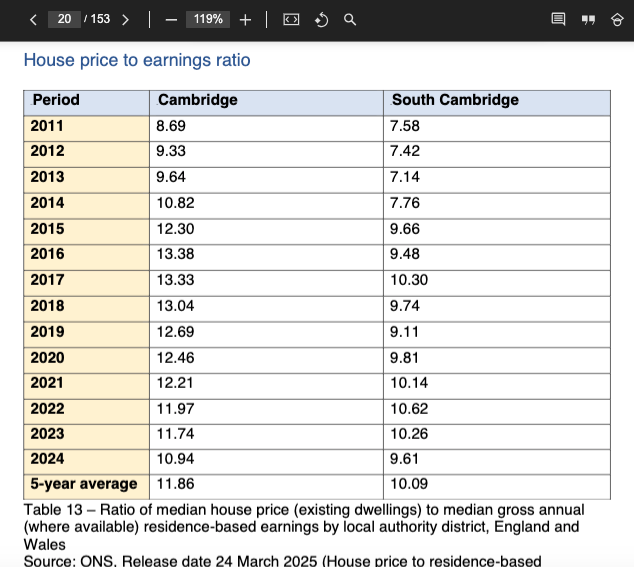
Above – AMR Appendix 2 p20
While the trend on house prices to incomes ratios from 2018 for Cambridge has fallen, compared to 2011 it still shows a painful rise. As things stand, the house price to incomes ratios are still utterly unsustainable.
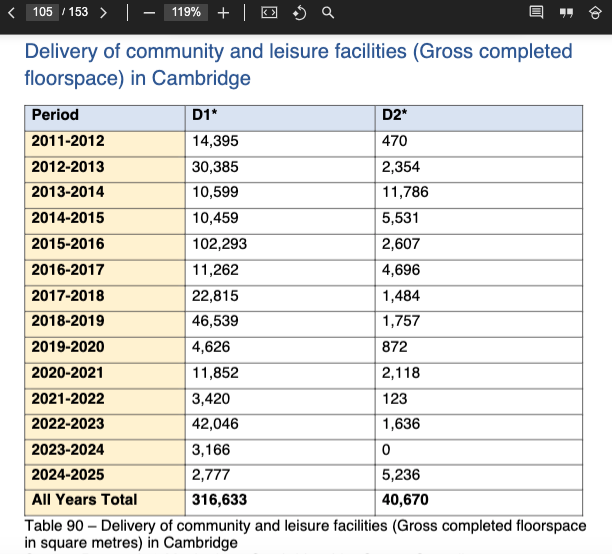
We’ve still not seen significant additions to major sports and leisure facilities given the population growth
This remains worrying given the existing infrastructure gaps
And when accounting for the old facilities that were demolished to make way for the new/replacement ones…
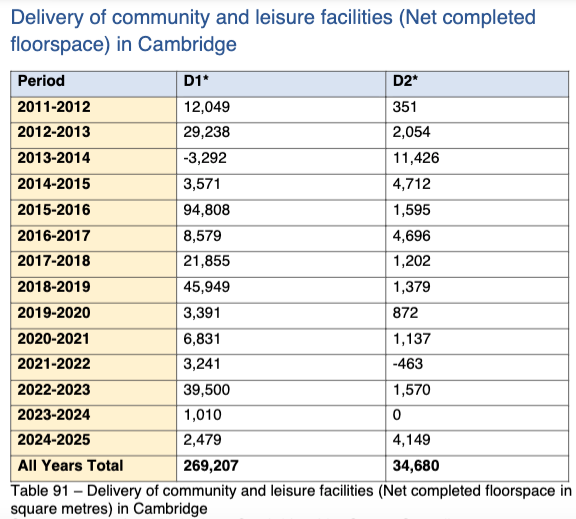
Note the definitions which are based on the older definitions, not the current ones which don’t capture the details
*D1 uses (Non-residential institutions) include clinics, health centres, crèches, day nurseries, day centres, schools, art galleries (other than for sale or hire), museums, libraries, halls, places of worship, church halls, law court. Non-residential education and training centres.
“D2 uses (Assembly and leisure) include cinemas, music and concert halls, bingo and dance halls (but not night clubs), swimming baths, skating rinks, gymnasiums or area for indoor or outdoor sports and recreations (except for motor sports, or where firearms are used).”
It’s the assembly and leisure amenities I’m particularly concerned about – hence making lots of noise about things like swimming pools, concert halls and performing arts venues.
“How much floor space did we get for D2 uses?”
This relates to scrutiny from former Queen Edith’s councillor Sam Davies MBE who wrote dug into the data this time three years ago in this post. Because the data in the table above on gross completed floorspace is meaningless to most people.
“The first step is to put this in context – so let’s use that standard reference point, a football pitch, which is roughly 7100 square metres.“
Above – Sam Davies 22 Jan 2023
Which means in 2024 the people of Cambridge got just over half a football-pitches-worth of assembly and leisure facilities.
“In the 2024-2025 monitoring year, there has been a net increase of 2,479 square metres of D1 (community use) floorspace and a net increase of 4,149 square metres of D2 Authority Monitoring Report 2024 – 2025 (recreation and leisure use) floorspace in Cambridge”
Note the big fat zero for D2 facilities for 2023/24.
Cambridge developers are clearly refraining from designing in and building the much-needed leisure facilities and amenities. And that’s not me saying it. That’s Dr Andy Williams, formerly of AstraZeneca now chair of the Oxford-Cambridge Supercluster Board.
“One of the things Dr Williams mentioned was the failure of previous governments to build the necessary infrastructure needed for previous expansions”
Above – Dr Andy Williams who gave a presentation to the Queen Edith’s Community Forum AGM back in 2023, which I wrote about in this blogpost (and which also has video links to his speech which I filmed)
Cllr Helene Leeming (LibDems – Cambourne) asks Peter Freeman about concert halls – and facilities we do not have.
It’ll be interesting to hear what comes of the conversations on this ‘Arts Strategy’ and whether it’s a University-of-Cambridge-only one or whether it goes beyond it (hopefully the latter) and if so, how they have engaged with town and county arts groups *at design stage*.
One thing I have asked both the Greater Cambridge Shared Planning Service *and* the Cambridge Growth Company is to get hold of the anonymised postcode data of ticket buyers for the larger venues and throw them on a map like the GCSP did with the Corn Exchange data.
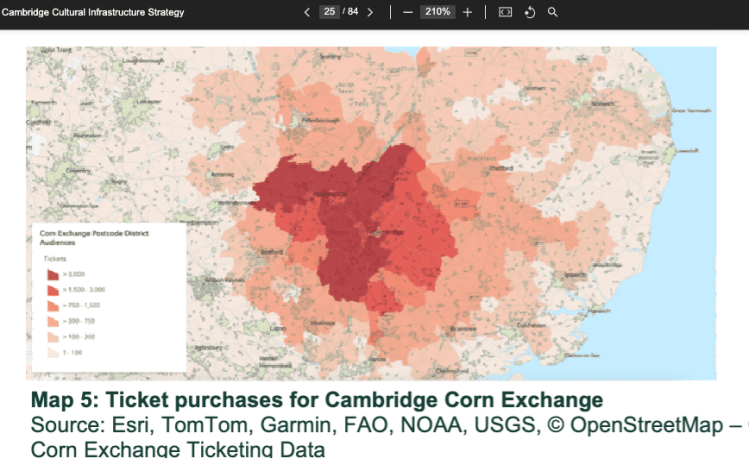
Above – GC Cultural Infrastructure Strategy (2025) p25
This then helps make a stronger case for locating any new medium-or-larger facilities close to public transport hubs. The larger the facility, the greater the case for locating the facility to a railway or light rail station.
One of the things Cambridge needs to get right this time around is frequent, reliable, safe, and affordable public transport access to and from venues
We didn’t get it right with The Junction in 1990 because central government refused to fund the necessary station improvements from the venue to the railway platforms. Furthermore, the Greater Cambridge Partnership decision-makers chose not to prioritise pedestrian access from The Junction to the railway station. Fortunately both East West Rail’s proposed new eastern entrance *and* the proposed comprehensive redevelopment of the Cambridge Leisure Park site should deal with this.
Cambridge East Station as a transport hub for a new urban centre for Cambridge
For me, Cambridge South Station was a huge missed opportunity to provide a civic square with the essential amenities that local residents and workers on the Cambridge Biomedical Campus need. Having been a rail commuter myself during part of my civil service career, I know what it’s like to come up exhausted and need a convenience shop with essentials close to a public transport stop. Brookgate failed on that front because the bus stops are too far away from the convenience shops – choosing to prioritise the taxi rank rather than the buses.
For Cambridge North Station, the less said the better – other than I keep pointing out to people the video of Brookgate’s representative at the planning hearing making the case for ‘acceptable’ design for the bland North Cambridge hotel, rather than ‘outstanding’ or ‘awe-inspiring’ design standards. We’ve got more than enough buildings designed to meet the bare minimum acceptable standards. The onus is on the design professionals and those firms that commission them to do better. And for ministers to tighten up the standards and regulations when they do not.
One of the things I want to see from the design and property professionals is for them to push back on their clients to insist on building a new generation of buildings and urban environments to much better standards than the mediocrity all too prevalent today. Only a few days ago I heard one of my family talking to a local tradesman, the latter complaining about the poor quality of new build properties and in particular the poor sound insulation due to poor materials used as walls between dwellings (using the examples of not being able to use normal picture hooks on walls). Recall in 2021 Cambridge MP Daniel Zeichner gave a speech to Parliament about the poor build quality in Cambridge – citing the numerous complaints from his constituents. It would be interesting to see much much things have improved since then, and if so what were the things that drove the improvements in quality.
Looks like 2026 is the year we have to start putting some real collective pressure on the house builders and those financing them
Fortunately I get the sense that the team Mr Freeman is assembling is one that’s in a different league to what previous generations were able to recruit – mindful of the chronic challenges of the salary imbalances between local government public and private sectors. That’s not meant as a collective slur – rather it’s to acknowledge that the problems are primarily structural and that the results of those imbalances (which are also persistent in the civil service as the Grenfell Inquiry also exposed) results in over-worked and under-resourced staff who all too often have to deal with unfilled vacancies. It was a Political decision by the previous government to refuse to ease the artificial restrictions they imposed on local government through their austerity policies. It remains to be seen how quickly the full cost-recovery policies now open to local councils feed through into better-resourced planning teams.
If you are interested in the longer term future of Cambridge, and on what happens at the local democracy meetings where decisions are made, feel free to:
- Follow me on BSky
- Spot me on LinkedIn
- Like my Facebook page
- Consider a small donation to help fund my continued research and reporting on local democracy in and around Cambridge.

 The Cambridge Town Owl