Cross-posted from Lost Cambridge – my local history blog. The lessons from half a century ago also apply today.
Back in October 2021 I wrote a feature about the troubles that Prof John Parry Lewis faced as the Government’s appointed figure to lead the Cambridge Economic Sub-regional study (See my blogpost here).
As Peter Freeman CBE prepares to publish his own recommendations for the future of Cambridge, this profile by Cambridge interviewer Deryck Harvey from Sat 28 Aug 1971 features the man who faced similar challenges to those that Mr Freeman faces over half a century later.

Above – Professor John Parry Lewis (1971) in the Cambridge Evening News via Mike Petty MBE

Above – the article was also digitised in the British Newspaper Archive here
Both Messrs Freeman and Parry Lewis faced similar multiple crises as their backgrounds:
- A major geo-political crisis hitting world economies (The actions of OPEC being almost as disruptive as that of the current incumbent in the White House)
- The world on the cusp of major economic changes (this was the era of the collapse of the post-war Bretton-Woods settlement)
- Major changes to the internal governance structures and transport infrastructure (motorways replacing railway lines) including regionalisation and rationalisation of local government
- Cambridge was facing a water and sewage infrastructure crisis that threatened to stop development in its tracks – as it did in 1974-78

Above – from 17 July 1975 in the Cambridge Evening News in the Cambs Collections Planning News Cuttings File 1971-79.
Sewage capacity crisis – we have been here before

Above – another outstanding problem not resolved by previous generations.
At the time of writing it remains to be seen what the current Labour Government proposes and will be able to deliver on improvements to water/sewage, transport and energy infrastructure.
The challenges facing Peter Freeman are very similar to those faced by Prof John Parry Lewis – as Cambridge journalist Deryck Harvey wrote in 1971.
“His decisions will in some measure affect the future of the city as a regional centre”
Above – Deryck Harvey on John Parry Lewis – whose recommendations as we know provide to be too radical for the mainly Conservative, supporting local councillors of the time. Hence his proposals to double the size of Cambridge from 100,000 to 200,000, and create a second urban centre for the city were thrown out in their entirety. Will Mr Freeman be more successful?
This is what Mr Harvey wrote about the Professor for the Cambridge Evening News of 28 August 1971
“A personable Welshman of 44, Prof Parry Lewis, is tackling his responsible task, as it were, from a point of total innocence. His astute and inquiring mind, so obviously a part of his personality, is uncluttered by Cambridge’s domestic problems, its aspirations, and its assertions.
“A happy bachelor, fond of cooking(which he finds relaxing) and music, he is dedicated to his work and he readily admits: “you know there comes a time when, especially for university people I suppose, one’s work becomes very much a way of life. You get into certain problems and certain subjects, and you want to spend your time pursuing them.”
RESEARCH
“He has travelled quite a lot in Europe over the past five or six years and has served on an international committee on the uses of computers in urban planning and administration. In February[1971] he undertook a three week lecture tour of Scandinavia. Educated at University College Cardiff, where he took a degree in mathematics and physics, he taught mathematics for three years at his old grammar school, and then became a research assistant in economic statistics at Cardiff, and eventually a lecturer.
“Eight years later he went to Manchester on a research fellowship in economic statistics and eventually became a senior lecturer there in mathematical economics, leaving to become a Professor of Economics at Exeter University, where he stayed for two years.
PERCEPTIVE
“Five years ago he was appointed to his present position at Manchester, where he is an economist in the Department of Town Planning. Prof Parry Lewis is a gentle, intelligent, receptive, and ultimately perceptive man, who admits to being fascinated by towns and the way they are controlled, and the way they move. “I can sit for hours, for instance, as I have done in London, or Paris, or very much smaller places and just watch people walking past and see how they move,” he said.
“But when it comes to holidays he prefers to take canals in this country, or to the Thames with Karl, his alsatian, for company. “You can take a dog on a boat, but you can’t take him abroad: or at least you can – but you can’t bring him back.” he explained. [The laws have long since been changed]. In Cambridge he is to be found about two days a week working with a team of officials seconded from both the city and county authorities [The then Cambridge City Council, and Cambridgeshire and Isle of Ely County Council (minus Peterborough and Huntingdonshire]] in a pemporary office at the old County Hall, Hobson Street.
NO SECRET
“”I think it’s no secret that one of the reasons why I was asked to direct this study is that I am an outsider”, he said, raising a mug of afternoon tea, “and consequently, while to some extent I’m ill-informed at the moment, I am very ready to listen to all sorts of viewpoints but independent to make up my own mind about what I think ought to be done.”
“It is easy to regard a man in Prof Parry Lewis’s position as someone who should know all the answers, for the project is costing £100,000 [in 1971 money]. But the study started quite recently – on May 10 1971 – and he is many months from making any specific announcements.
“”You know that a few years ago the East Anglia Economic Planning Council produced a very important and very good report on the whole of the region [East Anglia – A study, 1968, which you can read here]” he explained. “And in it they suggested that the region can to some extent be thought of as four sub-regions centred on principle roles”.

Above – the East Anglia Study published by the Regional Economic Planning Council in 1968 – p35 – which I included in my earlier blogpost on Cambridge Growth and Regional Planning in the 1960s here.

Above – Detail from the Redcliffe-Maud report on overhauling local government in England (commissioned by Labour’s Harold Wilson, scrapped by the Conservatives under Sir Edward Heath who at the time Prof Parry Lewis was speaking, had not published his own government’s proposals)
EXPANSION
“”One of these is a sub-region centred on Cambridge and expanding roughly for a radius of 15-20 miles, and they felt that in order to provide a better basis for planning, it was necessary first of all to have a strategy concerned not with the detail but with a particular emphasis on its economic life – and yet not in a way that disregards other aspects of it”
“He emphasises that his study team will make only broad recommendations. “We may say that over the next 20 years the population of the sub-region may be expected to expand by a certain amount, and that if this expansion were to take place then it might be sensible to develop the region in a certain way; maybe to use a phrase well-known in this area, a necklace of villages, or maybe some kind of linear development – we don’t know”

Above – left: Thomas Sharp’s sub-regional theory in Town and Country Planning (1931) p205pdf here, and Above – right: Nathaniel Lichfield’s Cost Benefit Analysis in Town Planning – Cambridge Case Study (1965) p14pdf here
“”We might, for example make some statement about whether we consider Cambridge should grow industrially or commercially. We will have to make some statement about offices and hotels, about the roles of other towns – how Newmarket and Saffron Walden should develop, and not only the towns, but the villages as well.”
MEETINGS
““And I do want to insist that we are not just studying Cambridge and the area around about it, we are studying the sub-region which has Cambridge in the middle of it. There is a slight difference of emphasis”

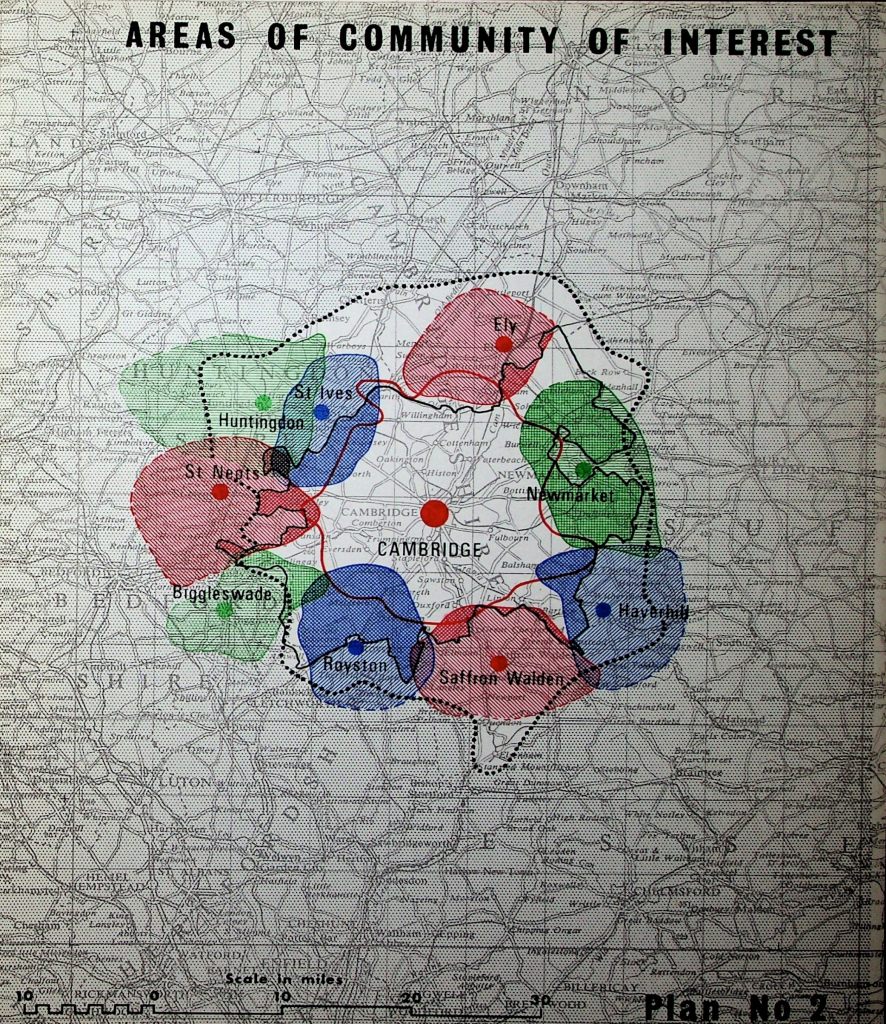
Above – from John Parry Lewis’s final report (p7 here) showing that he was prepared to cross county boundaries as shown by Royston in Hertfordhsire, Saffron Walden in Essex, and Haverhill in Suffolk, on the intersection of three county boundaries. Note at the time, Huntingdon and Peterborough were very separate from Cambridgeshire and the Isle of Ely – it wasn’t until 1974 that those two county areas were merged, and not until 1998 that Peterborough, 30 years after being nominated as a third generation new town for major housing growth, was hived off to become a unitary council.
“Partly, the purpose of these meetings will be to tell people what’s going on. “And party, too, I will be wanting help from people in Ely, say, when I start asking specific questions about where they shop, or maybe asking the local industrialists one or two questions.”
“I asked Prof Parry Lewis if he was aware that Cambridge City Council and Cambridgeshire County Council do have a difference of opinion. “I am not aware that they are at loggerheads,” he replied. “I do know that they have a difference of opinion I cannot make any pronouncements at this stage because I don’t know enough about the area.”
HELPFUL
“I have a number of questions forming, and I have read a great deal of what has been written over the past 20 or so years about the Cambridge Sub-region. But I am not going to come up with any recommended answers until I’ve studied the whole area a lot more than I have yet. They are both being very helpful. After all, this study is set up by the city, the county, and the Department of the Environment [today’s Ministry of Housing, Communities, and Local Government]. They all want this study done, and they’ve given me a great deal of help.”
“He does not consider the cost to be disproportionate at £100,000 and says: “It’s not a lot of money when you think of the way our final recommendations may affect the whole development of the sub-region.” [Turns out the councillors rejected the report in its entirety – was it a waste?!?]
RIGHT WAY
“Let me put it another way.” he continued. “I think that on average in this country every year about £100 per capita, man, woman, and child, goes into some form of what might be called Urban development – urban investment, at any rate. In an area of 200,000 people, very roughly you have a typical sub-region total, you’ll have an annual investment of £20million. Now, if some industrialist were investing anything like £20million a year, he’d be spending a great deal of money making certain that he was investing it in the right way. Although I’m not suggesting that it is only this study that is going to determine the shape of that investment, I think you ought to take the cost of it in those terms.”
“Although Prof Parry Lewis’s time in Cambridge is limited, he points out: “You mustn’t confuse time spent in Cambridge and time spent on this work. There’s a good telephone connection and also, I’m fortunate that the members of the team are all people who can get on with a job intelligently, and at the same time are perfectly prepared to get on the telephone and have a word with me if there’s any problem.
DIFFERENT
“The contract with Manchester University provides for bringing in consultancy assistants, and this will probably happen at some stage. If not in a position to make pronouncements, he had definite preconceptions about Cambridge.
“”I like it. I like it very much, not only because of its obvious beauty in many respects. It is a very interesting town in the way in which it blends university and other activities. It has struck me as being very much a combination of university town and market town, and so different from Oxford, which a colleague of mine described as the Latin Quarter of Cowley.” [where there was once a huge motor works].
“As a personal preference, I much prefer this kind of development where it is possible than I like, shall we say, the arrangement in Norwich where the university is right outside” [the city – similar to the University of Sussex which is outside Brighton and Hove]
NOISES
“I am quite certain that Cambridge wouldn’t be Cambridge if you attempted to disassociate the University and the Town, though ti does give rise to problems. What the answers to those problems are I don’t yet know, but I will, eventually have to make some intelligent noises about them. I think that one of the things I have to do is to try to become informed.”
/ENDs
On Prof John Parry Lewis’s final point about town and gown remaining together and not separated, note how it contrasts with the vision of Prof Jeremy Sanders back in 2014 for the Cambridge 2065 visions of the future project.
“The polarisation already visible in 2015 between an intellectual and financial leadership and workers who provide manual services will continue to grow. Service workers will mainly live further out, commuting into Cambridge via fast mass transit from hubs such as Wisbech, Alconbury or Haverhill, although many of the University’s lowest-paid staff will be living nearby in affordable housing that it owns. They will be providing service to the intellectuals and leaders in business and the University, and also servicing the world-wide tourist trade who come to look at the traditional colleges as living history.”
“Cambridge will be one of the key venues to come and be seen, and to rub shoulders with the global intellectual elite. If it sounds like an exclusive conference venue, then that may be about right.”
Sanders, J (2014) in Cambridge 2065, p40-41
This contrasted significantly with the view of the then Vice-Chancellor Sir Ivor Jennings when he presented his proposals for the growth of Cambridge in 1962

“We regard Cambridge as part of our inheritance as members of the University. It is our duty to pass it on to our successors improved and not impoverished. It will not be unchanged, because every generation has to build and rebuild.
“This second aim has no direct advantage to the University, and some people may question why we have included it in as a second aim. We do so to give a recognition to the fact that Cambridge is more than a University, it is a City in its own right, and its significance as a regional centre has grown and will continue to grow.“
Sir Ivor Jennings in the Cambridge Daily News 01 June 1962 in the Cambridgeshire Collection
I included both of those references in a blogpost about how Innovate Cambridge’s exclusivity presents a risk to the future of the city back in 2024 here.
The big differences between then and now
Apart from the obvious ones of different people, different times/technologies and so on, there are a few other things of note.
- Ministers are paying much closer attention to what’s happening in and around Cambridge – and have far greater legal powers of intervention compared with half a century ago
- The current ministers with policy responsibility for Cambridge have made it clear they are more than willing to intervene if what local councils try to do goes against national government policies – especially on house building and economic growth (therefore there’s no prospect of local government being able to throw out Mr Freeman’s proposals just because they don’t like them)
- Cambridge’s brand in an industrial context is far greater than what it was half a century ago, and the cultures and mindsets of the land-owning colleges is far more financially-incentivised than perhaps it was back in the 1960s & 1970s (and I dare say their financial assets are also far greater collectively)
- Although the motor traffic problems have not gone away, there was no M11 or A14 – both of which were unbuilt at the time of the interview
How similar were the issues raised with him and his team to those that Prof Parry Lewis and his team had to face?
If you are interested in the longer term future of Cambridge, and on what happens at the local democracy meetings where decisions are made, feel free to:
- Follow me on BSky
- Spot me on LinkedIn
- Like my Facebook page
- Consider a small donation to help fund my continued research and reporting on local democracy in and around Cambridge.

 The Cambridge Town Owl