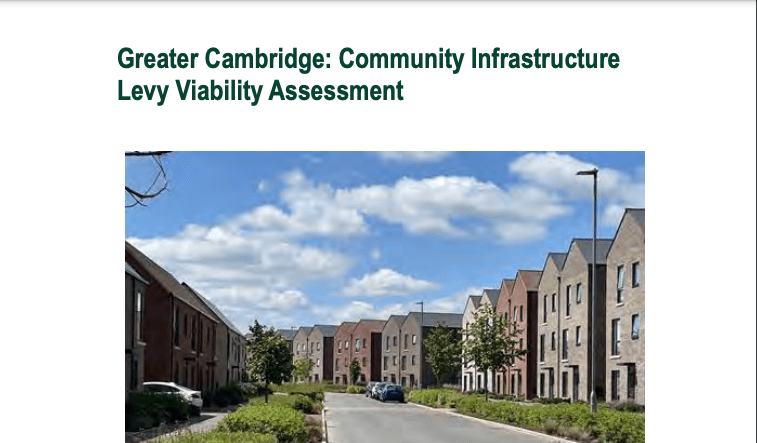
Going by previous rates of growth, it would generate an estimated £5million per year – or £25million over five years. How much difference will that make to the city?
The full report is at Item 5 Annex B of the City Council’s Cabinet Papers here. The officer’s summary is in the item 5 heading – the 135KB paper
Cambridge City Council’s funding and spending has been cut drastically since 2010. The current annual spend according to the city council is around £80million.
“Local authorities must spend the levy on infrastructure needed to support the development of their area, and they will decide what infrastructure is needed.”
Above – Government guidance on the Community Infrastructure Levy
That doesn’t mean the levy receipts generated from big developments on one side of town can be spent on repairing potholes on the other side of town – despite the huge temptations there might be on getting repairs done in ‘swing’ wards in the run up to local elections. This is why having a critical mass of active residents alongside a vibrant and high quality local media scene is ever so important for local democracy to function properly.
| Development Type/Use | CIL rate(per square metre) |
| Residential houses and flats | £60 |
| Retirement housing | £60 |
| Residential institutions | £60 |
| Student accommodation | £60 |
| Hotels | £50 |
| Shops, restaurants, financial and professional services | £50 |
| Offices and R&D | £175 |
| Industrial use including data centres | £35 |
| All other uses | Zero |
Above – Draft Charging Schedule – Item 5, Annex C
“Are there any other land uses that could easily fall through the net? Any loopholes?”
What does AirBnB and Aparthotels fall under?
I guess this is why this is going out to consultation – people with more expertise than me can go through this. I’m just making a bit of noise about it to increase the likelihood that those experts pick up on it and let the city council know.
The consultant’s report also has some interesting data displayed on house sales in Cambridge City and South Cambridgeshire District. One of them is the sales values per square foot – noting the huge disparity between Cambridge and Cambourne. (Is this disparity reflected in the price differences between newbuild homes in Cambridge and the newbuild homes in Cambourne?)
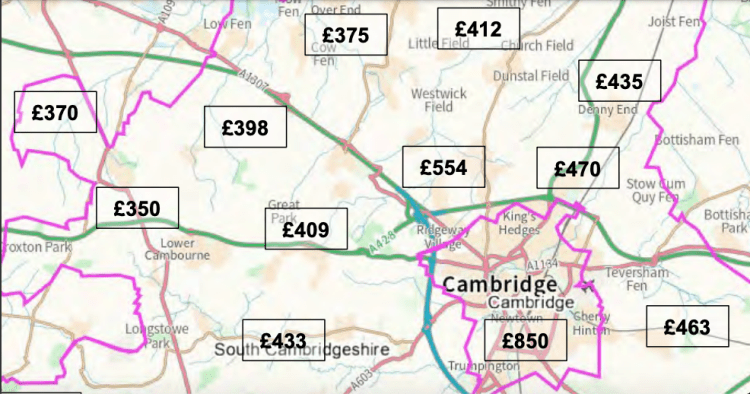
Figure 2.16.1: Sales values in Greater Cambridge (approx. £s per square foot) – App B in Item 5
Council housing – quality of new build homes seem to have more issues than usual
Moving onto the Housing Advisory Board Meeting (See the meeting papers here), something’s not going right with the finished homes that council tenants are moving into.
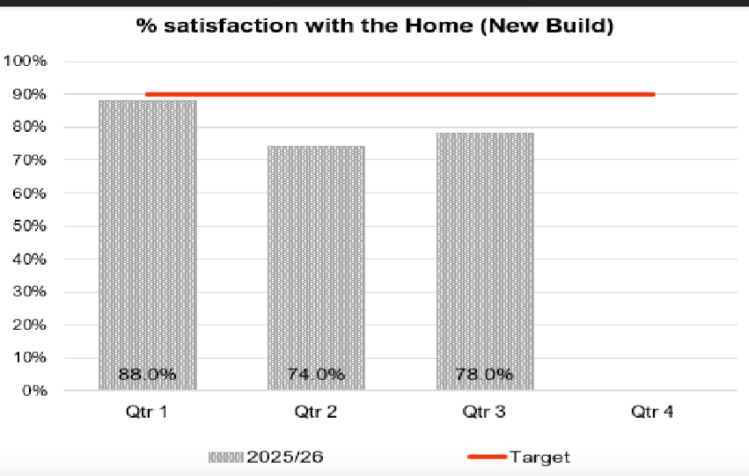
Above – HAB 02 Feb 2026 Item 4 additional document 4
WIth a target of 90% of tenants moving into newly-built homes, that the past two quarters have shown figures of under 80% of people being satisfied is a concern for the council. The report identifies snagging issues (build quality), anti-social behaviour, odour of drugs, and other issues that go beyond the building design and quality alone.
With the increase in the number of medium-high density developments replacing the post-war lower density council houses, issues relating to more people living in closer proximity could well increase – especially if design and build quality are not improved. (Thinking noise insulation in particular). Note the complaints about cost of fuel – a reflection of what’s happening on international markets as well as with government policies. Is this something that further investment can ‘design out’ through installation of renewables?
What the report does not reflect is the people living in the private new build accommodation – whether as owners or renters
This is one of the reasons why I think a new routine system of post-occupancy evaluations could make a big difference both to residents and also to future dwellers as the learning is routinely fed back into design and policy-making systems. Something that was not at all clear during my time in housing policy in my civil service days.
Cambridge [Mini] Arts Festival
Above – Cambridge Arts Festival – one of the Cambridge BID projects, from 9-18 Feb 2026
It covers part of the half term for schools so have a look out for the events, esp the free events coming up in the middle of this month.
The Greater Cambridge Partnership is back
There are only small items in their line-up – but there are still some outstanding issues
Item 6 has their quarterly report which contains their risk register. The transport projects heading south east out of Cambridge (Cambridge South East Transport – AKA CSET) have huge unresolved issues.
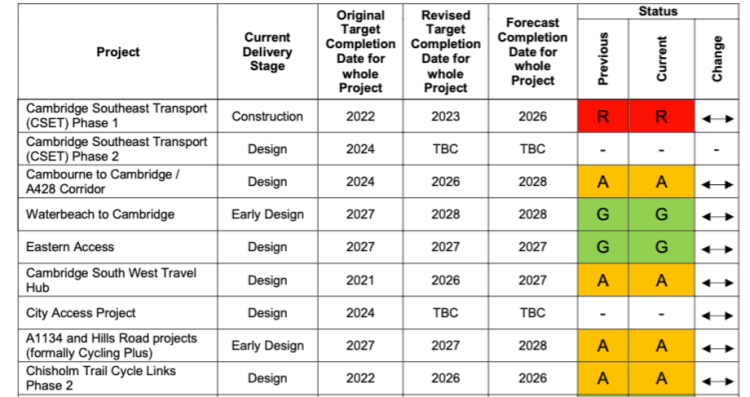
Above – there are a whole host of things worth picking out from the above table detail on p5 of the quarterly report if you’re interested in Cambridge transport infrastructure.
Cambridge CSET Phase 1 – the report says that “CSETS Phase 1 is red due to the requirement for the Haverhill Road and Wandlebury schemes to go through a planning process which is taking longer than originally envisioned. A progress update will be provided during the next Executive Board cycle.”
Cambridge CSET Phase 2 – the proposed busway that was supposed to have re-linked Cambridge to Haverhill: Still a red risk due to the increase in construction costs (labour and material) for the phase that is supposed to link the Cambridge Biomedical Campus to a new park and ride facility at the A11. The draft local plan proposes building a new settlement on the other side of the A11 by Granta Park. The report says “Following submission of the [Transport and Works Act Order] application for CSETS Phase 2 to the Department for Transport (DfT) last January, it is now likely that the Public Inquiry will take place towards the end of 2026 – the date has yet to be confirmed.”
This should have red risks attached to it given that the Mayor of the Combined Authority is strongly opposing the project as he is with the Cambourne-2-Cambridge ‘road for buses only’ project, stating that the Buses Act 2017 gives him the powers to decide where the bus routes go, and that he is under no obligation to use any busways that the GCP chooses to build. This is a reflection of broken institutional structures created by the previous Con-LD Coalition and then continued by the successive Conservative Governments without consolidation/improvements. Hence the complete mess.
The County Council also has a budget-setting meeting
…but there’s strikingly little content. Have I missed something?
Meanwhile at Addenbrooke’s and The Rosie Hospitals…
“There will be a meeting of the CUH Board of Directors on Wednesday 11 March 2026 from 11:00 via video conference.
“The Board of Directors welcome written questions. The deadline for receipt of questions is 12:00 on Monday 9 March 2026.”
More details on how you can submit public questions to the directors here.
Cambridge Biomedical Campus Open Forum – 18 March 2026
More details here – chances are I’ll moan about ugly buildings they are proposing which research shows risks making people more ill than before they got onto the site. For those of you who missed the last meeting, see the meeting slides at the bottom of the page here.
I think that’s all for now. Oh – and The Junction’s Creative Cafe is back – first Tuesday of every month.

And this weekend the Sing! Community Choir have a concert/fundraiser at Netherhall on Sat 07 Feb 2026 from 7:30pm. I wrote a profile of the 20th Century teacher who secured the funding for the hall and complex where that concert will take place.
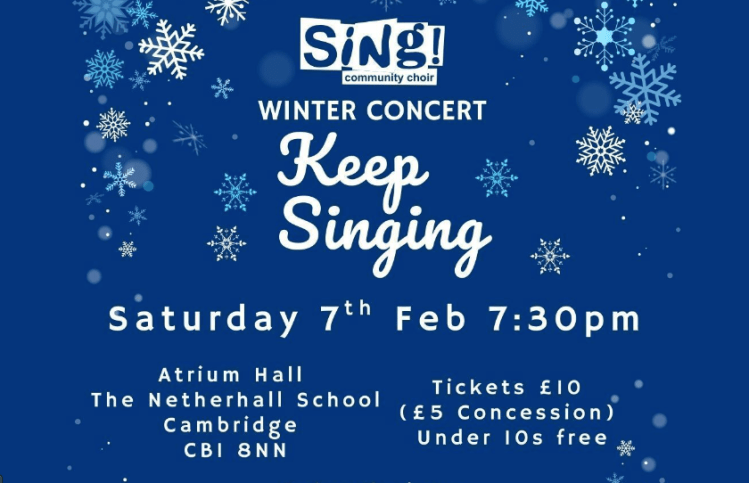
Above – Tix here ,supporting the Cambs Downs Syndrome Community Network
And following that on Sunday (and also on the second Sunday of each month) is the Queen Edith’s Community Cafe.
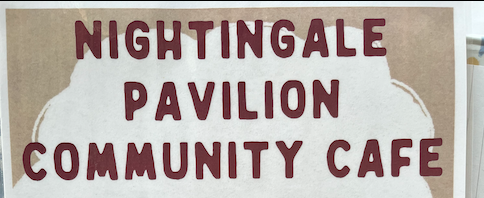
Above – Nightingale Pavilion Community Cafe – free refreshments too. At Nightingale Rec off Queen Edith’s Way, Sun 08 Feb 2026 from 2-4pm
And now it’s nearly midnight but I was hyper-focusing after a group singing rehearsal.
If you are interested in the longer term future of Cambridge, and on what happens at the local democracy meetings where decisions are made, feel free to:
- Consider a small donation to help fund my continued research and reporting on local democracy in and around Cambridge
- Follow me on BSky
- Spot me on LinkedIn
- Like my Facebook page

 The Cambridge Town Owl