Draft boundaries/areas confirmed as Cambridge City and South Cambridgeshire District only – and small scale planning applications will remain within local government control – but can the development corporation put an end to Kett House Karbuncle designs?
You can access the consultation here
Does anyone want to take part in some offline discussions on the content of the consultation?
I’m happy to run some library-based workshops as in the past if there is sufficient demand and if people can help with the costs. (Which means updating my workshops page!)
The case of the Kett House redevelopment which I moaned about in my last blogpost puts all of this into focus
Today was not a good day for Cambridge City Council’s Planning Committee. But here’s hoping that the new national design guidance now out to consultation can rein in lazy, dull, bland spreadsheet-style buildings in prominent places.
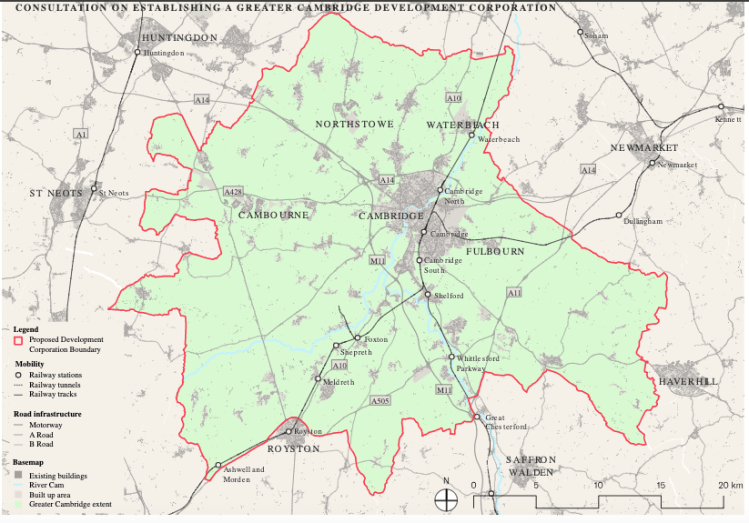
Above – the proposed development corporation boundary.
“What does the consultation cover?”
Taken straight from the consultation page’s executive summary
- The case for establishing a centrally-led urban development corporation.
- The proposed objectives and activities of the Development Corporation.
- The proposed geographical boundary in which the Development Corporation would operate.
- The proposed approach to a spectrum of powers that the Development Corporation would be granted.
- The proposed approach to integrating local democratic representation in the Development Corporation’s activities.
The Consultation Questions
- What do you think about the current delivery of infrastructure and homes in Greater Cambridge?
- What do you think about the proposal to create a centrally-led urban development corporation (UDC) in Greater Cambridge?
- What matters most to you about the future of Greater Cambridge?
- Do you have any views on the objectives of the Greater Cambridge Development Corporation, as set out in the consultation document?
- What do you think about the proposed boundary of the Greater Cambridge Development Corporation, as set out in Annex B?
- What do you think about the phased approach we have proposed in regard to plan making powers?
- What do you think about the proposals to give the Development Corporation plan making powers as set out in the consultation document?
- What do you think about the proposals to give the Development Corporation powers to determine planning applications as set out in the consultation document?
- Do you agree with using thresholds for the Development Corporation taking decision making powers?
- Which minimum thresholds for determining planning applications do you think are appropriate?
- Do you have any other views on the proposed approach to the Development Corporation’s powers and functions?
- What do you think about proposed local representation on the Development Corporation Board, as set out in the consultation document?
- What do you think about the board having expertise in areas such as planning, property development, design, environment, finance, and infrastructure delivery?
- Do you have any views on the impacts of the above proposals for anyone with a relevant protected characteristic?
Government policy for Cambridge has included the establishment of a new development corporation for the past few years
…and spans this and the previous government – ever since Michael Gove launched his surprise Case for Cambridge back in 2023. Prior to that, Government policy involved creating a ‘Metro Mayor’ in 2017, and prior to that the Greater Cambridge City Deal of 2014. And before that there was Cambridgeshire Horizons within the wider regional structures of:
- The Government Office for the East of England (part of a regional network for Englad)
- The Regional Development Agency (EEDA)
- The Regional Assembly made up of councillors from component councils – EERA
“How come you know this?!”
I started my civil service career back in 2004 in the old ‘GO-East’. Which is also why when it comes to any new regional structures, ministers need to learn the lessons from what didn’t go well in that old regional network.
With all of this in mind, Ministers have acknowledged past efforts…
“Local institutions, including councils, universities and businesses have adapted positively and worked hard to support Greater Cambridge’s rapid growth over many years.”
…and notes the number of homes built. But I have issues with that quality statement.
“The Greater Cambridge Shared Planning Service and local councils have a strong track record in facilitating high-quality housing delivery, with 22,422 homes built between 2011 and 2024.”
Therefore it is *not correct* to make that statement – but also the GCSPS *is not to blame for the build quality.* That is a Building Control function and this was a function that was part-privatised by the Conservatives under Margaret Thatcher. And when it comes to the failure of building control functions (and local council building control having to step in), Big developers in Cambridge have got form with Darwin Green.
“Building control was part privatised by Margaret Thatcher in 1985 with the creation of the National House Building Council (NHBC) to compete with local authorities.”
Above – Luke Barrett for Inside Housing, 02 May 2018.
“NHBC is the UK’s largest provider of new homes warranty and insurance, covering 70-80% of homes built each year in the UK, and currently provides cover to approximately 1.4million homes”
Above – NHBC Submission to Parliament on the Building Safety Regulator, 29 Aug 2025
So 40 years after privatisation the market for new homes warranties and insurance the leading firm still has monopoly power. Which reflects a chronic failure of government policy and regulation. But then that’s reflected in a host of other industries, from supermarkets to the big four consulting firms. It’s not just the privatised utilities & natural monopolies that have issues.
Ministers have listed the issues that many of us long term residents are more than familiar with – but it’s still sobering to see it all spelt out on GOV.UK
Current and future constraints
- Affordability – few on median-and-below salaries can afford a mortgage or market rents
- Transport networks – too weak and fragmented to deal with ever-growing demand
- Water supply not enough to meet current and future demand
- Wastewater Treatment – not enough capacity resulting in sewage overflows into rivers
- Electricity grid capacity – too low to meet the demand from energy-intensive sci-tech uses and the new generation of electric vehicles
- Commercial and Laboratory Space – not enough to meet the various spikes in demand – but are these bubbles and could we be left with empty sci-tech labs like we see with empty out-of-town and empty high street shopping centres?
- Social Infrastructure – including public services (Schools, doctors, dentists) and also the community centres that enable people to socialise
- Natural environment – there have long been symptoms of having gone beyond our ecological carrying capacities, most visibly with our rivers but also in the fields of ‘industrial agriculture’ where once there were the sounds of insects and birds, now there is just the rumble of internal combustion engines on wheels, and rubber hitting the tarmac.
“How do ministers propose the Development Corporation solve all of these problems?”
There are several different types of development corporation – including ones that can be established under Mayoral Combined Authority oversight. But ministers say Cambridge is of national economic importance so our one will be centrally led.
The consultation sets out a phased approach on future changes to the draft local plan for Greater Cambridge. As the current consultation nominally covers 2024-45, inevitably there will be refresh periods and amendments made because trying to predict where we will be in 20 years time…exactly.

Above – Gordon Logie’s futuristic proposals for Cambridge in July 1966 which I wrote about here.
Local History Matters
And in the 1960s the city was a-buzz with debate and discussions about what our city would be like in the Year 2000.

Above – Cambridge in the Millennium, something I’ve covered lots of in my local history blog https://lostcambridge.com/
The Development Corporation is mainly interested in the larger planning applications
The one important issue to be aware of is that the development corporation will not take over the processing and decisions on all planning applications. Accordingly it will proposes the following minimum thresholds below which local council planning teams and planning committees will carry on as normal.
“Proposed development corporation determination thresholds
| Development Type | Proposed threshold minimum |
|---|---|
| C3 (Residential dwellinghouses) | A minimum set at 250, 500 or 1,000 dwellings or equivalent floorspace |
| C1 (hotels) and C2 (hospital/care homes) | A minimum set at 100 or 250 rooms or equivalent floorspace |
| C2a (Secure Residential Institutions) | A minimum set at 1,000sqm or 2,500 sqm |
| Class E (commercial, business and service) | A minimum set at 1,000sqm or 2,500 sqm |
| Class B (general industrial B2 and storage distribution B8) | A minimum set at 1,000sqm or 2,500 sqm |
| Class F (learning, non-residential institutions recreation and community uses) | A minimum set at 1,000sqm or 2,500 sqm |
Above – from the proposed Development Management (i.e. planning applications casework) powers
1,000 square metres might sound like a lot but it’s only just over 30m x 30m of floor space. Or 0.14 of the size of a football pitch. Worth considering where there are multiple floors.
What will be interesting to see is where developers try to ‘game’ the system – especially if they see one planning route as being ‘easier’ than another. (I.e. will we see some developments trying to sneak under/over the minimums?
I’ll be writing more over the next few weeks on this and will try to link to what other people have written as well. Also, feel free to let the Editor/Letters Page of the Cambridge Independent know what you think if you don’t have a blog or similar.
If you are interested in the longer term future of Cambridge, and on what happens at the local democracy meetings where decisions are made, feel free to:
- Follow me on BSky
- Spot me on LinkedIn
- Like my Facebook page
- Consider a small donation to help fund my continued research and reporting on local democracy in and around Cambridge

 The Cambridge Town Owl