
The Government has published its statutory consultation with four options
You can read the consultation here
Each of the councils were invited to submit proposals containing significant evidence bases to support their proposals.
Further down the page is an explanation of why they’ve gone into so much detail:
“Although this will be a technical exercise, focused on the criteria, rather than a public consultation, we also welcome the views of any other persons or bodies interested in these proposals, including local residents, town and parish councils, businesses and the voluntary and community sector.”
That is why each of the options below contains over 100 pages in support of each of them – so unless you want to read 400 pages of background, analysis, local histories, and business cases, feel free to browse through and focus on the pictures/diagrams. Or simply look at the maps and tell ministers which one you like the best.
The options
Greater Cambridge (City & South Cambs), and ‘the rest of the county + Peterborough’
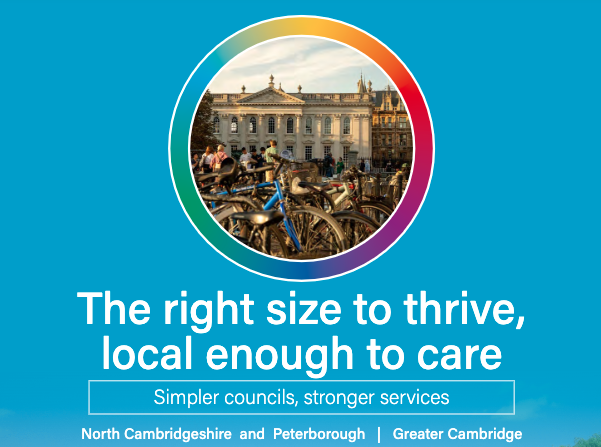
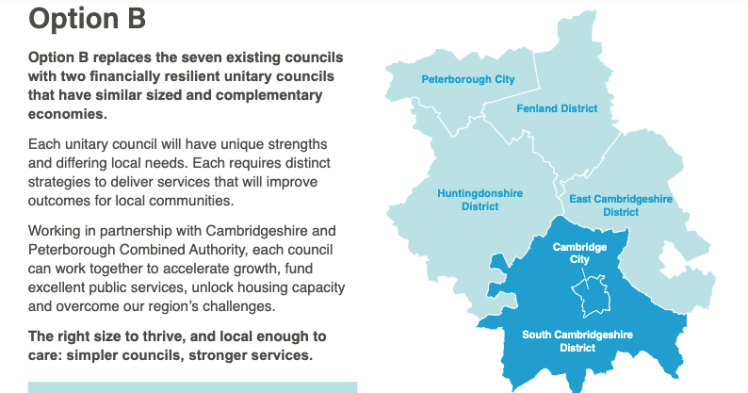
Above – Option B: Greater Cambridge + North Cambs & Peterborough, p7
…of 136 slides/pages. Which tells me these were for an audience of civil servants (and ministers) unfamiliar with the county and its issues.
Next up Option A:
This is the county council’s preferred option – now under a Liberal Democrat Majority
Bonus points for including the evolution of the county councils since their inception in 1889
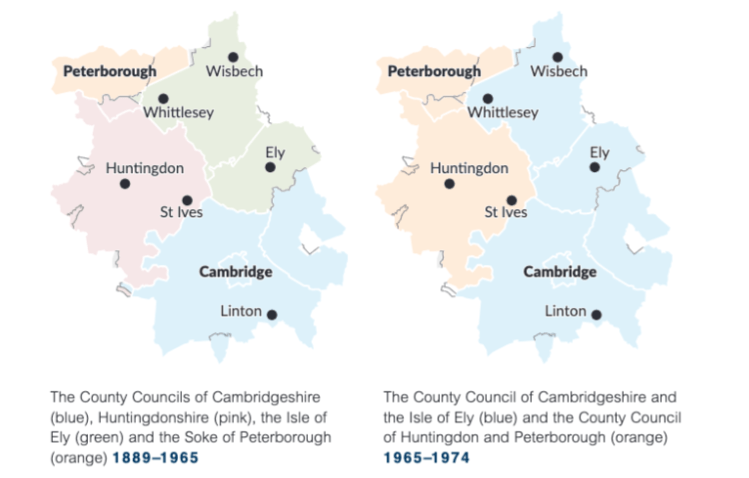
Above – Cambridgeshire County Council’s evolution (p36pdf)
Note the old boundary of Cambridgeshire County Council from 1889-1965, which includes the southern half of East Cambridgeshire District. This was previously known as “Newmarket Rural District” – the Newmarket Urban District being in Suffolk!
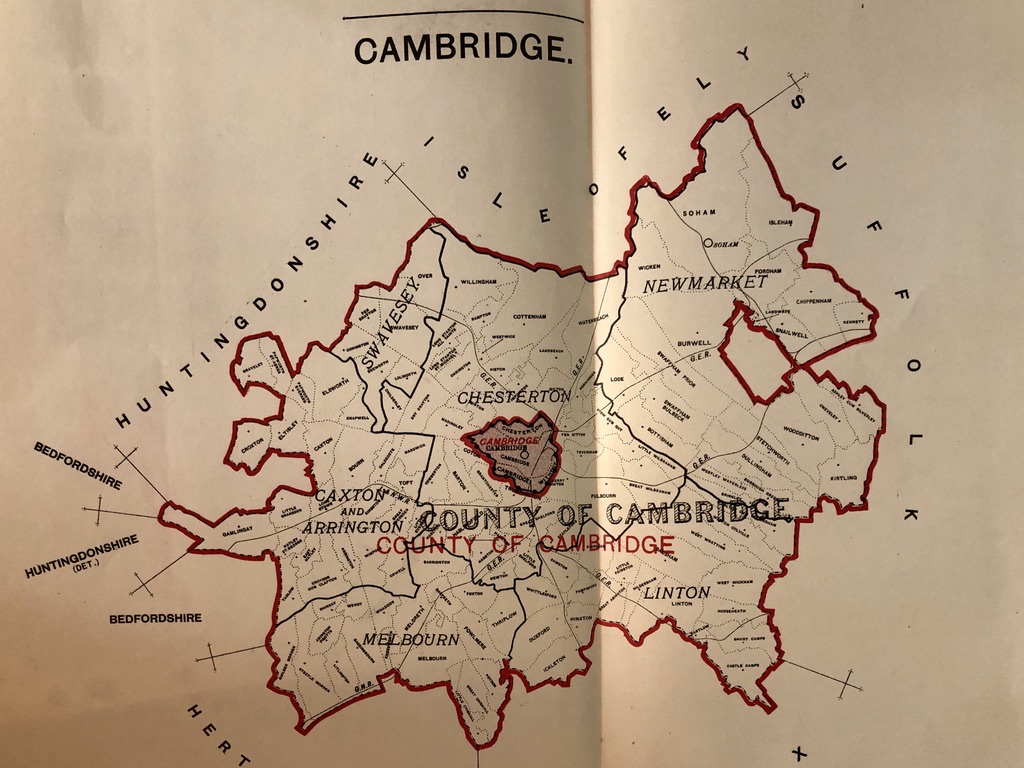
Above – proposals for an expanded Cambridge Borough within the ‘County of Cambridge’ circa 1910, and the old rural districts within it.
This shows that local government restructuring is not a new thing, but something that happens quite frequently in historical terms. These were also the boundaries for the first regional development plan for Cambridgeshire by Davidge in 1934.

Above – proposed protected green spaces and new roads and bridges as proposed by Davidge’s report. (See here for the accompanying text)
Huntingdonshire has made a bid for independence looking back to its pre-1965 days with this colourful introduction to its bid for three unitary councils.

Above – Huntingdonshire Unitary bid
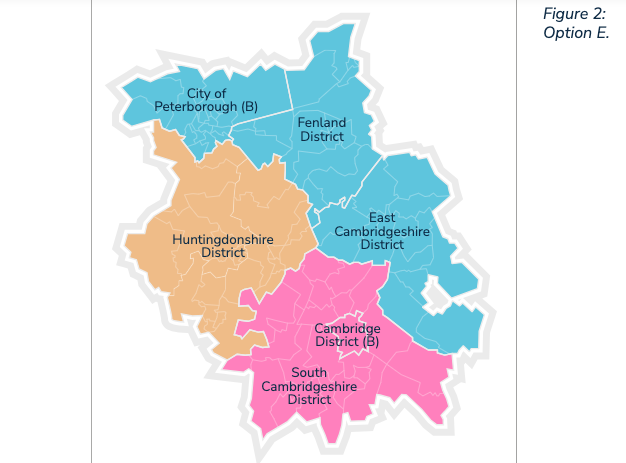
In the final option, Peterborough goes for a North Huntingdonshire land grab
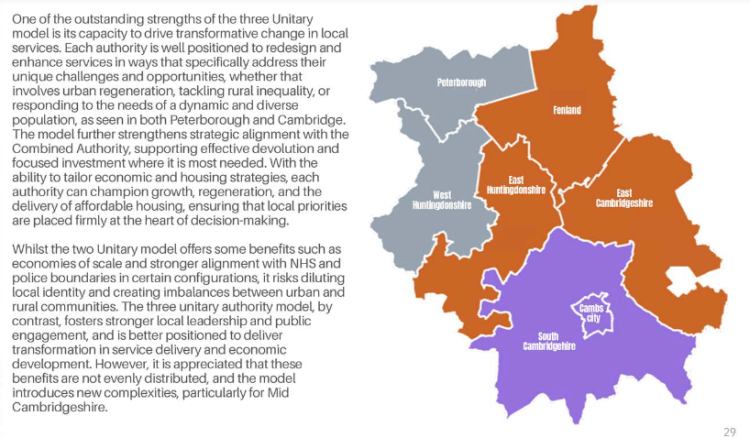
Above – the ‘land grab’ from Peterborough, incorporating West Hunts
I can’t see that final option going through because it leaves a geographically fragmented ‘Mid-Cambs cut off from the two fast-growing cities that have ministerial support behind them. It would only be a matter of time before such a disjointed county was broken up again. Given the proposed growth for Cambridge’s economic sub-region, my expectation is that we’ll have another round of local government restructuring within the next 25 years – probably far sooner.

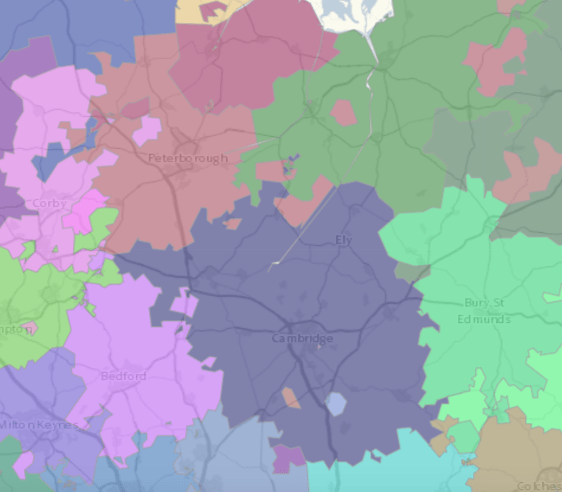
Above – the abandoned proposals from the Redcliffe-Maud Royal Commission 1966-69, and the Cambridge Travel to Work Area 2011
My preference for a new Cambridge Unitary is to base it on how people live their lives, and to build the green and public transport infrastructure around that.
It’s not just pointing at the option you like and telling ministers which one you want
If you scroll down the consultation page there are a number of questions they put to readers. These are:
- “To what extent do you agree or disagree that the proposal suggests councils that are based on sensible geographies and economic areas?
- To what extent do you agree or disagree that the proposed councils will be able to deliver the outcomes they describe in the proposal?
- To what extent do you agree or disagree that the proposed councils are the right size to be efficient, improve capacity and withstand financial shocks?
- To what extent do you agree or disagree that the proposed councils will deliver high quality, sustainable public services?
- To what extent do you agree or disagree that the proposal has been informed by local views and will meet local needs?
- To what extent do you agree or disagree that establishing the councils in this proposal will support devolution arrangements?
- To what extent do you agree or disagree that the proposal enables stronger community engagement and gives the opportunity for neighbourhood empowerment?
- If you would like to, please use the free text box to explain the answers you have provided to questions 1-7 referring to the question numbers as part of your answer. You may also use the box to provide any other comments you have on the proposal.
- Where a proposal includes a request that the Secretary of State modifies a proposal to achieve boundary change, or the proposal affects wider public services, such as fire and rescue authorities, you will be asked an additional question:
- This is a proposal that is accompanied by a request that the Secretary of State considers boundary change or that affects wider public services. To what extent do you agree or disagree that the proposal sets out a strong public services and financial sustainability justification for boundary change?
- If you would like to, please use this free text box to explain your answer to question 9.“
To respond you can complete their online survey here or simply email your responses to lgrconsultationresponse [@] communities.gov.uk.
If you are interested in the longer term future of Cambridge, and on what happens at the local democracy meetings where decisions are made, feel free to:
- Follow me on BSky
- Spot me on LinkedIn
- Like my Facebook page
- Consider a small donation to help fund my continued research and reporting on local democracy in and around Cambridge.

 The Cambridge Town Owl