Fenland District Council has an open consultation on the future of the district (see here) – closing date 16 March 2026, as the district plans for the next quarter of a century (to 2050)
The drivers for this were both the proposed reservoir which needs more work done on the plans according to OfWat back in January 2026, and the new policies coming from the Ministry of Housing.
“On 15 December 2025, Fenland District Council’s Full Council agreed to withdraw the previous emerging Local Plan. This followed changes to national planning rules and gives Fenland the chance to take a fresh approach.”
This is a fresh start following the withdrawal from the previous process. That said, it’s worth looking at the evidence bases and papers FDC has collated in a document library here – especially anything flooding-related..
Fenland District Council’s planning issues.
CambsNews covered the problems FDC’s Planning Department has had in detail over the past few years.
“Mr Leigh reminds Fenland council they have previously been at risk of being placed in ‘special measures’ due to poor performance in relation to the time taken to determine the smaller scale planning applications.”
Above – John Elworthy, 29 Sept 2024
And housing development remains a controversial issue as December’s Planning Committee for the district council revealed in one planning application for Chatteris – and there was significant opposition to the proposals to build on Wenny Meadow, negotiations only finally completed two years after planning permission was granted in the face of strong residential opposition.
One of the issues the Save Wenny Meadow campaigners highlighted was the impact that the growth would have on their town, saying that the existing approvals since 2014 will already increase the size of the town by 30%.
The problem?
On the largest site with an allocation for 1,000 houses, no developer can be found to build the homes on the site. The site known as Tithe Farm is currently up for sale for just under £5million. (Is this a site the Cambridge Growth Company could acquire, and incorporate their negotiations with Anglian Water with the Department for Transport on providing a new rail link to the town, even though it’s outside of the draft area in its current consultation? In which case the CGC would need to engage early on with the people of Chatteris so that the development avoided the risk of simply becoming a dormitory settlement for ‘Cambridge overspill’).
It should not take over an hour to get from Chatteris to Cambridge City Centre in the morning rush hour
But that’s what G-Maps tells us – both by motor car and public transport. Residents cannot win.
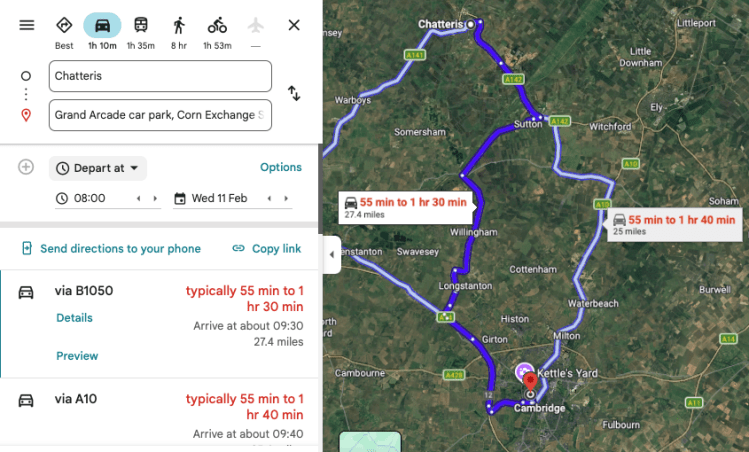
Above – from G-Maps here, Chatteris to Lion Yard Car Park, Cambridge
And if you assume that the Tithe Barn site gets built out, chances are several hundred additional commuter journeys will be added to that existing motor traffic.
Chatteris matters to the future of the county because:
- It is the fourth largest town by population in Fenland (2021 Census)
- It is just outside the top ten of largest settlements in Cambs & Peterborough
- It is next to the site of the new Cambs reservoir (which also makes it the site of a new nature reserve and sub-regional-sized water-sports-based outdoor leisure facility)
- It is only 25 miles from Cambridge
This means that under the current trajectory, the number of journeys between Chatteris and Cambridge is likely to increase significantly in the next decade or so.
You can see how the past fifty years could have been quite different for Chatteris had Labour won the 1970 General Election – Chatteris would have been incorporated into a new Greater Cambridge Unitary Council area – mirroring Nathaniel Lichfield’s analysis which also includes Chatteris (next to Ely in the map below-left) in Cambridge’s economic sub-region.


Above – left: Lichfield (1965) and above-right, detail of Recliffe-Maud (1969)
The people at the Chatteris Museum may have some more local insights on what local people at the time thought – mindful of the current restructure that puts Chatteris with a Greater Peterborough or a mid-Cambs unitary.
Fenland District is not the place you can cover in concrete (where is?) without building in massive flooding risks for future residents.
The flood risk/zones map demonstrates why.
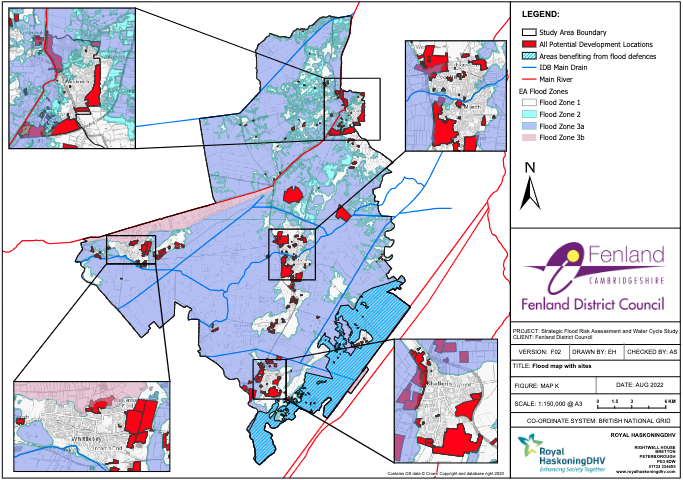
Above – Fenland District Flood Risk Map
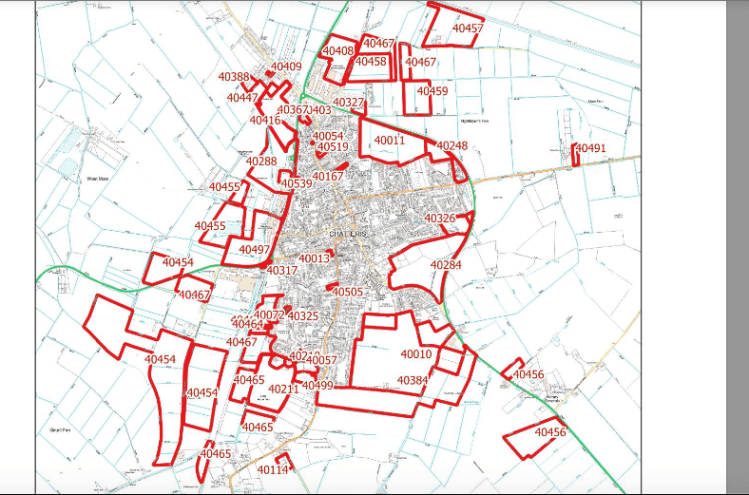
Above – sites submitted for consideration in 2022 for a future Fenland District Local Plan
What will the new reservoir mean for the people of Chatteris?
This is what BBC Cambridgeshire’s Mousumi Bakshi asked local residents in August 2025. The issues that local residents raised will sound familiar to many residents of small towns:
- Complaints of lack of basic public services (GPs, dentists, school places)
- Hopes of more facilities and things for children and teenagers to do
- Hopes of more, better jobs for the town
- Substantially-improved transport infrastructure
“What does failure look like and how can Chatteris avoid such a scenario?”
You may be familiar with the challenges that Northstowe and Cambourne, but both of those are new settlements. Chatteris is an historic market town that used to have a rail link prior to the Beeching cuts. Therefore one of the other victims of the Beeching-era cuts, Wisbech, is a better comparator. I visited the latter back in 2014 quite accidentally as I wrote on my old blog. The big risk is that a small number of large retail and leisure facilities are built on the edge of town, with the inevitable consequences for existing businesses.
Working with the residents at design stage
Not being familiar with Chatteris, it’s not for me to tell them what should go where. I can pick out things such as the location of the North Cambridgeshire Training Centre – which was funded by the Combined Authority and opened by the Princess Royal a few years ago. It looks like it’s stuck out on the edge of town with access designed for car drivers. Given the development of the new reservoir and also the possibility of a new rail or light rail line in the more distant future, what services could be located/relocated and where to take advantage of new public transport routes, new footpaths, cycleways, and bridleways, And what existing facilities could be improved and expanded given the increase in population and also the likely increase in visitors to the town following the completion of the reservoir’s construction?
The challenge for central and local government is the current structures do not allow for the latter to meet people’s needs and concerns on doctors’ and dentists’ surgeries and clinics, nor do they deal with concerns on education because of Michael Gove’s centralisation/academies programme in the early 2010s. Which is why I think central government will have to deal with the structure of local government beyond what they’ve legislated for in the English Devolution Bill sooner rather than later. (i.e. on the scale that MPs recommended under the last government in 2022)
Food for thought?
If you are interested in the longer term future of Cambridge, and on what happens at the local democracy meetings where decisions are made, feel free to:
- Follow me on BSky
- Spot me on LinkedIn
- Like my Facebook page
- Consider a small donation to help fund my continued research and reporting on local democracy in and around Cambridge

 The Cambridge Town Owl