
Cambridge United Football Club has published its official response to the draft Greater Cambridge Local Plan
You can read:
In their submission they recommend the council planners make provision for both the improvement of the Abbey Stadium, and also for a possible move ideally to somewhere on the Cambridge East (Airport) site.
That said, the football club acknowledged that the investment needed on The Abbey Stadium Site would need to be significant.
“Put simply, the potential future upside of a partially improved Cledara Abbey would not justify the tens of millions of investment required, and it would end up being a significant cost and long-term financial burden to the club.”
Above – Cambridge United FC press release from 21 Nov 2025
I wrote about this and previous attempts to find a new ground from times gone by here
Peter Freeman of the Cambridge Growth Company has also spoken positively about the Club and has made clear that he wants the future growth of Cambridge to work for the football club too.
“Cambridge United brings different parts of the city together in a way few organisations can.Through football and its community outreach, the Club has an important role to play in Cambridge’s future.”
To move or not to move?
For those of you not familiar with the location, the Abbey Stadium in the East Barnwell part of Abbey Ward is geographically cut off from the rest of the city as you can see from G-Maps here.
- The River Cam and Stourbridge Common to the north
- The Railway line to the west
- Coldham’s Common to the south
- Cambridge Airport to the east
In the detail of the draft Cambridge inset map from the documents library, the Abbey Stadium is designated as a potential area of major change, labelled as S/AMC/AS bottom-centre.
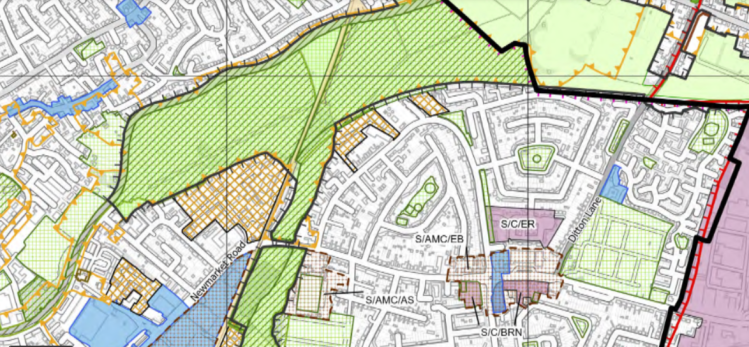
Above – detail from “Draft Greater Cambridge Local Plan: Cambridge Inset Map (2025)” (10.74 MB) which is in the GCSP Document Library here
Hence the football club are acutely aware of the potential impact that moving out of the neighbourhood might have. Hence they indicated that if they were to move, a new ground with much better transport access for supporters, a higher capacity, more facilities, and the potential to expand the ground further would need to be considered if the ground relocation was chosen.
The 2019 relocation proposal

Above – From BBC Cambridgeshire’s 2019 article – the proposed site being just beyond the airport close to J35 of the A14
Since then we’ve had huge Political upheavals locally and nationally. In 2019 I don’t think many people could have foreseen the sort of landslide that Labour got nationally, and that the Liberal Democrats got locally. Furthermore, while the growth of Cambridge was always something that the University of Cambridge and many in the affluent sci-tech and property sectors were lobbying for, the policies of first Michael Gove, and now Matthew Pennycook as Minister for Housing and Planning, were probably beyond even their wildest dreams.
Local council leaders oppose the loss of planning powers
Following on from Cllr Cameron Holloway’s statement that I wrote about here, his South Cambridgeshire District counterpart released a statement on LinkedIN with similar concerns about the loss of planning powers. In particular (and I didn’t spot this originally) it would have huge consequences for the Greater Cambridge Shared Planning Service
“We have tried extremely hard to find the best way to work with Government and it is more than disappointing to see how little trust they appear to have in us despite acknowledging that our award winning planning team is the ‘gold standard’. By-passing or dismantling this team risks slowing growth not accelerating it.”
Yet as I wrote a couple of days ago, isn’t the whole point of having a development corporation/growth company about acquiring the planning powers of local councils *as a bare minimum* in order to facilitate development far faster than local district council planning teams might otherwise have the capacity for?
But then maybe Cllrs Smith and Holloway are right given that the consultation is also looking at what types of planning applications – and what sizes of planning applications should be taken on by the development corporation.
Recall The new consultation that I wrote about here which covers:
- The long-awaited proposed boundaries of the growth company
- The sizes of planning applications that the growth company proposes taking control of, and taking it out of the hands of local government (something that the councillors oppose)
- The phased approach of bringing in the new powers rather than a ‘big bang’ approach.
“Proposed development corporation determination thresholds
| Development Type | Proposed threshold minimum |
|---|---|
| C3 (Residential dwellinghouses) | A minimum set at 250, 500 or 1,000 dwellings or equivalent floorspace |
| C1 (hotels) and C2 (hospital/care homes) | A minimum set at 100 or 250 rooms or equivalent floorspace |
| C2a (Secure Residential Institutions) | A minimum set at 1,000sqm or 2,500 sqm |
| Class E (commercial, business and service) | A minimum set at 1,000sqm or 2,500 sqm |
| Class B (general industrial B2 and storage distribution B8) | A minimum set at 1,000sqm or 2,500 sqm |
| Class F (learning, non-residential institutions recreation and community uses) | A minimum set at 1,000sqm or 2,500 sqm |
Above – from the proposed Development Management (i.e. planning applications casework) powers
1,000 square metres might sound like a lot but it’s only just over 30m x 30m of floor space. Or 0.14 of the size of a football pitch. Worth considering where there are multiple floors.
For the local council leaders, they will want those minimum threshold figures to be as high as is reasonably possible in order to keep their local planning team together in the near future, and not to lose some of the more interesting and perhaps intellectually challenging larger planning applications. At the same time it remains to be seen how the Cambridge Growth Company proposes how it will work with local planning teams. How did it work with Peterborough City Council when it was a third generation New Town 1968-88? Especially after the restructure of local government in 1974 put Peterborough City Council into the Cambridgeshire County Council area as part of a two-tier council structure. (Peterborough only became a unitary council in the late 1990s).
Either way, see Cambridge City Council’s consultation pages here – as well as the existing consultation on the creation of unitary councils, there’s also one on local council enforcement on things like nuisances eg noise, public health, and environmental protection.
If you are interested in the longer term future of Cambridge, and on what happens at the local democracy meetings where decisions are made, feel free to:
- Follow me on BSky
- Spot me on LinkedIn
- Like my Facebook page
- Consider a small donation to help fund my continued research and reporting on local democracy in and around Cambridge

 The Cambridge Town Owl