
The Cambridge Growth Company’s consultation sets out the powers it seeks to acquire from local government in Cambridgeshire – and councillors are not happy. Is there a workaround?
Possibly.
But it might require some innovations in structures and lines of accountability.
BBC Cambridgeshire quoted some councillors who described the move as a power grab.
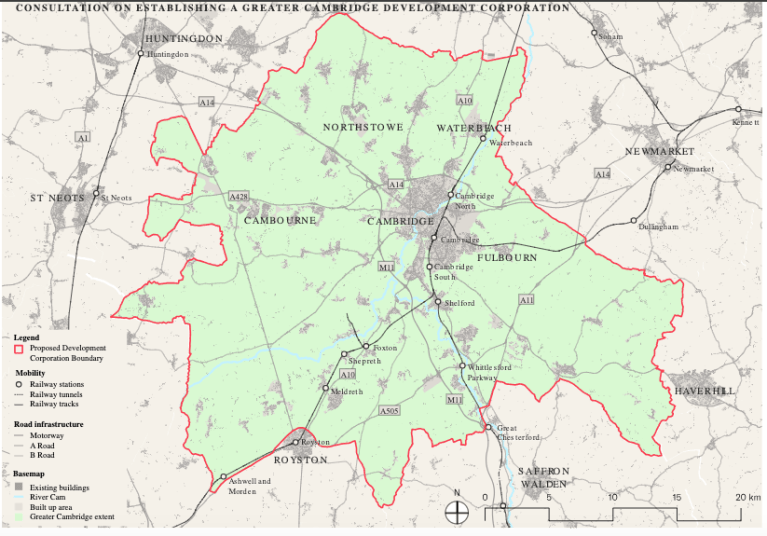
Above – the proposed external boundary of the development corporation’s powers via my earlier blogpost
Within those boundaries, the consultation published by the Ministry of Housing & CLG asks about which applications should be done by the development corporation. Given that they won’t want to be doing micro-applications such as extensions, they want to set quantifiable criteria that leaves them for the local planning officers – hence asking the public for their views as below.
“Proposed development corporation determination thresholds
| Development Type | Proposed threshold minimum |
|---|---|
| C3 (Residential dwellinghouses) | A minimum set at 250, 500 or 1,000 dwellings or equivalent floorspace |
| C1 (hotels) and C2 (hospital/care homes) | A minimum set at 100 or 250 rooms or equivalent floorspace |
| C2a (Secure Residential Institutions) | A minimum set at 1,000sqm or 2,500 sqm |
| Class E (commercial, business and service) | A minimum set at 1,000sqm or 2,500 sqm |
| Class B (general industrial B2 and storage distribution B8) | A minimum set at 1,000sqm or 2,500 sqm |
| Class F (learning, non-residential institutions recreation and community uses) | A minimum set at 1,000sqm or 2,500 sqm |
Above – from the proposed Development Management (i.e. planning applications casework) powers
Transferring powers would inevitably break up the ‘award-winning town planning service’
RTPI Planning Authority of the Year 2025. Plus Stephen Kelly’s award of an MBE in the New Year’s Honours. (Congratulations to both!)
So proposing breaking up such a service is not something that should be undertaken without significant consideration and analysis of other options. At the same time, I’ve struggled to work out how it would be possible to have a development corporation *without* the planning powers that councillors want to hold onto.
“Isn’t this just pre-election posturing by councillors up for re-election in less than three months?”
Francis Urquhart from House of Cards had a quick response to that…
Party political and electoral considerations aside, there still remains a challenge for the Greater Cambridge Shared Planning Service – especially if the development corporation comes in offering substantially higher remuneration. The desire to switch from former to latter would be irresistible.
One possible solution is already a standard way of working for the GCSP Service
The GCSP already has to serve three different planning committees.
- Cambridge City Council
- South Cambridgeshire District Council
- The Joint Cambridge & South Cambridgeshire Planning Committee
The committee of the Cambridge Development Corporation that determines the planning applications could be served by that same local service – assuming that the GCSP received the resources needed to cover both small local applications and CDC-scale applications.
Councils will be able to set fees at a level where they can recover costs
See The Government’s factsheet from Sept 2025 here. It may take time for those higher fees to work through the system in terms of higher salaries for qualified town planners but the point remains that both local government *and* the development corporation will need the processing capacity for the applications. Furthermore, the Higher Education Sector needs to expand its offering on town planning. (I’ve asked Anglia Ruskin University on various occasions to extend their Town Planning courses to Cambridge and Peterborough – progress update?)
“What would the HR and accountability arrangements be between the shared planning service and the development corporation?”
The default option is to keep a skeleton town planning function for what will become the Greater Cambridge Unitary Authority, and transfer over those working on larger applications and development planning work over to the CDC. But then that could be a very messy process.
Alternatively, the entire shared planning service could be seconded over to the development corporation with local government contributing financially towards the work done on small planning applications. Or.
…the shared planning service could negotiate a Service Level Agreement with the development corporation on the processing of planning applications, development plan work and anything else that it has to deal with – thus keeping the GCSP Service as a single unit.
The big risk to avoid is…
…developers gaming the system and designing their planning applications close to the minimum levels set out in the consultation, and adding/subtracting from them so that their application gets decided by whoever they think is most likely to grant planning permission. It could go either way. Target just below the minimum and you face an under-resourced planning team that might put up less of a fight vs a substantially-resourced development corporation which might do the opposite, incurring greater costs on developers. On the other hand they might think that a local planning committee is more likely to reject a planning application than one from a development corporation instructed by the Minister for Housing to deliver growth for Cambridge.
Take your pick.
By having a single unit equally resourced, that risk is avoided because the different committees will still get the same officer recommendations
Furthermore, in terms of internal career progression, there won’t be a barrier for internal applicants in the planning service looking to move into work that’s primarily for the development corporation.
Food for thought?
If you are interested in the longer term future of Cambridge, and on what happens at the local democracy meetings where decisions are made, feel free to:
- Follow me on BSky
- Spot me on LinkedIn
- Like my Facebook page
- Consider a small donation to help fund my continued research and reporting on local democracy in and around Cambridge

 The Cambridge Town Owl