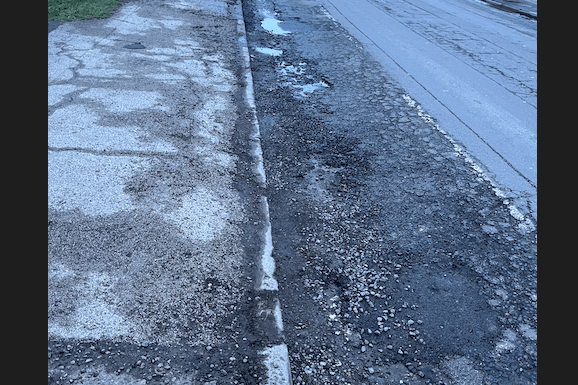
The potholes in the roads are very visible symptoms of a much greater set of problems whose roots are in Westminster. Is there a local solution given the huge rise in heavy construction traffic associated with Cambridge’s rapid growth?
My photo above of the state of Cherry Hinton Road in Cambridge earlier this month was picked up on the cycling website Road.CC here
I think it was in the very late 1980s that I first heard the term ‘pothole’ mentioned by anyone. My late grandfather took me on a cycle-ride into Cherry Hinton (I was still at primary school then) and we were at the top of the junction between the High Street and Fulbourn Old Drift near St Andrew’s Church. It was about as far down the High Street I had ever been, and I wanted to go down this road I had never seen.
“It’s full of potholes!”
Cautioned my grandfather. And so we turned around and headed back – me with this vision in my head that these potholes were big enough for me to fall into and get stuck in. Maybe I should have thought about the size of small plastic plant pots that my late grandparents had lots of and I’d have been closer to the mark.
Yet even in those dark austerity-ridden days of the early 1990s when I had a paper-round, I don’t recall the roads being anything like as bad – although the surfaces of the main roads were noticeably different. They still had the larger stones embedded in the tarmac whereas a resurfaced road today does not.
“Why does local government struggle to maintain roads?“
Because:
- Successive Chancellors have not allocated sufficient funding for local councils
- Successive Chancellors and Transport Secretaries have not brought in new policies (properly funded) to pay for a new generation of rail freight to move heavy vehicles onto rail
- Transport ministers approved the use of increasingly heavier vehicles on the roads – which do proportionately more damage for every unit of weight they increase by
- Because of increased traffic volumes
The evidence of broken funding systems comes from Chancellors themselves – every time in the Budget they announce a new national ‘pothole fund’ they are admitting that their existing funding allocation system does not meet demand.
The House of Commons Library states that road maintenance budgets come from central government, and the work is commissioned by local councils/highways authorities
You can see the briefing here. So next time you want to complain about potholes, it’s your MP you need to get in touch with. (If it’s about a pothole in a specific location, get in touch with your highways authority – your local or county council. In my case it’s Cambridgeshire County Council here).

Above – George Osborne quoted in CityAM back in 2015 from the Wayback Machine
But then George Osborne was the same Chancellor that allocated another pothole fund in 2014 here.
And it was also the same Chancellor who announced more pothole funding some three years before in 2011.
“Did it get any better for the 2020s?”
The briefing from the House of Commons Library shortly after the 2024 General Election lists a number of pothole funs here. That briefing (scroll halfway down) picks out five major announcements between 2018-23 on dealing with potholes.
“What is behind spike in pothole related call-outs?”
…asked Louise Perry for BBC Cambridgeshire.
“”Really heavy vehicles cause damage to roads and that combines with the weather,” said David Cebon, Professor of Mechanical Engineering at Cambridge University.”
Have we seen an increase in heavier vehicles? Let’s go back to 2023.
“Longer lorries to be allowed on Britain’s roads”
“The Department for Transport (DfT) said the vehicles would help businesses be more productive. For example, bakery chain Greggs – which has used the vehicles since 2013 – says it can carry 15% more goods than usual in a longer trailer.”
Above – DfT to BBC News 10 May 2023
“Who was the Transport Secretary at the time?”
Interestingly the Roads Minister at the time – now the Shadow Transport Secretary – spun the move as increasing safety, reducing emissions, and supporting growth.
“Let the good times roll as we reduce congestion, lower emissions and enhance the safety of British roads.”
Above – Roads Minister, GovUK 10 May 2023
The former Transport Minister Norman Baker (formerly LibDems – Lewes) who later became the pro-light rail policy director for the Campaign for Better Transport disagreed, saying in the BBC article here earlier that longer lorries are more dangerous. Furthermore…
- “the Campaign for Better Transport said the change was was a “deeply retrograde step” which will “do nothing to tackle carbon emissions or air pollution”.”
- “a spokesman for the Road Haulage Association urged the government to go further by increasing the permitted weight to 48 tonnes.”
The RHA also published this statement just over a year ago on potholes
Both the Automobile Association (The AA) and the Asphalt Industry Alliance (AIA) spoke out about the state of the roads last month – the latter identifying the lack of up-to-date tools and technologies, while the former called for ‘5 year warranties’ on pothole repairs. Both however are dependent on funding.
“Councils face a £17 billion backlog of road repairs. Only longer-term funding certainty will help councils more effectively plan for future maintenance schemes.”
Freightliner Chief Executive states lorries with heavier axles do the most damage
road freight enjoys a hidden subsidy. Damage to the road surface increases exponentially with axle weight, to the extent that one 44-tonne lorry is thought to cause as much damage as 136,000 Ford Focus cars. “The tarmac is breaking up and potholes are appearing – and that damage is paid for by all of us. So from a national perspective it is worth taking some of that traffic off the roads,” argues Mr Shoveller.
Cambridge’s roads will only get worse in the face of the large construction projects – so what can we do?
What solutions are there? Because ‘business as usual’ is utterly unsustainable. This is one for the Cambridge Growth Company to commission some research papers on. One place to start is with light rail – and in particular “Light Freight Rail” on which there are a number of recent case studies in the EU – in particular in Poland.
Dr Larysa Lytvynenko explored Light Freight Rail in her 2022 paper “Prospects of using the urban railway for logistics support of urban areas”. Additionally, Montwill, Pietrzak, & Pietrzak for the University of Szczecin in Poland have a look at Light Freight Rail as part of an integrated Logistics Centre in their 2020 paper using a case study in Italy.
“Light freight rail for logistics…why does that sound vaguely familiar?”
Because the former Conservative MP for Cambridge Sir Eric Geddes – later the Minister for Transport, made the case for it back in 1918.
“Is this the speech where he said he’d hang the Kaiser?”
Not quite – although the print press of the day outside of the city (along with some of the history books!) ran with that phrase.
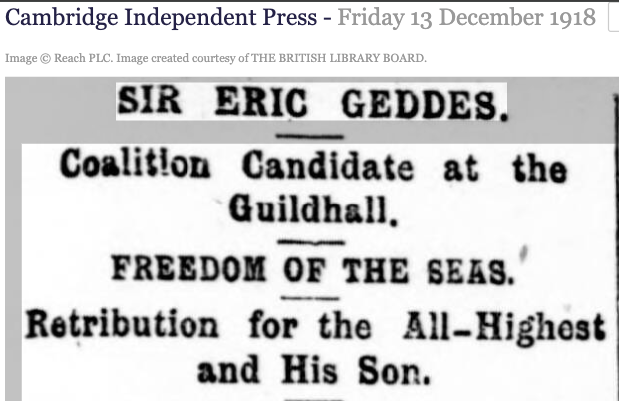
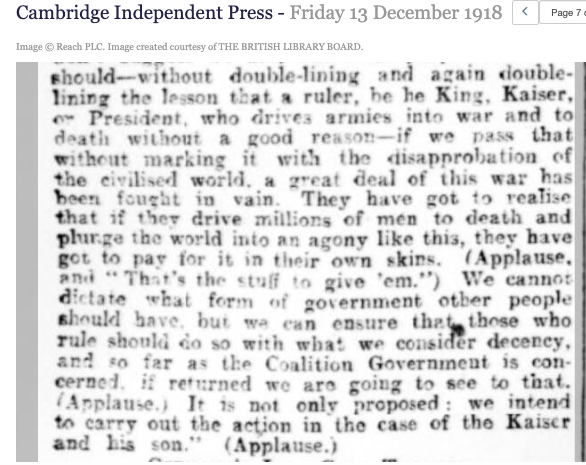
Above – Cambridge Independent Press, Fri 13 Dec 1918 in the British Newspaper Archive
The bit that matters to this blogpost is that in that same speech full of rabble-rousing words (perhaps understandable when you look at the casualty list of the Cambridgeshire Regiment in the Guildhall), the then MP for Cambridge re-standing against Labour’s first ever Cambridge candidate T. Rhonnda Williams, as the Lib-Con Coalition candidate, made the case for light rail freight transport for agriculture!
I transcribed parts of Sir Eric’s speech from 108 years ago here in LostCambridge.com
“We had learnt in France what railways could do in the way of distribution. There we had a vast network of railways behind the front, and those railways were operating at rates which in peace time would absolutely revolutionise the agriculture and industries of this country. We saw that Belgium and Northern France were covered in a network of light, cheap, agricultural railways and it was that kind of development that we wanted if we were to get the best out of this country”
Above – Cambridge Independent Press, Fri 13 Dec 1918 in the British Newspaper Archive
Did we get those light cheap agricultural railways? No. Interestingly, William Plowden’s book on The Motor Car and Politics 1896-1970 covers the competition between ‘light locomotives’ and the rise of the motor car. (It also covers the conflict between cyclists and motorcars too!)
Could a light rail network be constructed for Greater Cambridge that could serve both the construction projects *and* passenger movements over the next quarter of a century so as to reduce significantly the damage done by construction vehicles to the local road network?
There are lessons from HS2 and the Olympic Delivery Authority on this.
“…the import of bulk materials to areas of the HS2 outside London was not mandated in Undertakings and Assurances and thus the use of rail deliveries direct to site was not considered or mandated at the early planning stage… …Ultimately, this resulted in a sub-optimal material logistics plan, based entirely on last miles by road.”
Above – HS2 Legacy, December 2023
Given the nature of Cambridge’s growth – especially for higher density and larger building projects such as the new employment parks (requiring large deliveries of very heavy steel components), having a designated freight exchange and logistics park connected to the heavy rail network that can then be connected via light rail to the larger building sites must be considered.
“What’s the best place to locate a freight exchange and logistics park?
One option is on the railway line at Six Mile Bottom where the A11 passes over the Cambridge-Newmarket line (due to be upgraded anyway by East-West-Rail) and the near the junction of the A11/A14.
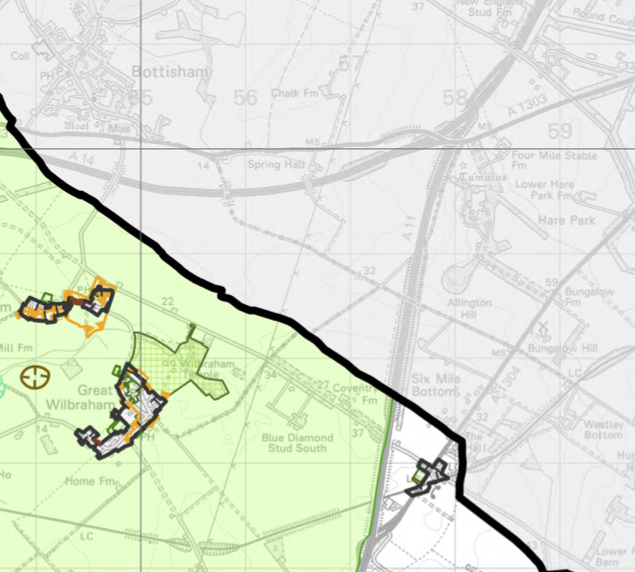
Above – Detail from the Draft Greater Cambridge Local Plan: Policies Map ((2025) 13.14 MB) in the Local Plan Document Library. See also G-Maps here.
Essentially it provides a place for all very heavy deliveries to be deposited just outside Cambridge whether via rail freight or road freight – while avoiding local roads in/around the city. With very little component manufacturing being done within Cambridge itself, most of the deliveries should come in via the national rail or the national road network.
Connecting the large development sites in the draft local plan
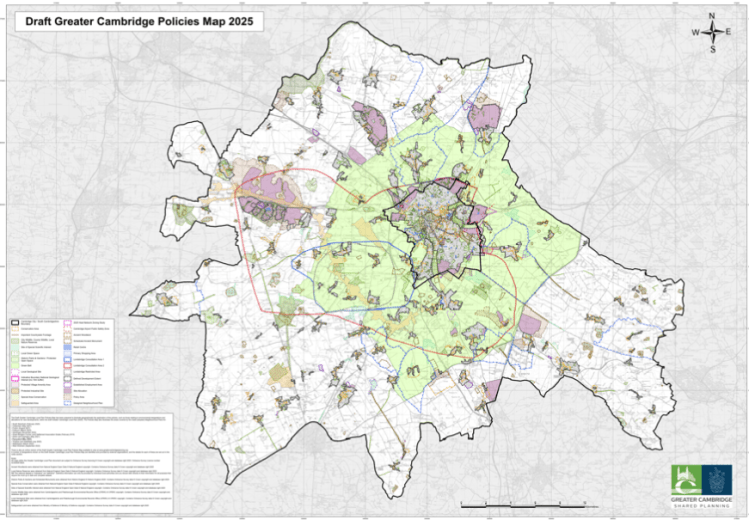
Above – Low-res view of the Draft Greater Cambridge Local Plan: Policies Map ((2025) 13.14 MB) in the Local Plan Document Library.
What that potentially provides for initially is a light rail freight loop that connects the different large development sites with a single rail-based freight exchange and logistics park
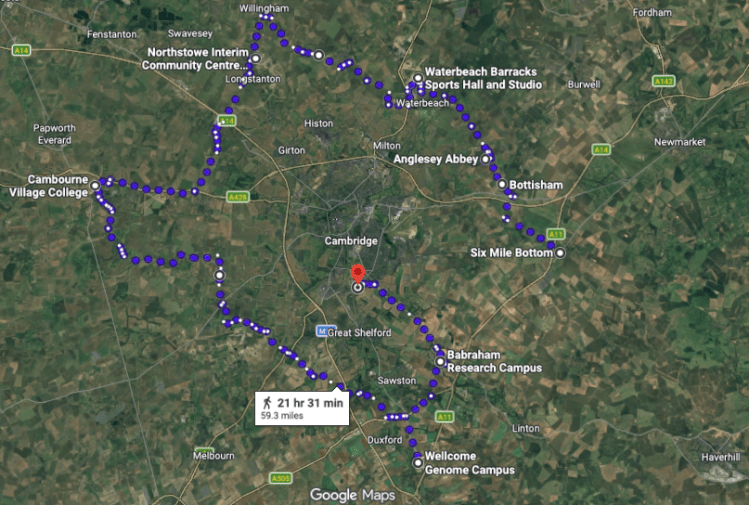
Above – playing with G-Maps here using *existing footpaths* to stop at the major developments and settlements under construction
– there’s nothing to stop the proposed Grange Farm development by the Babraham Research Campus being connected, and thus heading towards the Cambridge Biomedical Campus – something that would then negate the need for the proposed and controversial CSET Busway which terminates near Babraham at a proposed new Park & Ride.
“Pro-roads and busways consultants would zap that proposal”
Of course they would – that’s their job. The assumption they’d use is one that assumes the repair costs to local roads using existing road haulage systems is zero. Recall I tabled a public question back in 2017 asking about linking Haverhill to Cambridge by rail in this public question to the old City Deal Assembly, with this response from the then City Council Transport Director Graham Hughes.
You can read the consultants’ study on Rail Haverhill to Cambridge here from Jan 2016

Above – how does this report look today?
“A Cambridge-Haverhill railway line could also ultimately form part of a more strategic rail link from Cambridge to Colchester, via Haverhill and Sudbury, including the existing Sudbury to Marks Tey branch. However, this strategic option is beyond the scope of this technical note and the current study.”
Above – quoting the report in my original Public Question from my old blog from nine years ago.
Which is a *very long way away from potholes* I concede. But it goes to show how the potential long term solutions to potholes in the roads are not simply a case of getting more repair teams to go around patching the holes up faster. It requires a much more holistic re-think about transportation of people (Eg commuters and tourists), goods (eg food supplies) and materials (eg bricks and steel beams).
Food for thought?
If you are interested in the longer term future of Cambridge, and on what happens at the local democracy meetings where decisions are made, feel free to:
- Follow me on BSky
- Spot me on LinkedIn
- Like my Facebook page
- Consider a small donation to help fund my continued research and reporting on local democracy in and around Cambridge

 The Cambridge Town Owl