In an eight-point battering, the influential group strongly criticised the failure of politicians over ‘poor transport options and lack of consensus on future solutions’. How do things look nearly 12 years after three councils and The Government signed the City Deal in June 2014?
Image – Neurodiversity pins, because no one in their right minds should be writing blogposts about the past decade of the Greater Cambridge Partnership, but my neurotype (AuDHD-suspected) combined with CFS/ME flare-ups mean I spent most of today staying home and looking to hyperfocus on something. Then Cambridge Ahead’s press release popped up.
You can read Cambridge Ahead’s statement here – which will need to be read in the context of the CPCA’s Transport Committee Meeting on 04 March 2026
If 24 hours is a long time in politics, 12 years must be an eternity.
It was 14 years ago that I was struck down by a mental health crisis – what I now believe to be AuDHD Burnout, which left me with CFS/ME – a condition that severely restricted my functioning hours and more importantly my mobility. (The last time I ventured more than a dozen miles outside of Cambridge was before the first lockdown – so I don’t get out that much!) One side-effect of this was having more time than was sensible to follow what was happening in local democracy. So I was around at the start of what we now call the Greater Cambridge Partnership.
- Filming an early ‘Shadow Board’ meeting on 18 Nov 2014 at The Guildhall on their Comms Strategy
- Tabling one of the first public questions on 28 Jan 2015 – to Cambridge University’s representative asking how his institution can be held accountable by the public via the City Deal Board that the University has a seat on.
- Asking striking medical staff at Addenbrooke’s, and people outside the Guildhall if they had heard of the ‘City Deal’, 19 Feb 2015
- Querying the lack of young people at a very well-attended public event (over 200 people IIRC) and City Deal attempts to get their views. 13 Nov 2015
- Giving evidence on 16 Nov 2015 to the City Deal Assembly in support of the Rail Haverhill Campaign
- Asking why there was no City Deal publicity at Cambridge’s central bus station at Drummer Street a decade ago (02 Feb 2016)
- Asking County Council officers what historical research they undertook to inform the work they were doing. (22 Sept 2016 – the response is excruciating, and not the only time county council and GCP officers responded as such to questions on past transport schemes)
- Filming the early engagements with residents forums – such as this one highlighting how consultations did not lead to substantial changes in response as happens in other professions (26 Sept 2016 – this would later come back to sting GCP senior executives when they tried to ram through a controversial congestion charge in 2023).
Many of my videos were supported by the Federation of Cambridge Residents Associations in the days before council chambers had professional live-streaming functions – those being installed following the first lockdown.
My observations/views in response to Cambridge Ahead’s Eight Points:
“Clarity and certainty are needed – which will require the complex governance system that oversees transport planning and delivery in Cambridge to find a more optimal operating model “
For over a decade I’ve been blogging about the case for a unitary council for Cambridge/Gtr Cambridge – including calling for the abolition of the county council in this blogpost from 2017 – noting that despite all of the general election candidates supporting the principle of a unitary council, it wasn’t until after the 2024 general election that we got to where we are today. That’s a decade wasted – and much of the fault rests with Conservative Party ministers at the time for not agreeing to a unitary council but instead signing off the inefficient structures that served no one – and then bringing in a Combined Authority for which there was no historical precedence.
Quality of life outcomes should guide system design – for example reliability, accessibility, affordability, and user-friendliness should be key metrics. In particular, the ease of multi-modal journeys for users (such as single ticketing, interchange between modes) should be prioritised in system design
Agreed – and again the fault for the convoluted system of bus franchising created by the much-criticised Chris Grayling, Theresa May’s Transport Secretary in the Bus Services Act 2017. (It took the whole of Dr Nik Johnson’s mayoral tenure to go through the stages required to get the Combined Authority to get the powers available.
Further delay or failure will lead to massive economic cost – growth and investment will be lost in the short-term, the competitiveness and status of the Cambridge economy are risked in the long-term.
It didn’t need to be like this – here’s Dr Colin Harris making an early presentation of his Cambridge Connect Light Rail concept back in October 2016 at Lee Hall in Wolfson College. Since then it has been through multiple iterations (See https://www.cambridge-connect.uk/ for the latest) but if the GCP had chosen to work with Suffolk County Council (as I suggested back in January 2015 in a public question to that first board meeting at the old Shire Hall!) to make a cross-party approach to ministers for the additional funding/tax raising powers needed, in the ‘sliding doors’ world of Cambridge we might have been living in a 2026 where the first and most difficult part of the line (The tunnel under the city/Isaac Newton line) is complete – with new services dramatically reducing motor traffic.
Segregated public transport corridors are gold dust – the reliability of any mass transit system relies on the level of segregation from other transport modes. Options for corridors are sparse and diminishing. Where there are options in front of us that have been through due process, these should be recognised for the major assets that they are – and we should use them before we lose them.
Segregated corridors are an inherent part of light rail – therefore I refer honourable readers to the reply I gave above. And/or the lesson politicians and senior transport officers did not learn from the first guided busway is that those buses get stuck in motor traffic once they get to the city centre. One of the core problems the GCP was meant to resolve was that ‘last mile challenge’. The independent audit of the Cambourne-2-Cambridge busway highlighted the “Grange Road problem” as being unresolved.
“[The Cambourne to Cambridge Busway Project] …offers no solution apart from the City Access program of soft measures to restrict on-street parking and reallocate road space to active travel. The assumption is that these measures will be enough to enhance bus speeds and provide more reliable journey times across the city. However, no detailed modelling of the likely impact has been conducted so it remains uncertain whether bus accessibility will improve.”
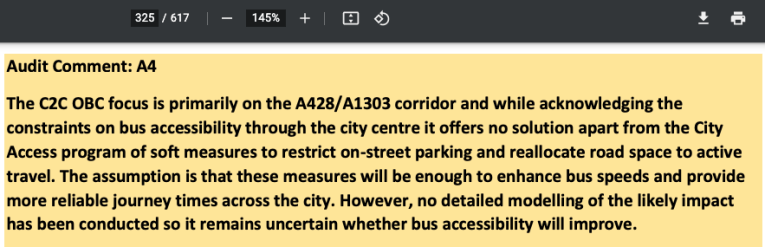
Agenda Pack for Greater Cambridge Assembly, 20 June 2021 – p 325.
A credible solution for cross-city connectivity must emerge – this represents a strategic gap in current adopted plans and 2026 should be the year to confront this.
The Greater Cambridge Partnership had over a decade to find a solution to this, spending £millions on consultancy fees – as the Smarter Cambridge Transport group observed in its final, damning post on the GCP.
“There is remarkably little to show for the more than £200million that the government has so far given the GCP and Combined Authority to spend on transport. Nearly all of it has been paid to consultants for reports rather than delivering new transport options.”
Above – Smarter Cambridge Transport 08 Dec 2021
Furthermore, the Combined Authority has had eight years to come up with its own solution. It didn’t.
City centre vibrancy and bus service viability are intertwined – congestion management can be contentious, but Cambridge must tackle city-centre congestion to support both the economy of central Cambridge and the ongoing viability of city-region wide transit.
The City Centre is dead compared to what it was like when I was in my mid-late teens. Yet the population of Cambridge since that era has increased by around 40% in those 30 years that have passed – as have tourist numbers. So why are there so many empty shop units? While transport is one of the key factors, there are other things going on which also need to be addressed. Those may involve difficult conversations with, and compromises from college landowners. (Mindful of the University of Cambridge’s new high profile civic engagement workstream for which I am an independent adviser on)
Hard-nosed business case discipline needs to be applied to Rapid Mass Transit assessment – so that there is market confidence that the solution pursued by authorities and politicians will be delivered. The operating cost of options needs to be strongly considered within this. Much of the rhetoric is focused on capital costs which risks missing the important point that the system chosen must be affordable to operate on a year-to-year basis.
This also must involve hard-hitting reviews and appraisals of the previous schemes and reports submitted by previous consultants who were paid handsome sums for delivering things that never got built – or not within the timeframe anticipated assuming *something* gets built with the long overdue busways.
Options appraisals should consider future solutions and flexibility – not just working with the restrictions of today’s operating assumptions. This may be the defining point on capital expenditures, operating expenditure, and benefits. So just focussing on existing technologies and operating models risk being backward looking.
I didn’t see GCP Officers being flexible towards other reasonable proposals. They seemed to be hyper-focused on busways that they have not delivered. There has also been a significant level of collective Political failure where the buck must ultimately stop at ministerial desks – in particular the then Chancellor George Osborne, the then Deputy Prime Minister Nick Clegg, and the then Minister for Cities Greg Clark who signed the City Deal on behalf of The Government. They approved the structures, and at no point did the three gateway reviews ask critical questions about how the City Deal Board and Assembly were functioning.
Reviewing the circumstances behind the generation of, and scrapping of transport infrastructure proposals – such as the Cambridge East project that
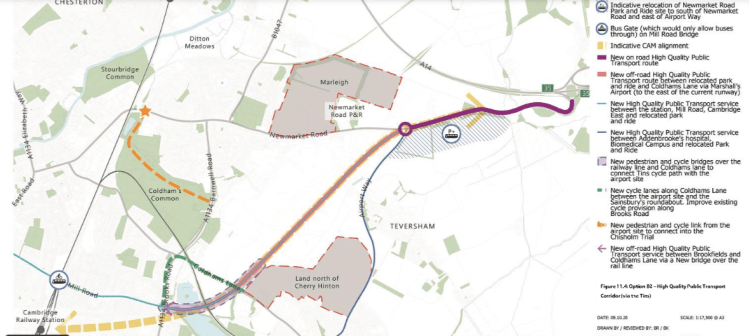
This was all but abandoned following the Mayoral elections in May 2021, with only the proposed improvements for bus lanes and cycle lanes on Newmarket Road to a new Park & Ride site proceeding so far.
The University of Cambridge and Cambridge Ahead were accused by the Smarter Cambridge Transport group in the Cambridge Independent in Dec 2019 of reneging on support for a Work Place Parking Levy
“Cambridge seems to have ruled it out, faced with strong opposition from Cambridge Ahead. The business group’s membership includes both city universities, Arm, AstraZeneca, and other major employers, land owners and developers. In the 2015 City Deal Call for Evidence, Cambridge Ahead and the University of Cambridge both advocated consideration of a WPL. What has changed their minds?”
Above – Why Cambridge needs a WPL – Smarter Cambridge Transport 12 Dec 2019
In the end, neither the WPL nor the proposed congestion charge went ahead – the latter being abandoned after a backlash at the ballot box in 2023 along with the withdrawal of support from the Conservatives from the City Deal more generally which their party locally and nationally played a majority role on both sides in negotiating. So what went wrong?
And why didn’t the Greater Cambridge Partnership senior officers read in depth the work done and the studies commissioned by Cambridgeshire County Council back in 2007-08? (See Lost Cambridge here) Because one of those reports was an attitude survey commissioned in 2008.


Above – guess which local historian found the original report in the archives. I never got permission from Cambridgeshire County Council to republish it so it’s up to them to do so.
As we know, congestion is not a new problem. County council officers in the 1970s created this board game for the county’s children who faced their own traffic problems.
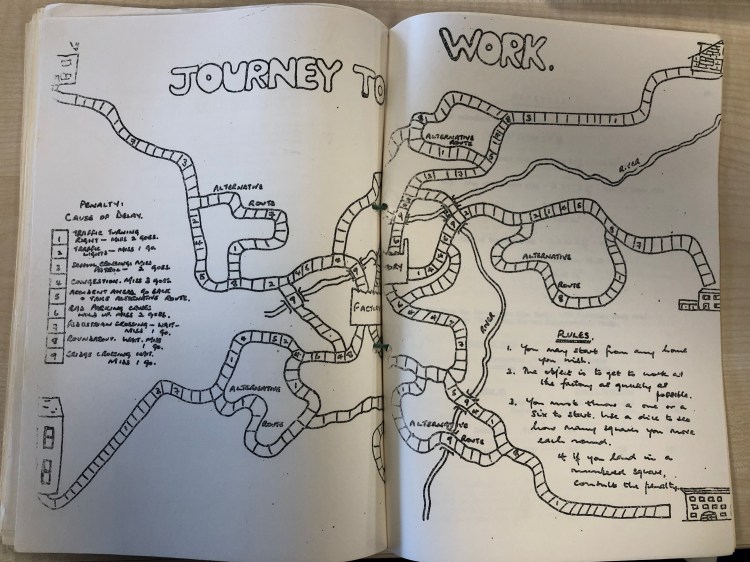
Above – Journey to work – courtesy the Cambridgeshire Collection
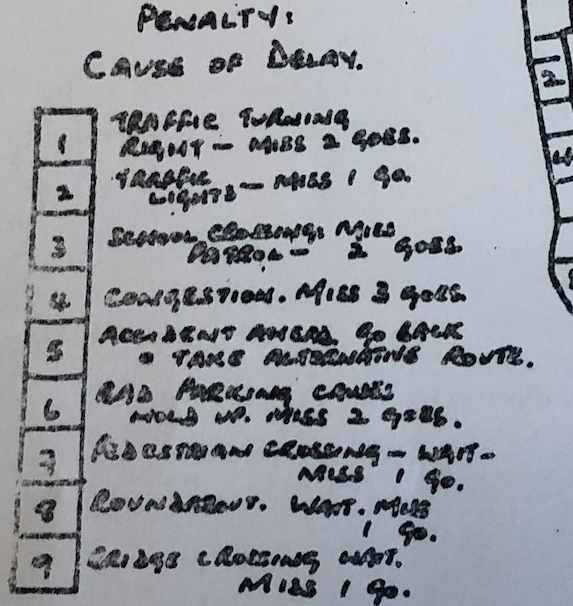
- Traffic turning right – miss two goes
- Traffic lights – miss one go
- School crossing – miss two goes
- Congestion – miss three goes
- Accident – go back & take alt. route
- Bad parking hold up – miss two goes
- Pedestrian crossing. -miss one go
- Roundabout – miss one go
- Bridge crossing wait – miss one go
Time for an update for this?
One of the things the members of Cambridge Ahead – especially those on its Transport Committee, may want to reflect on is why despite their heavy lobbying were they not able to get the proposals they supported through? What are the lessons learnt for how their institutions engage with their own staff (especially in seeking the opinions and ideas of their members’ workforces) and the wider city and district? (I wrote about this in a blogpost back in December).
Given Cambridge’s rapid population growth, inevitably there will be thousands of residents living here who were not around when the City Deal was first negotiated. What was it about the GCP that meant it was unable to take ‘the people’ with them? What was it about democratic mandates that resulted in a city council election for only a third of seats being the election that forced the withdrawal of the congestion charging scheme? And why has Oxford, with different structures, been more successful than Cambridge and who are now ready to go forward with a consultation on a WPL for Oxford, with their temporary congestion charge now in place. (The latest feedback from last month…have a read here).
If you are interested in the longer term future of Cambridge, and on what happens at the local democracy meetings where decisions are made, feel free to:
- Follow me on BSky
- Spot me on LinkedIn
- Like my Facebook page
- Consider a small donation to help fund my continued research and reporting on local democracy in and around Cambridge

 The Cambridge Town Owl