…according to the latest statistical release from the Office for National Statistics for the period covering January 2026
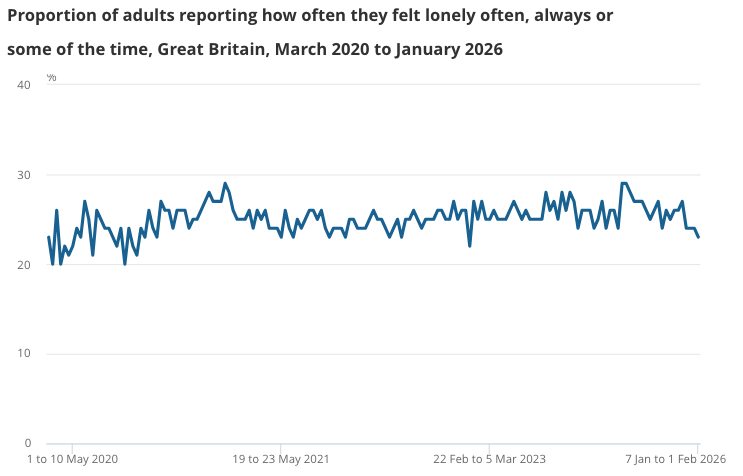
Above: “Proportion of adults reporting how often they felt lonely often, always or some of the time, Great Britain, March 2020 to January 2026” ONS Feb 2026
The data in the above-mentioned graph is interrogated in the statistical update “Loneliness and support networks”.
The above-mentioned update looks at the demographics, identifying which cohorts are at greater risk than others. Not surprisingly with long term disabilities amongst other things, I find myself in a greater risk group.
Hence returning to the issue frequently!
“Has there been any progress on public policy solutions?”
Only I’ve written enough blogposts about loneliness (from public policy issues to my own experiences)
The World Health Organisation had a look in their report: National policy responses to address loneliness: A global scoping review of 194 WHO member states.
“The development of a national policy to address loneliness should be viewed as an evolving process rather than rigid framework. It requires cross-sector collaboration and a careful balancing of scientific evidence and political priorities. This can be particularly challenging when there is pressure to recommend specific interventions, but the existing research does not yet offer clear or conclusive guidance.”
Above WHO (2026) Section 5. Conclusion
The report highlights intervention types which fell into the themes below
- Social access (specifically a) improving social infrastructure and community spaces, b) improving access to services by addressing financial barriers, transport issues, or digital inclusion, and c) empowering local actors to leverage civic engagement.)
- Skills training – including for those professionals working with those most at risk eg teachers and care workers
- Social engagement facilitation (eg joining clubs)
- Psychological therapy (eg counselling)
- Systemic approaches (eg a) focus on building a knowledge base, b) identifying data and evidence gaps, c) mapping intervention evidence.)
- Multi-component (a combination of some/all the above)
One of the researchers of that paper, Professor Pamela Qualter of the University of Manchester was quoted as stating the following about the research:
“This report is a vital step in acknowledging the widespread nature and serious consequences of social disconnection, especially for young people. It emphasises that addressing social connection is a global societal priority, and reinforces the need for targeted interventions and policies that prioritise building meaningful connections for everyone.“
Above Professor Pamela Qualter for University of Manchester, 01 July 2025
NESTA’s research.
Formerly a part of central government, the National Endowment for Science, Technology and the Arts was given a large financial endowment by the Government in the form of a Lottery Grant, then spun out as an independent foundation post-2010.
“We design, test and scale solutions to the biggest challenges of our time.”
One of the things they published a report on was on Loneliness – in 2024
“We found strong evidence that loneliness causes depression which is comparable to the effects of bereavement and unemployment.”
The report also recommended research into the cost-effectiveness of different interventions. Which is why the research into awe – which I had previously read about in the context of the built environment, was also of interest.
“Experiencing awe in daily life is linked to lower loneliness” is an emerging area of research examining the case of healthcare workers and experiencing the concept of ‘awe’ in life. I’ve sort of covered the concept of ‘Awe’ in a number of blogposts – for example on urban design and the future social centres of the new housing developments.
But it’s not as simple as building something that makes people go ‘Wow! That’s awesome!’ After all, I can walk past King’s College Chapel and barely notice its presence – in sharp contrast to the tourists who spend huge sums to be in the presence of the 500+year old chapel. But then I grew up with it always being there in the background since early childhood. There needs to be something more than just big pretty buildings to maintain that sense of awe.
And that was reinforced by the local residents of 1954 when the Cambridge Daily News invited its readers to send in letters about what they didn’t like about the city. The result? The volume of correspondence was so great that they had to extend the feature into a second week!


Above – “Unless one is connected or in some way attached, however remotely, to the University, one remains a nonentity” Cambridge Daily News quoted in Lost Cambridge 20 Feb 2026
In the case of Cambridge (and referring it back to the WHO publication), one of the more recent developments in Cambridge has been the new public outreach and community engagement functions of the University of Cambridge. This corresponds with the findings in the WHO report showing that co-ordinated multiple interventions at different scales (from 1-2-1 personal support through to big changes in local and national public policies) are needed.

HM Treasury as a barrier to dealing with loneliness in society
When it comes to those public policy interventions, HMT becomes the inevitable millstone. Local government cannot do anything without specific grant funding because there is no means for raising revenues via a wider range of taxes and levies. At The Budget there are opportunities annually to change this but it never happens. Reforming local government finances is in the ‘too difficult’ box.
Additionally, the research shows that the responses cut across Whitehall policy silos. But the funding and accountability models – and the structures, are designed for single lines of accountability even though something as complex as loneliness in society is an issue requiring a cross-departmental response.
I still don’t get the sense officials and ministers in The Treasury appreciate the impact that their institution has on the ability of public sector institutions to function. Which is why I also read with interest a few weeks ago of the proposal from the Liberal Democrats to abolish The Treasury in its current form. This was discussed by two party members on LibDemVoice here.
What makes loneliness such a difficult public policy challenge is that it’s not the sort of problem that can be solved with the traditional levers of:
- providing more funding
- passing legislation
Many of the solutions that could make a significant difference are not ones that would sit easily alone in a ‘Tackling Loneliness directorate’ in a department of state. For example:
- Investing in bus services
- Reducing ticket prices substantially
- Increasing the range of places and routes
- Extending the length of time during the day that frequent bus services run
- Building and funding new large community centres
- Building and funding new adult education and lifelong learning centres
- Building and funding more youth clubs
- Subsidising new activities in communities
None of these things are policies/actions that can be micromanaged from Whitehall. But so long as Treasury stays as it is, that’s what ministers will be stuck with.
If you are interested in the longer term future of Cambridge, and on what happens at the local democracy meetings where decisions are made, feel free to:
- Follow me on BSky
- Spot me on LinkedIn
- Like my Facebook page
- Consider a small donation to help fund my continued research and reporting on local democracy in and around Cambridge.

 The Cambridge Town Owl