The papers for next week’s Transport Committee meeting of the Combined Authority has been published, and it contains an independent report on the state of transport in and around Cambridge. It doesn’t pull its punches.
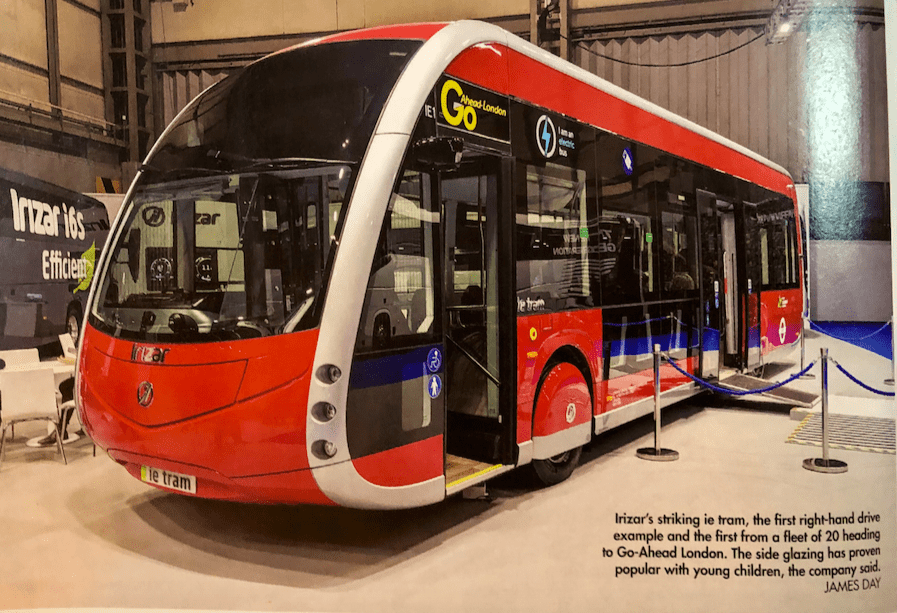
Image – London’s sleek buses from Buses Magazine in 2022
The meeting papers here. The deadline for public questions is midday on Friday 27 February 2026.
If only we had such things. But Cambridge is nowhere near getting such nice things. The Combined Authority commissioned some research on the state of transport in Cambridge from the perspectives of various stakeholders in focus groups and these were the results:
The research and report was done by Lindsay Coulson. She took the findings of seven focus groups.
“What is the current state of transport in the region?”
“Participants described it as
- ‘dire’,
- overly complex’,
- fragile’,
- ‘poorly integrated’
- ‘problematic’,
- ‘inefficient’,
- ‘a mess’,
- ‘choked’,
- ‘log jammed’,
- ‘limiting’, and ‘limiting opportunities’ and more.”
Above – Coulson (2026) for CPCA, p6
At the end of the report it states:
“Many people were supportive of the idea of a mass transport solution and talked about city centre trams and a light railway as options but acknowledging they would take time to implement.”
Above – Coulson (2026) for CPCA, p27
***Hang on – they’ve had nearly a decade to plan for and build a light rail for Cambridge!***
I knew these meeting videos would come in handy sometime in the future. Here’s me tabling a public question to the then fairly-recently-elected Mayor of the CPCA James Palmer on light rail.
Above – CPCA Board Meeting, 31 Jan 2018, Shire Hall, Cambridge.
You can also see Michael Page’s public question here, who was also critical of the consultant’s report and the lack of availability of key documents to the public.
That was in early 2018. It is now early 2026.
How long should it take for a city to design and build even just a single functioning light rail line? Which reminds me – the latest edition of Tramways and Urban Transit Magazine is now out.
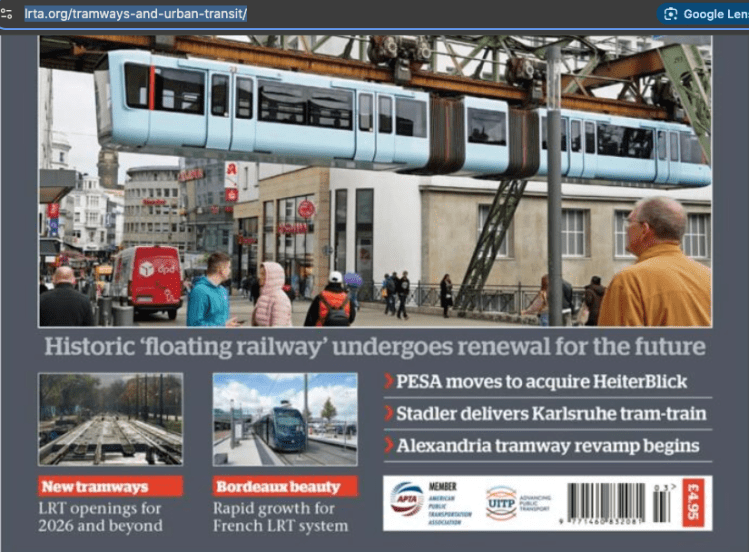
Above – Light Rail and Urban Transit Magazine with its feature on the Wuppertal overhead line and the massive growth of light rail transit in France.
The paper for the meeting summarising the report highlighted the following issues with transport in/around Cambridge:
- Current system: Fragile, fragmented, inadequate for growth
- Planned growth: Will exceed transport capacity; transport must align with development
- Funding: Major barrier; significant investment needed
- Culture: ‘No change’ mindset and political shifts hinder bold solutions
- Risk: Unsustainable growth; loss of global status and competitiveness; growth will be stifled unless short term measures are also progressed alongside ambitious and more transformational interventions
- Action needed: Incremental improvements insufficient; major changes required•
- Timescales: Need reliable, trustworthy, accessible, safe, affordable and sustainable transport system which works seamlessly between modes. Must plan for long term but need immediate/short term interventions in the meantime (arterial/orbital). Action now could pave way for more significant change in future.
- Challenges: Effective interventions may be unpopular but necessary
- Mass rapid transit: Multi-mode approach to public transport needed; integration via
timetabling and ticketing essential.
Above – Item 10 Officer’s Report
The bit that’s missing is power: Does the Combined Authority have the necessary legal and financial powers to bring in the solutions needed for Cambridge’s chronic transport problems?
For me, the answer for years has been ‘No’. Hence why back in 2023 I was asked to stand as an independent candidate in the local elections, calling for a unitary council for Cambridge & District and for the abolition of both the Combined Authority *and* the Greater Cambridge Partnership. The independent report helps make that case.
“I find there’s a lack of accountability. Every time you challenge someone, theysay, well, that’s not us, it’s somebody else. So, you end up just going around incircles.”
Above – Coulson (2026) for CPCA, p6, quoting one of the focus group participants
One question theme got close to the root cause:
“What are the challenges that policymakers face in order to improve transport?”
“We’ve been asking the same questions and having the same conversations for 10 years, 15 years, nothing ever changes.…
“Every time leadership changes, the big ideas change. One minute it’s a metro, the next it’s bus franchising, then it’s something else. You can’t build a 20-year system on four-year politics.”
Above – Coulson (2026) for CPCA, p12, quoting focus group participants
Hence my repeated calls for a new combined authority for Cambridge and its economic sub-region that broadly matches its travel to work area. At least that way in principle everyone has a shared interest in finding solutions. With the Combined Authority’s current boundaries, you have councillors in Cambridge on the Transport Committee voting on transport problems in Wisbech and northern Cambridgeshire, and vice-versa. Quite understandably the councillors and residents in the north of the county (where the basic road network has been substandard for decades, and rail-based public transport is something of a fairytale – i.e. has little credibility on the ground) would want to support road improvement solutions over ‘public transport’ promises. And vice-versa for Cambridge.


Above – left: Detail of Redcliffe-Maud (1969), and above-right, detail of the Cambridge Sub-region, Lichfield (1965)
Again, the two things that have been consistent in the local transport policy failures are:
- The structures of local government (which have been broadly the same since 1974)
- The lack of powers for local transport authorities to act independent of central government when it comes to planning and resourcing new local public transport infrastructure.
The move towards outsourcing and the hollowing out of local policy teams since the early 1980s means that local government has become dependent on commissioning outside organisations for policy and project management advice that was once in-house.
“There’s so many different players within the transport network that getting that connection between different modes is really challenging but is critical to the whole network kind of working well.”
Above – Coulson (2026) for CPCA, p13, quoting focus group participants
How many of those layers don’t need to be there? Which ones can be consolidated into a single institution? How can lines of accountability be simplified so that the general public are clear as to who is responsible for what?
Next Light Rail update
“Our strategy is closely inter-linked with the ongoing work on the Cambridge Growth Company’s Mass Rapid Transit commission. CPCA are key partners and officers are working closely with CGC colleagues to steer this work so that it reflects our transport, and Local Growth Plan, aspirations. This work will provide the basis for identifying and delivering the strategic transport solution for Cambridge. The output of the work is planned for the summer 2026.”
Above – Item 10 Officer’s Report, para 3.2
Talking of outsourcing, here’s a consultant’s paper on bus stop improvements
And we’re not talking about that late 1990s Manchester chap from 1998
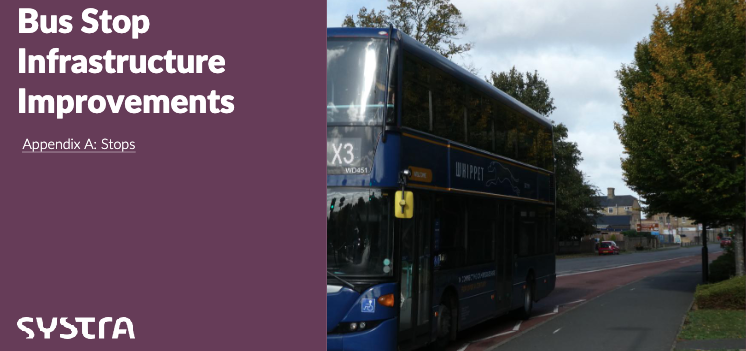
Above – Item 11 Appendix A which has *lots* of pictures in it
The bus stations at Wisbech, St Ives, and Huntingdon are proposed for improvements. The stops in and around Cambridge are summarised on the map below.
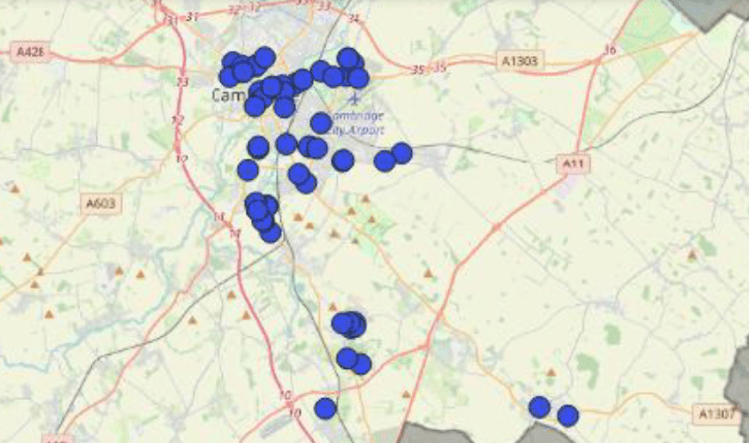
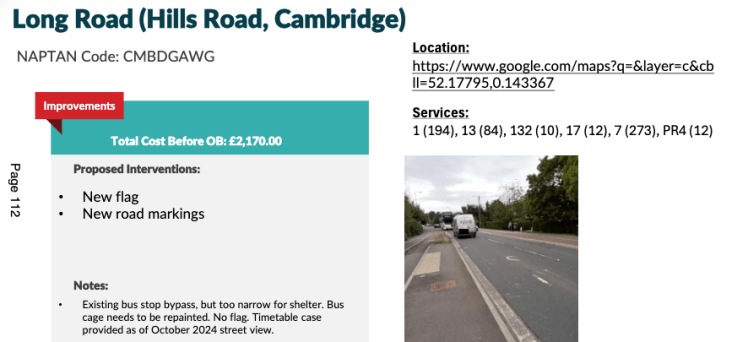
Above – “Total cost before OB” – Outline Business case?
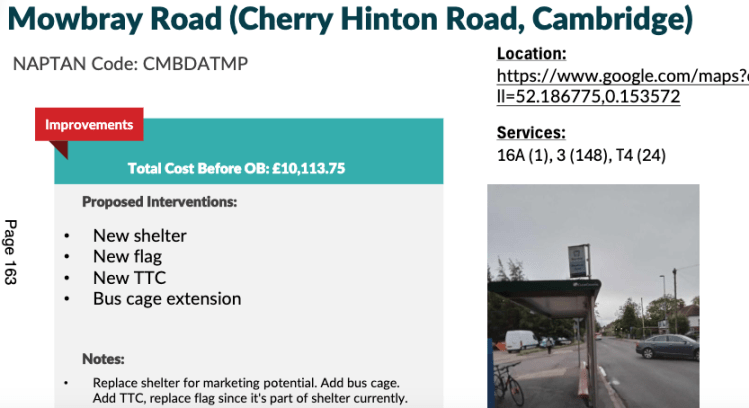
Above – a couple of case studies
For those of you interested in finding out more, get in touch with
The Cambridge Area Bus Users Campaign
I think with these I’m in the ***Hurry up and get on with it!*** camp!
Anyway, in case you forgot, the meeting papers here. The deadline for public questions is midday on Friday 27 February 2026. (Please send some in!)
If you are interested in the longer term future of Cambridge, and on what happens at the local democracy meetings where decisions are made, feel free to:
- Follow me on BSky
- Spot me on LinkedIn
- Like my Facebook page
- Consider a small donation to help fund my continued research and reporting on local democracy in and around Cambridge

 The Cambridge Town Owl