Can you remember the Quango that was operational between 2004-2011?
I can! (Sort of.)
It was very early in my civil service days and us young early-mid 20-somethings would watch lots of people going into meetings with lots of papers to discuss things that …had lots of long words and big concepts in them but didn’t feel particularly tangible/real to the rest of us – or to the general public outside. This was one of the big problems that the Government Offices for the Regions was never able to conceptualise let alone communicate to the general public: ‘What is it that you actually do?’
I dare say that those same questions are being asked of civil servants who work outside of London in non-specialist roles as ministers seek to transfer more functions outside of the capital. (A move much-lampooned in Yes Minister in the 1980s)
Satire aside, it’s all the more important now to compare what Cambridgeshire Horizons was established for, what powers it had, and what it achieved between 2004-2011, compared with the Cambridge Growth Company which has just launched its long-awaited search for a first chief executive.
Looking at the job description, there are possibly only a handful of people in the country who meet enough of the criteria. No – really. And as for the experience you need before even considering yourselves,
- “Delivering large-scale building and regeneration programmes.
- Delivering major infrastructure projects.
- Working with or for Central and Local Government in delivering major capital programmes.
- Leading high powered multi-disciplinary teams.
- Setting and delivering long term business plans.“
Above – Candidate Brief p10
So if you’ve been a key decision-maker on something like Crossrail, The Olympics site in London, The Eden Project – and have experience of managing very large teams of people (requiring excellent judgement when it comes to delegation) and managing budgets that look like telephone numbers (knowing you’ll probably be called before the Public Accounts Committee in Parliament to answer for the spending)…exactly. That’s why corporate headhunters have been appointed for the task.
What is there to learn from Cambridgeshire Horizons?
Lots. You can find out more by browsing their archived web pages on the Internet Archive
The big difference between Cambridgeshire Horizons and the Cambridge Growth Company is ultimately one of powers. The former was a co-ordinating body. The latter is a ‘doing’ body.
“Coordinating growth on such a grand scale is quite a challenge and can only be achieved through effective management and commitment on the part of everyone involved. In 2004, Cambridgeshire Horizons was established in recognition of the fact that no single existing agency or authority could be expected to implement this planned growth on its own.”
“Horizons is a company limited by guarantee and, as a partnership organisation, does not have statutory planning powers, which are the preserve of the democratically elected local authorities.”
Above – Cambridgeshire Horizons ‘About Us’ circa Jan 2010 via Wayback Machine
To which my initial response might have been along the lines of asking about a restructure of local government. But in those days it was much more easier in the short term to establish a new ‘partnership’, appoint someone to lead it, give them a budget, give them some targets, and to come back annually with progress updates.
Above: “Precisely! Months of fruitful work! Leading to a mature and sensible conclusion” (Sir Humphrey Appleby in Yes Prime Minister, BBC Comedy Greats).
So when you look at the Cambridgeshire Horizons Board, count the number of people likely to be sat around that board table. This is not a criticism of the individuals who attended those meetings. Rather I’m asking the question of the ministers who commissioned and signed off such structures. How effective is any board of any institution with that many people sat around the table? (Yes – that includes the Cabinet in central government – fewer very senior government ministers are better able to rein in a Prime Minister than dozens of people around the table).
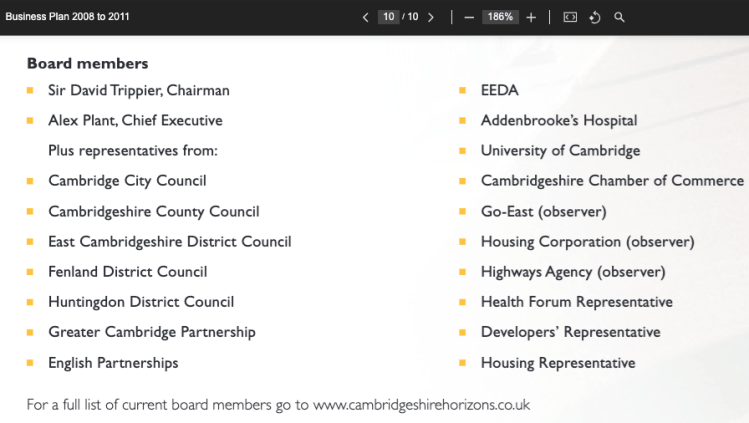
Above – Cambridgeshire Horizons Business Plan 2008-11, p10 from the Wayback Machine
“There’s another Greater Cambridge Partnership”
It’s not the same as the current Greater Cambridge Partnership. It was responsible for delivering Cambridgeshire’s Local Area Agreement 2006-09. You can read the document here. It was a short-lived policy that was scrapped by the Coalition in 2010. Basically central and local government negotiated a series of performance targets that councils and their partners had to meet. If they exceeded them, they got extra money. (I wrote more about it in LostCambridge here) The Conservatives and Liberal Democrats didn’t like the concept of central government performance-managing local government that way, so they abolished the entire system, structures, and eventually the institutions involved. Including the regional government offices. I think Labour were taken aback by the speed at which the Coalition Government was able to dismantle the institutions established under Tony Blair and John Prescott – the latter who as Deputy Prime Minister until 2006 had a much more prominent role on domestic policy than perhaps we recall.
The core objectives for Cambridgeshire Horizons were:
- “Coordinate development and infrastructure implementation.
- Overcome barriers to sustainable development.
- Secure and manage funding for infrastructure.
- Ensure developments employ high quality sustainable design.
- Communicate the wider benefits of the planned development to the wider community.“
Some of you may be wondering ‘How’ Cambridgeshire Horizons achieved these objectives. That’s something for an early career researcher to look into and perhaps interview some of the former staff there.
*J’aime la qualité*
One for any 1990s teenager set French homework to complete the phrase ‘I like…’ / J’aime… with a word from every letter of the alphabet. Q was a particular challenge if I recall correctly. I wasn’t around at the time when this was charter below was put together, otherwise I might have insisted it was titled: “J’aime la qualité” (Or in the plural Nous aimons la qualité if I’ve conjugated the verb ‘to like’ correctly!)
“The planned growth for Cambridgeshire provides an exciting opportunity to create sustainable and vibrant new communities. It is crucial that we build high quality housing with a unique identity that will provide visually pleasing environments where people will want to live.”
Above – Cambridgeshire QCG 2008, p3
That could have been written by the Combined Authority or any local council within the county and it wouldn’t look out of place.
The question is: “Did Cambridge build high quality homes with a unique identity?”
The two case studies often quoted in case studies are:
I’m not a fan of the Accordia development but then I’m not a fan of the design style of one of its core architects. That’s not a criticism of the quality of their work – my aesthetic preferences and disposition happen to be different to what most contemporary architects and developers create today.
For Marmalade Lane it’s different. Some of the housing design choices I’m fine with, others I’m not. But that’s not why I like it. I like it because the people living in the properties at the very start were *all involved at design stage.* Furthermore, the land itself had not been through a process of asset-stripping and value-extraction by land speculators – thus leaving the final developer with a very expensive plot of land needing to make a profit on. The problem is that ministers have not made the legal and structural changes needed to stop such land speculation.
As for those high quality homes, according to Cambridge MP Daniel Zeichner, back in 2021 me delivered a damning verdict on the construction industry’s work on new homes in and around Cambridge. In a speech to the House of Commons no less.
“What else did we not get from Cambridgeshire Horizons?”
One of the big reports they commissioned was on the water cycle
“Detailed Water Cycle Strategy up to 2031
Major Growth Areas in and around Cambridge
Phase 2 – Detailed Strategy”
In it they recommend:
“Relevant partners should carry out an investigation of how the retrofitting of the existing
housing stock could facilitate water neutrality.”
Above – Cambridgeshire Horizons Water Cycle Strategy (2011) p6
Make what you will of the other recommendations on that page.
Given that Cambridgeshire Horizons was wound down from 2011 onwards, you could argue that they never got the chance to complete their work. That said, they produced a number of reports on top of the water cycle report in the mid-late 2000s. The Cambridge Growth Company, local councillors & officers, and those working with them can examine and compare with what was actually completed.

Above – Cambridgeshire Horizons: Balanced and mixed communities – a good practice guide
The final two pages of the above mentioned document (at Appendix I) there are a series of tables that provide suggested monitoring indicators which when measured will show whether a standard has been met or not. Those targets were (and in some cases still are) set out in other reports and strategies. Others at the time of designing were included in the Local Area Agreement structures that were abolished by the Coalition Government.
There are other reports such as on sporting facilities that list some big things too

Cambridge City Football Club eventually got a new ground at Sawston – which also holds community events (see here). Cambridge United’s Abbey Stadium is up for debate, with Peter Freeman of the Cambridge Growth Company showing significant interest in the future of the club. And earlier this morning Cambridge United Women’s FC finally got a new home ground within Cambridge’s city boundaries, sharing what will be a revamped Cambridge University AFC pitch which is being upgraded.
“What about the 50m Swimming Pool the University of Cambridge owe us? And the long-proposed rowing lake east of Milton?”
That’s now in the Cambridge Growth Company’s inbox – along with the new large concert hall.
Actually, it’s worth re-stating that Cambridgeshire Horizons also made provision for a new large concert hall back in 2006
Above – An Arts and Culture Strategy for the Cambridge Sub-region (From the University of Southampton)
This report states:
The cultural framework for Cambridge East should involve artists and all key partners in the area and provide:
- A comprehensive Heritage and Landscape characterisation exercise for Cambridge East
- The opportunity to create a new gateway and welcome to Cambridge as an integral
part of the city through major public arts commissioning opportunities - The location of a regional centre for culture and related activities.“
One of the reasons I go on about a large concert hall is because here it is mentioned in
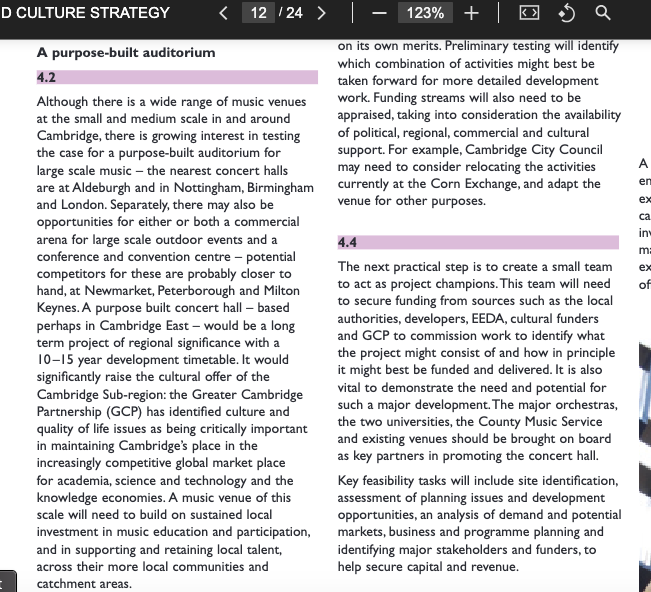
Above – Cambridgeshire Horizons Arts & Culture (2006) p12pdf
“A purpose built concert hall – based perhaps in Cambridge East – would be a long term project of regional significance with a 10-15 year development timetable. [20 years have since passed since its publication!!!] It would significantly raise the offer of the Cambridge Sub-region: the Greater Cambridge Partnership (the LAA one, not the current one) has identified culture and quality of life issues as being critically important in maintaining Cambridge’s place in the increasingly competitive global market place for academia, science, technology and knowledge economies. A music venue of this scale will need to build on sustained local investment in music education and participation [hence also my repeated calls for an Adult Late Starters Orchestra similar to ELLSO in East London, or perhaps more ambitiously, a new institution along the lines of the Mary Ward Centre near where I used to live in London. (I wrote about the latter here)
“What are they calling the Cambridge sub-region?”
This:
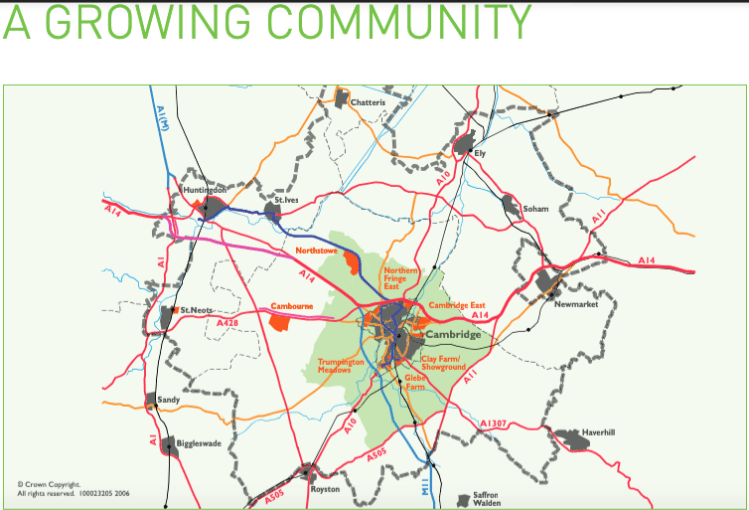
Above – Cambridgeshire Horizons Business Plan 2008-11 p6
Can you spot the larger market towns just over the Cambridgeshire border? This looks a little bit like the definition from the Cambridge 2030 report from a consortium of business, civic, and voluntary organisations in the early 2010s that seems to have been hosted by Cambridge Past, Present, and Future.

Above – The Cambridge Sub-Region in the Cambridge 2030 Vision report p2
And if central government had made the changes proposed by Lord Redcliffe Maud in his Royal Commission 1966-69, Cambridge would have had over half a century of being a unitary council.
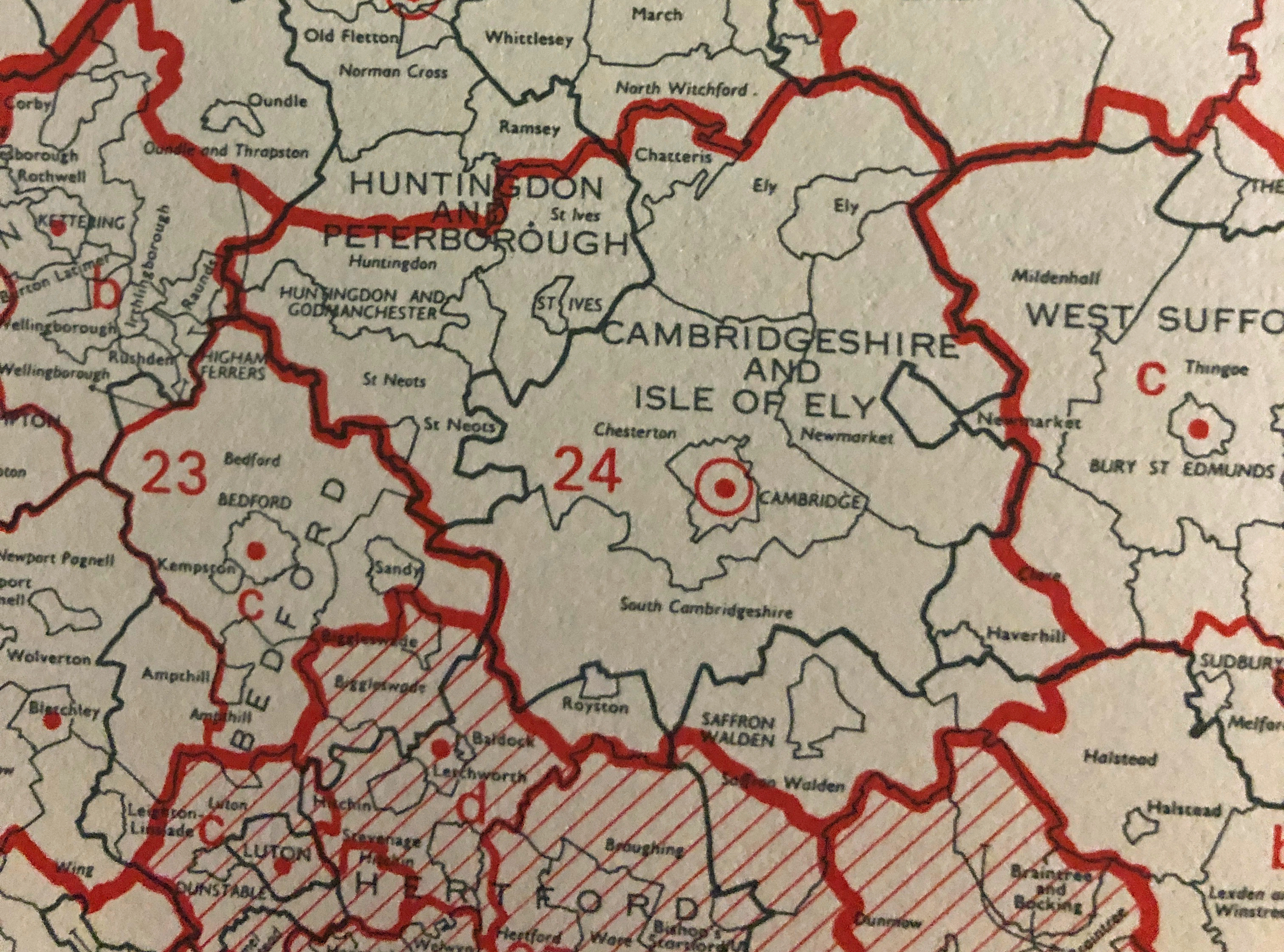
Above – Detail of Redcliffe-Maud (1969) – see the digitised copies via Lost Cambridge here
“So you could say that the really big barrier Cambridgeshire Horizons came across were about powers and structures?”
You could say that. Let’s look at the funding side.
Cambridgeshire Horizons had a funding page and it has been archived here
It states CH funding came from:
- Housing Growth Fund (HGF, previously known as Growth Area Funding, or GAF, in 2007)
- A further tranche of Housing Growth Fund grants for 2009/10 and 2010/11 – allocation confirmed
- A ‘rolling fund’ to start work on infrastructure eg roads to support developers, with the developers ‘paying back’ the difference when homes are sold – and those receipts being reinvested in a similar manner. (I’ve seen capital receipts reused in such a manner in other projects)
- Community Infrastructure Fund for the Cambridge Station Gateway project [Oh dear!]
The funding page also mentioned possible innovations such as:
- Variable Tariff – on developers via Section 106 agreements. May well be replaced by the Community Infrastructure Levy for such financial payments in future – see the consultation here.
- Social Bonds – being explored again in Cambridge finance circles (See also p12 by Andrew Limb for the Bennett Institute here)
- Tax Increment Financing – borrowing against future higher tax receipts that are collected from new developments. (Made all the more harder by the system of local taxation in the UK).
- Regional Infrastructure Fund – proposed under the remit of the old Regional Development Agencies – we had EEDA which was intended to “provide capital investment to pump prime growth related infrastructure schemes ahead of development starting and, by recycling receipts [from developers to] allow forward funding.” Ely Masterplan 2010 pp69-70. It might have worked had the coalition not scrapped regional development agencies!
“No mention of land value uplift? Or land value taxes?”
It was James Palmer in the first CPCA Mayoralty who made the case for it, but was unable to persuade ministers of the merits of it in time. I cannot see how the mass transit infrastructure alone can be funded without some sort of land value uplift capture/levy to prevent the landowners and speculators running off with all of the financial gains.
How the money issues resolve themselves…well that’s up to ministers.
If you are interested in the longer term future of Cambridge, and on what happens at the local democracy meetings where decisions are made, feel free to:
- Follow me on BSky
- Spot me on LinkedIn
- Like my Facebook page
- Consider a small donation to help fund my continued research and reporting on local democracy in and around Cambridge

 The Cambridge Town Owl