In designs I’ve labelled as ‘worse than communism’, the developers who are meant to be partners with Cambridge City Council are now saying they cannot proceed with the affordable housing element because it won’t make a big enough profit for them
Hence…their proposal to apply to Homes England for a subsidy
It’s the regeneration of Hanover and Princess Courts between Hills Road and Trumpington Road – old tower blocks built in the post-war era. (See G-Maps here)


Above-left, a CGI from Hanover and Princess Court, and Above-right, a propaganda poster from East Germany in the mid-1980s.
If your built environment vision images are less colourful and less varied than their late 20th century command economy equivalents, it’s hardly a great advertisement for the construction industry’s private sector firms.
That said, you might like the designs. Either way if you want to comment on the application see the planning portal here and type in the reference: 25/04187/FUL
“You and local planning applications!”
Above – another chap scrutinising planning applications!
So I was more than a little surprised to see that the developer was now complaining that they would no longer make a profit.
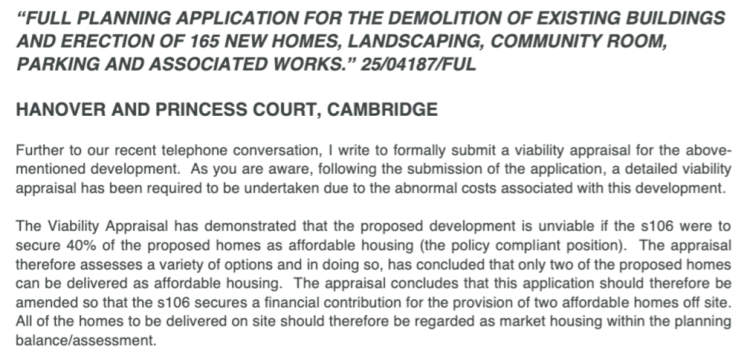
Above – Savills Instructed by Cambridge Investment Partnership
“Cambridge Investment Partnership is an equal partnership between Cambridge City Council and The Hill Group.”
“As part of the £70 million Cambridge and Peterborough Combined Authority (CPCA) Devolution Grant, CIP committed to starting construction on 500 new council homes by March 2022. This ambitious target was met a year ahead of schedule, and in 2025, CIP completed its 1,000th new home.”
This was the concession that former councillors Lewis Herbert and Kevin Price squeezed out of Chancellor George Osborne in return for agreeing to sign up to the Cambridgeshire and Peterborough Combined Authority at a time when the backlash from politicians and businesses to a mayor of East Anglia’ was intense – perhaps not helped by the former MP for South Cambs and ex-Health Secretary being touted as a favourite candidate.
Above – the Cambridge Investment Partnership
Planning application (ref: 25/04187/FUL) proposes “demolition of existing buildings and erection of 165 newhomes, landscaping, community room, parking and associated works” (“the application”).
- The FVA has been prepared on behalf of Cambridge Investment Partnership (‘the Applicant’).
- The Site is owned by Cambridge City Council (“the Council”).“
Above – Financial Viability Assessment (Savills for CIP) p2
Which makes things a little bit more complicated.
“How much profit should a firm be allowed to make?”
I don’t know – but the projection that the viability report puts forward says 25% profit on on cost. Which in this case is over £13million. How much would go to Hill and how much would go to the city council I’m not sure because the site itself is owned by Cambridge City Council, not Hill.
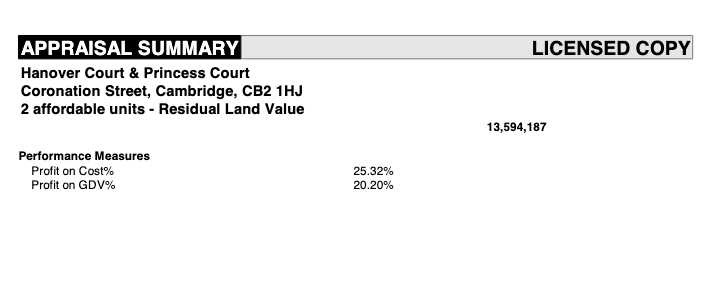
Above – Financial Viability Assessment (Savills for CIP) p96
The caveat above is that there are ***lots of workings*** and assumptions to go through in the report and it needs someone familiar with accounting in a construction industry context to scrutinise the numbers. I’m not that person. Certainly not at 1 o’Clock in the morning. (I have a neurodiverse / AuDHD bodyclock). Someone else may want to go through the numbers and see if there are alternatives.
“So…what’s their plan?”
A Homes England bailout.
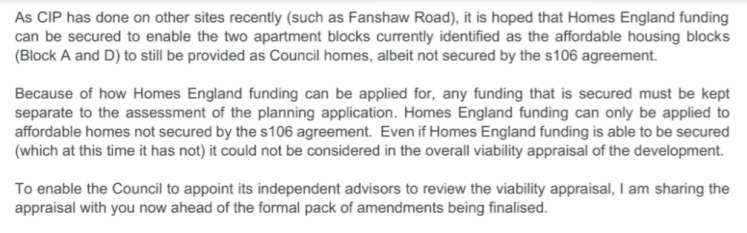
Above – reference to the Cambridge Investment Partnership work on Fanshaw Road in Coleridge Ward. Carter Jonas for CIP to Cambridge City Council 03 Feb 2026.
So it looks like that so long as costs for the construction industry remain high, social housing and affordable housing delivered through Section 106 Agreements (which makes the developers meet the costs) is going to be less of a thing. Which perhaps is why ministers are making a bigger thing of community infrastructure levies.
Which reminds me: We’ve got a consultation on a Community Infrastructure Levy for Cambridge
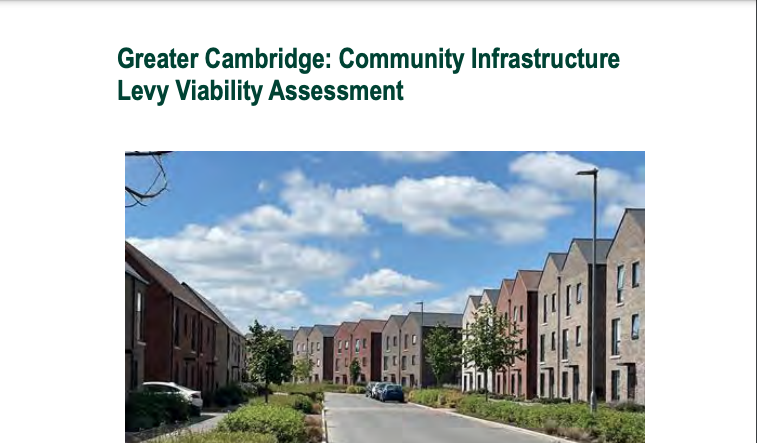
Above – “Open for comments from Monday 16 February to Sunday 29 March 2026.”
“What’s proposed?”
I covered it in this blogpost here
| Development Type/Use | CIL rate(per square metre) |
| Residential houses and flats | £60 |
| Retirement housing | £60 |
| Residential institutions | £60 |
| Student accommodation | £60 |
| Hotels | £50 |
| Shops, restaurants, financial and professional services | £50 |
| Offices and R&D | £175 |
| Industrial use including data centres | £35 |
| All other uses | Zero |
Above – Draft Charging Schedule – Item 5, Annex C
What’s not clear is whether such a levy would have the same effect of having developers pull out of such projects like the Hanover and Princess Court redevelopment, or whether there is another way.
If you are interested in the longer term future of Cambridge, and on what happens at the local democracy meetings where decisions are made, feel free to:
- Follow me on BSky
- Spot me on LinkedIn
- Like my Facebook page
- Consider a small donation to help fund my continued research and reporting on local democracy in and around Cambridge

 The Cambridge Town Owl