
Chairman Peter Freeman confirms the proposed development corporation is not looking to build a parallel planning service – but senior councillors remain concerned.
At a public event at The Grafton Centre in the expanded Cambridge Room a group of councillors, local government officers, industry professionals, campaigners, and curious residents heard from the Chair of the Cambridge Growth Company and from the lead councillors on planning for both Cambridge City, and South Cambridgeshire District Councils (Cllrs Katie Thornburrow (Lab – Petersfield) and Dr Tumi Hawkins (LibDems – Caldecote) – the latter two also being trustees of the Cambridge Room.
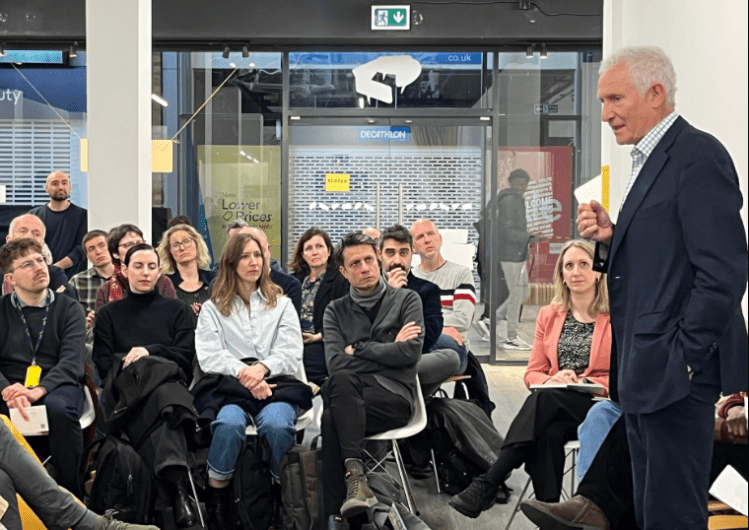
Above – Peter Freeman CBE of the Cambridge Growth Company at The Cambridge Room in The Grafton Centre.
Also on the line-up were Eleanor Riley of MHCLG – my old stomping ground in a previous life, and Bethany Dugdale, deputy chief executive of the growth company.
**Please don’t destroy our award-winning planning service!**
…was the plea from Cllr Dr Hawkins to Mr Freeman. You can see the extended case from Dr Hawkins here. Cambridge residents can also (actually, anyone can) see planning issues that Cllr Thornburrow has blogged about at https://katiethornburrow.com/
This is sort of an extension of the conversation that Mr Freeman and Dr Hawkins had on Cambridge Radio back in January with former city council leader Lewis Herbert – have a listen again here.
Working out how to work collaboratively on planning without creating another tier of administration.
It sounded like the growth company and the Greater Cambridge Shared Planning Service have made progress on coming to an agreement on how they can work together. I don’t know how many people picked up on the acronyms used in some of the discussions (it’s a little like learning a new language at times!) but it was mentioned that the CGC is negotiating an SLO with the GCSP – mindful of the issues with the CPCA which with the powers in the EDCE Bill going through Parliament will become the SPA and will have to work with the GCC which will be formed from May 2028 when this stage of LGR comes to an end.
“I didn’t understand a word of that”
Which is why acronyms need to be explained (or ideally designed out early in the process) when engaging with the general public.
What struck me was that the solution that both Mr Freeman and Ms Dugdale for the Growth Company said they were aiming for was very similar to the one I described in my blogpost from last month here. In a nutshell Mr Freeman said he’s not looking to recreate a huge town planning unit of professional town planners – rather he sees greater merit in negotiating an agreement with the local council planning unit which is the joint responsibility of Cambridge City Council and South Cambridgeshire District Council.
“What does this mean in practice?”
It means the Cambridge Growth Company provides the additional funding to the Greater Cambridge Shared Planning Service to carry out the planning requirements of the Growth Company – with the planning service then undertaking the recruitment for additional staff and professionals as necessary. Which makes sense to me.
Question from the executive councillors for planning: “how do you make developers build out the planning permissions they already have?”
This was one of several issues that was beyond the remit of Mr Freeman and colleagues. Ultimately it was one that few of us had an answer to in the current planning and development framework. Hence the call from some political quarters to re-empower local councils to create their own building and construction companies to build homes directly. Maybe that could become a policy option for the development corporation – to form a subsidiary building company to build the social and affordable homes that the market won’t provide for.
Edward Leigh, formerly of Smarter Cambridge Transport questions how much of an improvement a development corporation will be over the Greater Cambridge Partnership
It has been nearly five years since Smarter Cambridge Transport retired with this damning conclusion on the much-criticised Greater Cambridge Partnership. He told the audience that the GCP has spent over a quarter of a billion pounds over the past decade and has got precious little to show for it. (Reminder – the GCP has a board meeting coming up). He also stated that the Political structure of the Combined Authority resulted in three very different transport strategies each one ripping up the work of the predecessor. Hence little progress made on anything.
Ministers need to be clear on what the mechanisms are on dealing with Anglian Water on water supplies and sewage
The current practice of putting a ‘Grampian Condition’ into planning permissions – i.e. that buildings once constructed *cannot be occupied until the water companies / sewage companies have confirmed in writing they have the capacity to connect*, is not sustainable in the longer term.
This is something Cambridgeshire MPs need to be tabling public questions to DEFRA ministers on at least a quarterly basis. (Ministers appear before MPs every month for their ‘departmental questions’ – it is at one in every three of these sessions that county MPs need to ask the Minister for Water for a progress update on water supplies and sewage capacity investment). Amongst other things it will get Anglian Water into the habit of publishing updates because every three months a mid-ranking civil servant will be asking them for an update to include in the ministerial briefing pack for departmental questions. (Spot the ex-civil servant! I think it’s a neurodiversity thing because most normal people would have forgotten such workplace minutiae from over a decade ago!)
The amenities and facilities deficit
To cut a long story short, I took a couple of print outs from the reports in my recent Cambridgeshire Horizons blogpost here that date from 2006 and listed the items that we were supposed to have gotten built by 2021 that never happened. Including:
- A new large concert hall
- An Olympic-Games-Standard swimming pool
- An outdoor rowing lake
Mindful that the 2006 Major Sports Facilities Strategy was written with the London 2012 bid in mind.
We need to talk about HM Treasury. Again.
I resisted the temptation to say to the panel: “Here are a list of my demands…”
Hence restricting myself to handing over a couple of printouts to Ms Riley of MHCLG that my former colleagues in a previous lifetime were working on 20 years ago. As it turned out, several people at the end told me that having those print outs of the historical reports made the spoken points even more powerful than I thought they would be. A couple of other people in the audience followed up Edward Leigh’s point saying that the establishment of the development corporation indicated that previous approaches had failed.
Which is correct.
That’s why ministers tabled, and Parliament enacted the Planning and Infrastructure Act 2025. The threshold for a minister getting government backing for new primary legislation is *very high*. Not only do you need a very strong evidence base, you need things like strong ‘stakeholder’ support, strong political support (eg from backbenchers) and an acknowledgement from your fellow ministers that your case merits priority even though they have their own pieces of legislation they want to champion.
It doesn’t remove the barrier that is HM Treasury
As I sort of pleaded with Ms Riley having been in a similar position to her, the root of the challenge related to something Mr Freeman said about Cambridge being a global brand. We are a city with a globally-recognised name with the governance institutions of a large market town. Thus local councils and regional tiers have no powers to raise revenues directly to pay for new infrastructure. Everything is dependent on HM Treasury approval – the result being policy and delivery paralysis. And Cambridgeshire Horizons was quickly shut down by Eric Pickles and co following the General Election 2010. The result? As Dr Andy Williams – now Chair of the Ox-Cam Supercluster Board – told Queen Edith’s residents back in 2023, previous rounds of growth in Cambridge did not deliver the infrastructure the growing city needed – and still needs.
Therefore if policy-makers in Whitehall want to avoid past mistakes, they need to look ahead to what Cambridge will be like when most of the proposed development will be completed and ask what governance institutions, structures, and powers (incl tax-raising) will be needed. This was something that the Mayor of Greater Manchester (a former Cambridge student) Andy Burnham raised at a recent Centre for Cities event in London.
Note that will also require a cultural change in Cambridge University circles – where it supports calls for more localised decision-making with locally-obtained funds from the wealth generated in the economic sub-region rather than going direct to ministers asking for special treatment. I dare say that if Cambridge politicians, academics and civic leaders made that case to The Treasury – stating that it would allow central funds to be redirected to other parts of the UK unable to generate local resources themselves, they might find fewer complaints about Cambridge ‘getting all the money’. (Even though Cambridge is a net contributor to The Treasury for business rates revenue)

Above – The then Leader of Cambridge City Council, Cllr Mike Davey at Cambridge Guildhall, 06 Dec 2023, showing how little of the £122.8million in business rates collected in Cambridge is retained by the city.
The large lifelong learning college as a solution to the skills shortage
One of the first audience comments covered the chronic shortage of technical level staff – and also low-paid staff having to take multiple bus journeys to get to work. Without re-stating my thoughts on a new large lifelong learning college in Cambridge, I thought the points made about the Combined Authority transforming into a strategic authority in the English Devolution and Community Empowerment Bill – and its responsibilities on transport were an interesting talking point. Mr Leigh mentioned how little the Combined Authority had achieved – with three different mayors having three different transport proposals for Cambridge. Either way, the Local Transport Plan still has to be signed off by the Transport Secretary, and major transport infrastructure still needs funding from central government. Which means an effective Treasury veto on anything it doesn’t like.
“What’s that got to do with lifelong learning?”
Adult skills and lifelong learning are combined authority responsibilities. See the Skills Committee meeting for next week. Followers of this blog may be familiar with my public questions on things like:
- Town planning courses (why doesn’t Anglia Ruskin offer them in Cambridge when if offers them at their Chelmsford campus?)
- A new school of dentistry (something I think ARU Peterborough should be building at a site close to the existing or an additional railway station in Peterborough)
- Using lifelong learning services as a means for dealing with a much wider range of social issues including but not limited to loneliness in society.
Above – recent research from NESTA on loneliness
The root of the problem is that Thatcher’s government hit the sector with cuts that lifelong learning never recovered from. Being seen as a ‘nice to have’ area of public spending, as financial belts tightened the budgets for lifelong learning and basic adult skills were merged, with the latter policy area taking priority under successive governments. Which is why on skills policy I see the Combined Authority as the delivery agent for Whitehall’s policies, and combined authority committees responsible for little more than ensuring procurement processes are carried out lawfully.
The reason being that as CPCA senior officers told me, they have no discretionary funding for lifelong learning from ministers. They are limited in what they can do by the conditions that ministers attach to funding streams and grants.
One other issue – one the Development Corporation may want to look into are the contributions that developers have to make towards skills and training. There’s a research project for some students out there – perhaps involving AI, to assess all of the skills documents contained in large planning applications over the last decade or so. What are the common themes? Furthermore, how much did developers ultimately contribute financially, and what was the outcome of that spending?
And finally…
On the new citizenship curriculum
I can’t recall who I mentioned it to, but I suggested that the Cambridge Growth Company should work with the Faculty of Education to commission a new generation of citizenship education materials for schools in/around Cambridge. It doesn’t need to be restricted to citizenship – they could cover so many other subjects.
That said, not everything needs to involve re-inventing the wheel. Last year I gave some examples from an earlier generation of citizenship books aimed at primary school aged children.
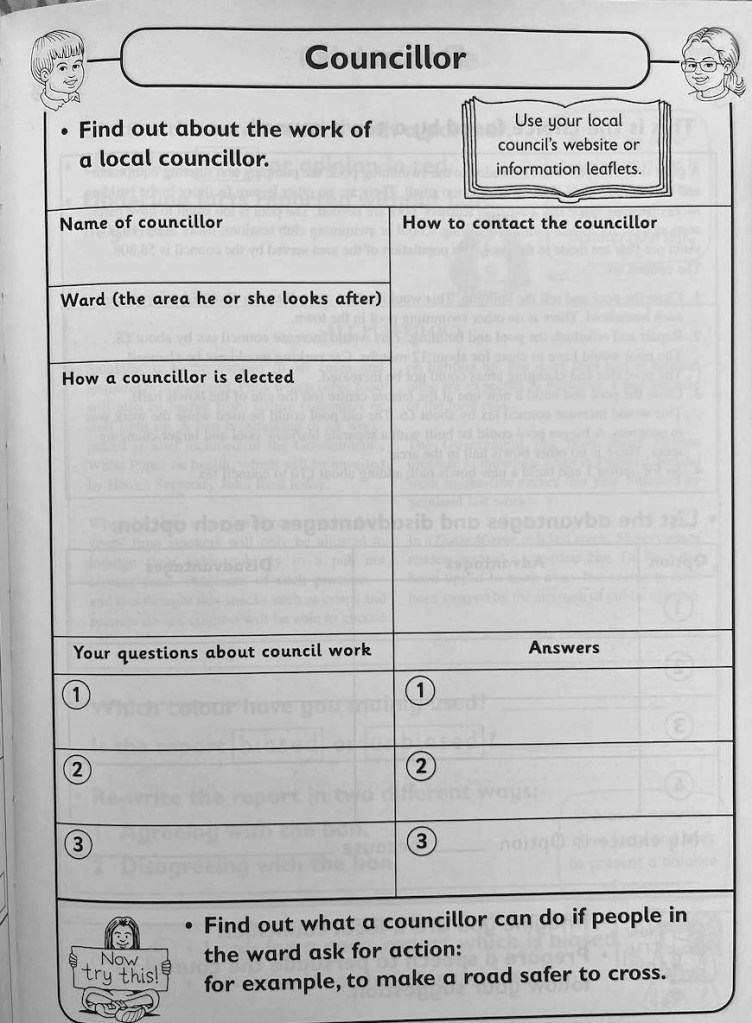

Above – prompt sheets for the children and teenagers discussing the future of our city (from Developing Citizenship – Year 6 (2005) by Moorcroft)
I’ll finish now or I’ll be up until 1am. Again.
If you are interested in the longer term future of Cambridge, and on what happens at the local democracy meetings where decisions are made, feel free to:
- Follow me on BSky
- Spot me on LinkedIn
- Like my Facebook page
- Consider a small donation to help fund my continued research and reporting on local democracy in and around Cambridge

 The Cambridge Town Owl