The college commissioned Bidwells to undertake an accommodation needs assessment for the college’s student population. The results – which are included in a new planning application to Cambridge City Council, are striking.
Being the sad so-and-so who doesn’t get out much due to CFS/ME amongst other things, I end up browsing through planning applications in the public notices section at the back of the Cambridge Independent where few people dare to tread. Though I haven’t reached the Waterford Whispers level of obsession. Yet.
It’s not just Cambridge University that has had expanding student numbers – so as Anglia Ruskin University.
I wrote about the latter last October in the face of their anticipated further rise in numbers.
The question is straight-forward:
“What are their limits to growth?”
In the case of our two universities – and note the Anglia Ruskin University’s civic roots date back to the mid-1800s, at what point does the growth in student and researcher numbers start to become detrimental to the sound functioning of, and the quality of life in the city?
“Why has the college commissioned Bidwells to help?”
Clue is in the introduction.
“This Statement outlines the circumstances to underpin the need for Wolfson College to provide further dedicated student accommodation through the conversion of two properties into a larger House of Multiple Occupation (HMO). This includes demonstrating why the proposed development is necessary to meet the Colleges’ needs, how it aligns with the Colleges’ strategic housing objectives, the efforts the College are making to secure a long-term purpose built student accommodation solution and the planning benefits and material considerations that act in favour of the proposed development.”
“How bad is the problem?”
Bidwells summarises the problem below.
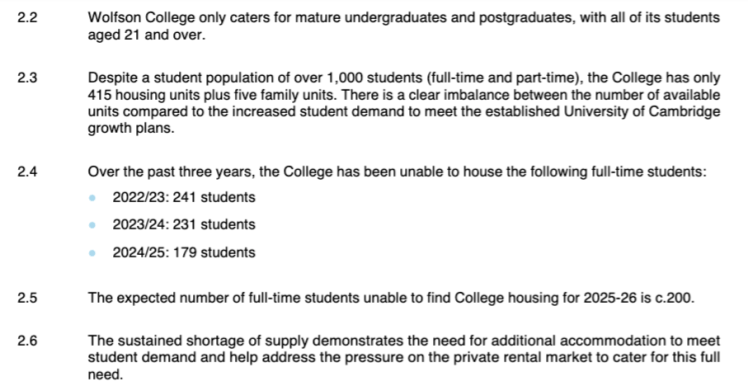
Above: “The expected number of full time students unable to find College housing for 2025-26 is c.200”. Bidwells (2026) p3/5pdf
“It’s not very responsible to expand student numbers far beyond the capacity of your college and then complain about it!”
I’m gutted for the students as well as the local residents affected by it because this is a problem not of their making. Furthermore, when I was at university I experienced similar – even though this was a quarter of a century ago. The result? Spending my second year at uni in private sector accommodation over an hour’s bus ride from the campus that was later condemned by Brighton and Hove Council as unfit for human accommodation. Which was nice.
But perhaps more strikingly for the university’s alumni office (we’re talking about Sussex here) their indifference towards problems that they had created – and to the student struggling to find accommodation, poisoned the relationship between me and the institution permanently. The opportunities our cohort could and should have had at university were not there because of the draining impact that accommodation hunting in the private rented sector had – and it has only gotten worse unless you have super-wealthy support. Which is why I’ve never been back, not donated a penny, and not said a good word about the place ever since. And it was utterly avoidable. With things like that my neurodiverse mind is like the proverbial elephant that never forgets. Or put it another way:
“A grudge from your formative years is like a puppy…”
***It is for life!!!***
Please don’t follow my example – it can eat you up from the inside!
“So what’s Wolfson College’s plan?”
Bidwells states that postgraduate students are most affected, with 25% unable to secure college accommodation. It comes as no surprise that the University of Cambridge chose to increase its numbers of postgraduate students in recent years – supported by Government policies from successive governments as it sought to tap into the lucrative international market.
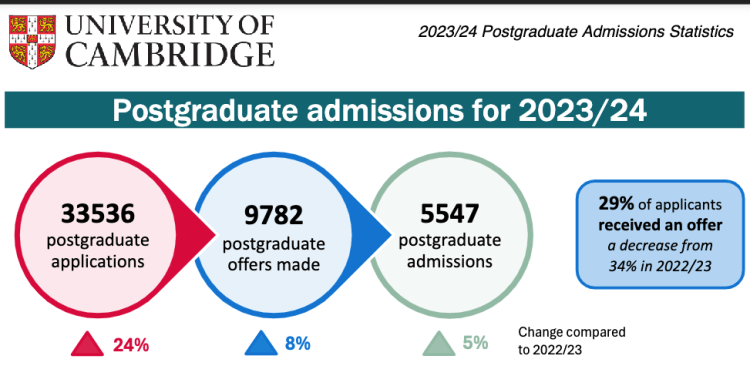
Above – PG admissions for 2023/24 were 5,547 students, which is around 2,000 more than the 3,530 PG admissions in 2014/15.
It’s not just Wolfson College that has issues. Newnham does too
In July 2025 Newnham College was reported in Varsity Newspaper of having run out of rooms for its PG students and advised them to seek external support including from housing charities.
Which is astonishing.
Only a few months earlier the same student newspaper featured case studies of students and researchers living far outside of Cambridge for their studies.
“Who gets to tell the University of Cambridge: “No!”?”
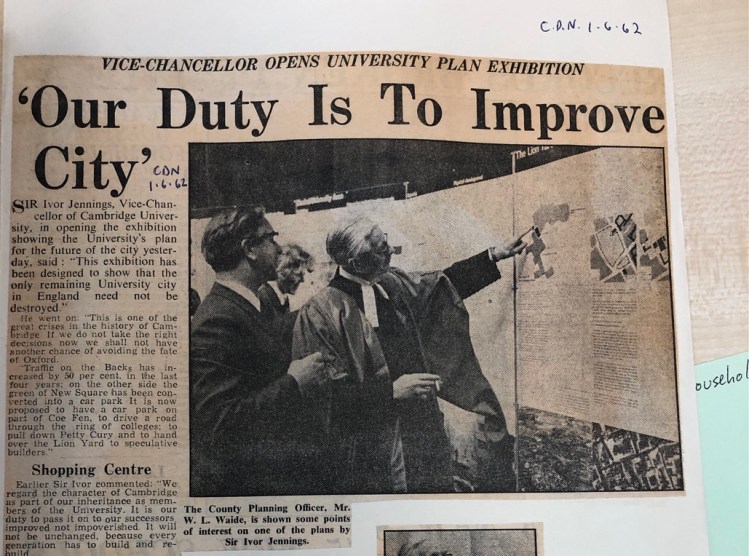
That was a question I explored in this blogpost – again reminding readers of the very different vision that Sir Ivor Jennings QC, the Vice Chancellor in the early 1960s had for both the University and the City.
Bigger isn’t necessarily better
If you look at the challenges members of staff and researchers have in an era of the fixed term contract as Cambridge UCU wrote about here in May 2024, the instability of a housing crisis *and* the possibility of losing your job or placement when the contract comes to an end can be devastating. And with a chronically-toxic Home Office only too happy to chase international students out of the country, egged on by headlines of hatred from the print press, it does not add up to a happy and contented student and researcher population. Again, over the years this is something I witnessed first hand with a number of friends and acquaintances over the decades having to leave the UK because they could not find similar employment in their specialist fields not only locally, but within the UK. It’s a conversation that academia needs to have with itself and with politicians. Places like Cambridge cannot keep expanding its academic sectors sustainably while the problems within those sectors remain outstanding.
It’s not like Cambridge City Council has been blocking the construction of purpose-built student accommodation. Quite the opposite

Above – an additional 4,803 student accommodation units have been added to the city’s student accommodation stock since 2011. From the Draft Greater Cambridge Local Plan: Strategy Topic Paper (2025), p534/535
That’s why I don’t buy the reasoning in Bidwells’ report. Furthermore, given his recent remarks I think Peter Freeman of the Cambridge Growth Company might have a few things to say to those colleges that expand their student numbers without ensuring they have the accommodation and wider facilities for their students and researchers. Because Mr Freeman has said repeatedly as he said last night at the Cambridge Room that *infrastructure must come first*. In the context of the city of Cambridge that means building the things that the city needs before expanding the housing. In the context of Cambridge University and ARU, that means building the student accommodation and facilities *before expanding student numbers*
About the impact on students
The report covers this on p7pdf but I imagine more than a few of you may want to take issue on what it states.
“While the private rental market currently absorbs the unmet demand, the College has found that its students struggle to find suitable accommodation in Cambridge”
This would not be a problem for Wolfson students if the College and the University of Cambridge chose to restrict numbers of students to the accommodation that was available. The problems that students face are the result of poor policy choices by institutions and decision-makers within them. Those decision-makers need to own those decisions.
“The reliance on private rental markets for accommodation is creating challenges for students. The lack of secure, College-managed accommodation is exposing some students to the risk of unaffordable and challenging living conditions and leading to unequal access to education.”
The reliance on private rental markets for accommodation *is a policy choice* made by institutions. If senior decision-makers within the highly-influential institution that is the University of Cambridge were that worried about unaffordable and challenging living conditions for their students, they would have noticed that ‘town’ also faces the same, and would have done far, far more to deal with what is a shared housing crisis than they have done in this era of expanding student numbers – one that dates back decades.
“The College has an intake of significantly more international students than UK students…international students are particularly vulnerable to having inappropriate accommodation contracts, excessive payments and feeling isolated in accommodation away from the campus. Loneliness can be debilitating”
Again, *this is a policy decision for the college*. If colleges and higher education institutions more generally are going to recruit from the lucrative international market, then they have a duty of care to those students to meet the extra needs that come with being a young adult often living and studying in a new country for the first time – and in a country where English is not their first language.
As for the planning application
(See https://applications.greatercambridgeplanning.org/online-applications/ and type in: 26/00797/FUL into the search box)…
The site is next door to the college.
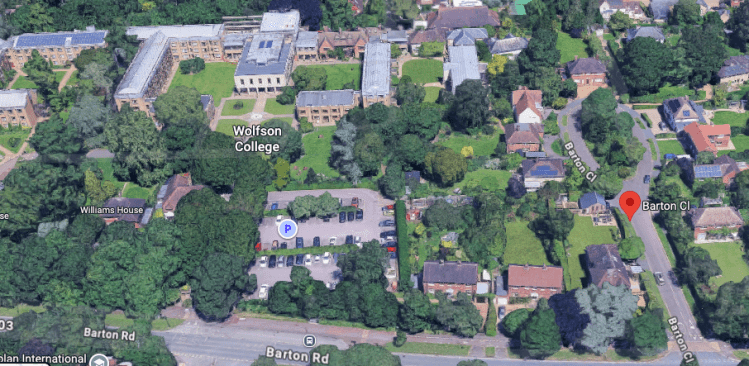
Above – Barton Close from G-Maps by the red balloon icon, with Wolfson College to the west
First of all, those homes were not built as houses for students. They were clearly built for more affluent persons. It’s a cul-de-sac full of detached houses in one of the most exclusive and expensive parts of Cambridge. One that party-politically could find itself with ***four Green Party councillors in a few months time*** for a seat that property editors of print press publications might assume are true-blue-voting residents going by the seven-figure house prices.
“Why doesn’t the college buy out the other houses, flatten them, and build much higher density student accommodation?”
Money – something the college lacks. They have mentioned a Masterplan for 2023-28, which you can read here.
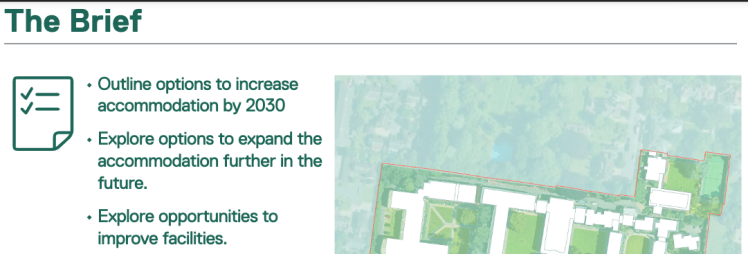
Above – four years left until 2030 and counting: Wolfson Masterplan by Grimshaw 2021, p2
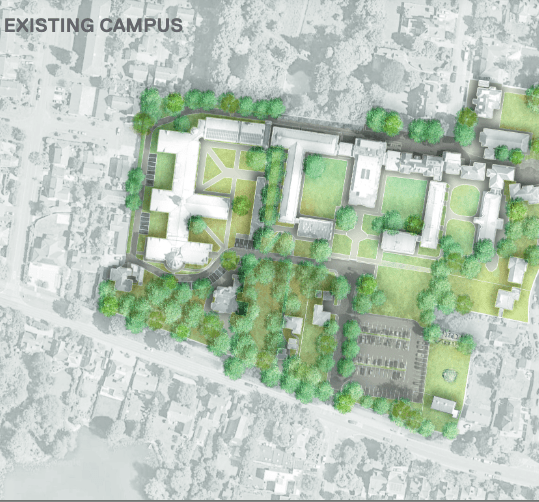
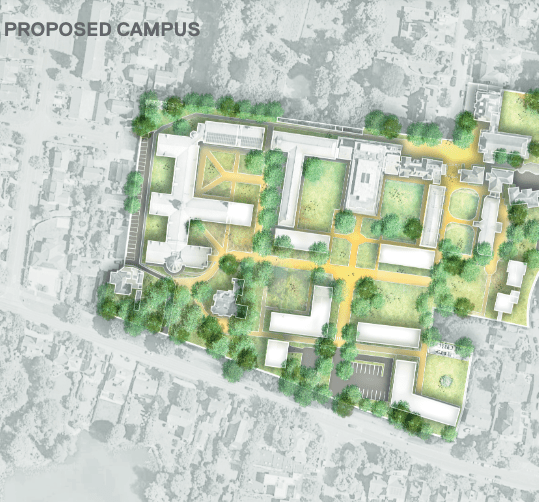
Above – Grimshaw (2021) p5 – current and proposed. You can see the proposed additional accommodation blocks.
You can get a sense of building heights below – the blocks without detailing are the ones to be built.
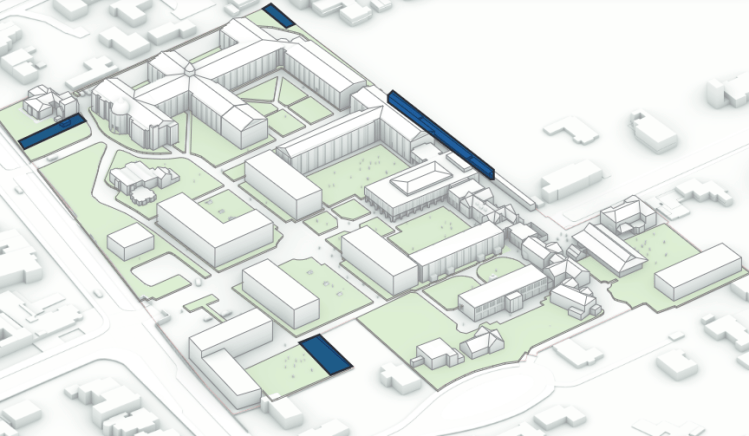
Above – Grimshaw (2021) p16
In principle if they accommodated around 60 students per new oblong box (one of the existing ones facing Lee Court with the library of the same name opposite seems to have around 54 windows, one for each room/unit), then they should be able to meet most of their current shortage. But if the college then says it needs to expand student numbers again to generate the income to pay for the capital costs of the accommodation, they are back to square one again.
What ever the alternatives are, they need to be debated publicly – with students and residents alike because the challenges facing Cambridge now and in the future are shared ones. It’s not sustainable for the University of Cambridge and the sci-tech bubble to continue expanding at expense of the people who make up our city. (Both residents inside the 1935-era municipal boundaries, and those that commute in to work or study, without whom a number of services and institutions would collapse).
Given that there are local elections coming up over the next couple of months in both Cambridge City and South Cambridgeshire District, now might be the time to start having conversations with the parties standing candidates. They’ll all be listed at https://whocanivotefor.co.uk/. Even better – organise a hustings in your area (or ask a local community group/campaign group to do so, and offer to help! You may be able to find some interested groups on Cambridge Resilience Web.
If you are interested in the longer term future of Cambridge, and on what happens at the local democracy meetings where decisions are made, feel free to:
- Follow me on BSky
- Spot me on LinkedIn
- Like my Facebook page
- Consider a small donation to help fund my continued research and reporting on local democracy in and around Cambridge

 The Cambridge Town Owl