The Combined Authority Mayor has a manifesto commitment for a light rail for Cambridge. It will be interesting if the consultants WSP support him when they publish their report
You can read:
- The CGC’s press release here
- The response from Combined Authority Mayor Paul Bristow
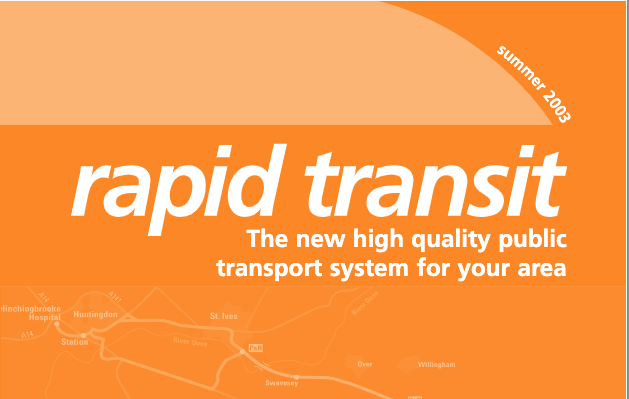
- [Image] The 2003 Rapid Transit publicity leaflet – how does it read today?
And for those of you that want to table public questions to the CPCA Mayor, see the next CPCA Board Meeting on 18th March (papers will be up by the end of the week).
It will be interesting to see which part of the consultants appointed – WSP, is more influential:
Create Streets, The Campaign for Better Transport, and Trams
For all of the issues and criticisms that people have of them (and not without good reason), they are making a push for trams and light rail alongside the Campaign for Better Transport. The latter produced a case study comparing Dijon in France with Oxford in England. Furthermore, The Campaign for Better Transport has created a list of UK towns and cities, pairing them with their French equivalents with similar populations. In Cambridge’s case we are paired with Orleans.
You may be interested in their report published this week with examples from France
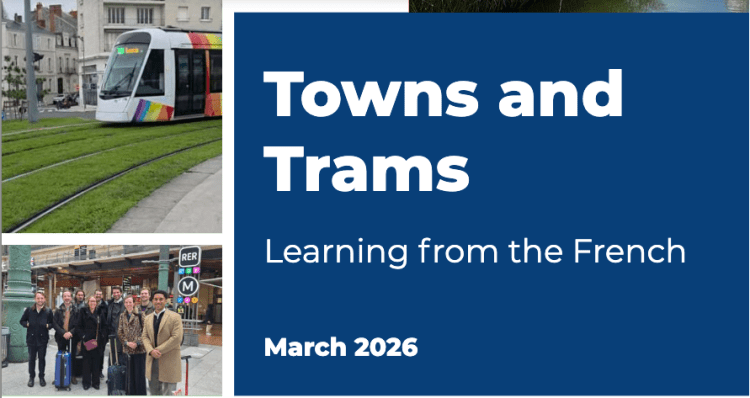
Above – Towns and Trams by Create Streets, March 2026
“Tram Network has 2 aims. That Britain has 15 tram lines under development in 5 years and that the cost of delivering a line is reduced by half.”
Above – by the Campaign Better Transport and Create Streets
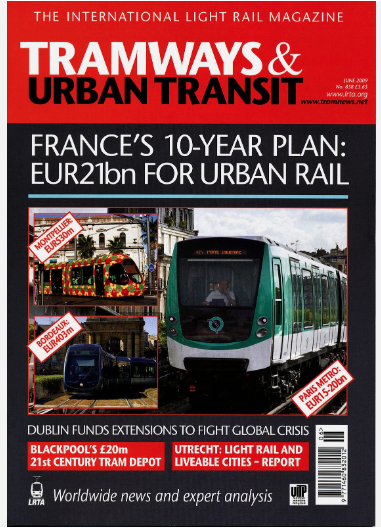

Above – Tramways and Urban Transit Magazine – the publication of the Light Rail Transit Association. I purchased the back copy of the above-left one from that online auction site because the content from it should be influencing UK policy – just as much as the failure of John Prescott’s own ten year plan (and the lessons learnt) should be.
“Cambridge 2026 – another consultant’s report?”
Par for the course I’m afraid. Which inevitably makes me wonder how much money has been spent on such reports over the past few decades, and what the public has got in return from all of that spending. (One of the reasons I’m trying to pull together the reports gathering digital dust in far flung corners of cyberspace…let’s not re-commission stuff that we already know/have access to)
There’s very little to add to what is in the press release. Ultimately the early findings will have to be incorporated into the Mayor’s Local Transport Strategy. Which is why one of the public questions people may want to follow up on are the funding and local revenue-raising powers that The Treasury might be reluctantly willing to devolve to local government to make it happen.
A couple of months ago I quoted the below two in this blogpost
“A developed country is not a place where the poor have cars. It’s where the rich use public transportation“
Attrributed to Gustavo Petro, former Mayor of Bogota, Colombia.
“Don’t you believe that Cambridge should have the best? If you walked into a municipal public transport showroom you would select light rail! It’s lovely, it’s elegant, it’s beautiful, it’s quite simply the best – and Cambridge should have the best! In the world of municipal mass transit it is the Savile Row Suit, the Rolls Royce Corniche, It is the public transport system Harrods would sell!”
Parodying Sir Humphrey Appleby in Yes Prime Minister (performed brilliantly by Nigel Hawthorne even though the brands might have changed! That and Sir Humphrey was talking about replacing one system of WMDs with another – Trident!)
What happens if you take UK politicians and policy makers to France?
The RAC Foundation, Create Streets, and the Campaign for Better Transport did just that
“Rather than presenting a traditional comparison, we took five senior British policymakers with direct responsibility for housing, transport and planning to visit three French locations where tramways have been used to unlock development.”
Above – https://www.freewheeling.info/trams-and-towns
We’ve been here before
Spot the local historian. Much of this blogpost will look at what has happened in the past for those of you who may want to pick up on things that you either weren’t aware of, or perhaps things you campaigned in previous eras that might be of interest again. (Eg Rail Future, CamCycle campaigners in particular!)
- Cambridgeshire Monorail (1970s)
- Cambridge Light Rail Transport – 1991 by Colin Buchanan & Partners
- Cambridge to St Ives Railway (1990s – 2000s)
- Cambridge to Huntingdon Multi-Modal Study 2001 (one of several commissioned by ministers for England)
- Cambridgeshire Guided Busway (Partially completed – the segregated busway was meant to go onto Huntingdon but stopped at St Ives – and strongly opposed by CAST.IRON)
- CAM Metro (Abandoned following 2021 Mayoral Elections)
Above – the Cambridgeshire Monorail abandoned in the 1970s
The Cambridge to Huntingdon Multi-Modal Study of 2001
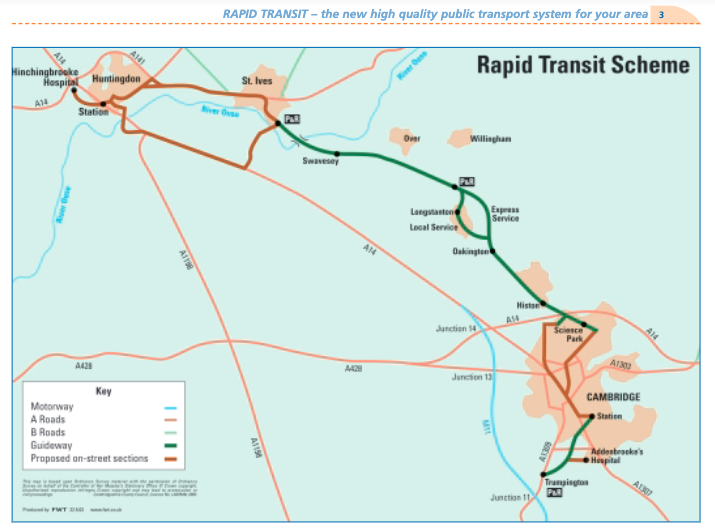
Above – the proposed Cambridge to Huntingdon Guided busway. Have a read of the 2003 consultation leaflet here. How does it read today?
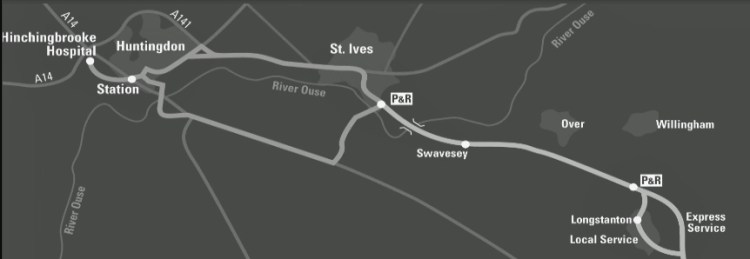
Above – An edited version of showing the original proposed route
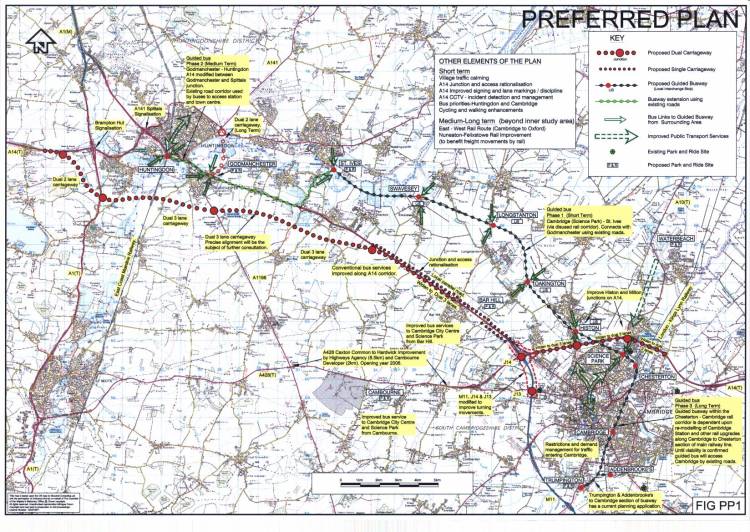
Above – Proposed map from the final report, GO-East CHUMMS 13 April 2003, via the Wayback Machine
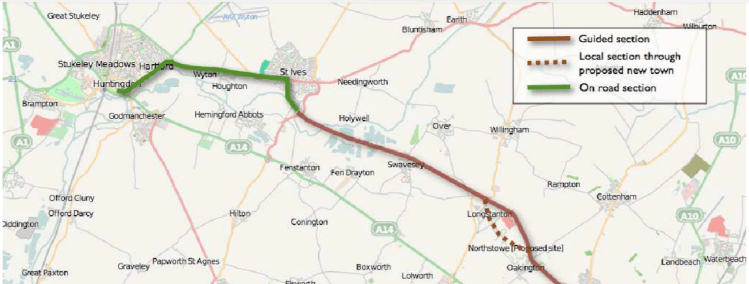
Above – the guided busway route in the 2014 independent report, p4 / p9pdf.
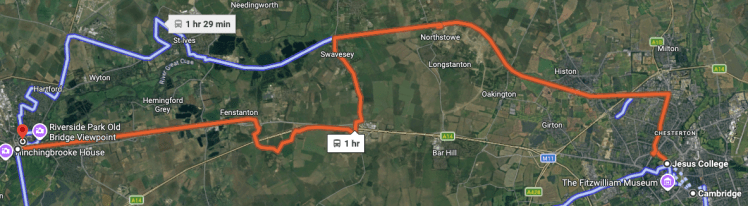
Above – over 2 decades later and the orange ‘Tiger Bus’ route brought in by the previous CPCA Mayor Dr Nik Johnson providing a more direct, faster bus route from Huntingdon Railway Station into Cambridge. From G-Maps here.
It’s also worth having a browse through their public engagement processes in the early 2000s in the very early days of mass internet access.
Ministers endorsed the original busway plans in 2001.
“Transport Minister Sally Keeble today welcomed proposals for a combination of innovative public transport solutions and road improvements to tackle transport problems between Cambridge and Huntingdon.
“The Minister, speaking at the new Trumpington Road Park and Ride site in Cambridge, stressed the Government”s commitment to early delivery.”
Above – Press Release 13 Dec 2001 (I was living in Hove at uni at the time so you can’t blame me for this!)
But it took over a decade to get it built and passengers inside buses
Which means something somewhere went ***very badly wrong***
“It meant the final cost of the busway was £152m, against a budget of around £126m”
Above – Cambridge Independent 12 June 2023
It wasn’t just the busway that CHUMMS recommended back in 2001:
“The study called for:
- A guided bus system utilising the former Cambridge to St Ives rail corridor as its core;
- Complementary measures to encourage public transport, cycling and walking;
- The widening and partial realignment of the A14 in the corridor to form a dual three-lane carriageway, including a southern bypass of Huntingdon;
- Associated junction and local road improvements, including parallel local roads between the M11 and east of Fenstanton.”
Above – Press Release 13 Dec 2001
It was cycling and active travel campaigners (in particular CamCycle) who got the access road doubling up as a cycleway, one of the unexpected successes – reflected in the LTN/20 guidance on new cycling infrastructure which featured a large number of case studies in Government national guidance.
Rail campaigners were not happy with the Minister’s decision.
“A rail-based environmentally sound transport system for the Cambridge area looks like being ignored in favour of a road-based scheme which will inevitably lead to more road congestion and pollution.”
Above – Rail Future East Anglia 26 June 2001, via the Wayback Machine.
You can read the final CHUMMS Cambridge – Huntingdon Multi-Modal Study report of 2003 via the landing page on the Wayback Machine here, and/or each individual section as below:
- Executive Summary
- Preferred Plan
- Introduction
- Chapter 1 – Context of Study
- Chapter 2 – Problems and Issues
- Chapter 3 – Study Methodology
- Chapter 4 – Strategy Development and Performance
- Chapter 5 – The Preferred Plan
Which adds up to *a lot of background reading*.
Food for thought?
If you are interested in the longer term future of Cambridge, and on what happens at the local democracy meetings where decisions are made, feel free to:
- Follow me on BSky
- Spot me on LinkedIn
- Like my Facebook page
- Consider a small donation to help fund my continued research and reporting on local democracy in and around Cambridge

 The Cambridge Town Owl