Councillors on Cambridge City Council and South Cambridgeshire District Council will be debating their councils’ formal responses to the Government’s consultation later this month
You can read the responses at:
- Cambridge City Council – Item 5, 19 March 2026
- South Cambridgeshire District Council, Item 3, 17 March 2026
See also Cllr Katie Thornburrow’s blogpost at https://katiethornburrow.com/2026/03/lets-talk-about-the-greater-cambridge-development-corporation/
This sort of links to my earlier blogpost on the Mass Transit Study which BBC Radio Cambridgeshire asked me to discuss with them on the radio yesterday.
Have a listen to Sue Dougan of BBC Radio Cambridgeshire putting the questions to Mayor Paul Bristowe and Daniel Zeichner, and then to me on 10 March 2026 here
Feel free to table any public questions to the CPCA Mayor at the Board Meeting for Wed 18 March 2026 – papers are now out for you to browse through. (There’s a big item on Energy supplies, and lots of graphs and charts on corporate risks).
“Any themes on the development corporation from councillors?”
Note that the papers presented to each council come from the same Greater Cambridge Shared Planning Service. That said, they are not identical as each paper has been tailored towards the political preferences and the different needs of each council area.
“[People are] growing increasingly sceptical as transport, utilities and community infrastructure deficiencies lead to a perceived reduction in the quality of life and equality of opportunity in Greater Cambridge.“
Above – South Cambs Item 3 App B p1
“…our area faces key blockers: Greater Cambridge faces a major challenge with utility (water, waste water, electricity) and transport infrastructure planning and funding delays…infrastructure uncertainty is harming investor/innovator confidence and local quality of life; community support for growth is becoming more sceptical.”
Above – Cambridge City Council Item 5, p7
Both councils highlight the declining support for the policy of economic growth for Cambridge because despite the significant housing growth over the past couple of decades, the infrastructure needed to support that growth has not been provided – despite the numerous reports and corporate documents.
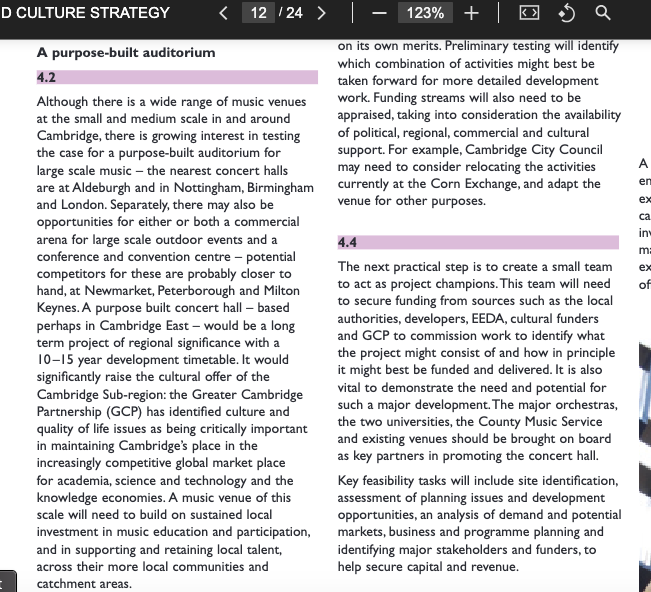
Above – purpose-built concert hall / auditorium proposed by Cambridgeshire Horizons in 2006 which I blogged about here last month.
Don’t get me started on the unbuilt swimming pool for West Cambridge!
The councils *oppose* a mayor-led development corporation – and the reasons they have given are not party political. (Convenient as it might be for Labour and Lib-Dem councillors to avoid such a scenario)
“That scale of investment [measuring £billions] is beyond the resources of the Local Authorities and the Cambridgeshire and Peterborough Combined Authority (CPCA). The shortfalls in water and energy holding back our economy can also only be resolved across a sub national geography and with the input of regulators and government departments.”
Above – South Cambs Item 3 App B p2
“The Council supports a stronger central government role because the scale of constraints (water/energy, transport, skills, investor confidence) requires national convening power, regulation and multi-billion pound investment over the long-term.”
Above – Cambridge City Council Item 5, p7
Both councils are saying that the timescales involved, the funding and resources required, and also the seniority and competencies needed to face down the huge utility interests are better suited for a Development Corporation headed by someone appointed by (and thus accountable directly to) a government minister. What this means is that if there is anything that cannot be resolved by the Development Corporation gets escalated to ministers (as is happening with the water supply and sewage capacity issues).
Comparing the development corporation with the ‘partnership’ set up of the Greater Cambridge Partnership, I don’t think there was a significant precedent for the GCP structures. I can’t think of one involving a two-tier area with the county council and two district tier councils plus two ‘non-voting’ board seats deciding on what got approved and what did not. Furthermore, I think there’s a lot to be unpicked regarding the reliance on commissioning outside consultants time-and-again.
“There is remarkably little to show for the more than £200million that the government has so far given the GCP and Combined Authority to spend on transport. Nearly all of it has been paid to consultants for reports rather than delivering new transport options.”
Smarter Cambridge Transport 08 December 2021
One serious long term consideration for ministers is building up the in-house capacity of the development corporation (and through it the local councils and strategic authorities) so that huge sums are not repeatedly paid out to external organisations and so that the public sector can grow a long-lost resource of corporate memory. (I saw the difference it made in my late-20s of having members of staff who were working in my policy area for longer than I had been alive – as many a former fast-streamer in the civil service has experienced).
Building out the sites that already have planning permission
One of the persistent frustrations of housing campaigners is the reliance on the private sector to build the homes – ones that developers only release in small numbers to keep the price high. Hence Cambridge City Council is calling for the development corporation to force the issue on this. How they will do this I don’t know.
On the democratic deficit
With previous development corporations, the area covered for each one has been much smaller than the one proposed for Greater Cambridge. Which is one of the biggest points of contention.
“If the proposals proceed as outlined, the Council considers that addressing this substantial democratic deficit (arguably greater than any previous development corporation in the UK)will require an unprecedented commitment from the Government to ensure comprehensive participatory systems of engagement and listening to partners and the communities ofGreater Cambridge. To date there has been no evidence that the Government understands the significance of such engagement.”
Above – South Cambs Item 3 App B p5
Cambridge City Council has similar concerns – but it has accepted in principle the boundaries of the proposed development corporation.
How should a development corporation work with places and sites outside of Greater Cambridge but which are within or close to Cambridge’s economic sub-region?
The most recent generation of public institutions that worked with ‘the Cambridge economic sub-region’ defined it as below:
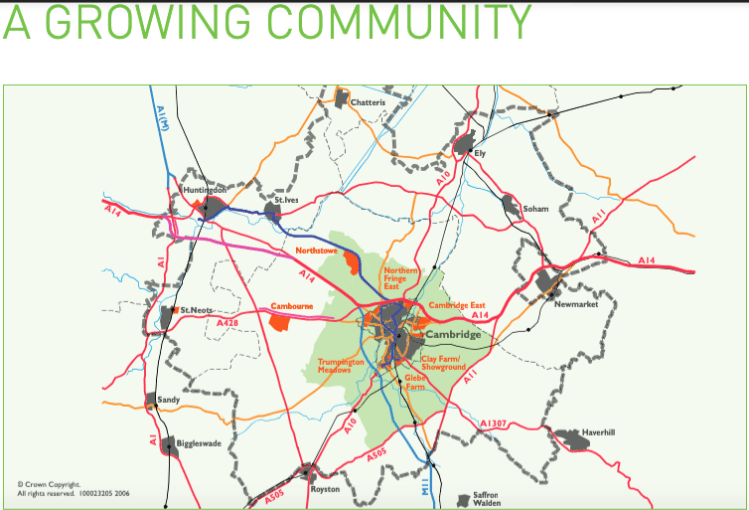
Above – The Cambridge Sub-Region in the Cambridge 2030 Vision report p2
As things stand, it looks like that Stansted Airport will eventually function as the nearest airport (assuming the airline industry can work out a zero-carbon method of fuelling aircraft that does not involve fossil fuels!). One other issue that I also mentioned on BBC Radio Cambridgeshire earlier this week was how market towns over the county boundary would be involved. Because long term commuting patterns force the issue
“The development corporation should also look beyond its boundaries to other relevant sites in the travel-to-work-area, such as Tempsford, Stansted Airport,Universal Studios, Haverhill, Newmarket, Royston.”
Above – Cambridge City Council Item 5, p9
This appears to ask ministers to consider ‘strategic sites’ over the county boundary. While this makes sense from a regional planning perspective, the issue of democratic legitimacy returns. Could the structures of the development corporation include sub-committees that contain local councillors from town councils or the emerging unitary councils to sit on the planning committees that determine planning and transport infrastructure applications that are located in those council areas?
Both councils strongly object to the loss of local development plan-making powers for the next phase of future development
“The approval of a Local Plan by the Full Council of a Local Authority is a reflection of the significance of Local Plans within the democratic process. The transfer of [those] powers from the Local Councils to the Development Corporation for over two decades will sever entirely the statutory plan making process from the democratically accountable processes that have served to commit the Councils to the emerging Joint Local Plan and its predecessors.”
Above – South Cambs Item 3 App B p6
Furthermore:
“The consultation materials fail to justify by reference to any robust evidence its conclusion that the objectives of the development corporation require the transfer of plan making powers.”
Above – South Cambs Item 3 App B p6
Both councils also object to the loss of powers to decide individual planning applications
Even though there is a long, depressing history of ministers overruling sound objections from local planning committees (give or take the odd unsound one!)
“Greater Cambridge must have a democratically controlled planning service that is fit for a global city. Development corporation could provide additional specialist capacity to support the planning service.”
Above – South Cambs Item 3 App B p6
While it sounds like the proposed development corporation is looking to negotiate a Service Level Agreement with the Greater Cambridge Shared Planning Service (which post-unitarisation will come under the control of the new Greater Cambridge Unitary Council) and thus benefit from the funding that comes with it to expand capacity as needed, the loss of control for all but the smallest of planning applications remains an issue.
The theme of the councils’ responses is that the development corporation should focus on strategic issues and ‘strategic sites’ which has issues that go beyond the local.
“The Development Corporation therefore risks being distracted by a significant volume of planning applications spread across Greater Cambridge which would raise only local, not strategic scale planning issues and which could and should be subject to democratic scrutiny and local determination.”
Above – South Cambs Item 3 App B p8
‘Focus on non-local issues’ says South Cambridgeshire District Council
“The Consultation acknowledges that many of the delays to the planning and development process have a national dimension to them. The Development Corporation must focus on these issues. Doing so would mean that the national factors that caused the delays to the SCDC Local Planning Authority’s determination of the developments highlighted in the consultation (Northstowe, Waterbeach and Bourn Airfield) will not be repeated.”
Above – South Cambs Item 3 App B p7
There’s a Ph.D waiting for someone to research and write about the past
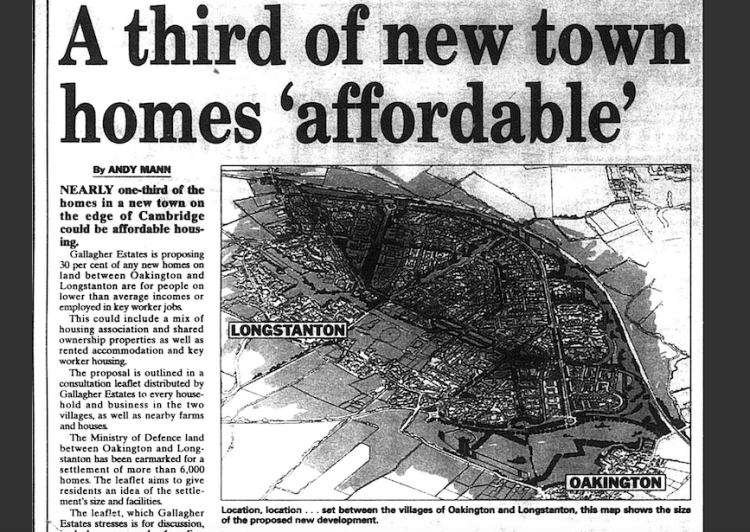
Above – site that became Northstowe in the old Cambridge Evening News 11 March 2003
One of the many errors with this development – meant to have been one of PM Gordon Brown’s much-publicised ‘Eco-towns’ was selling off the old Ministry of Defence-owned site to a single corporate developer.
Q: Where will the money come from for the infrastructure?
I can’t see it being Politically expedient for The Chancellor to allocate a £multibillion package for infrastructure for Cambridge. Both councils have highlighted the lack of HM Treasury sign off
“The Government has suggested £400m is available in the Autumn 2025 budget for Greater Cambridge, but this sum is woefully inadequate to convene all of the necessary partners and deliver on the scale that has been referenced, and in any event does not yet appear to have been allocated by the Treasury.“
Above – South Cambs Item 3 App B p9
Furthermore, little has been said about amenities and facilities.
“…social infrastructure: cultural facilities, community centres, schools, hospitals, GP surgeries etc is currently largely absent from the consultation, but is a crucial part of [the future of Cambridge]“
Above – Cambridge City Council Item 5, p13
This brings us back to the problem of a fragmented public service structures. The unitary council should have oversight of local public services but does not. Successive governments have since the mid-20th Century removed a host of locally-provided services from the control of local councils. What should the relationship between the development corporation and the Whitehall silos responsible be?
“Who should be on decision-making boards of the Development Corporation?”
Good question. One for a citizens’ assembly to thrash out the criteria?
After which, invite nominations. The ones that cite being an undergraduate at Cambridge as being their ‘local link’ should come under the most scrutiny given the longstanding town-gown divide. Because those students that did not engage with societies that were/are active in the wider city could have an even more skewed image of what Cambridge and South Cambridgeshire are, than someone coming to the area with a fresh mind.
I think another question to put to potential nominees is whether they have any ‘lived experience’ of the problems that Cambridge and South Cambridgeshire are dealing with.
The climate crisis.
“If we are going to have a development corporation, we need to be really honest about the future we are facing regarding climate change and resource scarcity and use its powers positively to counter them. Greater Cambridge should instead be the frontline of “nationally significant resilience”.
Cllr Katie Thornburrow (Lab – Peterfield) 10 March 2026
Cllr Thornburrow made the case for the Development Corporation having powers to insist on higher environmental standards than those written into national planning policies. (The corporate lobbyists want the opposite – national standards to apply to all and for those to be as limited as possible so as not to affect profits. We saw this at the examination in public hearings for the Cambridge Local Plan 2018 – I filmed the meetings for FeCRA and was struck by the interventions from barristers representing the Home Builders’ Federation and others on this point).
I’ll leave the last point to Cllr Thornburrow.
“We need to think about placemaking on the larger scale and all that implies. Inclusivity. Community. Culture. Being a place of refuge. And working collaboratively across all levels of government. One day the development corporation will be gone – we want it to leave a legacy that those who design and run it, and all those who come after, can be proud of. Surely everyone here does too?”
Cllr Katie Thornburrow (Lab – Peterfield) 10 March 2026
If you are interested in the longer term future of Cambridge, and on what happens at the local democracy meetings where decisions are made, feel free to:
- Follow me on BSky
- Spot me on LinkedIn
- Like my Facebook page
- Consider a small donation to help fund my continued research and reporting on local democracy in and around Cambridge

 The Cambridge Town Owl