
Back in August 2024 the Cambridge Connect Light Rail group sought ministerial support for feasibility study funding that *really* should have been provided by either the Greater Cambridge Partnership or the Combined Authority – but neither was forthcoming.
It remains to be seen if the current review by the CPCA under Mayor Paul Bristow with the Cambridge Growth Company are willing to commission such a study.
“Cambridge Connect, which was founded in 2015, called light rail vehicles “a proven and practicable form of rapid transit, adopted throughout Europe in numerous cities of a type and size similar to Cambridge”.”
Above – BBC Cambridgeshire 15 Aug 2024
The bid was turned down.
Fast forward to today and we find 2003 could be repeating itself as I wrote earlier this month. Only this time we might be more successful than the multiple previous attempts to do something other than spend fortunes on reports by external consultants – something that from where I see things ends up further undermining the public’s trust in political institutions.
Tramways and Urban Transit Magazine June 2009 arrived!
“What did it say?”
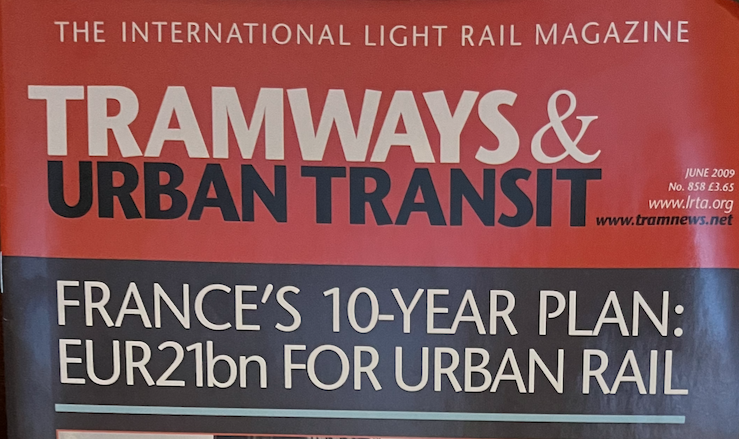
Surprisingly little given the front page splash, but at least it listed the series of cities and regions that were allocated significant sums of money that read a little like what John Prescott could have had for his 10 year transport strategy.
“For people in towns and cities …
- a large fall in traffic congestion in our largest cities, and reductions in the projected growth in smaller urban areas
- up to 25 new light rail lines in major cities and conurbations
- major bus infrastructure (including guided bus) schemes in many of our cities and larger towns
- up to 100 new park and ride schemes
- a new Urban Bus Challenge fund to improve links to isolated urban estates
- much higher quality bus services, and a 10% growth in use
- improved local traffic management, better maintained and safer roads”
Above – Transport ten year plan (2000) GovUK p68
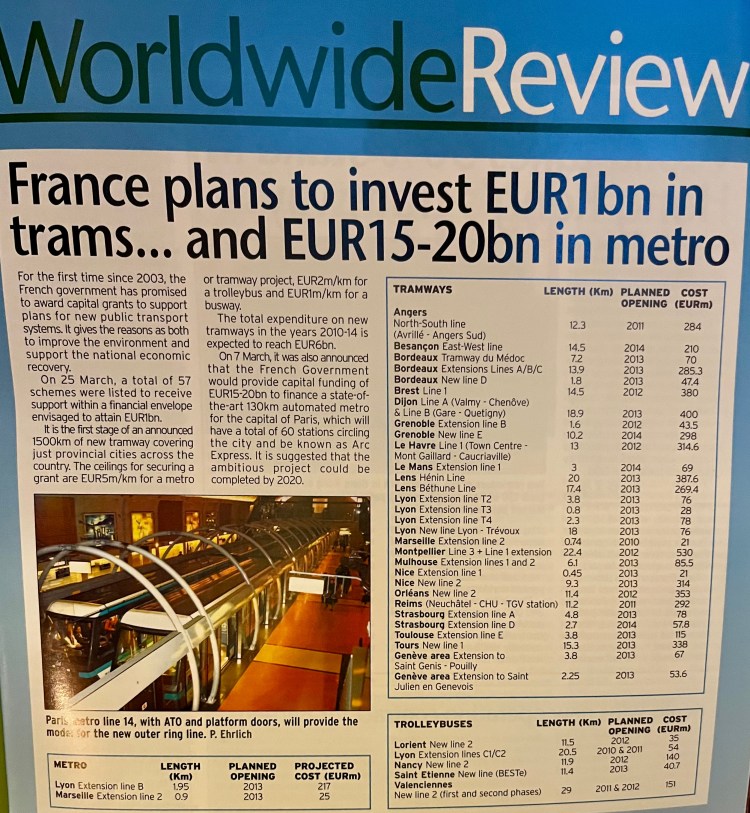
Above – Tramways and Urban Transit Magazine June 2009 by the LRTA which you can join
Part of this blogpost was sparked off by this article from March 2026 on what France seems to be getting right.
It’s something I will come back to further down. In the meantime…
East-West-Rail’s assessment of light rail between Bedford and Cambridge
I missed this out first time around but Miranda Fyfe of Cambridge & South Cambs Green Party reminded me in this exchange that I had explored the alternative northern approach into Cambridge for East West Rail – in particular examining whether a four-tracked corridor making provision for stops at the passing villages might reduce the opposition at the time.

Above – from CamBedRailRoad. Via CTO 29 March 2022
My more wackier-looking concept using G-Maps along existing roads tries to imagine what a four-track corridor where two of the tracks are effectively light or suburban rail serving Bar Hill, Northstowe, stops at visitor attractions such as Denny Abbey, and providing a freight line for the waste processing centre near Waterbeach, incorporates far more stops than

Above – From CTO 29 March 2022
What did the EWR Technical Report say about light rail?
It was tucked away in an annex – which was why I missed it from my blogpost of 31 May 2023 here.
Above – me getting angsty about the amount of reading required to have a vaguely-informed opinion about something
The Annex is on Page 70 of the document here
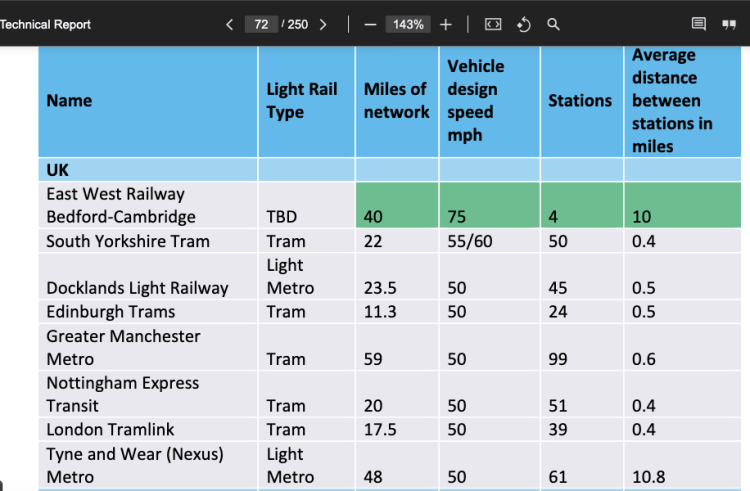
That table does not compare like-with-like. For a start there are only four stations over 40 miles of track. (And there’s an error in the Tyne & Wear row on average distance between stations). So a light rail which is meant to utilise frequent stops at lower average speeds than heavy rail, was never going to stand a chance.
This is why with technical reports it’s essential to scrutinise their assumptions
That’s how the Greater Cambridge Partnership dodged funding Rail Haverhill – something that should have been a major part of the Greater Cambridge growth plans since 2014 and really should be being incorporated in the Growth Company’s plans going forward.
The options included in the East-West-Rail annex were:
- Second generation tramways are those built in the late 20th and early 21st centuries, characterised by modern, articulated vehicles and new formations, they embrace systems such as:
- Nottingham Express Transit,
- Manchester Metrolink and
- Croydon Tramlink.
- Metro systems tend to be segregated and in the UK include:
- Hybrid systems, often using old Heavy Rail alignments such as the Tyne and Wear Metro and Sheffield Tram/Train; and
- Light metro, such as the Docklands light railway, which is an urban transit modelcharacterised in many cases by segregated, elevated track.
- Heavy metro systems are largely distinct from light rail and embrace systems like the London Underground and Glasgow Subway, although it is technically classified as an underground light metro.
Above – Different rail-based mass transit systems described: EWR ETR (2023) p71
“Do the conclusions of the report still apply to Cambridge today?”
No – because the context has changed and so have the assumptions. In fact, they were out of date within three months of being published because by July 2023 Michael Gove, the then newly-appointed ‘Levelling Up’ Secretary had announced his proposals for even greater growth for Cambridge in a speech on 24 July 2023
In March 2024 even Michael Gove had stopped talking about busways – perhaps with an eye on a looming general election where his party was defending the seats where the GCP busways would run through.
“To deliver this step-change in capacity and connectivity this ambition requires, the government envisages a transport system made up of several elements, which may range from improved walking and cycling routes to mass transit options, such as trams and light rail.”
Above – The Case for Cambridge (2024) HMT p30
Don’t forget Bus Rapid Transit!
Social media threw up this diagram at me so I thought I’d better look at it.
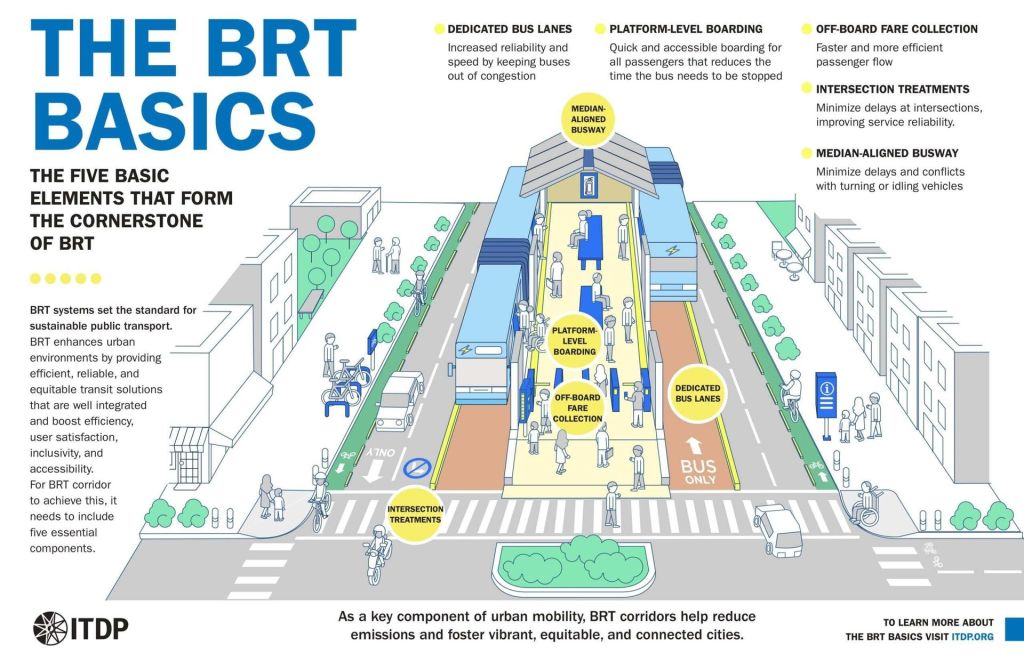
Above – the BRT Standard (2024) from the Institute of Transport and Development Policy
“That doesn’t look like anything built in Cambridge of late”
Are urban designers, transport planners and decision-makers designing in wide-enough road spaces for such infrastructure to be installed? Because if they were imaginative enough, the corridor between Cambridge North Station and Cambridge Regional College could look like the above diagram if they wanted it to.
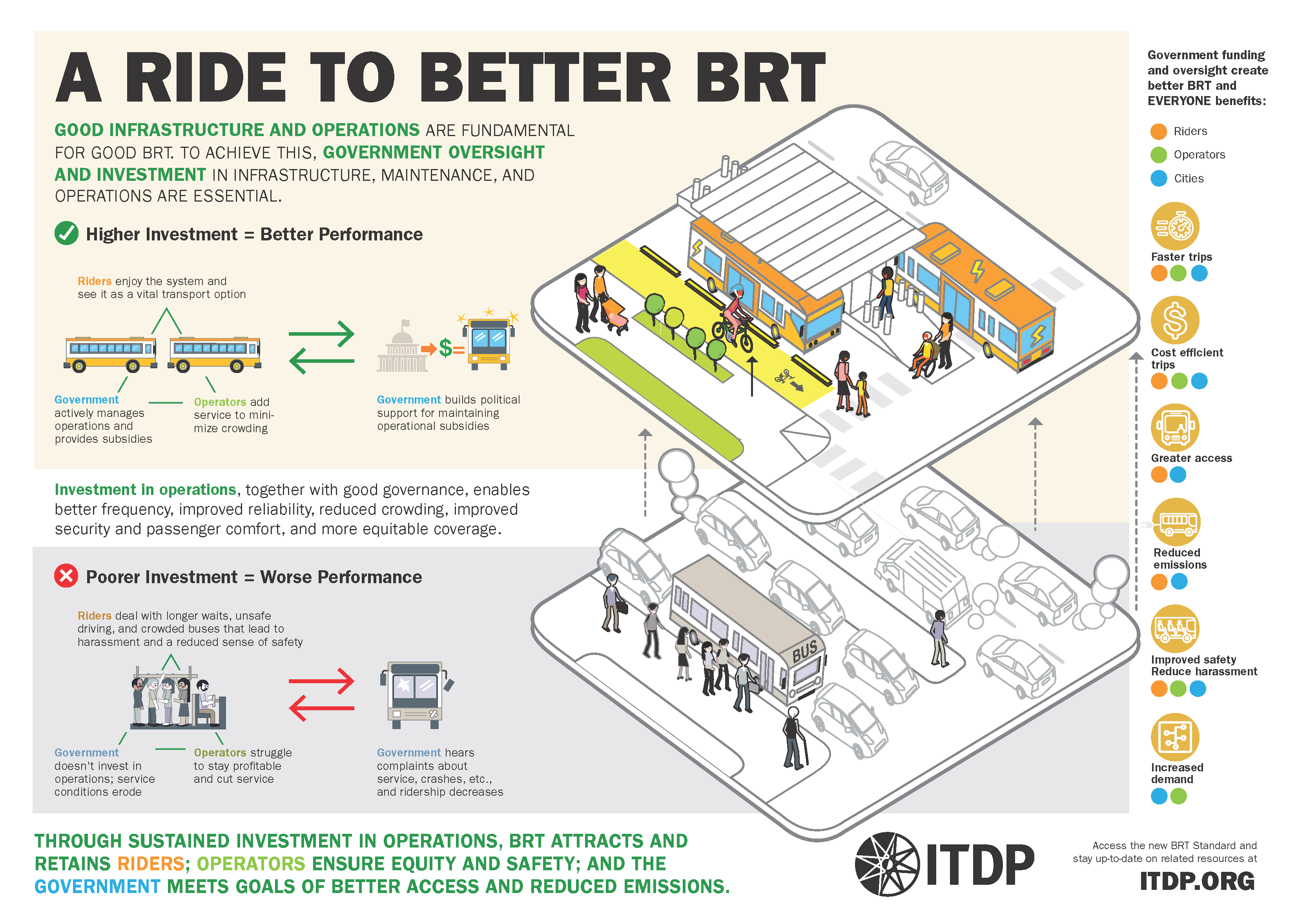
Above – A ride to a better BRT (or bus journey) – the ITDP from 2024
Governance structures – the bit where the UK nearly always falls down
For this we have to go back to Frankreich again and a research paper about public transport contracts.
Above – The Evolution of Public Transport Contracts in France (2017) by Odile Heddebaut for ITF – UK policy people, the author’s LI page is here.
“Why does this matter?”
Because it involves the funding – and the accountability mechanisms. What France did was to overhaul their structures and funding streams. Which is why they can have nice things and we can’t.
“We first examine the evolution of the territorial distribution of institutional powers in transportation mainly for passengers. A focus is made on the regional passenger railway reform in France that allowed the 20 French metropolitan regions to become transport organising authorities following a first experiment by seven volunteer regions.”
Above – Heddebaut (2017) Abstract
“How many do we have?”
Six outside London according to the ORR – note that public transport is a devolved matter so in my case we’re only looking at England, not the whole of the UK. Furthermore, France has a different model for regional and local government compared to the UK. Pages 6-7 of the Heddebaut paper summarises.
Prior to 2004 England’s regional governance structures looked like they were going to become stronger with EU-funded regional development agencies mirroring the directly-elected regional assemblies. But John Prescott, the Deputy Prime Minister made the error of going out to a local referendum on establishing the first one and the people said no in 2004. There was no legal requirement for him to do so. Parliament is Sovereign, and at the time Labour had a massive majority. If he wanted to establish such assemblies, all he needed to do was to table the legislation to make it happen.
Paris and Ile de France – a case study
In the grand scheme of things this is effectively the equivalent of Greater London and bits of the Home Counties, but the paper from Laurence Debrincat summarises the regional history of the Ile de France region around the French capital. One of the points he picks out in his historical summary is the impact of the 1973 oil shock. Note the impact of the volatility which marked the end of very cheap oil imports from the Middle East. Oil supply being used as a weapon of war? Sound familiar? That instability was one of the factors that incentivised a change in French transport policies. Fast forward to March 2026:
“Europe is neither an oil nor a gas producer. For fossil fuels we are completely dependent on expensive and volatile imports, putting us at a structural disadvantage to other regions. The current Middle East crisis gives a stark reminder of the vulnerabilities this creates.
“But we have home-grown low-carbon energy sources: nuclear and renewables. Together, they can become the joint guarantors of independence, security of supply, and competitiveness – if we get it right – now.”
Speech by President von der Leyen at the Nuclear Energy Summit, 10 March 2026
Which puts European energy and transport policies into sharper focus.
The French regional model
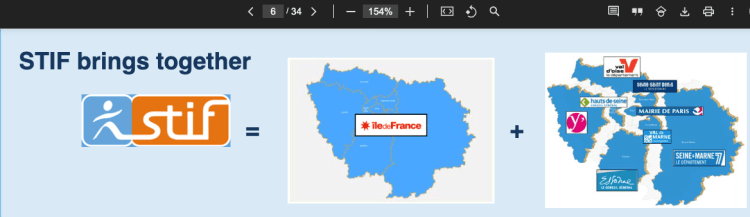
Above – Laurence Debrincat (2017)
Imagine Transport for London having powers/responsibilities extended to South-West Essex, Southern Hertfordshire, East Berkshire, Surrey, and West Kent, that gives you some idea of the equivalent. Because England does not have the sound regional governance structures (including a reasonable level of fiscal independence from HM Treasury), large infrastructure projects outside of London all too often get cut when the going gets tough.
Ile de France 2030
What I like about the diagram below is it brings together three very different themes and makes them greater than the sum of their parts:
- Transport infrastructure in particular
- Public transport
- Active travel (Cycling, walking etc)
- Development planning – in particular the densification of specific urban centres away from central Paris, and developing them in a way that *incentivises* (but does not compel) people to travel within their local areas for their essentials – hence the 15 minute city concept
- Restoring and enhancing the natural environment
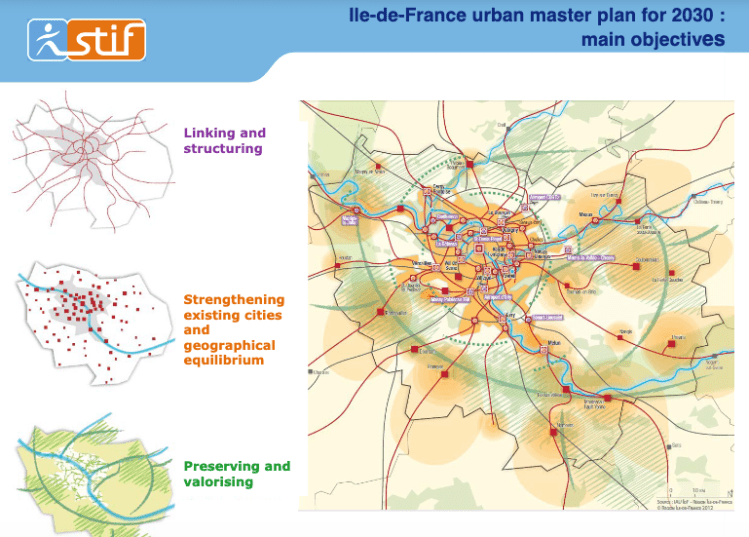
Above – Laurence Debrincat (2017)
Which while I wouldn’t want to compare Cambridge with Paris, the concept of having trams/light rail serving an economic sub-region that matches a travel-to-work area that then comes under democratic oversight, is one that works for me.


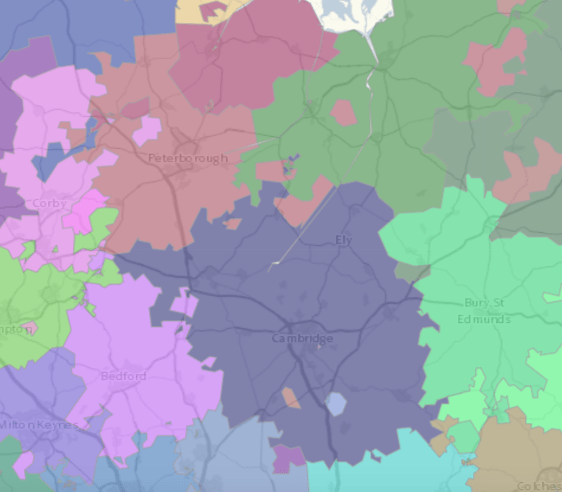
Above – left: Lichfield (1965) and above-centre, detail of Recliffe-Maud (1969), and above-right, Cambridge’s travel to work area (Cambridgeshire Insight 2011)
France goes several better with their future plans
Have a look at this article from RailwayPro, and also Île-de-France Mobilities here
- Develop the use of public transport by making it more attractive
- Place the pedestrian at the heart of mobility policies
- Ensure inclusive travel by making transport networks accessible
- Encourage the use of bicycles
- Support carpooling
- Facilitate the transition from one mode of transport to another for the same trip (think the old London one-day travel card)
- Make roads more multimodal, safe and sustainable (i.e. not just for motor cars and lorries)
- Better sharing of the street
- Adapting parking policy
- Supporting more sustainable and efficient logistics – eg last mile deliveries do not need large vans for small packages
- Phase out petrol/diesel vehicles
- Drive cultural change so public supports mobility services for those who need them eg mobility buggies etc
- Promote more sustainable tourist mobility – eg keeping tourist coaches outside of the city centre
- Change travel habits – both cultural changes and also incentives (positive and punitive!)
Using public transport to design out loneliness
…and to design in good things by accounting for journeys other than travel to work or study in the rush hours.
The Red Cross has published a number of reports on their webpage here. Furthermore, late last year a new APPG in Parliament was launched on tackling loneliness. Can they make that transport policy connection to their campaigning? Because as King’s College London wrote in late 2023, existing policies have not been working.
The previous APPG on tackling loneliness published this report in 2021

One of their big recommendations is to ‘loneliness-proof’ transport strategies.
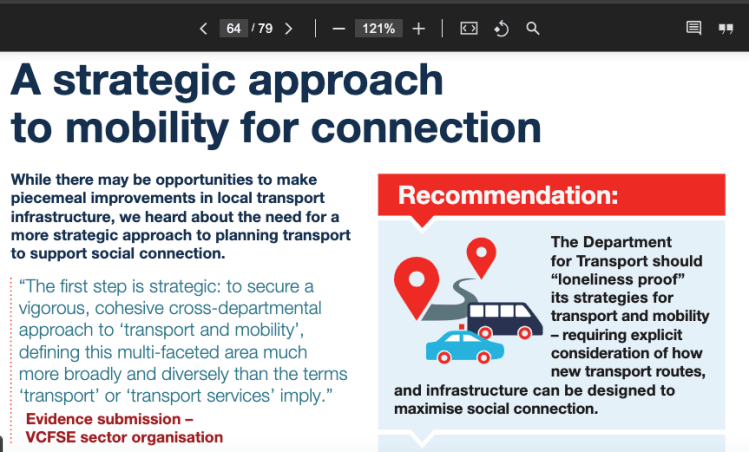
APPG on tackling loneliness (2021) p64
While I cannot see such policy proofing becoming a thing, it’s a consideration for transport planners to ensure that their future transport networks are not simply A-to-B by default.
Food for thought?
If you are interested in the longer term future of Cambridge, and on what happens at the local democracy meetings where decisions are made, feel free to:
- Follow me on BSky
- Spot me on LinkedIn
- Like my Facebook page
- Consider a small donation to help fund my continued research and reporting on local democracy in and around Cambridge

 The Cambridge Town Owl