
I missed this first time around (at least I think I did – brain fog from too many blogposts!) but the public objections from Cambridge PPF along with other civic society groups raise a number of issues with this and other sci-tech applications – in particular public transport
Image – Neurodiversity pins, because no one in their right minds should be writing blogposts on local town planning applications at such a late hour!
You can read Cambridge PPF’s responses to planning applications here – the one for the Babraham Research Campus planning application for outline permission is in the 2026 responses. (Alternatively see here)
The planning application is at https://applications.greatercambridgeplanning.org/online-applications/ Ref 25/04634/OUT
“5.2.2 If delivered, the CSET Phase 2 scheme will transform the accessibility of the BabrahamResearch Campus by non-car modes. It”
Above – Stantec for Babraham Research Campus Masterplan p37pdf, Nov 2025
Which makes me wonder what will happen if CSET Phase 2 is not delivered – only so far the record of the GCP on busways has not been great. Furthermore, while the original Cambridgeshire Guided Busway has benefited many who live close to the busway stops (along with the cyclists able to cycle extended distances uninterrupted) the busway is still yet make a significant impact on traffic volumes on the strategic road network.
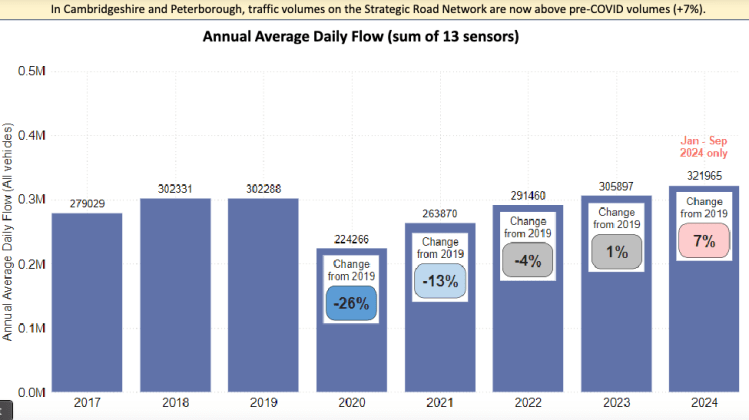
Above – Cambridgeshire Insight (2024) Slide 13, in Transport update: Cambridge and South Cambridgeshire – COVID-19 transport impacts and recovery
What’s even more concerning is that it is Cambridge and South Cambridgeshire District that experienced the highest increase in traffic volumes.
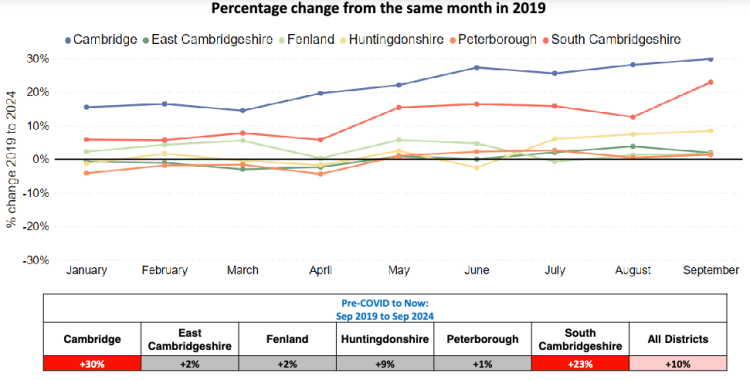
Above – Slide 14 – note the red indicators for Cambridge City (+30%) and South Cambridgeshire (+23%) increases in traffic volume between Sept 2019 to Sept 2024.
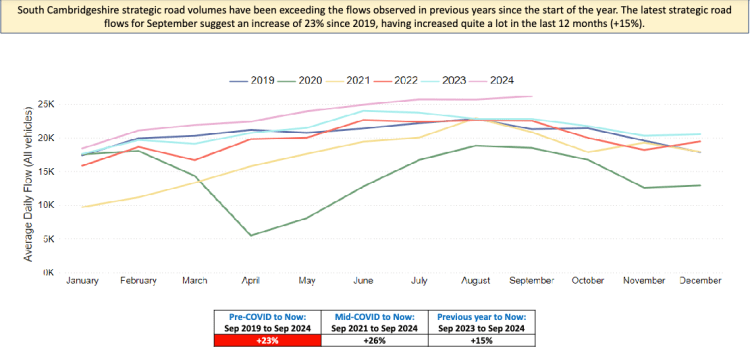
Above – Slide 20 – year on year increases for 2022 (red), 2023 (light blue) and 2024 (pink) comparing each month of the year
“Maybe they shouldn’t put all their eggs into one basket”
Or passengers onto a single mode of transport when better ones are available and given that the growth targets continually get bigger and bigger.
Cambridge PPF are sceptical about Stantec’s claims on the proposed busway
“We believe the claims regarding the CSET Phase 2 scheme are exaggerated. Connections from the busway will be at the P&R, which will be over a mile on foot through the village to the west-most Campus building; or from the stop in Sawston, which will be around two miles away on foot.”
That’s not the only concern they have with Stantec’s report.
“We hold significant concerns regarding the accuracy of the Transport Assessment”
…they said at the top of their issues – Stantec’s report and appendices running into 11 different sections on the Planning Portal. (Look at the documents in the application (25/04634/OUT) and scroll down to the ones submitted on 01 December 2025. They are labelled Appendix 11.1 Transport Assessment)
One of the problems here is the transport consultants don’t appear to have looked at the public transport network in the round. What I mean by that is that for the bus network, some people will want to get off at Babraham, and some won’t. Ask any further education student trying to get to CAST, Hills Road or Long Road Sixth Form Colleges and the last thing they’ll want is additional bus stops to an already poor service that their colleges have to subsidise to the tune of nearly £2million per year. Such is the mess that is fragmented public services. In an ideal world further education *and* public transport would come under the oversight of the same democratically accountable public body so that such budget transfers would not be needed.
“Which reminds me – where are we with the city access issues for busway buses when they hit the city centre?”
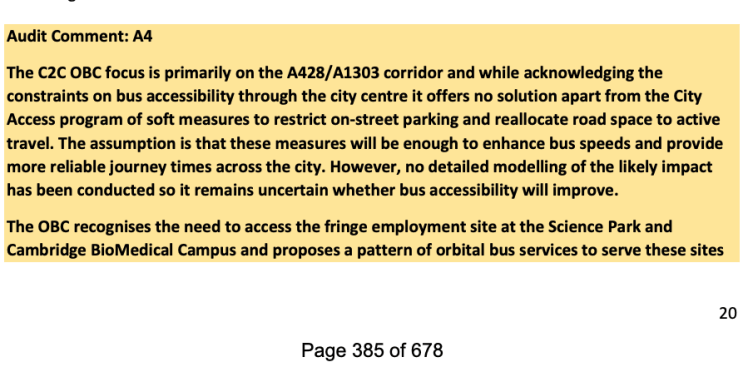
Above – GCP Independent Audit of C2C Busway 2021, p20 (although the page number bottom centre shows how intense the meeting of the GCP was when the report was discussed – nearly 700 pages of meeting papers!)
Highways authority maintain holding objection – Cambridgeshire County Council’s officers are not content
Much more detail is required from them – which is striking given how big the Stantec Transport Assessment was.
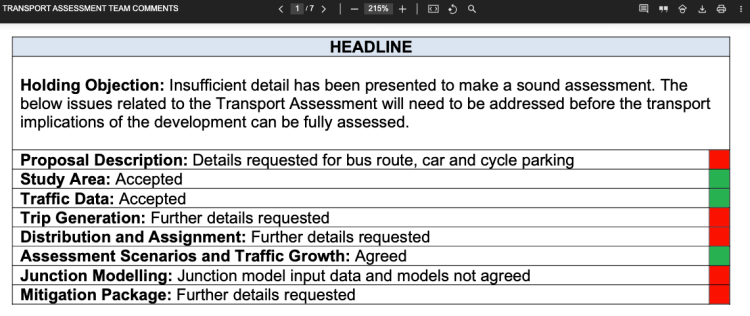
“The modelling scenarios detailed in 7.4.2 are appropriate and agreed. CSET2may get built nearby, and so scenarios with and without CSET have been included. CSET2 particularly adds trips to the A11 interchange with the A1307 to the travel hub access.”
Above – Cambridgeshire County Council Transport Assessment Team’s response, 30 Jan 2026
The transport officers noted that CSET has not been approved by the Transport Secretary – it’s still being considered. So much so that the GCP is still tendering for audio-visual services to stream that inquiry online.
Friends of the Cam and Friends of the Earth object over water supply
“Cambridge Friends of the Earth object to this planning application on the grounds of increased water use and abstraction from Cambridge’s already over-abstracted chalk aquifer. The rare and ecologically valuable chalk stream habitats in the Cambridge region are already degraded and under increasing pressure from current and proposed developments such as this. Furthermore, the nature of the businesses which will, ultimately, occupy the site is not stated, leaving the possibility of enterprises with excesive water consumption, such as Datacentres, being located on the site, greatly exacerbating any water use issues.”
Above – Cambridge Friends of the Earth, response to the application in the planning portal, 15 Jan 2026
“What does the Environment Agency say?”
“We are satisfied that section 12 of the Environmental Statement focuses considerablyon water resources. However, there are still some areas for improvements”
“Such as?”
“In the response to the EIA Scoping Report, it was stated that [The Cambridge Water Company] is heavily reliant on the success of demand management measures to maintain customer supplies until new strategic sustainable supplies of water can be developed.”
Which is not new.
“12.11 of the EnvironmentalStatement says there is a risk that modern scientific buildings may be more water intensive.”
Which a number of objectors have picked up on.
This is why post occupancy evaluations and surveys on water and electricity consumption are so important. Are construction professionals getting the data back from their designs and advice on large developments? Are their assumptions at design stage accurate when it comes to the actual use of the buildings once fully occupied?
Historic England also have issues
“The historic setting of the grade I listed building [which refers to the church as per the second paragraph below] is already compromised due to the development of the research campus. However, we note that some of the existing buildings to the north of the church are earmarked for demolition and we recognise that this may therefore be an opportunity to improve its setting to some degree.
“That said we note that the replacement building would have a flue of up to 3m in height, which could be visible from the churchyard and in other views, and this could have a negative effect upon the way in which the church is experienced and appreciated. As this is an outline application with all matters reserved, we are concerned that the lack of design detail makes it difficult to understand the full extent of the visual effect and to assess the likely impact.”
Above – Historic England’s response to the application in the planning portal, 03 Feb 2026
I wonder what prospect there is of undoing the damage done to the historic setting by the mediocre quality architecture
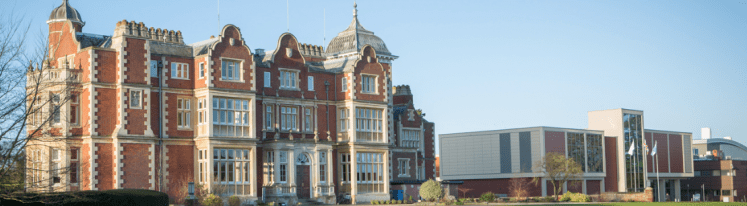
Above – from Babraham’s Research Campus – the Grade II-listed hall in the foreground, and the tribute to 1950s/1960s secondary schools in the background
“Oh it’s hideous! Take it away!” (in a Tom Allan voice)
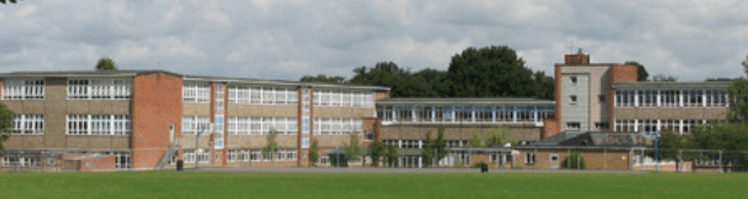
Above – the old Netherhall Lower School from Queen Edith’s Way photographed by John Sutton who some of you know. Is it me or does the building in the background in the photo above this one remind you of this?
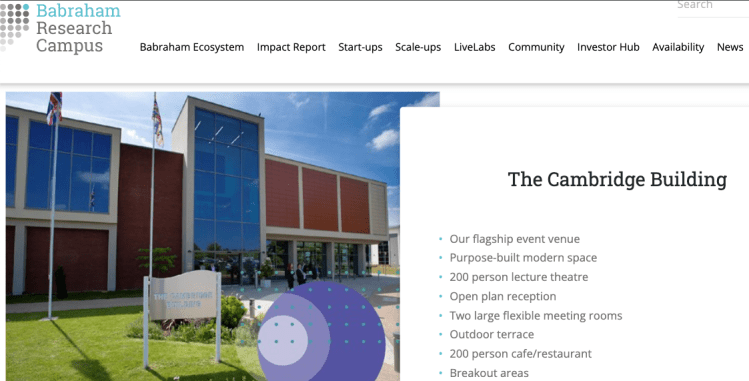
Above – ‘Our Flagship Venue’ according to the Babraham Research Campus
You can tell I’m not a fan of the exteriors of contemporary sci-tech campus buildings! Which is unfortunate because lots have been built around my neighbourhood and even more are planned! Hence my continued interest in the emerging field of neuroarchitecture which helps explain why I have such an instinctive negative reaction towards such vernacular/building styles.
Oh, it’s 1am. This is what happens when I hyperfocus on a side-quest.
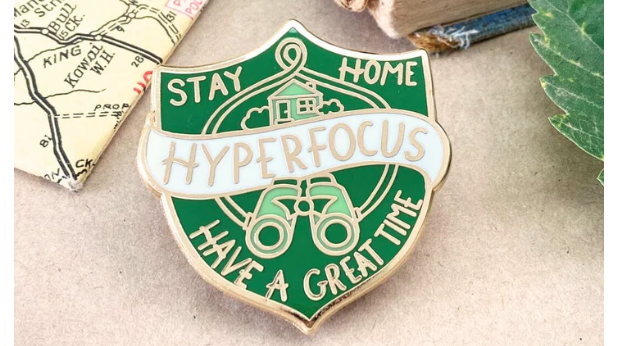
I should get the side-quest one!
If you are interested in the longer term future of Cambridge, and on what happens at the local democracy meetings where decisions are made, feel free to:
- Follow me on BSky
- Spot me on LinkedIn
- Like my Facebook page
- Consider a small donation to help fund my continued research and reporting on local democracy in and around Cambridge

 The Cambridge Town Owl