
As Cllr Ingrid Flaubert of Trumpington Ward on the other side of the city switches from the Liberal Democrats to The Green Party over national policy issues
Image: Trials of democracy. If you’re not at the table, you’re on the menu
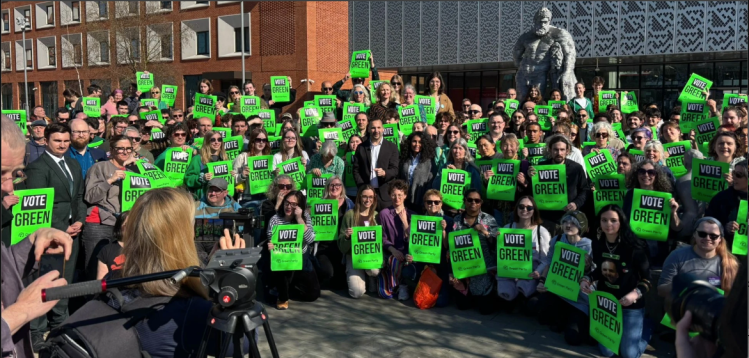
Above – From Mr Polanski’s BlueSky page, with Cllr Flaubert (Greens – Trumpington) surrounded by a crowd of supporters for their big action day
With two further by-elections looming in Trumpington, there is the small chance that this Liberal Democrat stronghold could unexpectedly end up with three Green Councillors. That said, local election analyst Phil Rodgers is predicting the LibDems will hold both seats.
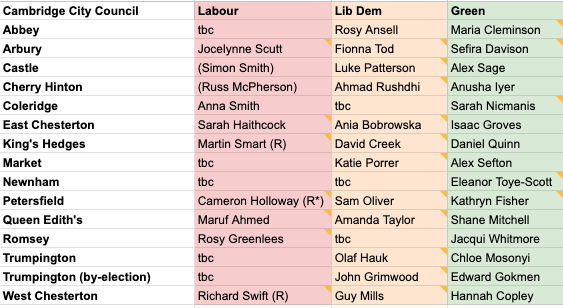
Above – detail from Phil Rodgers’ election candidates spreadsheet for Cambridge 2026
As Mr Rodgers said, the Greens now have six of the 42 council seats in Cambridge
By 2028 the new Greater Cambridge Unitary Council will be up and running. The shadow authority begins its work a year before that. Which is why the all-out elections next door in South Cambridgeshire District will be just as, if not even more important given the huge majority the Liberal Democrats are defending. (They currently hold 34 of the 45 seats).
Which is something that concerns former Labour, now Ind/YP councillor Dave Baigent.
This is also a similar point that some politicians in the south of the county make about the Combined Authority for Cambridgeshire and Peterborough: that mayors who win their majorities from Peterborough and northern Cambridgeshire seats inevitably prioritise work in that part of the county over the south.
My general take is that the Combined Authority is so enfeebled that it cannot do anything without ministerial approval – and funding, so in effect I don’t think most people could tell the difference.
This also reflects the problem back bench Labour MPs have. The very limited powers that local councils have, combined with the limited public understanding of what Members of Parliament are responsible for, means that MPs are not in a position to promote their own individual successes unless they are to do with securing government intervention and new spending in their areas. Furthermore, such is the time lag between ministers announcing the funding in Parliament to the spending being spent and the work being completed, can so long that voters don’t notice or give credit to the party concerned.
“Over-centralisation and ‘centralism’ make politics boring – and weakens democracy”
…as I wrote last November.
“Any news from the other parties?”
Labour were up early in Petersfield (it was a little nippy this morning until the sun showed up), campaigning not far from where the Cambs Unitaries Campaign had their AGM.
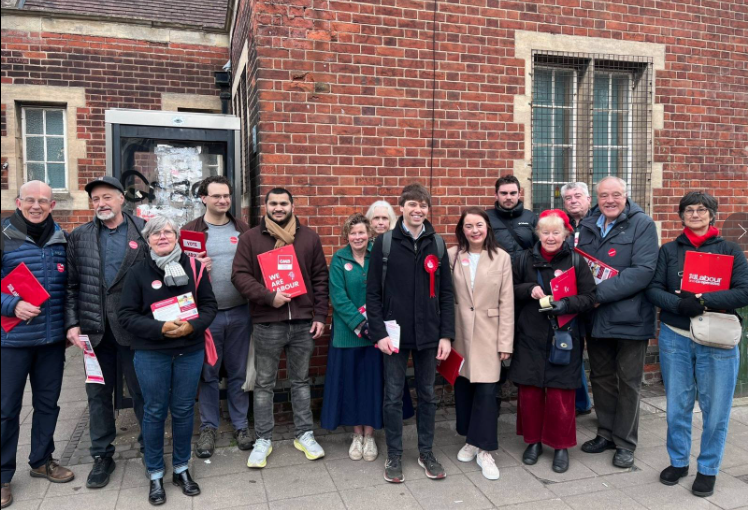
Above – Cameron Holloway standing in Petersfield, from his FB page.
Cambridge Labour haven’t at the time of posting announced their candidates – the deadline for all parties to nominate their candidates for the local elections is 4pm on 9th Aprl 2026 (i.e four weeks before polling day).
Cambridge Labour’s will be at https://cambridgelabour.org.uk/
Cambridge Lib Dems have announced their candidates at https://www.cambridgelibdems.org.uk/candidates
Cambridge Greens have announced their candidates at https://cambridge.greenparty.org.uk/your-local-area/
Nothing as yet from any of the other parties on candidates.
Because of national politics, this year’s city council elections will be some of the most unpredictable in recent years.
Historically Cambridge’s electorate has traditionally punished whichever political party is in government. In the 1980s & 1990s the once mighty Cambridge Conservative Association crumbled in the face of local dissatisfaction over the Kite/Grafton in the 1980s (which hollowed out their hold on central wards) and over continued austerity in the 1990s (where the LibDems gained at their expense) as the late Colin Rosenstiel wrote over 20 years ago. Labour, which made gains in the 1990s lost seats to the Liberal Democrats who dominated the mid-late 2000s until they too went into decline following Nick Clegg’s decision to take the party into a national coalition in 2010. Labour regained what they lost but started losing seats to a revived The Greens (who briefly held a couple of seats in the late 2000s/early 2010s), the latter as we’ve seen now gaining significantly from a much higher national press profile following both the general election 2024 and the election of Mr Polanski as party leader.
WhoCanIVoteFor.com will be repopulated soon
If you don’t know who your candidates will be, the website https://whocanivotefor.co.uk/ will have all of the information once the deadline for nominations on 09 April has passed. At which point people across the country can type in their postcode to find the details of the candidates campaigning for their votes.
If you are interested in the longer term future of Cambridge, and on what happens at the local democracy meetings where decisions are made, feel free to:
- Follow me on BSky
- Spot me on LinkedIn
- Like my Facebook page
- Consider a small donation to help fund my continued research and reporting on local democracy in and around Cambridge

 The Cambridge Town Owl