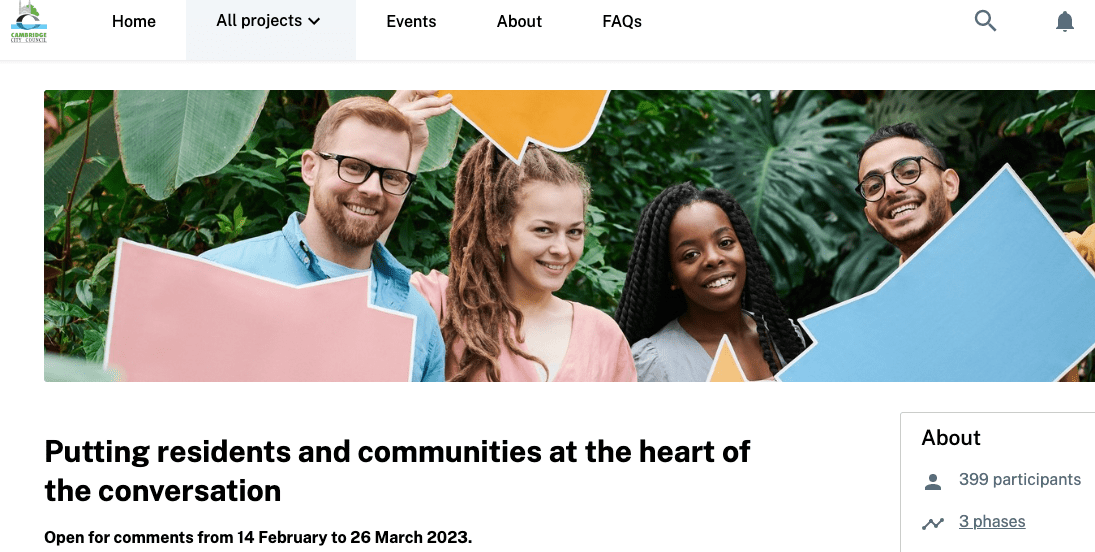
Well… about 979 of you responded one way or another – which in itself reflects how fragmented and broken our civic consultation systems are
You can read the report here, and also browse through the background here. In case you missed it or weren’t aware, Cambridge City Council has its own consultations portal at https://cambridge.citizenlab.co/en-GB/ At the same time, the GCP and Cambridgeshire County Council have their consultation portal at https://consultcambs.uk.engagementhq.com/ …while the Combined Authority has theirs here.
“The online focus groups generated limited interest and had very low-level attendance.“
Our Cambridge consultation report, 09 June 2023 by CamCitCo, p4,
“That’s a bit poor isn’t it?”
Did you know they were happening? Exactly.
I wrote a trio of articles in March 2023:
- Make responding to Cambridgeshire’s consultations (part 1)
- Make responding to Cambridgeshire’s consultations (part 2)
- Make responding to Cambridgeshire’s consultations (part 3)
…where I demonstrated to myself why I would make for a useless real life journalist or columnist: I can’t keep to word limits by myself – I’d need disciplining by a competent sub-editor!
Back in March 2023 I couldn’t sleep so wrote about consultations failing.
…which is where those trio of articles emerged from.
“What were the headline findings of the City Council’s Consultation?”
People like nice stuff, don’t like not nice stuff, and had some thoughts on how to deal with the latter.

Above – from the report. – also on page 4.
It’s not all negativity though. The council has stated that this is a baseline/starting point for improving things.
“The insight will also feed into other projects within the Our Cambridge programme, such as service redesign. Alongside its companion piece the “State of the City” Report, the Cambridge Together rich picture will inform council and partner priorities. The State of the City report and dashboard is a data led research tool which will provide a picture of what Cambridge is actually like (through economic, social and environmental lenses), and how that changes over time”
Report p5
Now, comparing reality vs perception can be very useful if the institutional response is done well. Take the Neighbourhood Agreements model in Oldham that I stumbled across during my civil service days (I wrote about them here) where commitments between the Police and local residents’ groups resulted in the latter telling the former when and where anti-social behaviour most frequently occurred, with the police responding by changing their ward patrols. The result? People commented positively that they were glad to see more police on the street. Were there more police on the street? No – it was better interaction between communities and neighbourhood police officers that meant officers were at the scenes of where anti social behaviour happened just before it was most likely to take place – nipping the problems in the bud.

Above – a headline from one of the Neighbourhood Agreements (you can read them in full here by Maxine Moar) that I’ve wanted to see in Cambridge for over a decade.
Keep an eye out for the State of the City report
“The final “State of the City” report and dashboard are due to be published in July 2023 and in the future should be updated as new data is released each year. “
There’s a literature review for someone to do on all of the recent reports about Cambridge that have been published. I’ve blogged about some of them including:
- Cambridge – City of Quarters (Cambridge Ahead’s Young Advisory Panel)
- University of Cambridge – impact on the Economy
- Cambridge’s responses to commissioned reports about our city
What the residents of Cambridge want is not the same as what the international speculative bubbles want
“Many people commented on the number of empty shops and how this affected the look and feel of the city. In particular, empty spaces at the Grafton Centre, the Beehive and Clay Farm, with suggestions that some of these could be used as community and art hubs. Science hub developments at shopping centres were not popular with many people who engaged at the Grafton Centre”
Report, p15
The response from The Grafton Centre’s new owners?
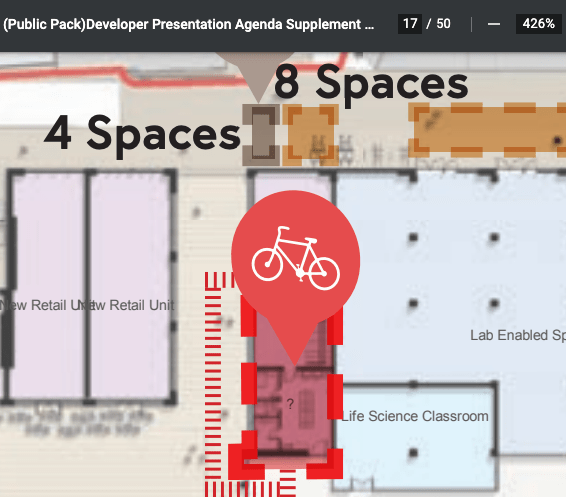


A ***tiny little life science classroom*** that isn’t even big enough to fit enough children in an average class size in a state secondary school. You can find out more on their website. As the Cambridge Independent reported at the end of May, just 15% of the existing site will be retail. Quite understandably, some local residents have accused the developers of increasing the rents to make them unviable as retail units so as to make the case for their conversion to sci/tech space because that’s where the money is. Yet Cllr Sam Davies MBE questions whether the Silicon Valley model is one we should be going for. She quotes Prof Mia Gray of the University of Cambridge in the latter’s 2018 prize-winning paper
“The scale, scope and nature of this double-crisis is downplayed in the regional studies literature, much of which still focuses on innovative growth models often divorced from broader social and ecological contexts.”
Betsy Donald and Mia Gray, 2018
The social context of Cambridge is our title of being the most unequal city in the country. The environmental context is in our water crisis – one which Anglian Water is now desperately trying to build new piping infrastructure to alleviate given that their proposed reservoir at Chatteris will not be completed in time for the next local planning period. Have those limits to growth caused problems before? Yes – half a century ago the lack of capacity in the sewage system in and around Cambridge led to a ban on medium and large scale building projects in the mid-1970s until the Milton works and other local works were upgraded. Don’t think the same cannot happen again. It can. That is why local history matters. Because decision-makers were warned in the 1960s about the capacity crisis and did nothing. Eight years later and large scale house building stopped.
I could list other case studies but you’d.be here all night.
As I’ve said on many occasions the broken structures of local government is an issue for Central Government that ministers repeatedly choose to ignore. Hence why Cambridge is the most unequal city in the country because it does not have the institutional structures or the legal and financial powers and capacity to deal with the interest, let alone tax it to pay for essential infrastructure. This is a question I will be asking Academy of Urbanism delegates to deal with when meets in Cambridge next week.
It’s not cheap to attend and a few of us managed to persuade the organisers to make some discounted tickets available for locally-based delegates who don’t normally get to go to these gatherings.
“There are a number of reduced rate tickets available for community / charity representatives within the city. To apply for one of these please email info@theaou.org quoting the organisation you represent.”
Academy of Urbanism 2023
Does Cambridge have “many facets of good urbanism?”
“Delegates will have the opportunity to experience the many facets of good urbanism in Cambridge and learn from how Cambridge is addressing some of the challenges that come with being one of the fastest growing cities in the UK.”
It’ll be interesting to see what examples they come up with in the face of our city being the most unequal in the country Because in the recent city council elections I explained to Queen Edith’s residents (who have the Cambridge Biomedical Campus in their neighbourhood) this:
My take? Any facets of good urbanism in Cambridge are massively outweighed by the facets of bad urbanism – including but not limited to:
- Fragmented systems of governance (eg Health and the local courts all have reporting lines to Whitehall, not to local government)
- Significant political decision-making powers resting elsewhere, whether in
- Whitehall, Alconbury (The Tories moved Cambridgeshire County Council out of our county town to an ex-airbase on the west side of Huntingdon),
- Huntingdon (where the Combined Authority is – as well as the county constabulary)
- Cambourne (South Cambs for the shared town planning service – why not have them all HQ’d in the same city/campus/site?!?),
- Frankfurt and Perth (Scotland – Stagecoach’s HQ on bus services),
- Madrid and Melbourne for Great Northern Rail’a majority owners Govia, and the Dutch Railways NS in Utrecht for Greater Anglia.
- Anglian Water – owned by UK & international pension funds (with a record of shame here)
- Inability to raise revenue from the wealth generated from Cambridge-based firms to pay for essential infrastructure
- Inability to designate plots of land for essential functions that cities need to make them pleasant places to live. What is the impact on neighbourhoods if a critical mass of properties designed and built as long term residential properties are turned over to short-term lets, whether for students or air-B&B?
Academy of Urbanism delegates – especially those experts not from the UK, must come prepared to deal with the City of Cambridge’s chronic and structural problems and be prepared to speak the truth to power if in your experience you think Cambridge’s governance structures area significant drawback on the city’s ability to deal with the negative problems and externalities of its rapid growth. Is it a place with a global name governed as a market town? How can you be part of the solution to our city’s problems rather than being just another ‘here today, gone tomorrow expert’ who quite likes the ancient buildings and the punting?”
Some academics are looking at Cambridge’s chronic problems – which is more than welcome. Furthermore I’d love to see their work publicised and see them engaging with local residents, commuters, students, and people who make up our city. The latest one I’ve been asked to share is this questionnaire from Julia Coonan.
Go for it.
What right do institutions in Cambridge have to tell the world how to deal with its problems when it cannot deal with its own problems on its own doorstep?
“I am inclined to think that in the University of Cambridge there is more exact knowledge of the social anthropology of, let us say, Papua, than of Pampisford.”
Archaeologist Sir Cyril Fox at the Cambridge & County Folk Museum in November 1936
This is not a new concern in Cambridge. We’ve been struggling with this issue for nearly 90 years. That’s one of the reasons why smaller towns have more grand local history museums than Cambridge has. (I declare an interest as a Friend of the Museum of Cambridge – you can join too). It still tells the story the people of borough and county as was, but given its premises it can never tell the story of the city. Hence my calls for its expansion.
But yet again the lack of financial powers prevent local government from raising the resources from the wealthy firms and industries to pay for the arts, heritage, leisure, sports, and entertainment facilities that make inclusive cities worth living in.
What is your solution, Academy of Urbanism visitors? Only Parliament has said:
- England’s national system of local government financing is unsustainable
- System of governing England needs a radical overhaul
Can your proposed solutions work within such broken systems? If not, what do you propose, and what will you be telling decision-makers about what you’ve learnt about Cambridge? Because if nothing positive for Cambridge comes from your event in and about Cambridge, then residents might start asking what is the point in having all of these experts coming. to our city if they cannot help us solve our own chronic and long term problems? (That could be an idea for an Open Cambridge Event this autumn: What impact could visiting experts have on helping the City of Cambridge and the County of Cambridgeshire solve its chronic problems?)
Food for thought?
If you are interested in the longer term future of Cambridge, and on what happens at the local democracy meetings where decisions are made, feel free to:
- Follow me on Twitter
- Like my Facebook page
- Consider a small donation to help fund my continued research and reporting on local democracy in and around Cambridge.

 The Cambridge Town Owl