
I think I lost the will to live after hearing the platitudes from the developers of another sci/tech building that only got approved on appeal to the Planning Inspectorate again – this one being on Fulbourn Road just over the city boundary in South Cambridgeshire.
I’ve moaned about Cambridge Technology Park before.
It was when they appealed and won against refusal of planning permission for a site on Fulbourn Road – one I’m old enough to remember what it looked like when it was fields.
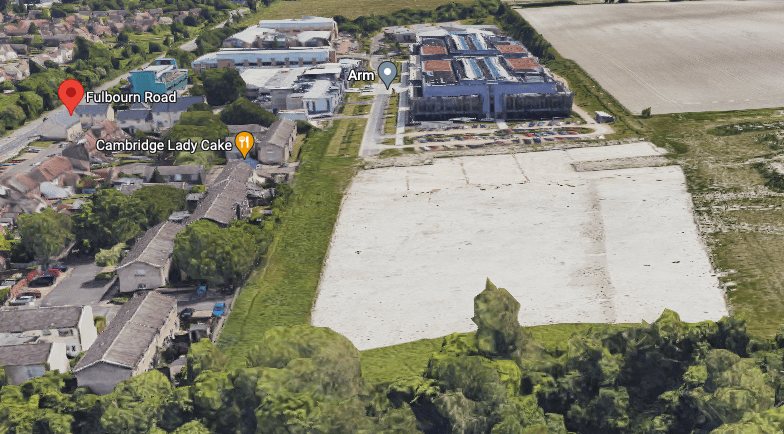
Above – from G-Maps here – Limekiln Close nature reserve in the foreground, with another pre-existing development site in pale land preparation phase.
In the summer of 1995 there were no youth clubs in the real meaning of the word – Austerity from Thatcher and Major destroyed much of the state and local government provision that my generation of teenagers didn’t really have much choice other than to acquire through various means cigarettes, alcohol, and soft narcotics and find somewhere out of the way to consume them. One such place was the field at the top of Limekiln Close nature reserve – formerly a chalk pit.
‘I see myself as more of an intermediate actually!’
The stereotypical yoga classes community activity strikes again!
Above – are the Cambridge yoga communities being used by big developers as a means of persuading councillors that a few yoga classes counts as a sufficient contribution?
Has anyone done any studies of provision of classes and workshops in Cambridge? How big is the market? The least the developers could do is consult with existing local providers or commission a market study to find out what the demand and supply actually is – and what the future prospects are. Furthermore, what facilities do participants in classes actually need alongside a large enough and well ventilated/lit room?
“Can’t the tech parks get together and offer to part-fund (if not fully-fund) a larger leisure centre that can provide more, better facilities not just for those working on the site but those who live and work in surrounding neighbourhoods too?”
This is something the Director of the Cambridge Science Park, Jane Hutchings told me last week that she wanted to explore given Cambridge’s appalling inequalities and the fact that one of the most impoverished wards in Cambridgeshire is on the doorstep of her science park.
Note the new freeholders of the Fulbourn Hospital Site also expressed a similar interest in getting more people from surrounding residential areas using their site.
“the new site owners said they were surprised not more residents used the site until some of the residents told them to take down the “Private Property – keep out!” signs dotted about the place.”
Cambridge Town Owl 10 May 2023
Looking at the sites of the science parks on the eastern edge of Cambridge, the active travel infrastructure is nowhere near good enough to enable older children to cycle independently to whatever facilities the developers claim there will be on the site shown in green/light brown that is currently scrubland.
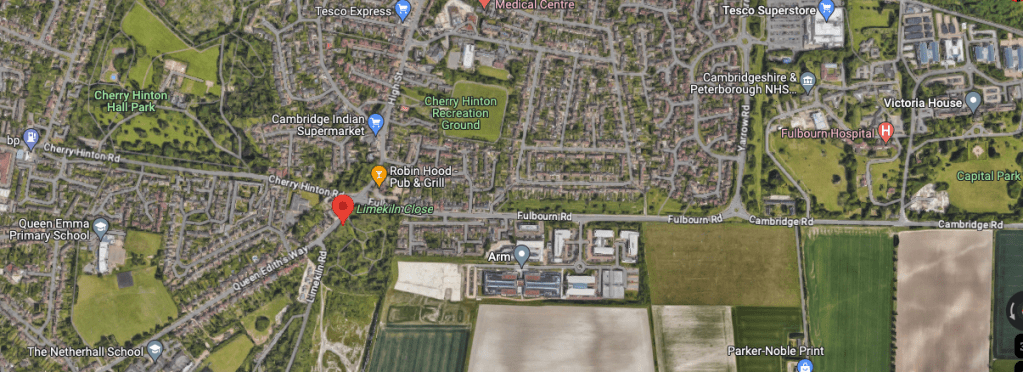
Above – South Cherry Hinton on G-Maps here.
Cambridge Colleges who form the land-owning interests need to change their investment cultures and act as if the interests of the wider city (and the children who live in/around it) actually counts for something. Don’t think that our built environment does not have an impact on things like child health. It does. In fact, one of the University’s own researchers has been examining the failures behind the policies on childhood obesity.
“In almost 30 years, successive UK governments have proposed hundreds of wide-ranging policies to tackle obesity in England, but these are yet to have an impact on levels of obesity or reduce inequality“
Dolly Theis (2021)
Furthermore, Dr Theis states:
“Governments should learn from earlier policy failures. They should prioritise policies that make minimal demands on individuals and have the potential for population-wide reach so as to maximise their potential for equitable impacts.”
Is obesity policy in England fit for purpose? Analysis of government strategies and policies, 1992-2020 – White & Theis (2021)
If that is not a call for ministers to empower local planning authorities to retrofit the built environments and active travel networks, I don’t know what is.
Have a listen to Dr Theis from her Cambridge research days.
Above Dr Dolly Theis, formerly of this parish
Do the executives that run the sci/tech parks in Cambridge’s sub-region accept that their sector is collectively failing our children and teenagers?
Or to put it more kindly, do they acknowledge that their sector could do far more to influence government policy in favour of children and young people in and around Cambridge rather than those who stand to gain the most financially?
Because getting the influential institutions and individuals to acknowledge the problems and challenges would be a very good start. Not least because there is a new generation of talent coming through that has a different set of values to previous generations – as the recommendations from Cambridge Ahead’s Young Advisory Committee demonstrated.
“There are limited places within Cambridge city that young people feel a sense of belonging, the only location directly mentioned by young people was Cambridge Leisure Park. No low-cost or free alternative was identified.”
Cultural Place-making Strategy, NE Cambridge, June 2020. P37
Above – from a blogpost I wrote in March 2021 calling on councillors to address the infrastructure gap for young people in Cambridge – especially teenagers under 18. This gap was described to me by one former A-level student a few days ago. The Junction has all-but- stopped providing for under-18s because of the risks associated with underage drinking. and potentially losing their licenses. Understandable from an individual institution’s perspective. The problem is there has been very little to replace it with for them. A situation replicated across the country. Therefore there is a wider public policy failure. We cannot be left in a situation where leisure providers simply shut up shop to under-18s. I come back to my point at the top: In the 1990s the public authorities became so strict on sales of alcohol to under-18s that it was easier for my generation to get hold of cannabis than alcohol because the dealers did not ask you for ID!.
Why then, are policy-makers and adults generally making the same mistakes of previous generations and excluding teenagers and young people from playing a full part in the life of their city? Has anyone seriously considered alternative policies, and have they been successfully piloted anywhere? (Taking the viewpoint that yes, many teenagers will drink and experiment, so isn’t a community risk-based approach to the worst impacts a better alternative than driving the issue underground?)
“What’s that got to do with the Cambridge Biomedical Campus?”
Some of the casualties end up up in Addenbrooke’s – A&E isn’t the most pleasant place to be at the best of times, and least of all on a Friday night.
At the same time, the proposals that the CBC were presenting to local councillors today (see the full video here) for me place a moral duty on the campus to provide for local teenagers. It’s their neighbourhood too. Are CBC representatives going into local schools – in particular secondary schools and sixth form colleges and engaging the students *at design stage*? Are they routinely involved in the decision-making processes? Are they being invited to scrutinise (and being educated on how to scrutinise) the proposals coming through whether through events or support through extended projects?
The risk is that Cambridge ends up surrounded by four ‘Eddingtons’: Exclusive communities designed and built for an exclusive, affluent, cosmopolitan, University-connected cohort that excludes the rest of the city because no provision has been made for them that is:
- affordable
- accessible
- sociable
- interesting and stimulating
Yes. Facilities. The site is lacking them. Big time.
And this from Cllr Simon Smith (Labour – Castle)
“Supplementary planning documents (SPDs) should build upon and provide more detailed advice or guidance on policies in an adopted local plan. As they do not form part of the development plan, they cannot introduce new planning policies into the development plan. They are however a material consideration in decision-making. They should not add unnecessarily to the financial burdens on development.”
Government guidance on plan-making
Councillors and decision-makers must make use of previous studies
I wrote about Cambridge needing well-connected leisure facilities back in September 2020. (Nearly three years ago.) In March 2022 I wrote about Cambridge’s civic and social infrastructure deficit.
“When we go out, people think we are troublemakers, but we just want to be able to enjoy the environment, get out there, and do our bit for sustainability”
North East Cambridge – Cultural Placemaking (2020) p36
The above-document needs re-reading by anyone interested in the future of our city. Furthermore, the statement below could – and should be tweaked so it applies to every new large development in and around Cambridge:
“North East Cambridge should be identified as a place that welcomes young people, centred on learning and promoting active lifestyles and creative minds. Featuring spaces designed with and for young people, recognising the vibrancy and creativity which they can contribute to an area; enabling them to have a sense of ownership, pride, and safety there. Establishing a culture where young adults can grow through real life learning opportunities, engaging with the local environment, business and residential communities positively.”
North East Cambridge – Cultural Placemaking (2020) p37
“Did Cambridge succeed with its 2006 local plan?”
It failed on the large sports and leisure facilities – in particular the additional municipal swimming pool.
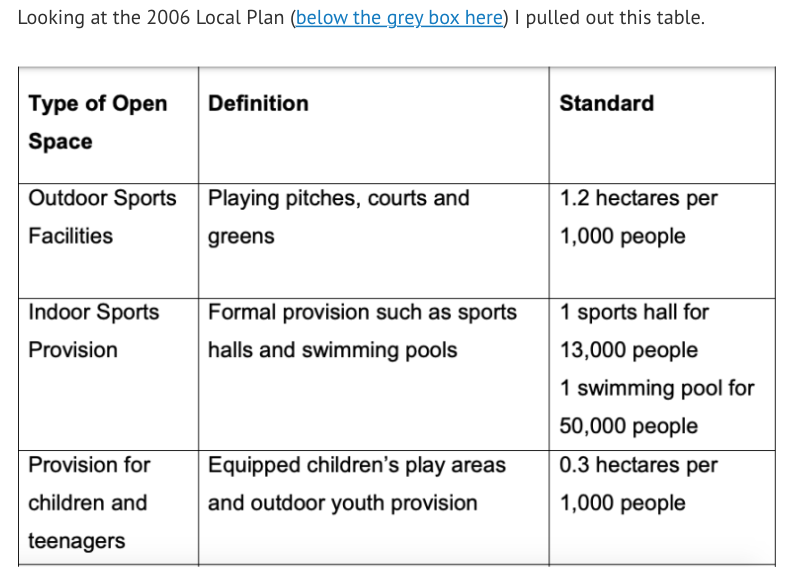
Above – from A new vision for the Cambridge Biomedical Campus – but what of the old vision?
How do the affluent and influential intend on making good those failures? Can the science park directors get together.and come up with a comprehensive match-funded offer to central government and local councils to provide the facilities that at present (and as Dr Andy Williams said earlier this year) are sorely lacking?
Over to you.
If you are interested in the longer term future of Cambridge, and on what happens at the local democracy meetings where decisions are made, feel free to:
- Follow me on Twitter
- Like my Facebook page
- Consider a small donation to help fund my continued research and reporting on local democracy in and around Cambridge.

 The Cambridge Town Owl