
TL/DR? I’m sick and tired of reading about powerful and wealthy institutions (and their representatives) talking about the future of my home town at events that exclude so many of the very people that make up our city and call it ***home***
“Cambridge is the most unaffordable place in the UK”
Above: A choice to look, Produced by Joe Cook & Abdullah Shah (2018)
I was one of many people who was interviewed in and took part in the above-film (in my case with my local history hat on)
I’ve just come back from a regular meeting with the Acorn Cambridge – the local branch of the tenants/renters and community union. (People can join here). There were nearly 20 of us there this evening – which is impressive given that 1) it’s August and 2) the branch hasn’t been running for that long. Yet it also reflects the desperation of the housing situation in our city, and 3) the high turnover of population beyond the student population means that people inevitably leave before a new cohort of people join.
As I mentioned in a recent blogpost, a number of previous meetings and conversations of late prior to this one reminded me of just how much of a challenge it will be to help inform and educate our city (town, gown, commuters, and regular visitors) on how our city functions and malfunctions in the face of utterly broken structures, systems, and processes.
As I mentioned to my fellow Acorn Cambridge members:
“Our response has to reflect the diverse needs and the complexity of our city. Have a look at Cambridge Resilience Web to get a sense of the multiple challenges Cambridge faces, as well as the people responding to them.”
Above – Cambridge Resilience Web’s template is available for other places too – York being the first city after Cambridge to use it.
What the cluster map option allows users to do is to see which local groups in a specific place have common interests and links, thus making it easier for grassroots activists to link up and undertake shared campaigns and actions.
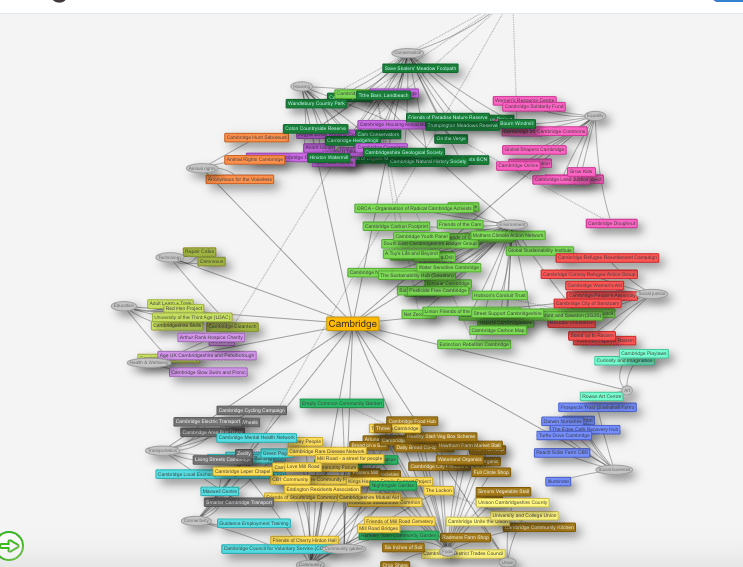
Above – from Cambridge Resilience Web
Civic Future’s event in Cambridge
I kicked off on Twitter over this because this was one event organised in our city that (at least in part) was about the future of our city but did not seem to involve many people that lived in or had a democratic mandate from our city.
More than a few of you will be familiar with the slogan: *Nothing about us, without us*. Some of you may have been to the exhibition at the People’s Museum in Manchester under the same title – their exhibition on Disabled people’s activism: past, present and future, ends in October 2023. Much as I would love to see it, the barriers of chronic fatigue amongst other long term health issues mean I won’t be able to get to it – I’m pretty much confined to Cambridge these days.
There were a number of blogposts (eg Mr Woolridge here) and social media threads (eg Mr Leslie here) about the event by Civic Future. This piece by Daisy Christodoulou also caught my eye.
…in particular this bit from the Director of Create Streets.
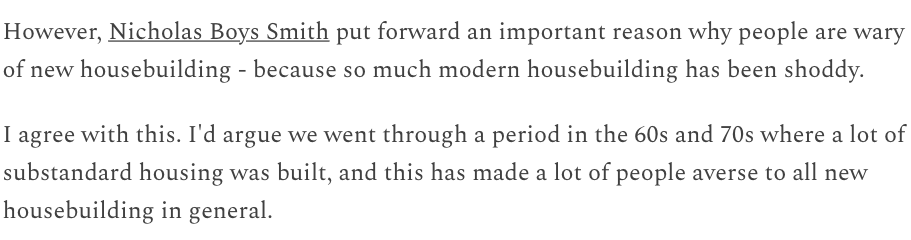
Only the 1960s and 1970s? Cambridge’s MP Daniel Zeichner was scathing of the big developers in Cambridge over the poor quality of building that his constituents keep raising with him – hence his adjournment debate speech a couple of years ago. The other things to consider are the social, political, economic, and also environmental contexts for previous generations of house building. There’s a local history research project or three waiting for any students or researchers interested in studying the post-war expansion of Cambridge. (Ask the Cambridgeshire Collection Local Studies Librarians for the files of newspaper cuttings about housing and planning).
Ms Christodoulou’s article then goes into the debate about Artificial Intelligence tools and how they are used. This reminded me of the debate stimulated by the AI-generated images that provoked a considerable amount of online debate on what the future of Cambridge should look like. I wrote a response here covering both my disgust at the ugly, minimalist, bland designs of too many new buildings going up in Cambridge, while also expressing concerns that the debate on building design and aesthetics is getting hijacked & dragged into the politically-inflated culture wars. After all, one of the things on my Cambridge-wish-list is a revamped guildhall inspired by John Belcher’s unbuilt plans from the late 1890s.
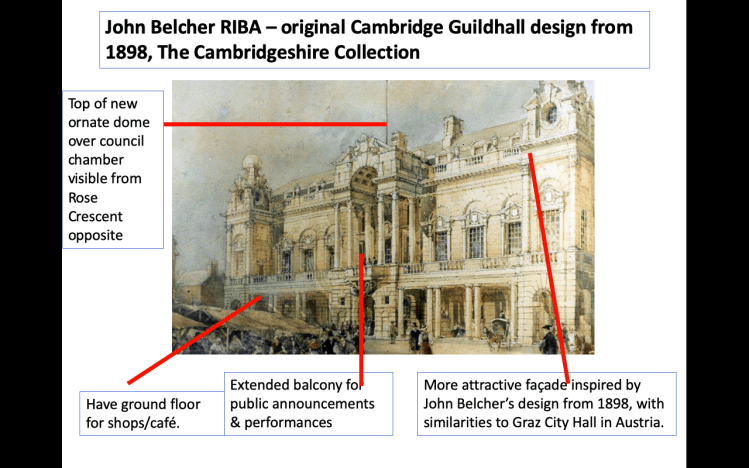
***Hello old bean! That’s a marvellous design you’ve got there! John Belcher, former President of RIBA you say? [He published his essentials of architecture in 1907 – digitised here]. Edwardian Baroque if I’m not mistaken! Splendid stuff! Shame it wasn’t built. Maybe we could bring back the Edwardian times as part of Empire 2.0 – we’ve got lots of other policies from the time that you might be interested in!!!***
Florence Ada Keynes‘ ghost wouldn’t let such a thing happen in our city. Neither that of Eglantyne Jebb who spent her Cambridge years trying to drag us out of such squalor having spent much of 1905 and 1906 carrying out the first social scientific study of poverty in our town as was. You can read the results of her work here. Both the women are two of my favourite civic heroes.
The event wasn’t just about Cambridge – but the risk remains that too much growth is being concentrated in too small an area
Here’s Tom Forth asking a reasonable question that could apply to all of the great cities in the north of England. (There was an equally strong case to have had the sci/tech engine in Manchester for example).
Above – Mr Forth amplifying the calls from the Public Administration and Constitutional Affairs Committee in Oct 2022 calling for an overhaul in how England is governed. As others have written over the decades, I’d be fine with the principle of a new Parliament for England being established in the north of England, leaving the Westminster Parliament to deal with UK-wide issues and foreign/defence policy. The impact this would have is many of the lobbying and campaign groups focused on domestic issues & currently based in London would move north, simply because that’s where the centre of power would move to for their policy areas.
That also doesn’t mean I’ve given up on the concept of a unitary council for Great Cambridge – along with the revenue-raising, spending, and legal powers to enable us to build the infrastructure (housing, transport, leisure, and so on) that Whitehall has prevented us from building. And ***Yes I still want that concert hall!***
Contested visions for the future of our city
The Leader of Cambridgeshire County Council, former MEP Cllr Lucy Nethsingha (LibDems -Newnham) is one of a number of local political leaders expressing deep concern over the plans from Michael Gove.
“I find the idea that a secretary of state should be the arbiter of what is beautiful for Cambridge deeply concerning.”
CTO – 26 July 2023
I agree with her. Furthermore her concerns reflect the longstanding policy position of the Liberal Democrats which is in favour of decentralising a number of the powers that over the past century or so have escalated upwards towards Whitehall. In this case however, there is local cross-party agreement regarding lack of clarity (not least the location) over Gove’s plans.
That’s not to say everyone is opposed. One of my former councillors, Chris Howell (Cons – Coleridge 2008-09) wrote this piece making the case for the growth of Cambridge. I provided a short piece of analysis with links here, before inviting readers to come to their own conclusions.
It’s far better for event organisers to make the effort to have genuine local involvement when debating the future of Cambridge
For a start, the lifelong residents who are much older than me lived through previous phases of major change. Ones that saw catastrophes such as the ban on new large developments (housing and industry) in the mid-1970s because central government had not heeded the warnings about the need to invest in sewage infrastructure. Or ones that saw the Cambridge Conservatives push through the comprehensive redevelopment of The Kite in the face of huge local opposition (and a grassroots alternative renovation plan from 1976 that would be an award-winning case-study today) that not only cost the Conservatives control of the city council, but almost wiped them out as a local political party in Cambridge by the early 2000s.
The number of significant planning applications along with Michael Gove’s much-criticised plans has concentrated the minds of more than a few people and organisations – and has also highlighted yet again our broken governance structures. What makes the next few months all the more crucial for Cambridge and South Cambridgeshire is that this will mark the start of the long ‘unofficial’ general election campaign. (Unless Sunak goes for a snap election in Autumn 2023). The time lag of both the policy-making process *and* the time lags for coming up with sound development plans for both the homes and buildings alongside the utilities infrastructure needed to support them, means that not a brick will have been laid by the time the next general election takes place.
What is Labour’s alternative?
The big question for Labour is what they will do in response if/when Gove provides further details. Because if investors and markets are expecting Labour to form the next government in under 18 months time, all Labour needs to say is that it won’t go ahead with Gove’s ill-thought-through plans. And that would terminate any attempts by the Levelling Up Secretary to drive things through because the institutions and firms needed to do the delivering simply would not engage. Why waste work, money, and resources on something that’s only going to get cancelled later? The historical precedent is with Labour’s Home Information Packs. The time it took to develop the policy and implement it meant that it was relatively straight-forward for the Coalition to repeal it. Which is what they did shortly after the 2010 general election.
In the meantime, the debate on the future of my home town continues.
If you are interested in the longer term future of Cambridge, and on what happens at the local democracy meetings where decisions are made, feel free to:
- Follow me on Twitter
- Like my Facebook page
- Consider a small donation to help fund my continued research and reporting on local democracy in and around Cambridge.

 The Cambridge Town Owl