
TL/DR? Have a browse – what do the courses and workshops show about our city and district beyond? What activities are missing that you would like to see?
“Again, I remain stubborn in my call for an annual Cambridge Societies Fair which I first wrote about in 2012.”
Cambridge Town Owl – 19 June 2022
I was reminded of this event organised by the Cambridge Arts Network last February (2023) – More than a ‘nice to have’
Given the facilities we currently have in Cambridge, our city is not providing anything like the comprehensive offer of lifelong learning opportunities that it could be doing. While the roots of this problem go all the way back to our broke governance structures, there are some things we can explore in the meantime to do better with what we’ve got. First things first: What’s already out there?
Every autumn new timetables are published by the various learning providers in and around Cambridge for over-18s outside of full time education. These include but are not limited to:
- Adult Learn and Train by Parkside/Coleridge
- Cambridge Community Arts (in Arbury and Mill Road)
- Cambridge Regional College Adult Learners’ courses
- Cambridgeshire Skills – provided by Cambridgeshire County Council
- Hills Road Sixth Form College’s evening classes (Between the Railway Station & Addenbrooke’s).
- Institute for Continuing Education – Cambridge University at Madingley Hall
- University of the Third Age, Cambridge (which is separate to the national organisation, having split many moons ago)
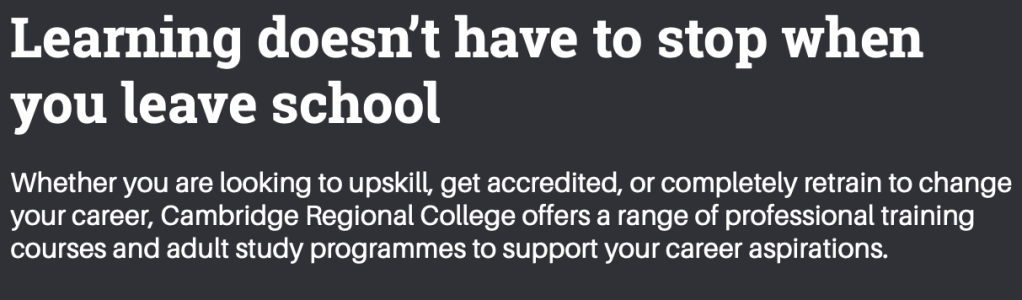
Above – CRC’s adult learner’s prospectus, p4: A message from Cambridge Regional College – one that needs reinforcing across our city
The Village Colleges also have their own programmes:
Cambourne, Melbourne, and Comberton Village Colleges
There are also specialist groups and institutions that run sessions and workshops that specialise in specific subjects or themese:
Alliance Française in Cambridge – The French equivalent of the British Council which you might have seen when abroad on holiday/studying/working. It’s the French state’s cultural institution and they’ve been in Cambridge for coming up to half a century.
Bodywork Company (dance / performing arts open classes)
“What’s missing from the collective offer?”
Let’s take an example: Sports courses. (I could and music for beginners (instruments), through to local face-to-face group gatherings for “Massive Open Online Courses” such as those provided for via FutureLearn – chaired by the former Education Minister Jo (Boris’s brother) Johnson.))
Sports courses – Cambridge United Foundation
Cambridge United run a series of excellent community football sessions at Coldham’s Common by the Abbey pool that are either free or low cost, yet as with other sporting clubs they are not easy to find unless you know what you are looking for. (I used to go to the Cambridge United Mental Health Football Sessions pre-CV19 / heart attack) I am still convinced that if employers across Cambridge knew about the existence of these, they would be approving their staff who needed it, to participate – and pay them for their participation too. In a different way but also dealing with mental ill-health, I’d say the same probably goes for Andy’s Man Club in Coleridge, Cambridge for men who are suffering from mental ill health but who feel that a physical activity/team sport is not their thing. It’s one of those things where being with people who you would not normally meet in your workplace or in day-to-day life on a weekly/routine basis over an extended period of time gives you a much wider perspective on life and the various challenges it throws up.
Our institutions are not thinking as, let alone functioning as a city – and Michael Gove’s treatment of our local councils demonstrates how he sees them as irrelevant
Why else would he make such a big announcement on the future of our city without at least briefing senior councillors let alone involving them in the development of his proposed policy? Which is why there has been such little support locally for his inevitably vague proposals (unable to answer simple Qs such as the location of his proposed developments).
I come back to my decade-long moan about not having a single portal that functions as a calendar and links to all of the providers in one place – ie what The Isle of Wight has with Events On The Wight. If we had something like ‘Events On The Wight’ we would be able to see very quickly what was available and what was missing
“Didn’t we used to have something called Cambridgeshire.Net back in the day?”
We did. Tories cut the County Council funding. (***Boooo!!!***)
See the Wayback Machine where I grabbed this old screenshot.
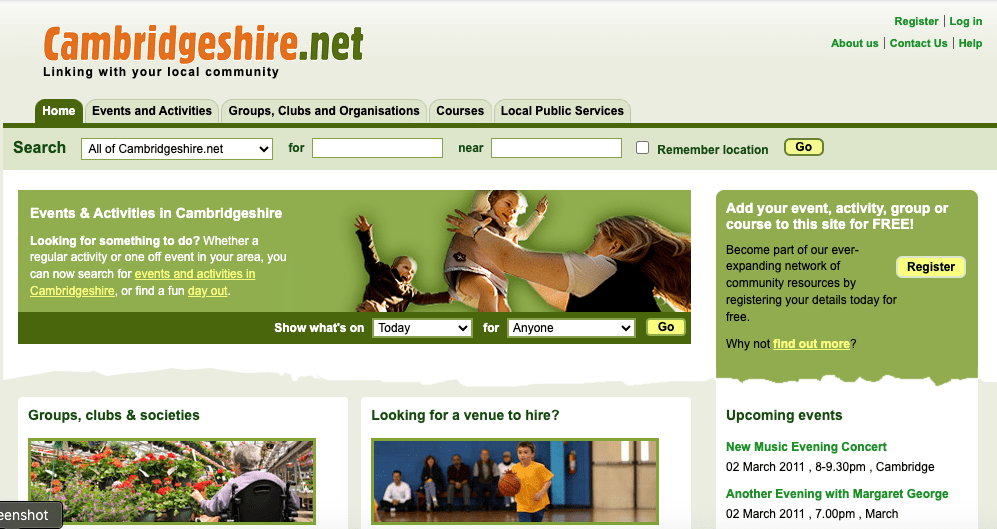
Above – From the Wayback Machine Internet Archive
In essence, the skeleton of creating the equivalent of Events On The Wight were there. Unfortunately the generation of councillors and the impact of austerity at the time meant that it was an easy target to pull funding for rather than investing in it. Again, the root of the problem was the broken structure of local government in England along with their unsustainable finances – something with the Commons Local Government Committee (Majority Tory MPs (LUHC)) concluded was something that needed radical reform. i.e. the existing system of council taxes and business rates is not fit for purpose as a means of funding local councils.
I remain of the view that a city-and-district-wide societies fair provides one of several solutions
Cambridge City Council took my original proposal from over a decade ago (which was a university-style freshers’ fair but for ‘town’) and, working with the Cambridge Hub aligned it with their policy objective of increasing volunteering in the city. Hence the Volunteer for Cambridge events in the mid-2010s (See my video playlist here). It had the beneficial impact of bringing dozens of people together from the broad sector who had never met before, and gave everyone a sense of what the scale of and the challenges with volunteering in our city was like. However, the event itself did not result in a significant change in the numbers of people volunteering, hence why it was pulled. Which is fair enough – I have no complaints.
Why I think the freshers’ fair concept needs looking at again
The simple reason is that the term ‘volunteering’ is one that comes with *a lot of baggage*. Especially in an era where so many of us have been ground down by so many things over the past decade (many of them Government-policy-related, but not all!) that the prospect of volunteering for something that inevitably means doing something unpaid for someone else / other people who you might not be particularly close to or knowledgeable about, or a campaign that you might not have much of a visible impact on, is off-putting for many. Especially if you feel that you are the one that needs the help.
If, however you organise as ‘A societies’ fair for town and beyond’ and keep the requirements down to a minimum (e.g. No h8 groups) and keep your metrics to a minimum (eg number of people attending, number of stalls booked) they that also tells councillors enough of what they need to know over time, combined with comments and qualitative feedback from the public and those stallholders.
At the same time, it’s a perfect opportunity to do some research and public surveys on the sorts of things people might be interested in taking part in. After all, it’s a section of society willing to make the effort to find out about what is going on in our city with a view to participating actively (rather than passively).
Go big and then expand outwards to residential neighbourhoods and surrounding villages, or start with surrounding villages and then build big later?
In one sense the community fairs are already doing their thing and have been for years. They’ve already demonstrated the concepts that work for their neighbourhoods. They don’t need someone like me telling them what to do. Furthermore the students at ARU and Cambridge demonstrate every year what can be achieved – give or take the plague of mass-produced centrally-branded takeaway paraphernalia that gets left behind every year. Hence my persistent suggestion to go big – and if people want to organise something similar with ere they live at a more local level, support them.
The three additional reasons for this include:
- Cambridge has an increasingly mobile and unstable population compared to previous decades – which means it has a higher population turnover than what our civic institutions were designed to manage. Therefore there’s a huge public interest in having such events annually so that recent arrivals (Whether students, academics, researchers, people moving for work, refugees, people returning home after time away – of which I’m one), can be integrated into the life of our city as quickly and as effectively as possible. Furthermore it puts out a very positive and collective statement about the city we want to become.
- Loneliness – a longstanding public policy issue that I’ve written lots about – but one that ministers are still in denial about regarding the underlying causes. Similar with mental health. The annual ‘awareness days’ are no substitute for comprehensive, properly-funded, and timely treatments, nor are they a substitute for dealing with the causes which can range from poor urban design, failure to deal with traffic noise, failures to provide easy and accessible non-car transport to community / leisure centres, failure to provide the necessary facilities, access and support for people to self-organise. (For example in Queen Edith’s and Coleridge wards, the only community facilities that I can think of that are regularly available to book are either church or school buildings. Which is no help at all if you had negative past experiences with both institutions).
- The lack of routine publicity in community-related media in the face of declining local newspaper sales. Take any copy of the Cambridge Evening News in the British Newspaper Archive 1969-99. (Normally you need a £subscription but if you take your laptop into your local wifi-enabled public library or use one of their computers, you can view them all for free!) Mens & boys sporting competitions were routinely published and in-depth. All of the local leagues, all of the age groups from under-10s playing on full-size football pitches (it was crazy, I know!) to adults. The fragmentation of media means we don’t get the ‘benefits of browsing’ beyond the subjects of our direct interest. The same goes with mainstream TV channels where back in the early 1990s my late grandparents would watch Children’s TV with us whenever we went to theirs after school, or Top of the Pops. They’d be the first to spot any cover versions from the 1960s.
Didn’t you want to say something about politics, democracy, and citizenship?
The only place you can debate these on a routine basis appears to be via the University of the Third Age in Cambridge on their Current Affairs course.
“University of the Third Age in Cambridge (U3AC), an independent Charitable Incorporated Organisation (CIO), organises educational, social and fitness activities for people who are not or no longer in full-time employment (there are no age restrictions). Set up in 1982, we are self-financing and run by our members.”
https://www.u3ac.org.uk/about/
Fortunately there are no age restrictions – although the branding inevitably has its own baggage – as one of the founders of both the U3A and the Open University, Peter Laslett summarised with the previous two ages:
“First Age – childhood, dependence and education. Second Age – younger and middle-aged adulthood, while people are generally working and raising families.”
The OU – Introducing Ageing
In the grand scheme of things I hit the third age in my early 30s because of chronic ill-health following a mental health crisis. Which in part is why I’m somewhat obsessed about lifelong learning policy because the strength or otherwise of the sector locally has a direct impact on my personal wellbeing. It’s not in my nature to be a passive recipient (Sorry!) and I’ve also reached the stage where isolated ‘personal self-improvement’ after so many years of trying and failing, is not something that’s compatible with how I want to progress and improve. I need to be around people. More often than not I need someone to ‘coach’ me and tell me what to do – to my face – without me having to over-think about it. This is what I said to my physios in cardiac rehab when they had to finish my treatment earlier than I would have wished because waiting lists and priorities. Again, ministers cannot put a financial value of the importance I put on having a familiar face who had gotten to know me over those months, and whose knowledge and competence I trusted, and at whose command I would get on with whatever exercise was set – no questions asked. (They had done the analysis of the settings and pace and order which I otherwise would have to have done – not a good thing with chronic fatigue. Taking away the requirement ‘to think’ for an over-thinker in my case actually makes a huge positive difference).
“And at the end of all of that?”
I’d like to see Cambridge having that city-and-district-wide conversation on adult education and lifelong learning, alongside the societies fair where we can get some idea of what sort of fun and leisure activities we’re willing to self-organise, and what new facilities and funding we’d need in the longer term as our city contines to grow.
Food for thought?
If you are interested in the longer term future of Cambridge, and on what happens at the local democracy meetings where decisions are made, feel free to:
- Follow me on Twitter
- Like my Facebook page
- Consider a small donation to help fund my continued research and reporting on local democracy in and around Cambridge.


