
The main driver for the element involving charging motorists was explained clearly in the meeting papers – if you could find the relevant paragraphs in the 500+ pages.
“The overarching objective of the scheme is providing viable alternatives to private car use which means reducing congestion (to allow alternatives to be faster, more reliable and safer than they currently are) and generating an ongoing sustainable revenue stream to support bus service provision beyond what is currently commercially viable and to invest in sustainable travel infrastructure and maintenance.”
GCP Agenda Pack, 07 Sept 2023, p77 A:3.35
Everything comes back to the relationship between local government and central government – an issue that goes back centuries.
Because Parliament is Sovereign, it can legislate for whatever it likes. We have no written constitution to restrict what Parliament can do, nor do we have a constitutional court to compel Parliament and Government to stick to a constitution. When you do hear about the Government losing a legal case, it is often because a minister has made a decision on which they had no legal powers to make – i.e. Parliament had not granted such powers. Sometimes you will hear of a case about a law ‘falling foul of human rights laws’. Which may mean that a court has found two pieces of legislation to be incompatible with each other – the ruling telling ministers and Parliament they need to table new legislation to rectify the situation.
Parliament invented modern local government by passing the Municipal Corporations Act 1835
See the WikiPage on that Act here. An incredibly controversial piece of legislation at the time between The old Tories (who quite liked the corrupt old system) and the old Whigs – later Liberals (who didn’t), this was the start of the process of modernising public administration at a local level. Over the next century, Parliament would pass successive legislation both empowering and burdening local councils with additional duties and responsibilities – as well as additional powers for raising revenue (or receiving grants from central government) to meet the costs of newly-invented public services. Such as electric street lighting.
Parliament also legislated for the means by which councils could raise revenue. The Municipal Corporations Act 1882 is another example. Section 144 of the MCA 1882 to be precise.

Basically what it says is that if the amount of money the council receives is not enough to meet its legal duties as set out in Law, then councils may raise further revenues by imposing a local tax – the Borough Rate. This is why older generations who complain about councils refer to ‘rate-payers’. Prior to the hasty invention of the Council Tax in 1991 following the Poll Tax Riots in 1990 that brought down Margaret Thatcher’s Government, the local taxes that local councils raised from residents were called ‘The Rates’. The bill was based on a professional assessment of the value of the property that a person owned or lived in. (See this WikiP explainer). Ministers never liked ‘revaluations’ because rising property values meant rising local tax levels for asset-rich, cash-poor residents who had a propensity to vote in far greater numbers than say people in short term rented accommodation. Can you see where this is going?
“So…if Parliament – or rather the Government through its control of Parliament and the whipping [politically] of its backbench MPs decides by what methods councils can raise revenues…”
Exactly. And in the Year 2000 Parliament passed legislation enabling county councils to bring in a method of charging motor vehicles.
“In this part, a “charging scheme” means a scheme for imposing charges in respect of the use or keeping of motor vehicles on roads…. A charging scheme may be made… …a county council in England”
Excerpts from Section 163 of the Transport Act 2000
****Ohhhhhhhhhhhhh!!!!!1111****
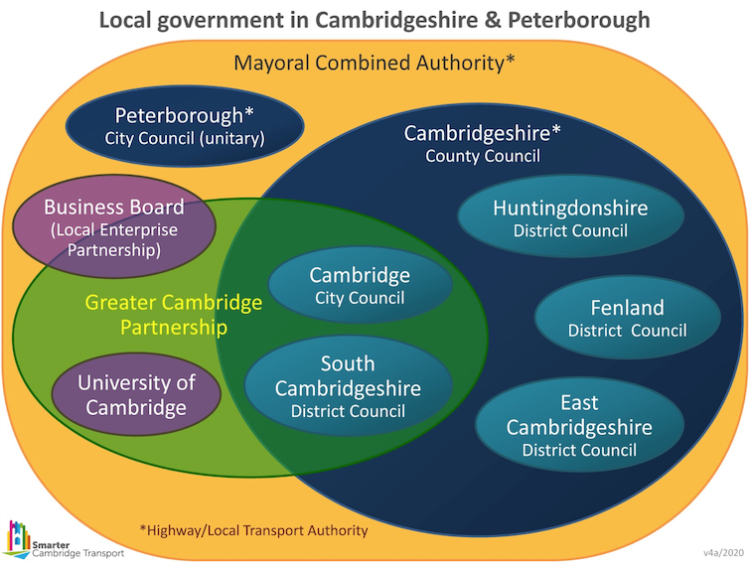
And *That is why* the Greater Cambridge Partnership has to ask Cambridgeshire County Council to use its powers to bring in such a congestion charge – because the GCP ***does not have any legal powers to do it by itself* Which is why the Conservatives kicked up a fuss about having a local referendum on it. (Hence the attempts to get lots of people to sign a petition under powers from a set of regulations with a really long name approved by Parliament under previous Acts of Parliament in 2011).
“Why didn’t ministers simply enable the councils to charge wealthy firms, or ‘The University’ / its colleges, or rich people instead?”
That is a party-political decision that ministers of the Crown will need to explain for themselves.
“No – really.”
Yes – really.
Ministers were told by the old Commons Housing, Communities and Local Government Committee in 2021 that local government finances are unsustainable.
“How did ministers respond?”
Let’s look at the specific recommendations.
Recommendation 3: Add more upper bands to tax wealthy home owners. Sort of like the Mansion Tax the Liberal Democrats called for. What follows is from the Government’s response to that committee in October 2021.
The Committee of MPs recommended:
“The government should reform council tax by undertaking a revaluation of properties and introducing additional council tax bands, in line with the recommendations of our predecessor Committee.”
The Government replied:
“The government has no plans to replace or fundamentally reform council tax. A revaluation would be expensive to undertake and could result in increases to bills for many households. The creation of higher council tax bands, which in itself would require a revaluation, may penalise people on fixed incomes, including pensioners”
Above – As a cohort/very large group with a common characteristic, pensioners have a higher propensity to vote than young adults. Pensioners are more likely to be settled and stable compared with young adults – especially those who find they have to move around to find work that matches their ambitions and qualifications
Recommendation 4: Let councils tax a range of different things – broaden the base and stabilise their finances.
The Committee of MPs said:
“We recommend that the government widen the funding base of local government to make it less vulnerable to shocks such as the COVID-19 pandemic, including by giving councils more flexibility over local taxes and other revenue-raising powers.”
The Government’s response:
“The government considers that the current charging regime for individual services strikes the right balance between allowing councils to raise revenue to cover the cost of providing services and ensuring that service users are treated fairly and fully informed of costs incurred.”
So ministers have no interest in broadening the revenue-raising base of local government. Certainly HM Treasury does not – because that means the institution loses power.
Above: As beautifully demonstrated in this wonderful satirical take in Yes Prime Minister.
Hence why, as I explained in my previous blogpost here, the Liberal Democrats in the Coalition were unable to impose their manifesto commitment of overhauling how local councils were financed, and ended up having to agree to a traditional grant-making programme with ‘gateway reviews’ so that ministers could account to Parliament for how taxpayers’ money was being spent.
“Was/is there an alternative?”
Yes – to let local councils raise the money and have full councils and overview and scrutiny committees undertake the responsibility instead. The problem is that after 13 years of austerity, local councils simply do not have the capacity to do that. And ministers and The Treasury know this.
This was the same view that Tony Blair and Gordon Brown took when they formed their New Labour Government. Wanting to hit the ground running, they took the understandable view that it would take too long to overhaul and improve local government so that it could repair the 18 years of underfunding local public services. So they instructed their ministers to table the necessary legislation in Parliament to establish a range of quangos that would bypass local councils and deliver directly – with the chief executives of those quangos being appointed by, and directly accountable to ministers.
“Ah – I can see why ministers of all parties quite like this system”
Yes – and more than a few of those quangos and their supporting functions such as the Audit Commission were abolished in the early years of the Coalition. It has since turned out that the latter might not have been such a good idea after all – the Public Accounts Committee strongly criticising the current arrangements for local government auditing in June 2023.
“So…why did the GCP throw so much political capital at congestion charging?”
Firstly they did no substantive review of past schemes.
“I don’t have time to [read the book on Cambridge buses], I’m very busy”
Officer response to Antony Carpen (me) Workshop on Cambourne-Cambridge Busway, Shire Hall, Cambridge 22 Sept 2016
I had asked a question about whether GCP and seconded county council transport officers had read up on the history of Cambridge’s buses given they were about to embark on a very controversial busway project mindful that the first busway took another seven years from when I asked that question, for the county council and their main contractor to settle out of court!
The main substantive exchange is below.
Above – note at the time of the meeting the Cambridgeshire Archives were based in the room ***directly below where we were all sitting***
So it would not have been hard for transport officers at the time to have popped down and asked archivists for some transport files. Only the official report on the very expensive opinion poll and survey on congestion charging carried out in 2007 for the county council ***might have been useful***.
“What’s important with this 2008 report is that transport officers from the various public authorities and also elected councillors on both the Greater Cambridge Partnership and the Combined Authority actually read this report.“
CTO April 2022. Did they study it?
“What did that report say?”
Here is the executive summary of that 2008 report. There is a huge public interest in that report being digitised and published in full.
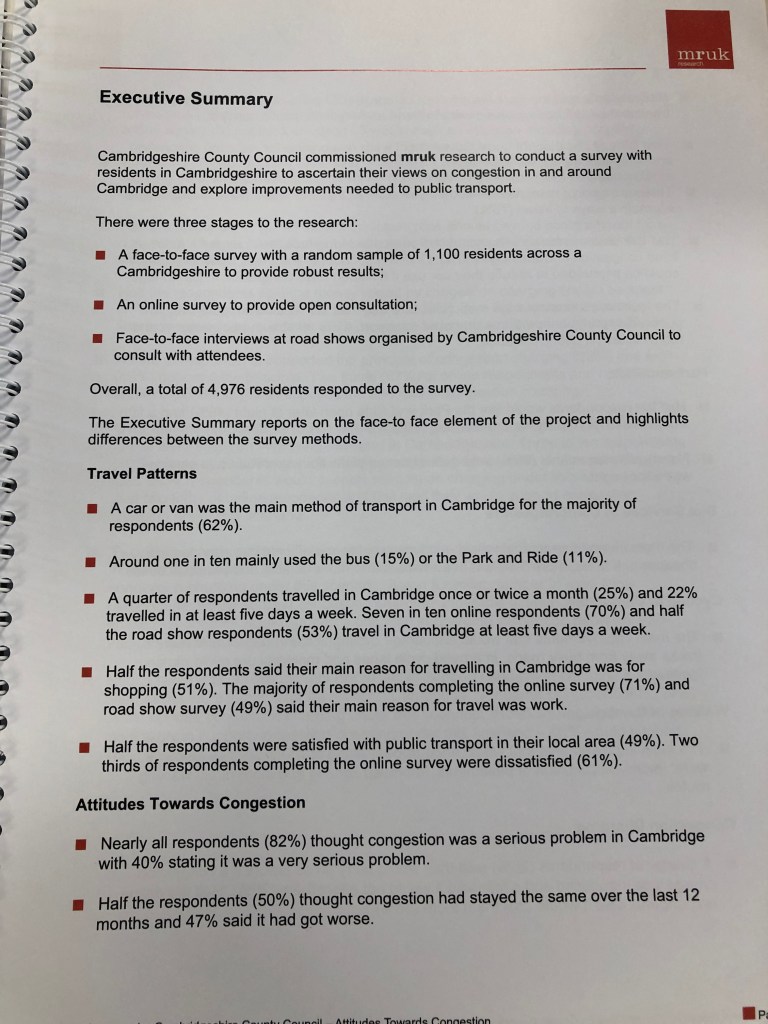
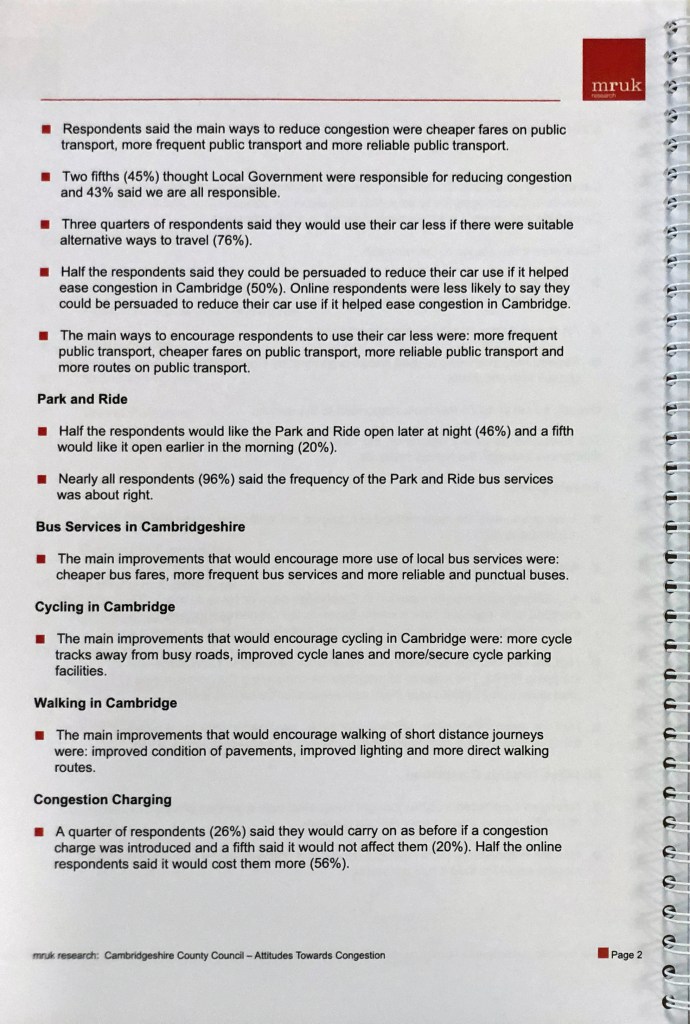
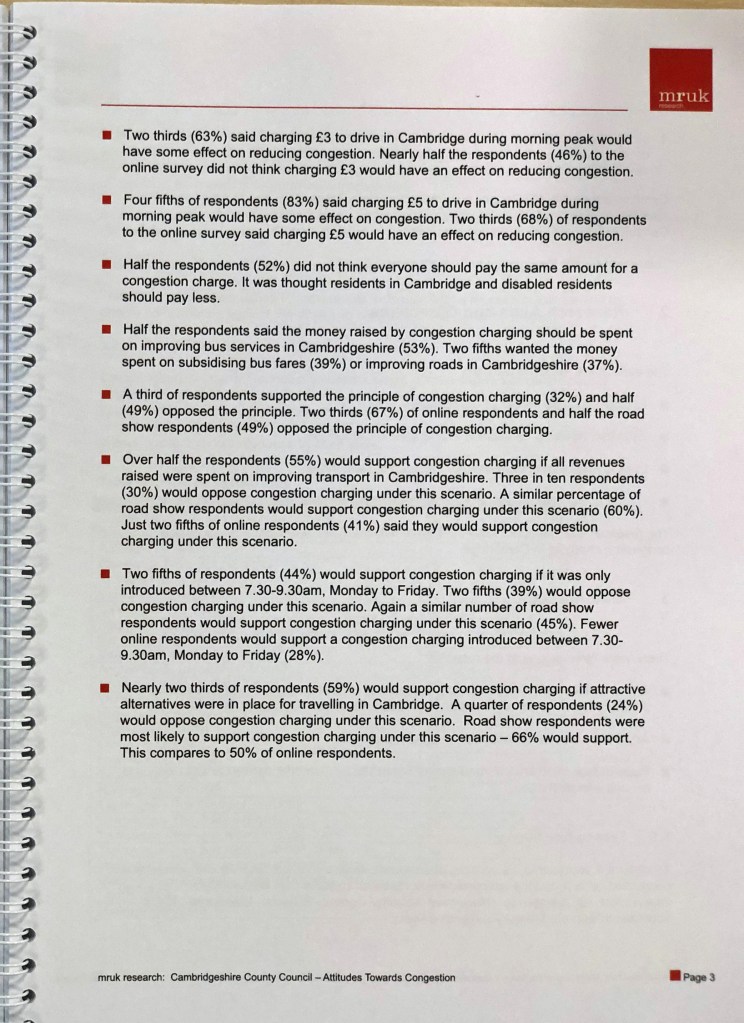

Above – MRUK Research for Cambridgeshire County Council, May 2008.
Alternatively, you can go to the Cambridgeshire Collection on the Third Floor of Cambridge Central Library in Lion Yard and read the document yourself. (It’s reference only – it must not leave the library!)

Above – click on the link here
If you find the document above useful when reading it in the Cambridgeshire Collection, feel free to:
- Tell the local studies librarians how useful you found the document
- Offer to make a small donation only to the collection only (See here, scroll down) that archive is run on a shoestring budget.
- Join the Cambs Association for Local History if you’d like to see more research done on local history – in particular past local transport plans!
“Coming back to why the GCP expended so much political capital…”
I think they are panicking [collectively]. They are under huge pressure to deliver. This is the stage where their busways plans should already be under construction – but they are not. Furthermore:
- They have a gateway review with ministers coming up
- One of the local MPs in the Government’s party (with easy access to ministers that could shut down the GCP) is now openly hostile to the GCP as an entity – not just a single transport project of it, but in its entirety. (See Phil Rodgers here who was the source)
- Michael Gove, the Secretary of State who has ultimate authority over the GCP on whether it should exist or not, has openly declared a very different vision for Cambridge *and* has already appointed the Chairman of Homes England to scope that work – having made that announcement ***without consulting any of the local councils, nor the GCP or the Combined Authority.***
- We are heading into general election territory in what could be the nastiest and most bitter campaign in well over a generation. Given its recent history, the GCP is an easy target to demonstrate ‘action’ and blame party political opponents for it. Which is what the MP for South Cambridgeshire is doing even though his party locally is responsible for the first four years of the GCP’s actions and inactions.
No one is going to come out of this period well. (I dare say myself included).
Because for all of the criticism, I actually wanted the GCP to succeed in delivering that radical improvement in transport infrastructure. And it has achieved things that people had been campaigning for, for years. Take the Chilshom Train north-south cycleway through Cambridge – see the photo of number of cyclists & pedestrians celebrating the completion of the new bridge over the River Cam. Historically, new bridges over the River Cam take ***ages*** to put in place. The Elizabeth Way road bridge opened in the early 1970s had its enabling legislation passed in Queen Victoria’s reign!
Ending up in a position where the GCP is closed down and the remaining funds surrendered back to The Treasury would be soul-destroying for so many people – with the possible exception of the consultants who made a fortune assessing stuff that never got built. But then I’d be crushed if I had spent long hours on something only to see it abandoned.
Given the convoluted decision-making processes, the structures put in place seemed to increase the risk of failure. No single person or entity with ultimate responsibility, fragmented and blurred lines of political accountability, and no clear electoral mandate in the eyes of the people for the big projects.
This is where ministers needed to show some leadership. But didn’t.
It is perfectly legitimate politically for ministers to say that they *are against congestion charging*. The problem is that in our political system, they have to follow that through with action. In this case, it is the Transport Secretary tabling legislation to repeal the legal powers that enable local councils (Certainly outside of London) to bring in such measures. If the Transport Secretary is *not willing* to do that, then he and his ministers should simply say that road user charging decisions are a matter for local government, not central government – Parliament having made up its mind (under the Transport Act 2000) and the Government of the day having no plans to change it. What we have is the worst of both worlds with backbench MPs egging on ministers to speak out on local issues that have been devolved to local government.
This then brings up the issue of the over-centralisation of government and governance in the UK. And the diseconomies of scale trying to micromanage stuff from offices in Central London.
I’ve got the scars and grey hairs to prove how difficult this is to do in practice!
The conversation we now need to have is on the governance of England – not just Cambridge and Cambridgeshire.
With that in mind, here’s a couple of books to read.

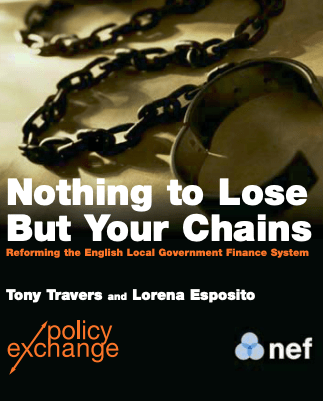
Above–Left: English Gov’t Reformed (1974). Above-right: Reforming Localgov Finance (2004) Digitised
We need to start learning and discussing collectively what alternatives might be like (hence trying to do my part to start some offline chats in workshops here) otherwise yet again Cambridge will find itself with a solution imposed on it from Central London. In. themeantime, the climate emergency won’t allow us the time to wait for them to decide.
Food for thought?
If you are interested in the longer term future of Cambridge, and on what happens at the local democracy meetings where decisions are made, feel free to:
- Follow me on Twitter
- Like my Facebook page
- Consider a small donation to help fund my continued research and reporting on local democracy in and around Cambridge.
 The Cambridge Town Owl