I stumbled across the syllabus for the old BTEC National in Public Services from 2010 for both the uniformed and non-uniformed syllabuses.
You can read the course outlines here.
For those of you who are old like me, “Level 3” is the equivalent of A-level academic standard. The core units for a BTEC Diploma are as follows.
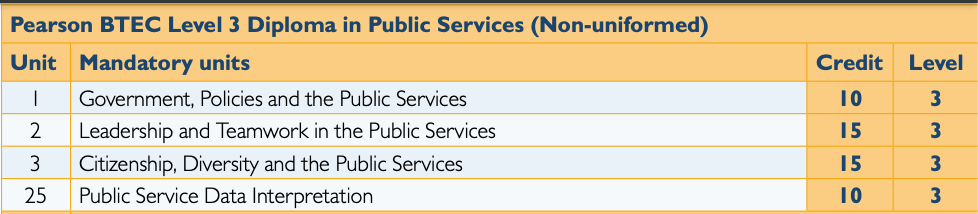
Above – Pearson, BTEC Public Services (2010) Spec, p21
All of those might have been useful for my generation at college had they been available and had someone in a position of real influence said how important knowledge of these would be in the real world outside the education bubble.
The optional units from which students can select from are also worth noting.
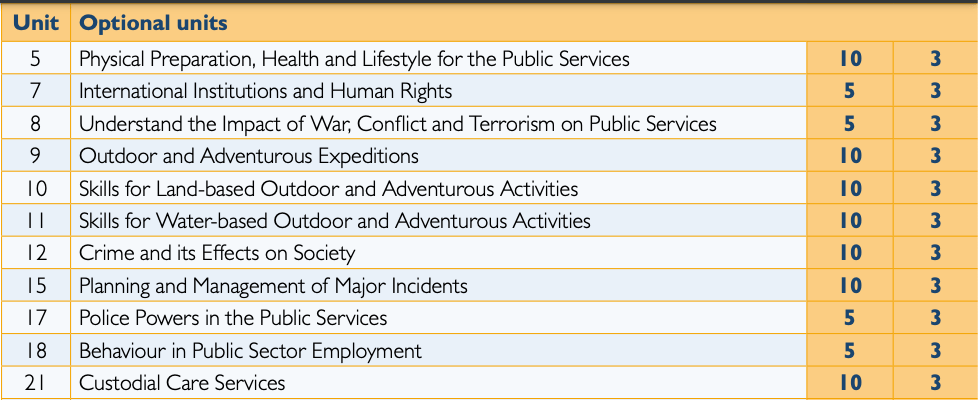
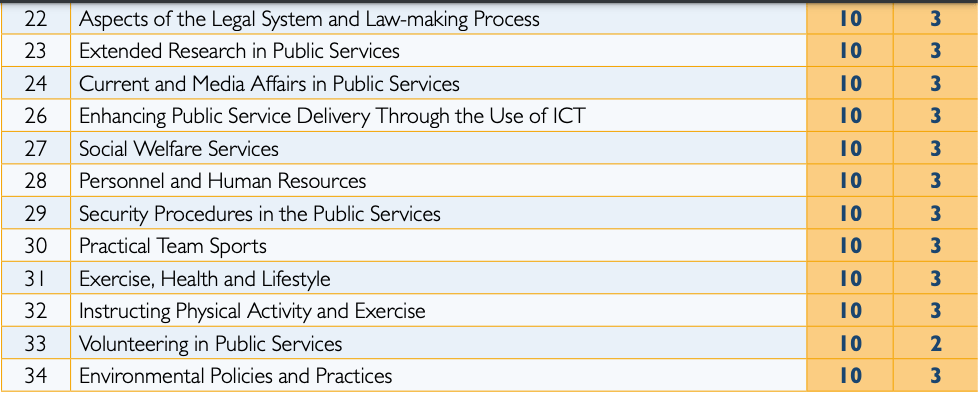
If someone had given me the opportunity during my early civil service days of taking one or two days out per week to study almost any of those modules, I’d have jumped at the chance. Not least on the slower working days that inevitably comes with the peaks and troughs of the political cycle.
“Doesn’t this sound a bit like the four day week?”
Yes – with the South Cambridgeshire trial coming under repeated scrutiny in the latest bout of ministerial phallus flanging in a pathetic attempt to come across all politically macho in the run up to the next general election. It was striking to hear on BBC Any Answers on 09 Sept 2023 testimony from one former prisoner about the decline in rehabilitation functions inside prisons. Not that you should take the testimony of one person as the reason to change a policy – rather it says to the listener: “Dig here”. i.e. “Ask more questions” of those in charge.
Which then brings us to former Prime Minister Sir John Major and his recent comments on the Government’s policy on prisons.
“When discussing rehabilitation he said the current approach ignores the public interest that the crime is never repeated.”
Lauren Terrell, The Justice Gap, 11 May 2023
You can read a transcript of Sir John’s speech here.
Some of you may recall in the early 1990s that ‘hardline’ Home Secretary Michael Howard was regularly in the media over this policies (see here) and rhetoric – especially in the run up to the 1997 general election as Labour’s own ‘hard man’ Jack Straw went in on ‘Tough on crime, tough on the causes of crime’ – the latter being a nod to the reformers with concerns about repeat offending and offenders with very long criminal records. Yet social history tells us that all but the most punitive of strong punishments (eg capital) don’t stop a person from reoffending.
“Three Notorious Scoundrels — As our readers perceive from our police report, those notorious housebreakers Pickle Bell, Paddy Groves, and Doddy Shadbolt were committed for trial at the ensuing Quarter on a charge of robbing the house of Mr John Hagger, of Shelford.“
Roguishness and vagabondery in Victorian Cambridge – 1851.
The crazy thing about the above episode in Cambridge’s history? ‘The notorious Doddy Shadbolt was transported to Australia in 1851 for seven years ***and managed to return to continue his criminal enterprises before his sentence was complete!***
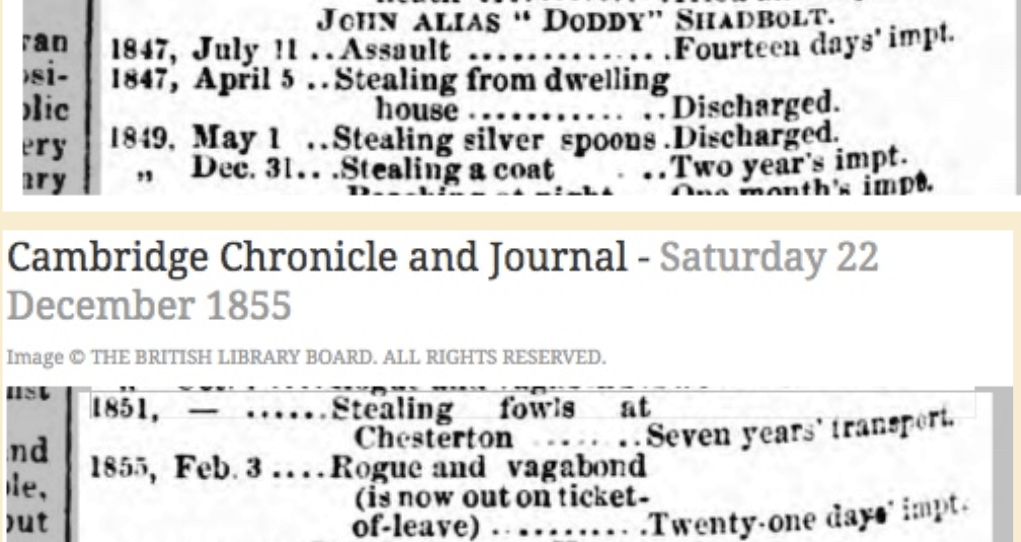
Above – CCJ 22 Dec 1855, from the British Newspaper Archive
Which then puts the units on the BTEC Public Services into context when it comes to alternative policies to deal with those being dealt with by the criminal justice system. And it is a system at breaking point.
“No one ever wants to see an escape from Prison but since 2010 this union has been on record as saying cuts have consequences. You cannot take out £900 million from the budget with reduced staffing levels up and down the country and expect the Prison Service to operate as if nothing has happened. “
Prison Officers’ Association trade union, 07 Sept 2023
“Isn’t public services a bit like ‘applied sociology’?
You could say that. For anyone unfamiliar with sociology except from conservative commentators labelling it an easy subject, either go into a bookshop and browse through a text book, or buy one from a charity shop (or get a super-cheap older edition online – and donate. toa charity shop when you’re done with it) two of the main themes that stand out are inequalities in society, and responses to crime in society. One of the things I’ve noticed with the still new https://www.cambsnews.co.uk/ news site for North Cambridgeshire by former Wisbech & Ely Standard editor John Elworthy are the frequent reports from the courts. Again this is important public interest reporting – and the staple of local news media ever since newspapers were invented. (Hence why I think the BBC’s local democracy reporting service should be expanded to cover local court reporters)
“It still misses out the NHS & Public Health”
This is covered in the Health and Social Care T-Level – in particular Unit 24 on Public Health.
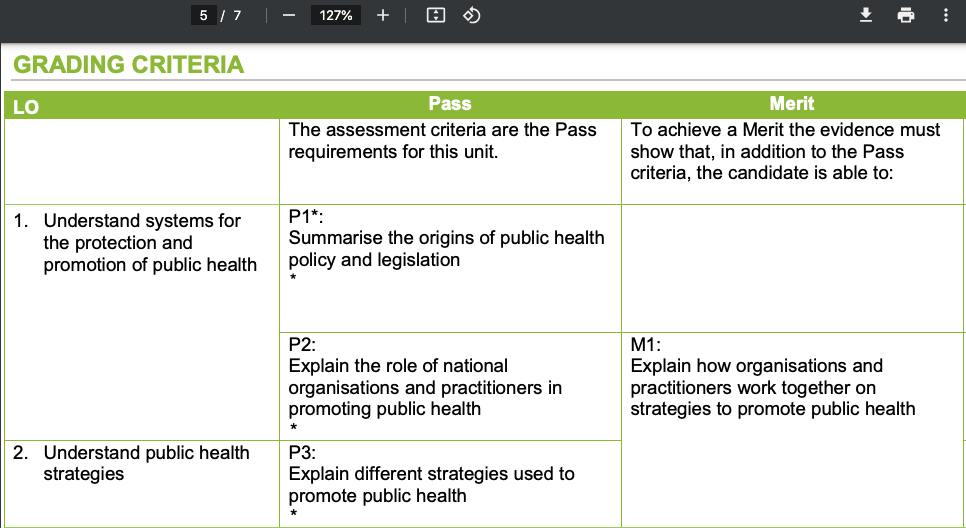
Above – from Unit 24 of the Cambridge T-Level – you can browse the other units here.
Sadly these don’t seem to be available as standalone modules suitable for evening classes. and lifelong learning centres.
“Town planning is missing too”
That’s covered in the BTEC for Construction and the Built Environment, although they only seem to be available as options in the extended diplomas rather than as mandatory in the shorter qualifications.
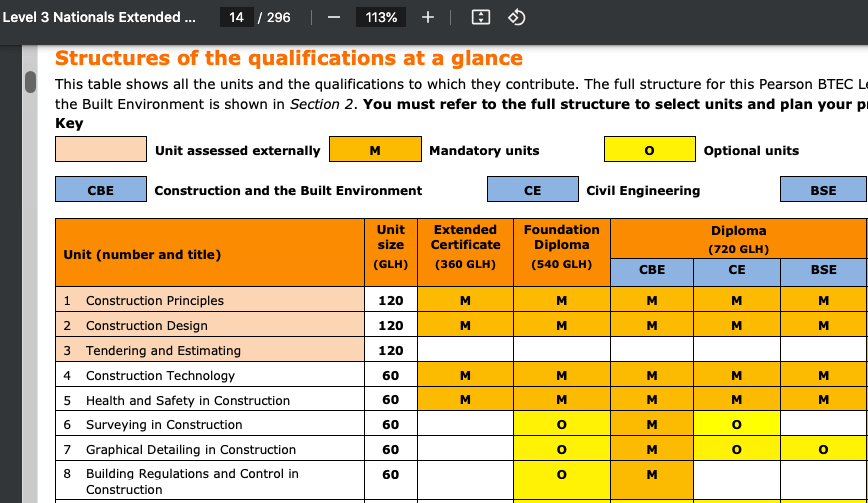
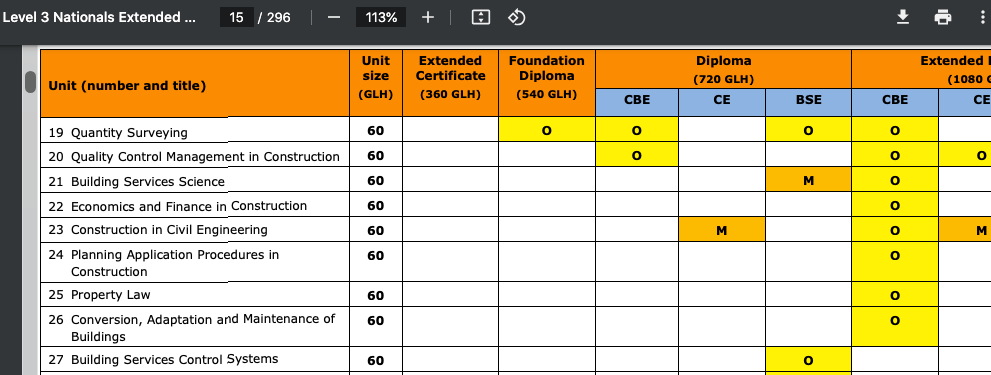
Above – Planning application procedures covered in Unit 24 – optional in the extended diploma.
The document goes into more detail on coverage of the planning system and building control – and how the law affects the vocation.
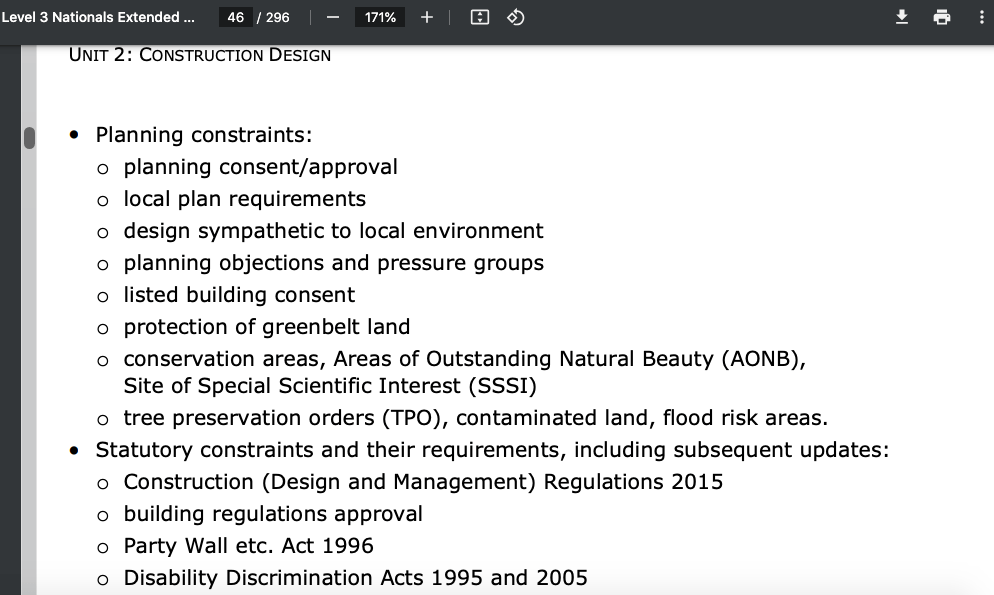
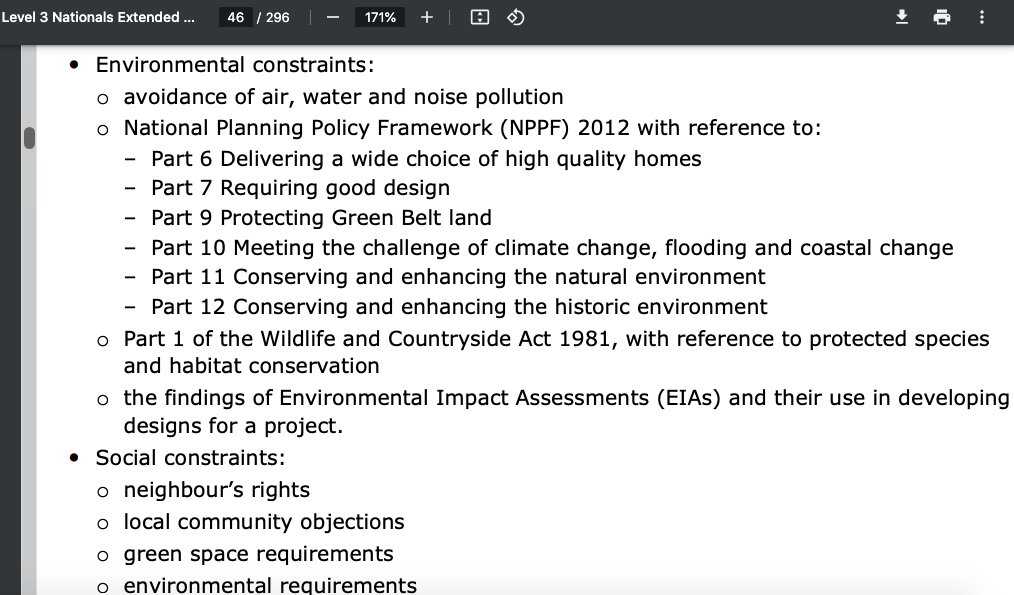
Above – from pages 45-46 of the specification
“We’ve been here before, haven’t we?”
“So…what’s changed?”
Feedback from people following the Greater Cambridge Partnership Assembly.
Themes that are emerging include:
- Issues on the future of Cambridge that are important to residents in and around the city but which have no direct local democratic forum – such as the provision of NHS GP and dentistry services
- Over-complicated structures of governance which make it very difficult for journalists to report from (due to multiple meetings vs longterm cuts to local and regional media)…which then makes it…>
- …impossible for the public to keep a track on who is making decisions on what without going ***way out of their way*** to keep up to date to the extent that living a normal life ceases. (I am not normal in that regard!)
- The continuing under-provision of citizenship education in Cambridgeshire schools reflected by only 145 entries for the GCSE in Citizenship Studies in 2022 when the qualification would be an ideal option for less academically-inclined as an alternative to other humanities such as history and geography. (Not least because the Citizenship Studies syllabus requires students to get out and about in their community doing practical work – geography often takes students further afield)
Listening to a couple of teenagers I met at a community event in Coleridge today (the re-opening of St Martin’s following a 3 year building programme) they told me they hardly touched on politics and local democracy at school. Which makes me wonder about the collective position of citizenship learning (formal or informal) for teenagers.
Why does this matter? Because at the GCP Assembly we heard the members debating about how older people were disproportionately more likely to respond to public consultations than younger people.
One straight forward way of dealing with this is for the authorities responsible to come up with a series of locally-researched and produced teaching materials and guides for teachers. That along with continued CPD workshops on citizenship involving local council and other public sector organisations would help keep teachers up to date on what real life changes are happening in and around our city that children and teenagers can not only participate in, but get credited for it in the qualifications they study for.
In the olden days Cambridgeshire County Council used to have an in-house publications department that produced such materials.
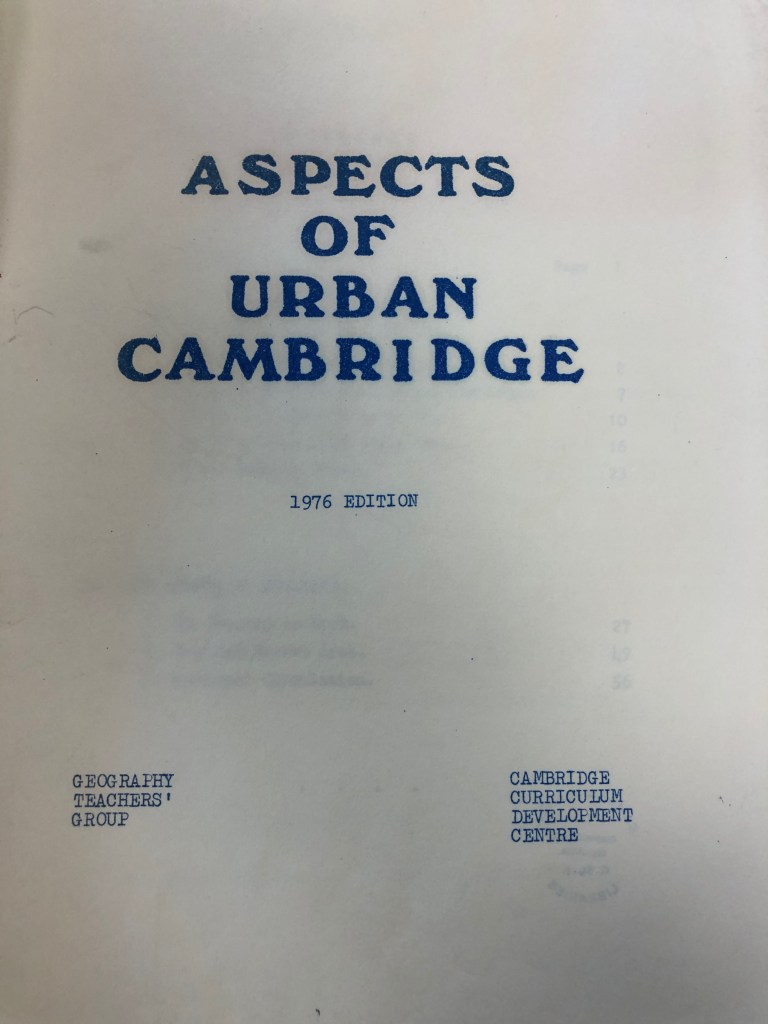
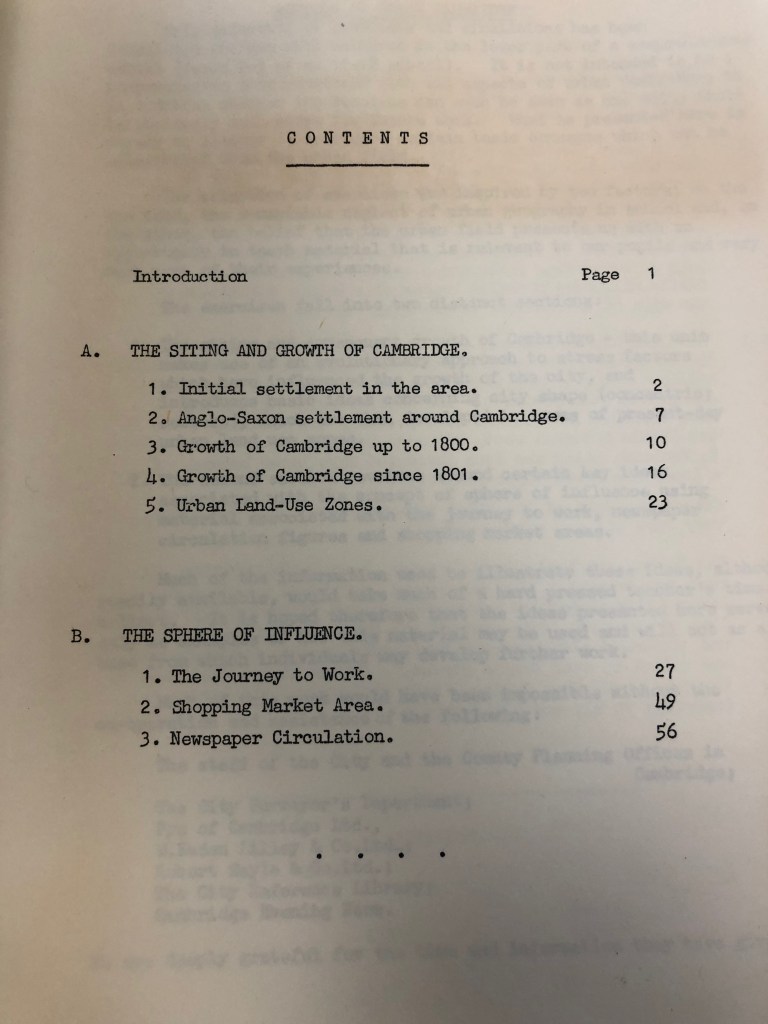
Above – Aspects of Cambridge by CCDC of Cambridgeshire County Council 1976 which you can access in the Cambridgeshire Collection in the Central Library.
You can see a detail of the Journey to work board game in this blogpost which may sound familiar if you’ve been stuck in a traffic jam.
Thus we come back to that same of problem of local government no longer having the capacity, let alone the in house knowledge or facilities to produce the materials that schools and teachers might want or need. The false economies of privatisation and outsourcing. Hoping that ‘big society’ might step in is no way to run a public service.
“So, what can we do about it?”
I was going to send in a PQ to the next CYP Committee on 10 October 2023. But with Michael Gove removing local authority control from schools and effectively centralising them, there is no local route to ensure teachers are getting the support and resources that they need in order to familiarise their pupils and students with how their city and county functions – and how to hold decision-makers to account. Given that GCSE Citizenship Studies has been a thing for the past 20 years, you’d have thought more schools would. be offering it by now, and far more than 145 students per year *across the county* would be selecting it as a subject. And that’s not mentioning the complete lack of citizenship education or ‘how our city functions’ learning offers around. Not that my offer is any more popular! No one has signed up yet. (Still 21 days to go and counting!) But as I mentioned recently, social media is fragmenting and the only way to get people interested and motivated is through tried and tested methods of leaflets and face-to-face conversations.
Food for thought?
If you are interested in the longer term future of Cambridge, and on what happens at the local democracy meetings where decisions are made, feel free to:
- Follow me on Twitter
- Like my Facebook page
- Consider a small donation to help fund my continued research and reporting on local democracy in and around Cambridge.