
Mixed – even polarised reactions to the Innovate Cambridge event. (Image – from Theresa May’s Civil Society Strategy 2018 which I wrote about here)
Some of you may recall the launch of Innovate Cambridge in September 2022 – see the Cambridge Independent here.
“…an ambitious Greater Cambridge organisation that aims to collectively agree on and define an inclusive vision for the future of Cambridge and its innovation ecosystem to be implemented over the next decade.”
Cambridge Independent 23 Sept 2022
For those of you that missed it, you can read the Innovation Cambridge Charter here. Furthermore, you can view who is on the Steering Committee here – see if you recognise any names and organisations.
“Vision for the future of Cambridge? Well I didn’t vote for it!”
Exactly
Above – Terry Macalister, former Energy Correspondent at The Guardian, responds
Fast forward to December 2022 and the University of Cambridge updated progress
“Tabitha Goldstaub, co-founder of festival and online platform CogX and a UK government advisor, has been appointed Innovate Cambridge’s Executive Director and the Rt Hon. Lord Willetts as Chair of its Steering Committee. Other members of the Steering Committee include:
- Professor Andy Neely, Pro-Vice-Chancellor for Enterprise and Business Relations at the University of Cambridge,
- Professor Yvonne Barnett, Deputy Vice-Chancellor for Research and Innovation for Anglia Ruskin University,
- Shaun Grady, AstraZeneca’s Senior Vice-President Business Development Operations and
- Robert Pollock, Chief Executive of Cambridge City Council.”
As mentioned earlier, you can view who is on the Steering Committee here.
“All of those people are very busy people – do they have time to be on *yet another* steering committee, partnership board, project group or think force?”
During my civil service days I often wonder that myself when I saw how many different project and programme boards different senior civil servants had to be on.
“Who invented that?”
It feels like something straight out of Rishi Sunak’s speech, but isn’t.
“Towns that will be given the opportunity to develop a long-term plan supported by a Towns Board.”
Downing Street press release 30 September 2023
Above – Rishi Sunak re-invents the borough council.
Cambridge [the city of] needs to consolidate and condense the number of boards, committees, and forums to strengthen transparency and democratic oversight
I’ve asked The Institute of Local Government Studies at the University of Birmingham to ask some of its researchers to have a look at the governance structures of Cambridge and Cambridgeshire
“Couldn’t Cambridge University or ARU do it?”
The University of Cambridge *as an institution* would have a conflict of interest if it were asked ‘to examine itself independently’. Furthermore, the University of Birmingham has got the academic expertise in that specialist field. We are also beyond the stage where someone with both the academic expertise in the field (not least in comparative local government) and someone who can approach the challenge with a fresh look can speak truth to power – local and national.
Thematic areas of action – where the University of Cambridge and partners are failing
This is from page three of Innovation Cambridge Charter: the themes
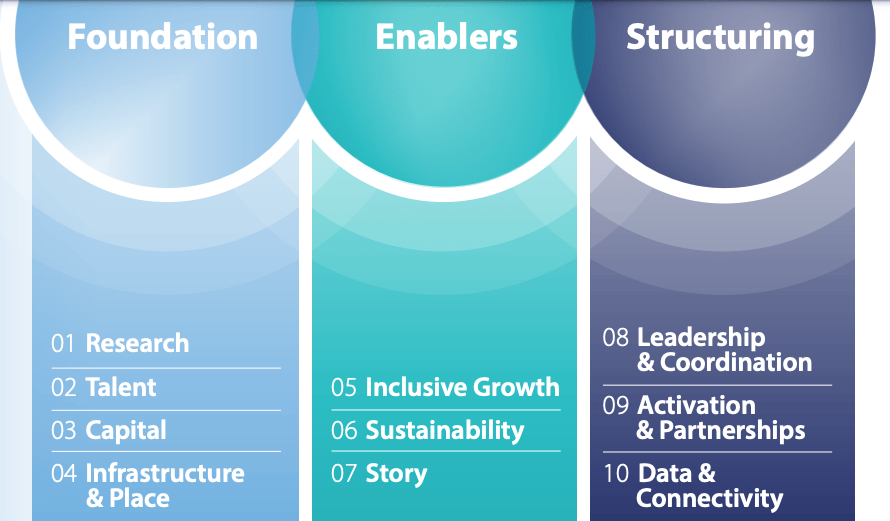
Each page has a few paragraphs for each section.
“Cambridge must develop the infrastructure needed to support our ambition”
Innovation Cambridge Charter
Above: ***Says who?***
Again, this comes back to the lack of informed consent from the people who make up our city, including:
- Residents
- Commuters (without whom our city would collapse)
- Students (not just in higher education but the all-important further education students who for generations have had sand kicked in their faces by successive governments over woeful public transport)
- Regular visitors such as those who may have longstanding historical, to new familial links to Cambridge. (Eg they grew up here, moved away, but still return regularly to visit parents /siblings etc).
The reason why this matters is because the electorate of Cambridge has already demonstrated it has the influence to bring down major transport proposals developed by poorly-designed partnerships and committees – especially those that did not demonstrate effective working with residents and potential service users *at design stage*. I was one of the people who observed the journey of the Greater Cambridge Partnership – starting off as a critical friend and finishing off standing on an election platform calling for its abolition eight years later. That should not have happened.
I saw for myself how (in my view) senior officers set the parameters of studies and consultations to give them the answers most likely to support what they wanted to do anyway. The Haverhill-Cambridge corridor consultations being a classic case. The GCP now finds itself in a politically hostile environment that it was never designed to cope with. What’s to say the same won’t happen again after the next general election if the Conservatives in and around Cambridge find themselves in opposition in Westminster, and also find there is an electoral benefit in opposing the very policies and institutions they created while in government and in control of two of the three local councils?
Innovation Cambridge failing on the Infrastructure and Place foundation theme
This for me is the result of its very insular culture that engages with the already affluent, influntial and/or well-connected, while excluding everyone else – in particular those who are likely to be most affected by their plans.
“It will incorporate the large-scale innovation district infrastructure needed to sustain and accelerate our capacity to translate research to impact. This includes the need for transport solutions which enable employees to access these major employment sites in a way which is both sustainable and affordable.”
Innovation Charter p4
If I was stereotyping, I’d assume that paragraph was written by an affluent bloke – if not signed off by one who had never had to take on childcare or elderly care responsibilities while being completely dependent on public transport or active travel. What’s the giveaway? It’s the A-to-B mindset of commuter-style travel routes. Ask any parent dependent on public transport – or those that would like to use public transport more if it were better designed and far better provided, and they’ll tell you that A-to-B service lines don’t meet their needs.
What that paragraph reflects is a mindset that:
- has no interest in providing a transport network beyond their own premises other than to major transport hubs (think the private commuter shuttle buses that pump out diesel fumes in my neighbourhood. Why should local residents subsidise their transport costs with our health?!?)
- views public transport purely as an employee facility from the mindset of the employer, rather than as a public service that cities are dependent on in order to function;
- has absolutely no interest in serving the people who might happen to live near by, even though some of the more open-minded senior executives in the sci-tech property world openly encourage people from surrounding area to make use of their facilities
Cambridge is not your place to turn into an exclusive gated community – town-folk have spent the past 800 years trying to reverse the trend established by the colleges and imposed by successive medieval monarchs. The town started making real progress at the end of the 1800s in order that Cambridge could become greater than the sum of our town-and-gown parts. Proposals for exclusive districts risk reversing those co-operative gains. Furthermore, Cambridge is the most unequal city in the UK – and the negative impacts of inequalities in society are well known in the humanities and social sciences fields of which Cambridge has more than a few experts researching in those fields. Go and consult them on the risks associated with designing in inequalities and exclusivity.
Fortunately there are a growing number of people within university and STEM circles who are more than willing to challenge decision-makers and raise those difficult issues. Here’s Anne Bailey, founder of Form the Future.
Anne has spent over a decade doing outreach work at schools across Cambridge and Cambridgeshire. Therefore she gets to meet the children and teenagers who live in some of our most economically deprived parts of our city on a more regular basis than most of us, working with them to ensure they get to benefit from what’s happening in our cities in. away that my generation of teenagers in the 1990s could only have ever dreamt of.
“”The Cambridge Pledge” – sounds interesting, but how could it go wrong?”
One of the things the civil service trained me up for was policy risk assessments: How could this thing go so spectacularly wrong to the extent that the whole thing was a complete disaster? Or rather, where it ended up in complete failure and was quietly forgotten about? (Politics students may wish to consult previous general election manifestos of winning parties and assess which election pledges got dropped and why).
The three big risks here are:
- Firms see the pledge as a ‘cost of business’ irrespective of whether their business activities are in the wider interests of the city. For example in the property sector we end up with buildings that meet the financial requirements of the international property market rather than the housing needs of the city. (This is a wider public policy failure requiring government intervention that is yet to happen).
- Firms see the pledge as a ‘thus far and no more’ contribution to the city – a sort of ‘licence to operate’ while not doing anything substantial to change their way of working or the culture of their institutions (or even sector) that could benefit the wider city and reduce inequalities.
- Firms and their senior decision-makers & influencers see the pledge as primarily a financial commitment and not a civic commitment.
Civic Culture – It Matters
There are a number of figures past and present who I could name who set a positive example. My top two are:
- Sir David Robinson (Think The Rosie Hospital – named after my late uncle’s grandmother)
- Charles Kelsey Kerridge (think the sports centre. Him.)
Politically, both were Conservative Party supporters, but they understood the importance of civic responsibilities that came with financial success in business. And not simply throwing money at charitable causes but taking a meaningful interest in supporting causes and projects that still have a legacy long after their passing.
One of the drawbacks of the corporatisation of fund-raising is the diminishing of the personal and human interest as firms outsource “CSR” activities to community engagement firms and seek all sorts of metrics to demonstrate quantitative returns on investments. But some things don’t have a financial return – as I found out with the Coleridge Rec Dragon Slide – commissioned by Cambridge City Council after Puffles polled 89 votes in the city council elections in Coleridge Ward in 2014.


Above-left – Puffles scrutinising the GCP in Cambourne; above-right Me with the dragon slide during the Cambridge Playlaws Project of Summer 2023
Such is the size of the slide that it’s a neighbourhood geographical point of reference, as well as being popular with the younger children. Earlier this summer I overheard one small voice saying: ***Wow Daddy! Look at that big dragon slide!*** In an area that has a fair amount of council and social housing, you can’t put a monetary value on that response, irrespective of how much it cost to put the slide there in the first place.
If Cambridge is going to develop a ‘Cambridge Pledge’, the criteria need to be flexible enough to encourage people of all levels of affluence to make a meaningful human connection with our wider city. And that’s not an easy ask. Because such things are not one-off actions, but require commitments over an extended period of time. Furthermore, they require more than a cursory level of research. Not everyone is going to be willing or able to to do a deep dive. But as I’ve said before, there’s strength in diversity. Not everyone needs to bundle into the single most economically-deprived ward to ‘sort things out’ top-down style. Furthermore, some of the pledges could involve things like:
- paying a rate higher than the Cambridge Living Wage to the lowest paid staff or contractors.
- Adopting a maximum pay ratio to reduce the inequalities between the highest and lowest paid in a firm (20:1 has been suggested by the Communication Workers’ Union)
- Recognising an established trade union for staff
- Providing information for employees (especially new employees) on local support groups that may help them settle into the city – such as the Acorn Tenants Union in Cambridge (*Declaration of interest, I am a member).
- Commit to commissioning services from local suppliers rather than large corporate chains, ensuring more of the benefits stay within the wider local economy
Finally, the pledge does not have to be a series of tick-boxes.
It can be modelled on the old Code for Sustainable Homes or the National Baccalaureate Trust’s campaign for a wider English Bacc, which I wrote about here.
Using the old NHBC’s guidance, the difference categories each have a number of credits.

Have a simple ‘Bronze, Silver, and Gold’ Awards, with tougher minimum standards across each category that rise as you go up. That way you avoid the risk of a very wealthy firm donating a large sum to some local charities and in effect ‘buying’ an award.
This can also be demonstrated with the National Baccalaureate Trust‘s model
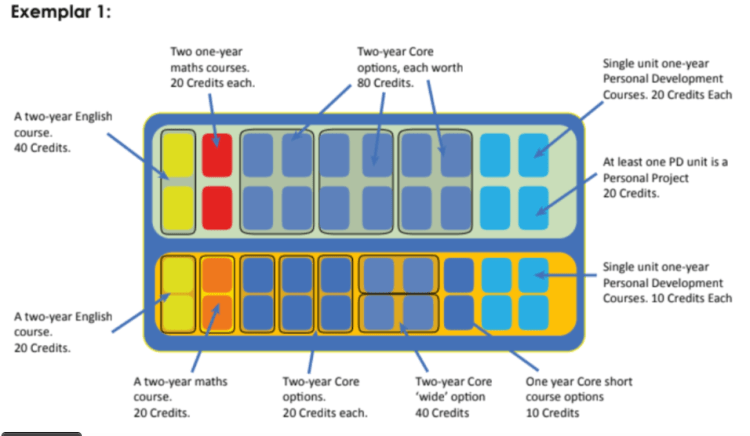
The award is made up of a series of components with core and additional/optional components. For me it’s essential that the core components of a Cambridge Pledge remove the risk of buying an award, and instead incentivise staff engagement from board room to stock room, as well as corporate culture change. Amongst other things, it has to challenge firms (and individuals within them – especially at boardroom level) to do things that involve them being in unfamiliar, and initially uncomfortable environments. The sort of action that may not make sense until after they have completed it – after which it has broadened their outlook. (Think the Undercover Boss series in the early 2010s on TV).
Because if Cambridge can get beyond the mindset of a transaction, those pledges could help strengthen the other themes – particularly on sustainability, inclusive growth, and more importantly a shared story that we are all part of.
At the moment though, we are a very long way off. That said, if we are as good as many in the sector say we are, that challenge is not an impossible one. Quite the opposite.
Food for thought?
If you are interested in the longer term future of Cambridge, and on what happens at the local democracy meetings where decisions are made, feel free to:
- Follow me on Twitter
- Like my Facebook page
- Consider a small donation to help fund my continued research and reporting on local democracy in and around Cambridge.
 The Cambridge Town Owl
Thank you Antony..
I had no idea about this Innovate Cambridge body.
Very unhappy about its lack of democracy and connection with the people who live in the City.
I’ll read over the week.. make sense if it all before commenting further on this over-lording-it group.
Best wishes
Penny
LikeLike