
Is it worth revisiting some of the policies of the previous Labour government in the run-up to the general election? For their candidates and activists interested in local government policy, most definitely yes.
I declare an interest as a former civil servant who worked during that last Labour government – I took a redundancy package just over a year after the general election in 2010. In the year or so leading up to that election, the old Department for Communities and Local Government. It was the logical direction of policy in trying to bring all of the public services together and to share budgets and local policies without actually going through a Redcliffe-Maud-Style major overhaul of local government that Harold Wilson’s Government included for their 1970 general election manifesto. (They lost that election).
The best way to think about the opposite of ‘Total Place’ is when a local council planning committee approves a large planning application for a developer to build lots of homes, but provide the bare minimum the law requires for community facilities.
One big complaint everywhere is the lack of doctors’ surgeries and dental clinics. There’s nothing in law that requires developers and/or the financiers involved in the land and site transactions (those who make the profits) to ensure that any buildings allocated for local health care facilities are actually funded and staffed. That is a responsibility for whatever latest restructuring fads the latest health secretary has come up with. (It was Integrated Care Systems at the last check!). These replaced Andrew Lansley’s failed Clinical Commissioning Groups which he controversially brought in while Health Secretary and MP for South Cambridgeshire in order to replace Primary Care Trusts and Strategic Health Authorities – all of which sat outside the direct remit of local government. Hence the talk of public sector silos. That was an example of said silos where institutions did not co-operate with each other.
You can tell this Total Place document is old because of the old-skool branding of the old Department for Communities and Local Government
In Spring 2010, ministers published this document – a management consultant-style slide pack. All 86 of them.
Which is why what Mary McKenna shared with me earlier also matters.
“The maven is a person who accumulates subject matter expertise and is willing to distribute that knowledge on request.
A connector is a well known person connected to multiple groups in an organisation.“
Paul Taylor citing Malcolm Gladwell, 08 December 2023 via Mary McKenna
I used to be the latter during my civil service days and have ended up as the former in my less-mobile, more broken state in my present days, which is a strange situation to be in.
It’s easy to forget how much the public sector has changed in the last 15 years – i.e. since the Financial Crash.
Yet if we compare that 15 year time period to say:
- 1935-1950 (The demands of a total war economy, followed by the creation of the welfare state and mass-centralisation)
- 1980-1995 (The demands of mass-financialisation, privatisation and outsourcing, and the demise of large state and public sector institutions)
…then the past 15 years arguably have, in some parts at least, come close to matching the social and cultural changes of those eras.
It doesn’t necessarily follow that the policies developed by an outgoing government are irrelevant. Rather, one question that it’s worth asking (given the civil service resources they committed to the policy development) is: “What’s changed since then?”
The reason why Total Place should interest Labour policy-makers is because their shadow ministers and senior policy advisers within their party political sphere are asking similar questions within a similar public finance constraints: i.e. the need to improve public services but not having much financial flexibility within which to do so. Furthermore, the complaint about over-centralisation of the UK state in the mid-2000s are just as strong today as they were 20 years ago.
At the same time, evaluating public policy is an under-rated area of academic research – and yet it is essential if we are to improve our policy-making systems. Take the party-political rhetoric around privatisation – I picked out what Michael Heseltine as Deputy Prime Minister in 1994 wrote about privatisation.
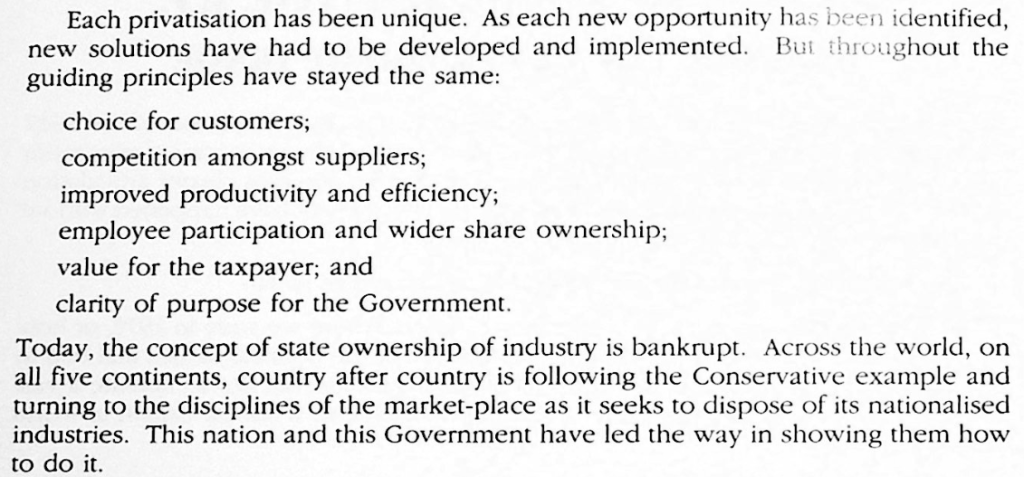
Above – From Privatisation: Everyone’s a Winner (1994) CPC
- Choice for customers
- Competition amongst suppliers
- Improved productivity and efficiency
- Employee participation and wider share ownership
- Value for the taxpayer
- Clarity of purpose for the Government
Here’s Labour’s candidate for South Cambridgeshire Dan Greef in 2017 sparring with a constituent over the above sorts of benefits with a potential voter
Above – Dan Greef (Labour – South Cambs 2017) at the Great Shelford Hustings, 17 May 2017
Put into the context of the sewage scandals that have hit the headlines repeatedly in recent times, and the chronic failures of ministers to deal with the problem, this is one of a number of big policy areas that, decades after implementation, need evaluating.
“So…what was Total Place?”
Essential it was a concept – one that involved all major public sector providers to pool their budgets and resources to deliver local public services and to address chronic problems specific to their local area.
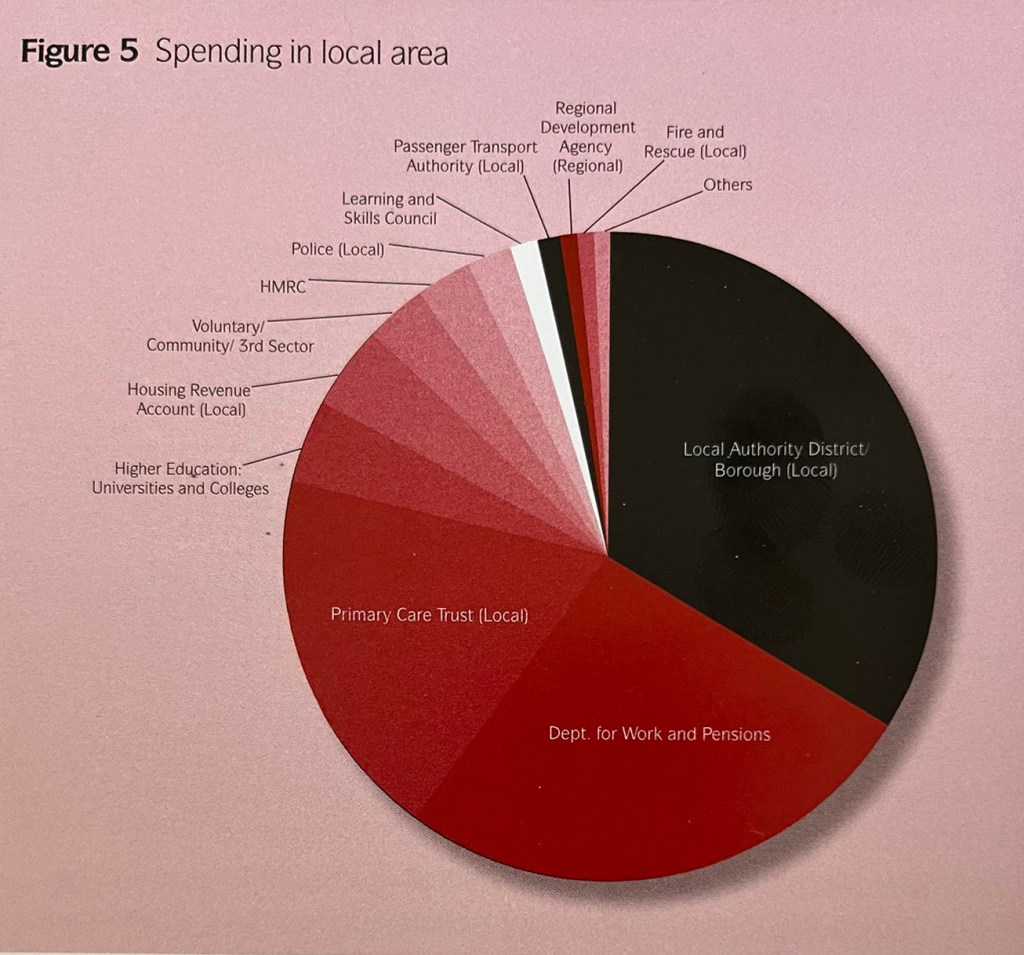
Above – from Keohane and Smith (2010) NLGN (noting significant changes to institutions since then incl abolition of PCTs and RDAs)
If we take Cambridgeshire as a microcosm of our polarised society, the problems facing the City of Cambridge require a different set of policies to deal with them compared with the district of Fenland, some 40 miles north where very poor transport connections and poor infrastructure mean it is significantly more economically deprived than the globally-famous university city. Yet the local councils for both are enfeebled entities either way.
The ideological difference between the Conservatives and Labour
When Eric Pickles and George Osborne hit the public sector with their big axe (taking my civil service career with it!) the benefit to local areas was meant to be getting rid of all of the performance management frameworks that the previous Labour Government had put in place. One of the things that had irritated Conservative-run councils for over a decade was what they saw as central government intervening in things that they thought should be the responsibility of local government alone. Labour ministers on the other hand saw the impact of 18 years of austerity under the governments of Thatcher and Major, and took the view that they did not have the time in their early years to try and rebuild local government, so simply tabled legislation to create national agencies of government to bypass local councils and get on with things. Which is easier said than done. The latter years of the Labour Government involved bringing in policies to rein in the huge amount of performance management required by that system – of which Total Place was one such policy. As the executive summary states below in slide no.9 / p5
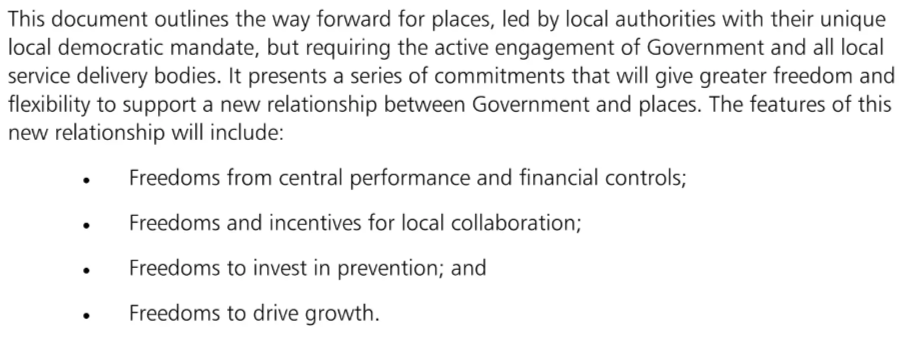
Above – Total Place by CLG/HMT April 2010
The language sounds very familiar to what Labour’s shadow ministers are saying today – investing in prevention, driving growth, limiting ‘top-down’ control. In the meantime, the removal of the Audit Commission and the failure of Eric Pickle’s replacement of ‘relying on the market’ has come home to roost with more and more local councils declaring themselves unable to balance the books. As Jessica Studdert points out below.
Austerity inevitably caught out some of those councils that had made some very poor investments as well as those that had broken the rules. The situation now, however is one where even well-managed councils cannot meet their legal requirements on public service provision with the meagre resources that ministers are providing. One of the first challenges for any new government is how to respond to that crisis.
Two ***huge but missing pillars*** that need to be addressed by the next government
One of the reasons I’m giving councillors in and around Cambridge a hard time on citizenship and democracy education is because two of the gaps I found during my civil service days are still there. Nearly all of the policy documents and models I’ve stumbled across make four very strong assumptions that when compared with real life, are found wanting:
- The public has the time to spare to take part in improving public services
- The public has the knowledge of public services to make a meaningful contribution
- The public has the desire to make a meaningful contribution
- The public can afford to take time out of their working lives to carry out the voluntary roles required to help improve public services
Take all of the above and the lack of diversity in local government and in the candidates standing for public office (whether elected or appointed) becomes all the more clear.

Above – from Place-based Health by Studdert and Stopforth p5
Two policies that I think would have an indirect but significant impact on the number of people stepping forward are:
- Universal basic income
- A four-day week
The first deals with the costs of living barriers, the second deals with the time during the day. That’s not to say those policies alone would be sufficient. Policy makers also have to come up with systems to educate the public that is unfamiliar with the essentials of politics and public policy. That means reviving the culture of lifelong learning across the country as well as reviving citizenship education in schools – the latter of which the Conservatives de-prioritised in schools, and the former of which both Labour, Coalition, and Conservative Governments have underfunded and/or redirected funding towards vocational skills and basic skills.
One of the big unforeseen costs of cutting arts, craft, sports and leisure funding in the lifelong learning sector is loneliness in society.
“In 2017, New Economics Foundation produced a report on the Cost of Loneliness to UK Employers. This report, launched jointly by the Co-op and New Economics Foundation and issued in conjunction with the Jo Cox National Commission on Loneliness, put the cost of loneliness to employers at £2.5 billion a year.”
https://www.campaigntoendloneliness.org/costs-of-loneliness/
And that’s before you consider the health costs – in particular mental health costs – onto the NHS.
Is democracy and citizenship education something that would fall into core skills?
Unlikely unless it were built into basic skills – but that would mean anyone who already had basic English and Maths inevitably missing out. Trying to find out what the current expenditure – if any, on non-vocational lifelong learning activities is very difficult to find.
Above – from the IFLL Inquiry from 2021
The above-linked paper goes into a host of technical detail but trying to disaggregate the funding to pick out funding for the sorts of courses and activities that bring adults together – in particular arts, music, sports, and creative subjects are actually very difficult to find. Furthermore, the trend in recent decades has been to remove core funding from providers – the funding that enables them to keep the lights on, the rooms heated, the buildings maintained and the facilities staffed, towards ‘direct delivery’ – subsidising teachers and materials only – unless you can somehow account for the core costs within those costs.
“Could a future Labour Government bring back something like Total Place?”
They could.
But it wouldn’t be in the form of taking an old policy document and saying: “Done it!”
Too much has changed in politics and society for that to happen. And that’s just with the technological advances. That’s not accounting for the shared traumas of both Brexit and the Pandemic. Furthermore, the climate emergency is going to force a series of changes to our built environment onto us anyway, so adaptation to things like extreme heat and extreme short, sharp rainfall will have to be incorporated into whatever they plan for the future. Yet I remain of the view that policies including:
- A reduced working week
- Universal basic income
- Democracy education as part of overhauling lifelong learning
…are essential components.
Food for thought?
If you are interested in the longer term future of Cambridge, and on what happens at the local democracy meetings where decisions are made, feel free to:
- Follow me on Twitter
- Like my Facebook page
- Consider a small donation to help fund my continued research and reporting on local democracy in and around Cambridge.

 The Cambridge Town Owl