At the first online meeting of the Cambs Unitaries Campaign (I can’t name names because The Chatham House Rule) I was reminded of first principles.
“Why bother?”
Or rather, the first option to a political problem or issue is: Do nothing.
It’s a bit like when someone disrespects you on the internet/social media – or as in the olden days, the papers. Just over a couple of hundred years ago, two of the most prominent figures in Cambridge came close to shooting each other as they arranged a duel in the most comical of circumstances. It took the Vice Chancellor to bind them both over to keep the peace – with a substantial bond.
How big a deal then are the structures of local government in Cambridgeshire if turnout at city council elections remains so poor, with far fewer than half of the voters turning out to vote?
It’s Poulet et Oeuf (even though eggs evolved in animals long before birds evolved…think dinosaurs). Do you try to get the people interested in local government first in order to change it, or do you try to change things first before getting people interested – assuming they are not interested in things given existing turnout?
The lessons from the Great Cambridge Crash Course
One more session left for this year – with a new round starting in 2024.
That lesson was that the general public collectively has far less knowledge of the essentials of local government than those of us active in such circles think they do. The same goes for party politics – or any movement that involves politics or religion! It’s all too easy to get stuck in your own little bubble. Furthermore, going up to random people in the street ***is a really difficult thing to do*** for most of us.
Existing council surveys
The Local Government Association has guidance for councils on how to do such things (see here). At the same time, the nature of people’s relationships with local government varies greatly – in particular if you are highly dependent on a council service, such as council housing. The survey of City Homes from 2020/21 comparing it with 2014 is striking for a host of reasons (have a browse through it). Furthermore, it reminded me of some conversations I had in the summer with local residents in South Cambridge, comparing the comments of one couple with young children who both had academic backgrounds, with another who did not go into higher education. The first said they wanted someone to explain to them how and why the GCP and CPCA were created and to account for the over-complicated structures, while the second wanted to know why council spending – especially for children’s activities, seemed to be concentrated on Arbury and King’s Hedges wards.
‘You’re not gonna be good at stopping them nazeez if you can’t stop them blokes p*ssin’ in the lifts!’
The above was an anecdote from the late Frank Dobson MP at an event I went to nearly a decade ago where the former Health Secretary and MP for where I used to live in London (Holborn & St Pancras) about local issues. He retold the tale that an older activist had told him in his much younger days when the latter was campaigning in the recently-built council homes in interwar London – which had new lifts but also had drunken men urinating in them. Having given the lines about how Labour would stop fascism to one tenant, the woman in the house asked:
“What are you gonna do about those men p*issin in the lifts?”
Being in opposition on the council and not being an elected councillor, there was very little she could do – and also it was most likely to be a police matter too.
“Well you’re not gonna be any good at stoppin’ them nazeez if you can’t stop those men p*ssin in the lifts!”
So when you look at the table below from the council house survey just mentioned…
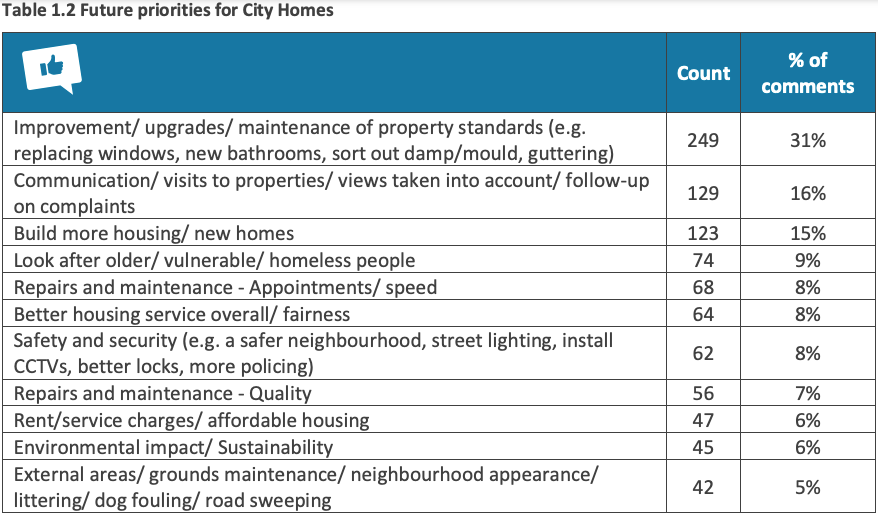
…you can see where some conversations would go.
“Well if you can’t get rid of the damp and mould in my council house, you ain’t gonna be much good overhauling the council!”
Note the response rate to the survey was only around 25% of tenants. What would it have been if the firm carrying out the survey had put more effort and resources into securing a greater response rate?
At the same time, does information on *where* councils get their funding from, and what powers/limitations they have carry much weight?
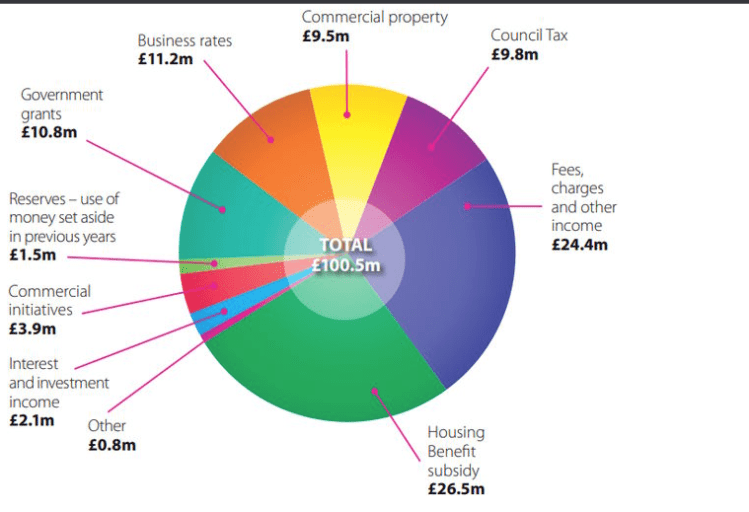
Above – from Cambridge City Council
The risk as always is getting tangled up in local government finance policy.
What’s in it for Cambridgeshire beyond Cambridge?
This is the bit that’s easily forgotten in a city whose affluent and connected institutions all-too-easily look towards London and abroad, overlooking the communities on their doorstep – whether town or villages.
Historically the concern that rural areas would not be able to raise the revenue necessary to fund local services should Cambridge become a ‘County Borough’ was the stumbling block that stopped most of the previous attempts by Conservative-led councils (against mainly Conservative governments!) from making Cambridge effectively a unitary council. In 1969, it was the concern that new unitary councils would be too far away from service users that helped persuade people to block the proposals by Redcliffe-Maud.
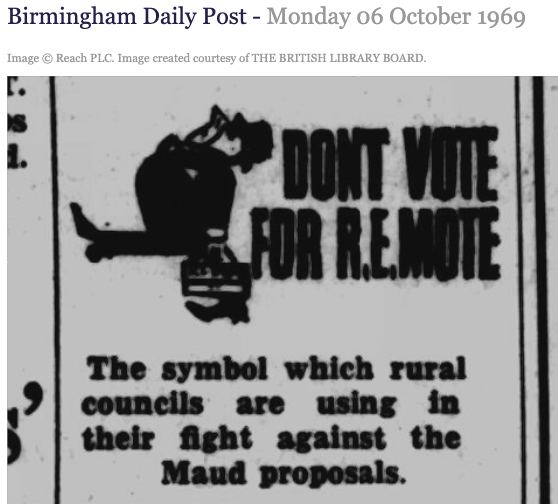
Above – “Don’t Vote for R.E.Mote!” From the British Newspaper Archive
That was an argument that resonated in a number of places, hence the proposals being abolished and the two-tier arrangements being kept – albeit with the abolition of the concept of rural district, and urban district councils (and thus fewer, larger district level councils of the structure we’re familiar with today).
One thing overlooked in the Redcliffe-Maud report was the evidence base – and in particular on the far greater proportion of workers commuting longer distances in the 1960s compared with the 1920s.
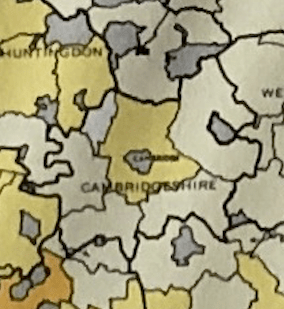

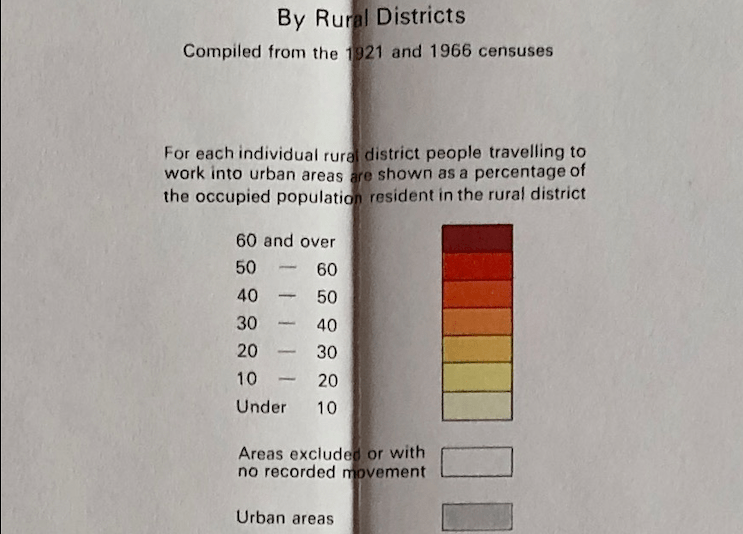
Above – from the Redcliffe-Maud Maps Vol 3, p5
Looking at the key, you can see how in 1921 fewer than 20% of workers travelled into urban areas for work. By 1966 that figure for Chesterton Urban District (now part of South Cambridgeshire District) and Newmarket Rural District (now part of East Cambridgeshire District) was between 40%-50%. This was also *before the construction of the A14 and M11.* That rose to 65% in 2001.
“Cambridgeshire has a very low percentage of people using public transport,” continues Mr [Peter] Goldblatt [Of the ONS]. “Only 6% compared to nearly 15% using public transport to get to work in England and Wales as a whole. More people than average use their cars in the county – 65% travel to work by car”
BBC Cambridgeshire 2001 Census
Technological change and the CV19 pandemic forced a major behavioural change
When you compare the travel to work patterns between 2011-21, the significant reductions are there to see. However that’s mindful of the caveats of the census, undertaken in the midst of a lockdown. (Hence the abnormally-high number of people working remotely – compelled to do so by force of law).
The points to think about here is the range of services that:
- can be accessed online
- are no longer provided for by local councils (eg they have been privatised, outsourced, or transferred to another part of the state)
- are no longer provided because technological and social change has made their provision obsolete
- are no longer provided because of Political decisions to cut services entirely and/or budget constraints
Part of the challenge will be considering what people’s expectations are of local government services in terms of what they think councils *should* be doing vs *how well* they are doing them.
“Who ya gonna call?”
This is the city vs county / district vs shire council issue. When you see a big pot hole in the road, who do you call to get it repaired? (Do you call anyone? Do you email anyone?)
There’s a pub quiz in this. Or a series of pub and/or cafe quizzes. (With random prizes available!)
A bit like the pub quizzes that use the comically-woeful Life in the UK tests ordered by the Home Office (you can get your own cheapo second hand copies from yesteryear here) as source material for light entertainment! Using a multiple choice system, how would people score? What would the scores be like across different parts of the city and county? How would they differ by things like rural or urban areas? By demographics (ages/incomes/occupations?)
If lots of people get the questions incorrect, the case for overhauling the system becomes that little bit easier. At the same time, if follow-up questions are asked (eg on potholes) is: If you have seen this problem, have you reported it? If not, why not? (Again, multiple choice). Because if the majority of responses indicate a low expectation that the issue will be resolved, that’s another evidence base that in the minds of residents, the existing structures are not functioning because of the lack of trust between governed and the governing institutions.
Avoiding the risk of leading questions
Apart from trying to avoid designing a questionnaire to give the sorts of responses we want to support a cause (see the numerous GCP surveys that did not have options for light rail because for whatever reason no one seemed to make much of an effort to explore that option with ministers or neighbouring county councils) some thought has to go into selecting questions that reflect the county we live in – and the people who make it. For example there’s no point in having a drivers’-focussed survey if a significant minority of people don’t drive. Hence

Above – This is from a report called “CLG Empowerment” by the Henley Centre which I acquired from a Freedom of Information request 10 years ago. It came with the disclaimer: “The results were a useful addition to the evidence pool, and informed community empowerment policy. However, the policy framework has now moved on.”
Part of this requires thinking about the ways different groups and cohorts of people interact with their local councils.
And therein resides the problem: How do you keep the actions straight forward without getting bogged down in the details?
For a cross-party-and-none campaign to succeed, the objective must be clear to the many and not require a detailed explanation. (See https://www.cambsunitaries.org.uk/ for the FAQs). Hence the diagram below from Smarter Cambridge Transport is a useful visual aid.
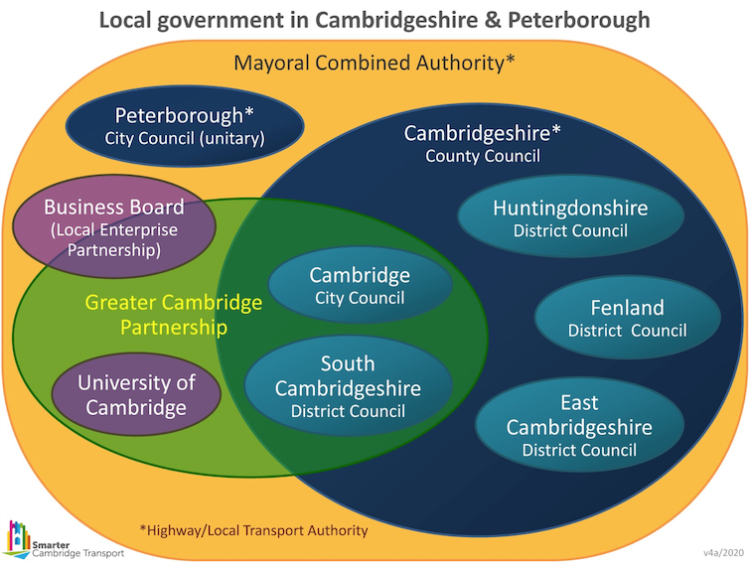
The first challenge is getting a critical mass of people to recognise that the challenge exists – one that implies doing nothing is not the best option.
Food for thought?
If you are interested in the longer term future of Cambridge, and on what happens at the local democracy meetings where decisions are made, feel free to:
- Follow me on Twitter
- Like my Facebook page
- Consider a small donation to help fund my continued research and reporting on local democracy in and around Cambridge.


