
Some of you will have seen the planning application for the sci/tech park south of the airport between Romsey and Cherry Hinton where I commented about their proposed shuttle buses to the railway station being incorporated into the existing 114 Bus Service.
Image – from Unite Glasgow
Well…there are a few more planning applications looming. Back in May 2023 I moaned about the wealth-and-traffic-generating sci/tech parks being made to pay their way for new rail-based solutions. The time it takes to build these however is not fast. Especially when you have the record of the past decade that our public authorities and ministers have.
The Combined Authority must make a strategic assessment about the bus and private shuttle proposals being prepared by all of the new employment site developers ***in the round*** rather than separately, and insist on contributions towards better services and better infrastructure as part of his Local Transport and Connectivity Plan for Cambridge and South Cambridgeshire. You can see that part of the LTCP at item 6E from Nov 2023’s Transport Committee Meeting. Furthermore, you can also read the CPCA’s Bus Strategy at item 2.2 from March 2023’s Transport Committee Meeting.
I’ve not been able to find anything substantial about the existing privately-run bus shuttles, but when they are stuck in traffic in rush hour my lungs complain about the fumes they belch out.
Put simply, wouldn’t it be better for such buses to be part of the public bus service, all be electric, and if they need to be minimal-stopping service, only stop at a couple of bus stops between the main terminals that the private providers need?
Question: Which sci/tech parks and employment sites already have their own private shuttles?
I know a couple of the South Cambridge out-of-town sites do. But has *anyone* in the Combined Authority either done a study of all of the existing shuttle services together, or at least commissioned some consultants to do so (as seems to be the way these days – nothing is done in house – US business studies theorists/Homer Simpson states outsourcing is the best way Note outsourcing comes with its own assumptions and limitations – including gutting the in-house analytical capacity which makes it harder to ‘join the dots’ on big picture issues)
My point is that we’ve got a number of big developments happening in and around Cambridge on top of the ones already completed. These developments carry with them ***huge volumes*** of documents and commissioned analysis. Which all then gets hidden in a dark corner of the internet where few dare to tread. (Normally the local council’s planning portal which links to a database that stores them all!) In principle it should be straight forward to locate all of the submitted travel plans and either hyperlink them to a single landing page or search page so that researchers and campaigners can scrutinise them in light of future developments coming through. For example testing and re-testing assumptions.
A new planning application for council housing in Coleridge Ward
I wrote about the development back in June 2022 here. I went along to the public consultation event the following March. You can see the proposals here, and also the planning application documents via the planning portal https://applications.greatercambridgeplanning.org/online-applications/ with the Ref number: 23/04686/FUL
Above – the developers commissioned a 27 page travel plan for the local residents – which everyone can read here. It has pictures showing the maximum distances people can cover using different modes of transport. So in this case getting to the convenience stores on the Cambridge Leisure Park is doable within around 10 minutes.
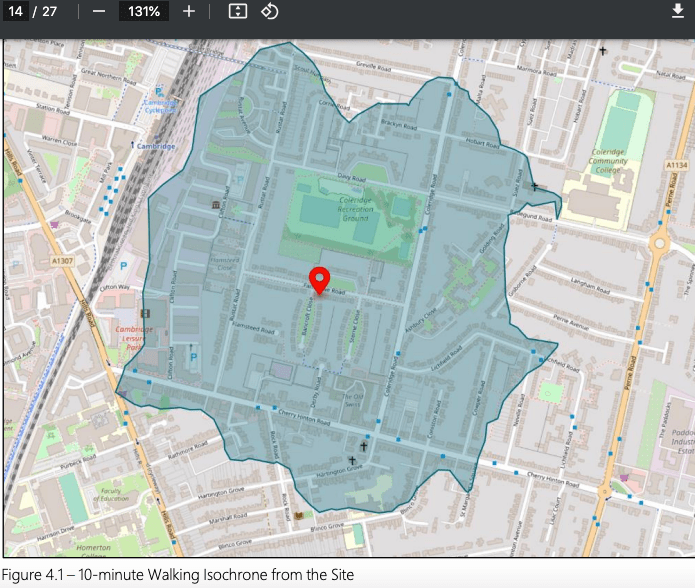
Above – p14 of the Travel Plan
I think they’re being a bit ambitious with the cycling distances – assuming for a higher level of competence and fitness on a bike plus a greater level of resilience and tolerance to motor traffic.
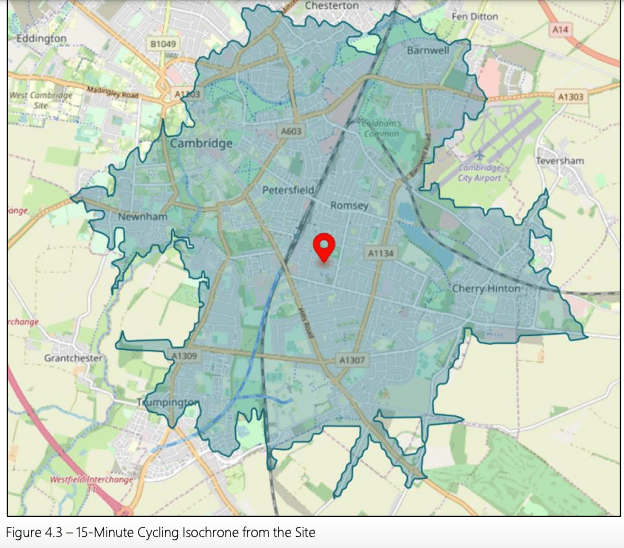
Above – where you can get to on a bike from Fanshawe Road in 15 minutes according to the consultants (KMC, who are based on Gwydir Street so should be familiar with the neighbourhood!)
It’s the buses that matter
This corresponds with what I was saying about the 114 bus service – one effectively subsidised by Cambridge City Council to ensure that residents in Abbey and Coleridge Wards can get to places such as Addenbrooke’s. The problem is funding is so tight that the frequency is so poor and the quality of the buses use is even worse that few people actually use them.
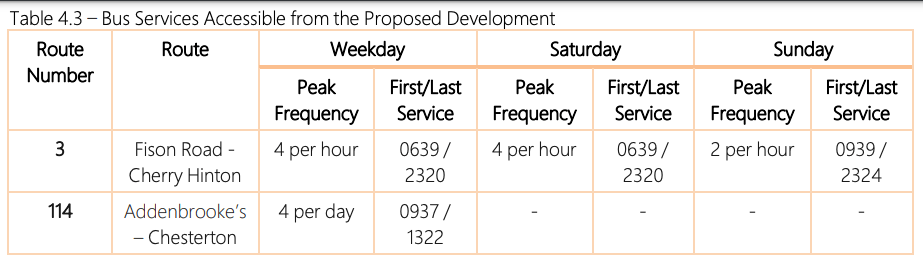
Above – four buses a day on the 114
Yet as I mentioned in my earlier blogpost on the Land South of Coldham’s Lane development, their proposals for a shuttle bus will add to an already over-crowded Cambridge Station – as will any proposals for cycling and walking.
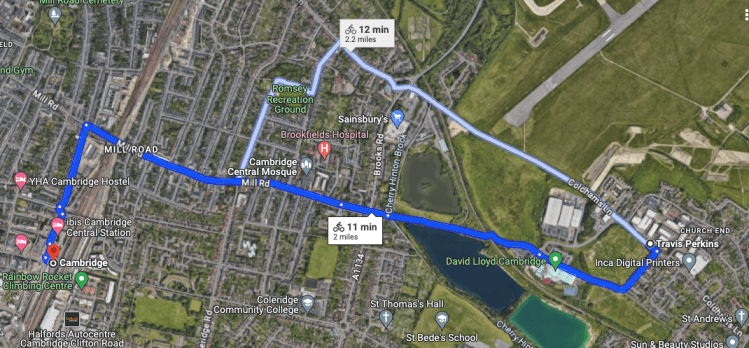
Above – from G-Maps. Far better to persuade Network Rail and the owners of Cambridge Railway Station to build that long-called-for Eastern Entrance to the railway station (see below from Holford & Wright 1950)
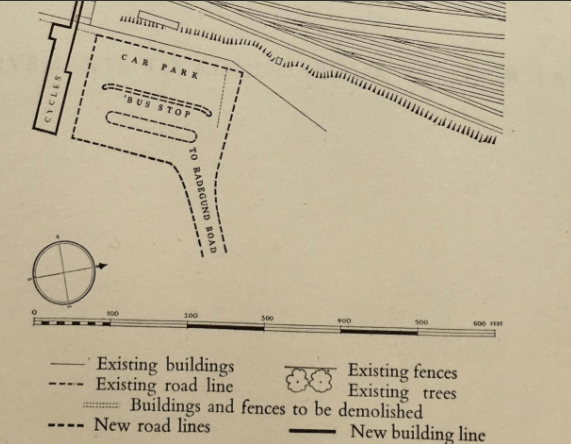
Above – from the post-war development plan for Cambridge in 1950 by Holford & Wright
Having that eastern entrance would mean taking away almost all of any commuter cyclists heading south/eastwards and also providing a detour for the 114 bus from Addenbrooke’s to stop at the station, pick up passengers, and head towards the Sci/Tech Park at Coldham’s Lane before heading onto its further destinations. The subsidy from the developers and the additional passengers would make a more frequent service on a better quality electric bus much more sustainable. Furthermore, it provides more services to/from Addenbrooke’s by bus from residential areas (with many elderly residents) that otherwise are somewhat cut off.
At some stage – and soon, Cambridge needs to talk about freight exchanges and delivery hubs for last mile deliveries
Part of this also depends on a change of government policy – one that I think should involve:
- An online delivery charge, the receipts of which go directly to local government and not the Treasury (thus helping rebalance the burden of running a business away from online and towards the high street)
- Stronger enforcement of existing minimum wage laws, and the strengthening of minimum wage / workers’ rights laws in the face of a recent court case.
“Won’t that make some delivery drivers redundant?”
Some of these will have been the same workers who were made redundant from retail jobs in recent years – a sector that struggles to compete with online sales. It’s simply tilting the balance back the other way.
Furthermore the out-of-town freight exchanges (similar to the Royal Mail depots I suppose!) should be constructed so that small packets can be transferred to e-couriers, thus taking vans off of the road. In an ideal world, some of the smaller e-couriers would be able to use a light rail network with one or two open/seatless carriages for those bringing cycles or cargo bikes with them if we can make the designs work.
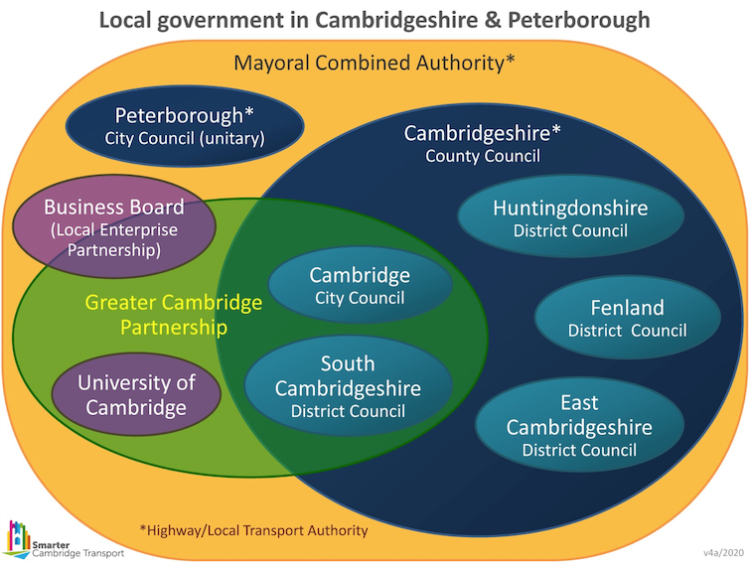
The challenge is getting this done with a government that has shown little appetite to make the necessary policy changes, and with institutions of local government that are fragmented, under-resourced and lacking the legal powers to bring in the infrastructure changes needed.
But then there’s a general election coming up. Nothing like the threat of the ballot box to concentrate the minds of politicians, is there?
If you are interested in the longer term future of Cambridge, and on what happens at the local democracy meetings where decisions are made, feel free to:
- Follow me on Twitter
- Like my Facebook page
- Consider a small donation to help fund my continued research and reporting on local democracy in and around Cambridge.
 The Cambridge Town Owl