
The barriers installed by the big social media firms seem to have had a particularly big impact this year, as social media streams clogged up with ads’n’spam, with exchanges between actual people fewer and further between
I noticed it more than in previous years because for whatever reason, my fatigue symptoms have been stronger of late. Inevitably some of this was the need to recharge from things like the recent Great Cambridge Crash Course events – the next one being on 06 Jan 2024. These hour-and-a-half sessions have the effect of knocking me out for the rest of the day and then some…!
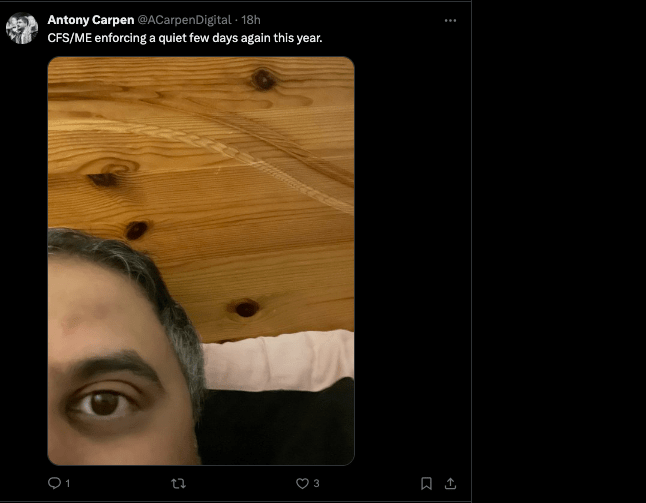
Above – me on Xmas Eve 2023
Xmas day today meant grabbing a bowl of cereal in the morning before crashing out again, and then getting up just before the King’s Speech and figuring out whether it was too rainy to go outside. (It is too rainy, and now it’s too dark as well!) Not that I’d have gotten far even if it was sunny outside – the sensation of lactic in my legs (even though I’ve done nothing today!) would have restricted how far I could have gone anyway. Hence every decision for the past decade or so has involved weighing up what I have the capacity to do/not do (See spoon theory here) in a way that a generation a go I simply wouldn’t have noticed. Hence noticing the traditions in the earlier days of social media that enabled people otherwise less mobile to stay in touch. Like when Sarah Milican launched #JoinIn. Only that has come to an end this year – or rather her formal part in it.
While DuvetKnowItsChristmas is still going, the the old Twitter site has become all but unusable. While the heavy politics-watchers seems to be switching over to BSky (I’m there at https://bsky.app/profile/acarpen.bsky.social) it remains to be seen how things go in 2024. Mastodon never seemed to get a critical mass going for me. FB/Insta have also prioritised paid-for posts over organic ones from personal accounts.
There’s something really depressing about how ‘the state’ was unable to defend the interests of social media users – and defend the social benefits of the technologies over the desire of corporations to monetise everything. Note the collapse in advertising in local newspapers – and the collapse in local media’s ability to scrutinise local government is one big side effect of this. So far, no one has come up with a comprehensive response.
Prof Mary Beard picked up on the power of invented tradition in her pre-Xmas blogpost
It’s strange to think about how both the previously-mentioned examples became sort-of traditions in such a short space of time. How long they will last for (especially if the social media platform implodes) feels like only a matter of time – unless they are somehow re-invented elsewhere. Moving onto Prof Mary Beard’s piece, this is something that may not only matter to individual families but also to communities forming in new build developments, of which Cambridge and South Cambs already have more than a few. Which makes me think there are a few student sociology projects waiting to be done in those new parts of our city and county.
What’s changed from Xmas this time a decade ago?
Lots – and not least the algorithms! But it’s also the impact of them as well – something that society is by-and-large still unaware of. (Hence one of the reasons I go on a lot about adult education and lifelong learning). Furthermore, I can’t help but notice the lack of visible communal feel to this time of year. It’s only anecdotal but we could look at the impact of the pandemic (which still hasn’t gone away) through to the medium-term state of the economy and growing inequalities – for example reductions in disposable spending in the face of rising food and energy prices. Then there is the wider state of the world continually on our screens. Hence a sense for some of us of: “What is there to celebrate?” But then for someone like me, that’s not new!
Here’s something I wrote a decade ago:
“I can grump for Britain, me! In a way I’m surprised that hardly anyone seems to have cottoned onto a market for people that want to have an ‘anti-Christmas”
ADBF 26 Dec 2013
It feels strange looking back on something I wrote at a time when we had *absolutely no idea* what would hit us:
- Tories making that disastrous commitment to an EU-Referendum in 2014 to try and distract voters and the print press from UKIP
- The electorate calling Cameron’s bluff in 2015
- The electorate calling Cameron’s bluff again in 2016
- Theresa May coming ever so close to losing snap general election to Jeremy Corbyn in 2017
- Locally in Cambridgeshire, Tories losing the safe-as-castles South Cambs District Council to the Lib Dems in 2018
- Greens and Lib Dems winning a swathe of new MEPs at the Euro elections, along with ‘Change UK’ followed by Boris’s landslide in 2019
- The first CV19 outbreak and Lockdown in 2020 – and the untimely deaths and corruption scandals that followed.
“What will 2024 bring?”
**Flowers**
“How do you know?”
**I’m planting the seeds**
Or so the exchange goes. [What metaphorical seeds could you plant in early 2024?]
As I often recommend to people running events, at the end it’s worth challenging participants to commit to one small one off action, or one small behavioural change that they’d not normally do as a result of attending. Especially debates or conferences. Otherwise things will stay the same.
Given the anti-social direction too many big social media platforms have gone down in recent years, there’s all the more reason to put more time/effort into offline things. That’s not to say it’ll be a walk in the park – it isn’t. As I’ve found out the hard way. Given the threat of misinformation and disinformation, face-to-face community action becomes all the more important – especially in those places where the ‘high brow’ debates and events seldom take place.
For someone who talks too much, one of the most useful things I’ve found that brings out responses in people at the events I’ve organised this year are…maps. Especially ones that indicate future options for Cambridge created by previous generations of decision-makers.

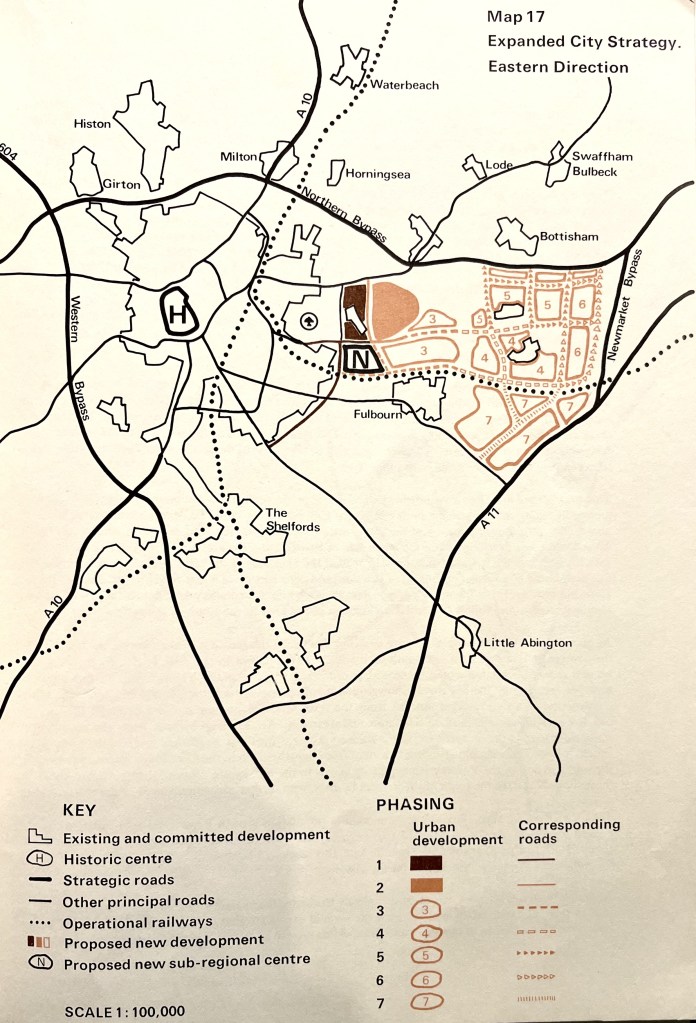
Above – Prof John Parry Lewis’s proposals for Cambridge – doubling the city’s then population from just under 100,000 people to around 200,000 between 1974-2000.
Then just sit back and listen, because the different perspectives that people bring out are an education in themselves. Also it gets people talking to each other as well – one of the weaknesses of traditional council and political meetings I have found is that only having one speaker at a time means people miss out on the benefits of multiple conversations. Think of any events or conferences you have been to over the years and ask yourselves whether the more interesting things were the keynote speeches/presentations, or the breakout conversations.
Pacing the Great Cambridge Crash Course events so I don’t burn out
That’s my big challenge – something I’ve mentioned to some of you in discussing future locations. Two reasons for picking meeting rooms in Cambridgeshire Libraries during daytimes is that:
- Cost – they are much cheaper than corporate venues
- The venues are open anyway which means not having the additional responsibilities of opening up and locking down the venues after hours (which for some reason is a strangely big barrier – alongside the deposits that can come with such bookings)
I’m also lining up some Zoom events as requested by several of you – although it inevitably means the format cannot be the same as the in-person events. The challenge here is how to ensure it doesn’t become death-by-powerpoint over videocon.
Which is easier said than done.
Anyway, I’ll leave you with this upbeat festive number on this unseasonably warm(er than usual) Christmas Day.
If you are interested in the longer term future of Cambridge, and on what happens at the local democracy meetings where decisions are made, feel free to:
- Follow me on Twitter
- Like my Facebook page
- Consider a small donation to help fund my continued research and reporting on local democracy in and around Cambridge.

 The Cambridge Town Owl
I broadly agree but accidentally I appear to have developed a solution, when you talk about invented traditions, my over a decade of posting a new picture of my cat followed by my cat in a box every Friday does to a degree penetrate the algorithm and enables me to maintain a wider audience for the other political causes I use social media for notably workplace and trades union organising alongside local community campaigns
LikeLike