
…says Prof John Denham to Jess Studdert of New Local – the former being the last Labour Secretary of State for Communities and Local Government.
You can read their report here
Alternatively, you can watch their video discussion here
“What is ‘Total Place’?”
As I wrote recently:
“Essentially Total Place was a concept – one that involved all major public sector providers to pool their budgets and resources to deliver local public services and to address chronic problems specific to their local area.”
CTO 09 Dec 2023
Click on the link above to read the full blogpost from 09 December 2023 which stems from finding an old policy document on Total Place from 2010 here.
In the olden days (pre-2010) the spending by the state in a local council area might have looked something like as below.
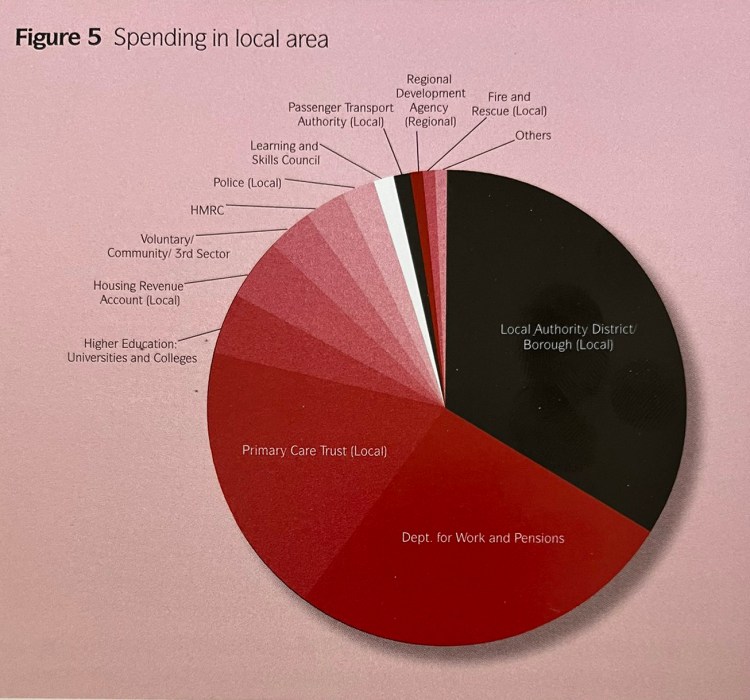
Above – Total Place – Keohane and Smith (2010) NLGN p50
But then the Coalition came in, and Andrew Lansley the then MP for South Cambridgeshire made a mess of the NHS, getting rid of primary care trusts and strategic health authorities, while messrs Pickles and Osborne slashed local council budgets by 40% which, 14 years later has resulted in local government finances being designated as ‘out of control’ by the House of Commons LUHC Select Committee responsible for scrutinising local government policy. Basically because neither of them gave councils any substantial powers to raise revenues outside of raising council tax – which we all know disproportionately affects those on lower incomes. Furthermore, they got rid of Regional Development Agencies which were aligned with European institutions and made it easier for the UK to bid for EU funding to go to places that actually needed it rather than the mess that the post-EURef arrangements have created in places like the Teeside Freeport. If you want to see more on this, follow Jen Williams of the FT, who is digging up lots of things that MPs missed out.
Total Place Pilots
The Local Government Association commissioned consultants to assess how successful ‘place-based pilots’ were back in 2023 – you can read their summary here, but I imagine to people new to all things public policy, many the phrases in the conclusions will be meaningless.
Interestingly, some of the reports on the pilots are still up online from 2010 – you can read them here. One of the ones listed is the Luton and Bedfordshire pilot.
The Luton and Central Bedfordshire Pilot focused on the welfare state and benefits payments, alongside crime reduction. Luton also hosted one of the New Deal for Communities programmes that was one of 39 launched in 2000. It was one of two in the old East of England region (the other one being in Norwich) which invested up to £50million over a period of ten years. The areas were selected on the basis of indicators of poverty and multiple deprivation. Sadly the programme for Luton did not achieve its potential – one complaint I recall was that too much money was siphoned off by expensively-remunerated consultants.
“‘There was a strong feeling at the time that when funding went into poor areas, the money never filtered down to the people that needed it,’ she explains. ‘We knew that if something was really going to be meaningful and lasting, it had to be from the bottom up.’”
‘Caroline’ – a resident on the Marsh Farm Estate
Raj Ali for Tribune Magazine, July 2021
“Did Luton and Central Bedfordshire make the case for Universal Basic Income (UBI)?”
Let’s have a look.
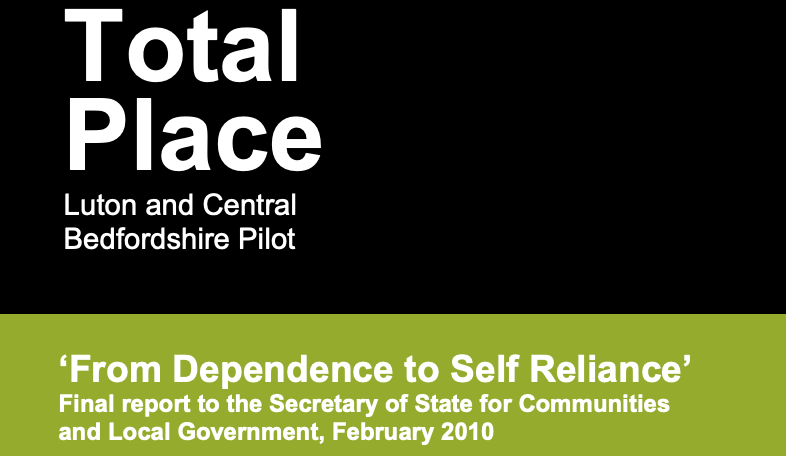
Above – Prof Denham was that Secretary of State.
The Leadership Centre hosts three reports here – scroll down to ‘conclusions and reports’ and click on the Luton one. The document states:
“This Total Place pilot addresses some major challenges for Central Bedfordshire and Luton. Our choice of theme, from dependence to self reliance”
Total Place Luton & C-Beds (2010) p3
Now compare that to the statement from UBI Labs:
“A Universal Basic Income (UBI) could provide financial security for all, building more resilient economies and giving everyone the resources they need to thrive.”
UBI Lab Network
Self-reliance and resilient communities go hand-in-hand. By self-reliance this is not about Victorian-style charity of ‘the deserving vs undeserving poor’, but rather ensuring that institutional barriers do not get in the way of ensuring everyone has the basic level of resources that they need to get on in life. You only have to look at the housing crisis or the cost of living crisis to see that this is not happening today.
One of the big arguments in favour of a Universal Basic Income is that instead of having to spend resources (money and people-time) on form-filling and means-testing, you simply pay everyone a flat basic level – saving on the expenditure of administering social security payments. That does not mean those with greater needs (I would fall into that category) get the same as those in well-paid jobs and no health problems in the totality – the state still needs to provide extra for those needing high levels of support. As of 2010, the problem according to the Luton & C-Beds evaluation was this:
“The benefits system is a complex, expensive behemoth, spreading across central and local government. There are over 50 benefits. The majority are complicated, require lengthy calculations and often overlap. Each has its own form, its own rules and its own costly administrative machinery.”
Total Place Luton & C-Beds (2010) p3
Today there probably are not anywhere near the 50 benefits mentioned – the whole Universal Credit policy was meant to significantly reduce the complexity and complicatedness of the system. The problem is that the Universal Credits system does not cover the costs of living for the vast majority of people dependent on it. Which means hundreds of thousands of people turned to food banks.
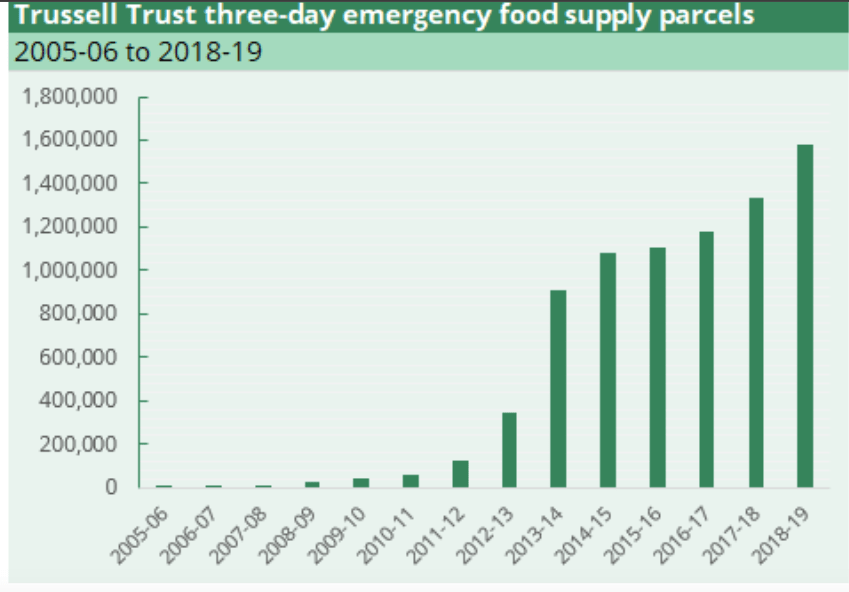
Above – Trussell Trust data on emergency food parcels from House of Commons Library
The Luton and C-Beds 2010 report continues…
“Administering authorities must work within extensive legislation, with the DWP having to issue no fewer than 14 lengthy advice manuals for employees. Guidance on housing and council tax benefits runs to over 1,200 pages.”
Furthermore, it’s not just central government or the public that bears the cost; it’s a waste of resources for charities too.
“This complexity consumes the resources of a vast array of other agencies: nearly a third of Citizen’s Advice Bureau time is spent helping people understand and claim their entitlements.”
Hence the call from various quarters – including at a Political level, The Green Party, for some Universal Basic Income pilots – noting their manifesto pledge at the 2019 general election.
“The Green Party will today [Friday 15 November 2019] become the first political party to promise a fully costed Universal Basic Income for every resident by 2025.”
The Green Party Press Release 15 Nov 2019
Sound public policy-making requires such things to be tried out/piloted in a range of different areas, and then evaluated properly before being ‘rolled out’ nationwide. But I can’t think of that many very high profile policies off the top of my head where high profile successful pilots have resulted in high profile successful policy delivery that has also been popular with the public.
Perhaps that’s a reflection of the short ministerial lives that ministers have. Prof Denham had less than a year in post, his predecessor Hazel Blears having around two years herself. That is not nearly enough time for any minister in any government to commence, work up, deliver, and evaluate a major policy programme. Which is why I’m in favour of separating legislature from executive and enabling the Prime Minister – the leader of the political party that wins a general election, to nominate whoever they think should be ministers for each portfolio, and seek formal parliamentary approval through public confirmation hearings (i.e. public job interviews!) and votes for such appointments.
Furthermore, at any time Parliament should be able to table motions of censure and motions of no confidence – the latter automatically resulting in the termination of an individual ministerial appointment – and requiring a sitting Prime Minister to nominate a replacement. With far fewer powers of political patronage, weak and under-performing ministers could be turfed out far faster than at present – and have the effect of persuading Prime Ministers not to appoint talentless cronies in the first place.
Whoever wins the next general election will have to rebuild out system of local government
As the Commons Levelling Up Committee stated:
“The Government elected after the next UK General Election, regardless of their political persuasion, must embark on a fundamental review of the systems of local authority funding, local taxation, and delivery of social care services.”
Financial distress in local authorities – Commons LUHC Cttee 01 Feb 2024
Essentially Mr Betts MP has called for the overhaul of local government in England on the scale that John Redcliffe-Maud called for in 1969, and noting Frank Layfield’s report of 1976.
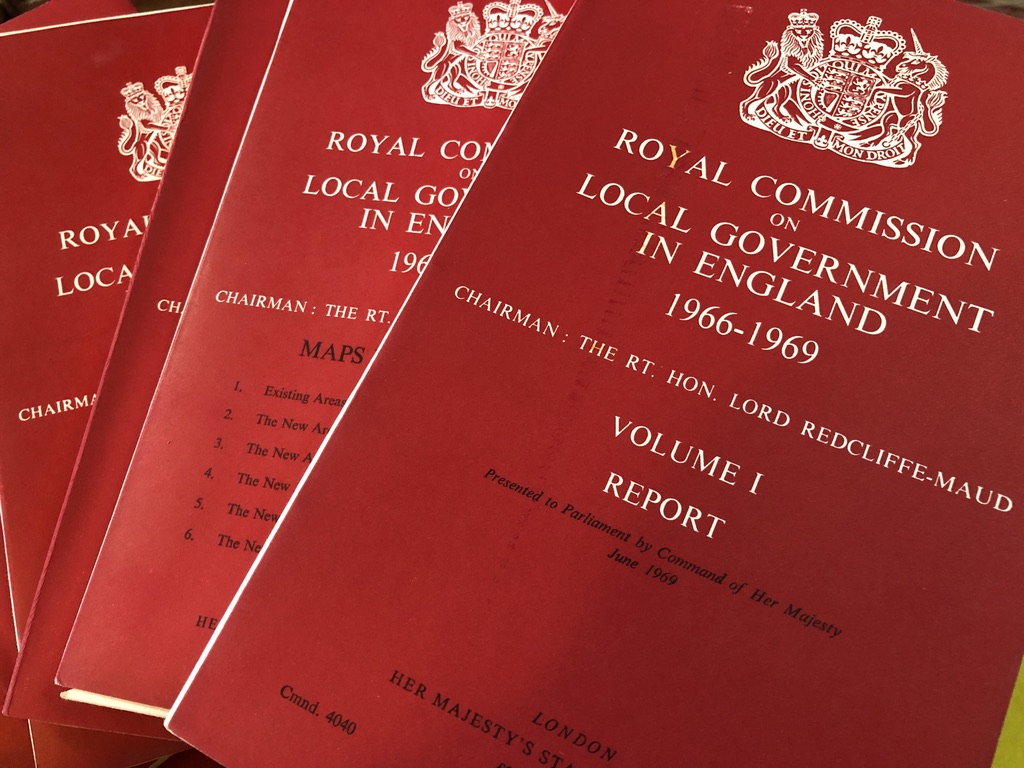
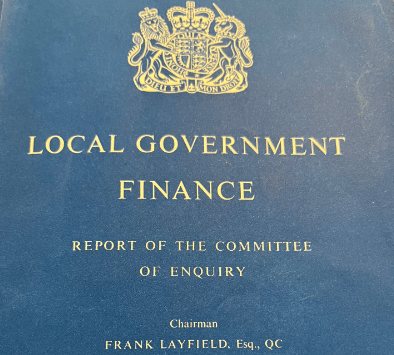
Above-left, Redcliffe-Maud summarised here, and above-right, Layfield’s conclusions here.
If there is a time to commit to major overhauls, it’s at the turning points in political history which come about once every 15-20 years.
Compare 1980 to 1995. Compare 1995 to 2010. Compare 2010 to 2024-soon to be 2025. In one sense they all have in common a burnt out political party in government. As former Home Secretary Charles Clarke told an audience at Anglia Ruskin University in Cambridge last week, a government that knows it is going to win a looming general election behaves differently to a government that fears it is going to lose said election. (See my blogpost on Lost Cambridge here)
In terms of local government, the Redcliffe-Maud Report recommended a complete overhaul of local government in England, noting that in effect they were designing a completely new system from scratch. The House of Commons Public Administration and Constitutional Affairs Committee recommended a similar overhaul in October 2022, pleading with ministers to table a short piece of legislation to enable a new commission to be established in order to start preparations before the general election. Ministers ignored the committee’s call and the Committee Chairman William Wragg MP has announced he will not be restanding for election.
“How can an overhaul of local government work with a new Total Place programme?”
As Prof Denham said to Ms Studdert, it was Whitehall that killed Total Place 1.0. Eric Pickles set out to destroy what he considered to be ‘municipal socialism’ in an echo of the party political battles of the mid-1980s (see The Politics of Local Expenditure from 1985 here) and in the grand scheme of things has succeeded. There are also those in the Labour Party who have strong centralising tendencies on the grounds that local government – in particular Conservative councils – cannot be trusted to deliver the improvements to public services that a Labour Government might want to deliver. The creation of the National Health Service was but one example of this. The alternative model of provision via local councils that Winston Churchill’s opposition in 1945-50 put forward when the Conservatives opposed the legislation that founded the NHS.
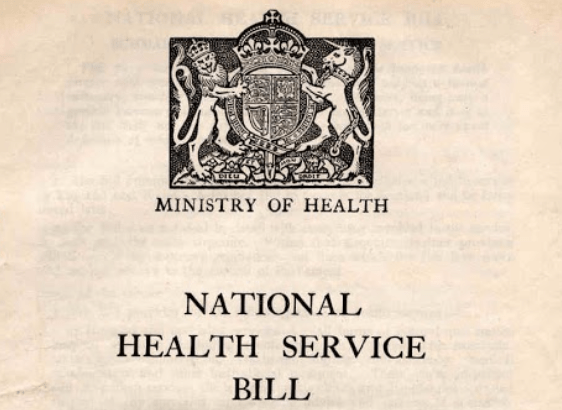
Above – the NHS Bill summary document from 1946 – which you can read a transcript of here, by the Socialist Health Association (itself founded as the Socialist Medical Association in 1930).
“The Minister of Health (Mr. Aneurin Bevan) I beg to move, “That the Bill be now read a Second time.””
National Health Service Bill HC Deb 30 April 1946 vol 422 cc43-142 – Transcript of Second Reading debate
For anyone interested in which party said what, the transcript of the debate is as above.
To bring in Total Place 2.0 would involve doing to Whitehall what the NHS Bill 1946 did to healthcare provision in the UK
As Prof Denham pointed out, Parliament has a responsibility to scrutinise the spending of government departments. Hence whenever government departments establish policies and programmes to be delivered locally by local councils, the civil service automatically resorts to the tried and tested methods of establishing a programme with funding streams and reporting requirements. Multiply the number of government departments by the number of local councils and you can see why this method becomes a bureaucratic nightmare. Hence the creation of Local Area Agreements – such as this one for Cambridgeshire in 2006. The idea was that multiple funding streams would be grouped together, and councils were measured against a series of ‘national indicators’ – which you can browse through here.
The big question I have is whether Total Place 2.0 is a destination or a stop en route to a much greater constitutional overhaul? i.e. one that could result in a written constitution that protects local government from central government interference as happens in other countries, and in a similar way to how UK ministers have to say that some matters for Scotland, Wales, and Northern Ireland are ‘devolved matters’?
But at 1am that’s too difficult to think about for now!
Night night!
If you are interested in the longer term future of Cambridge, and on what happens at the local democracy meetings where decisions are made, feel free to:
- Follow me on Twitter
- Like my Facebook page
- Consider a small donation to help fund my continued research and reporting on local democracy in and around Cambridge.
Also, if you want a crash course on local government finance, read this from 1993 by the LGIU. (Just not at one o’clock in the morning!)


