In my case it’s Cambridge City Council, but elsewhere it might be your borough or district council, or unitary council. Blogpost image – Cambridge ACORN the community union which campaigns on community issues especially rental housing.
This post stems from one of the strangest full council budget meetings that I’ve seen for years – interrupted by protestors, missing papers not shared with councillors in time, and a very moving speech on people who grew up as children in care.
The bit this blogpost covers is housing – one of my old policy areas during my civil service days over 15 years ago. Despite the passage of time, I still keep an eye on it. It relates to the consultation on the draft housing strategy and the consultation that is still open here.(It closes on 03 March 2024). Note the strategy covers both Cambridge City and South Cambridgeshire District Councils. And if you really want to go into the detail, see the housing research published here by Cambridge City Council.
If you wish to respond to that housing strategy, what follows is important as it relates to improving the condition of existing homes in and around our city
Cllr Cheney Payne (Lib Dems – Castle, and also MP-candidate for the Lib Dems in Cambridge) gave a powerful speech on the impact that people living in poor quality rental housing outside of the city council’s control (in particular in the private sector) had on their health. Furthermore this painted a picture of how costs to the NHS rose because the problems of slum housing were not being dealt with by local councils because the local government sector is in the midst of ‘an out-of-control financial crisis’
You can read Mr Gimblett’s article here
The paragraph that interested me highlighted the bits that I missed first time around.
“The document isn’t specific around the condition of current housing stock, and in particular Council owned stock across the area instead citing national data. If there is a backlog of maintenance issues due to housing reaching the end of its life then it should be identified.
“Equally if there is a proportion of housing that fails to meet Decent Home Standards then that should also be identified along with the number of properties that fail to reach a minimum Energy Performance Certificate (EPC) standards and where work may now need to be undertaken to achieve climate objectives.
“This is before any need to identify those areas where there may be the need to adapt those homes and communities to better cater for an ageing population or specialist requirements.”
J Gimblett, Housing Strategy, 24 Jan 2024
How to turn the above into a public question as well as a consultation response.
The easiest thing to do would be to table a PQ to the Housing and Scrutiny Committee (which next meets on 12 March 2024, so get in emailed in by 05 March via democratic services at the foot of the page here) and simply ask The Council to respond to the points Mr Gimblett has set out in his blogpost about the local data sets that he’s identified.
Alternatively, you could go into more detail. Similar to Freedom of Information Requests, keep it specific, and ensure that the information exists and is held by the council concerned. Before drafting the question, ensure what you need to know and why.
In this case as Mr Gimblett states, in order to deal with poor quality housing in our city, we need to know:
- How much substandard housing there is
- Where that substandard housing is in which parts of our city
- Who is the ultimate owner of the property and thus responsible for it being maintained as of a standard suitable for human inhabitance.
- What resources are needed to deal with the repairs backlog (council homes)
- What resources we currently have to deal with that backlog (council homes)
- What capacity the local economy has to deal with the improvements needed to be carried out in the private rented sector,
- What the gap is between enforcement resources and enforcement requirements – this doesn’t just mean enforcement officers, but also the legal and administrative resources needed to initiate prosecutions,
- How long it will take to deal with these backlogs
- How many properties will need work done between now and the time the present backlog is over.
“What does the existing data show?”
That much of the data is now out of date. Cambridgeshire Insight, which collates all of the data for the county.
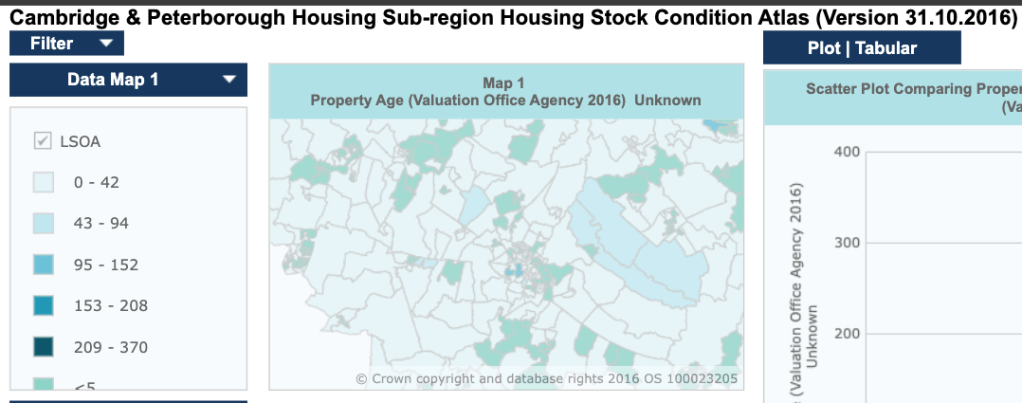
Above – a snapshot on what I think are the average ages of properties – to the unfamiliar user the above means nothing.
And now isn’t a time for a crash course in housing statistics. But the most important point is that a housing strategy for Cambridge & South Cambridgeshire 2024-29 should not be based on data collected at the latest, in 2016. Not least because of the volume of homes built since then and the number of outstanding planning approvals granted that are still to be completed.
“Can’t you do it?”
No
“Why not”
Because I live in the house of mum and dad – so I’m several steps behind everyone else in terms of getting my own place to live. And as things stand, the long term outlook of me ever living in my own place in Cambridge are not good.
Furthermore, ever since I started reading about her campaigns, I’ve started following more than a few of the principles of Cambridge social reformer, Eglantyne Jebb – before her Save the Children days.
“The corruption of elections first opened my eyes and I came to believe that no social reform could be of use that did not promote the independence of the people.””
Eglantyne Jebb, Cambridge Independent Press, 08 July 1910
And Eglantyne knew far more about the state of housing in Cambridge in her time than I ever will in my time – despite all of the technology our generation has. That is because she researched and wrote a report in 1906 on the condition of Cambridge – which is digitised here. Along with Margaret Keynes (later Margaret Hill CBE) and Gwen Darwin (later Raverat), she knocked on the door of every single house in town as part of that survey. I got hold of an original copy of the 1906 book and digitised the map that Gwen Raverat produced with the data on rents they collected.
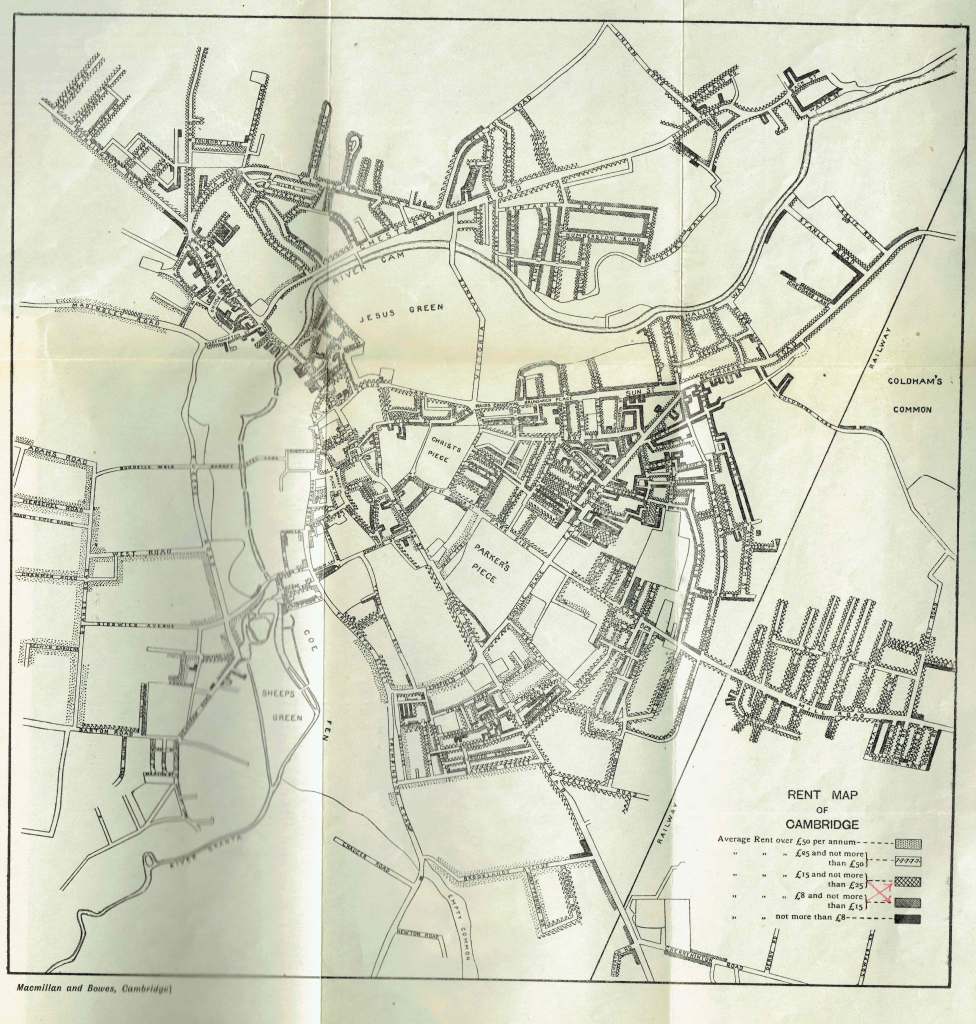
Above – Gwen Darwin, Cambridge (1906) Rent Mapp, in Jebb, E (1906) – A Brief Study in Social Questions.
The dark-shaded areas with rents under £8 per year show Castle End (top left), east of East Road (the St Matthew’s Estate today), and the eastern bit of Romsey Town as being the slum areas. What does a similar map of Cambridge show today with data on conditions of housing?
Unionising the tenants of Cambridge
The community union ACORN has a Cambridge Branch – It’s open to anyone, not just people in private rented accommodation. Its rates vary depending on your economic/financial/housing situation. In one sense, the local branch is becoming the eyes and ears of the city (or at least the areas where members live and are active) on the standards of housing in the private rented sector. This is something that civic society could be leaning into, not as a means of palming people off onto ‘charidee’ but rather about collective action to raise the base standards for the many. (And also ensuring that enforcement action is taken against those with the wealth whose properties fall below those minimum legal standards).
That’s one of the reasons why the austerity measures on local government started by Messrs Osborne, Pickles, and Shapps and continued to the present day were a massive false economy. I’m not going to pretend everything was going splendidly in the late 2000s in local government. I had a front row seat. But with enforcement functions being the first to be hit when budgets got slashed in the early 2010s, the knock on impact on budgets like the NHS for preventable conditions were inevitably noticeable – especially by those working on the front lines such as GPs. That also makes me wonder about the data sets over time for dispensation of medication for conditions most likely to be caused by people living in poor quality housing.
“Hence the concept of Total Place?”
Exactly – what would it be like if local public services were both properly funded and had the means where GPs on finding out their patients were falling ill due to living in substandard housing, could issue a formal note to the local council to take whatever action it needed to get the properties concerned back up to a legal standard. Total Place was in its infancy in the late 2000s and vanished after the 2010 general election, but seems to be coming back for a second round in 2024. Just as much will depend on breaking the Whitehall silos as it will ensuring that councils are properly funded. In Cambridge’s case that means (in my opinion at least) being able to tax the wealth being generated to pay for the public services needed – and also paying for the training of people working in those public services, and the increase in training facilities too. As I keep on reminding people about setting up a new school of dentistry in Peterborough.
But all of those are for the general election debates.
If you are interested in the longer term future of Cambridge, and on what happens at the local democracy meetings where decisions are made, feel free to:
- Follow me on Twitter
- Like my Facebook page
- Consider a small donation to help fund my continued research and reporting on local democracy in and around Cambridge.

 The Cambridge Town Owl