
Following on from Part 1 here that looked at what Cambridge and surrounding towns/villages might need to do to come up with a locally-designed vision, this post looks at some of the things to consider – and how/why it’s not simply a case of building pastiche houses, concert halls, and museums alongside the sci-tech things.
Some of you will have seen the post by former city council leader Lewis Herbert below
Note to self – insert podcast link when it’s published!
Until then, you can browse through previous podcasts/radio shows by Lewis on the challenges facing our city.
When it comes to delusions of grandeur on the future of Cambridge, I’m up there with the worst of them.
- New Concert Hall
- New light rail – the case for Cambridge Connect
- Revamping The Guildhall
- Expanding the Museum of Cambridge
“Yeah – where will the money come from?”
This is why I unpick the Government’s failures on local government finances. Noting that ministers got several years warning before the current cash crisis in local councils across the country.
It’s a niche subject but if you’re interested in either the poll tax riots of 1990 or the reason why your council tax bill is based on the value of your house index-linked to house price values in the early 1990s, or why older people often refer to council taxes as ‘the rates’, have a browse of this.
Some of the pre-2000 alternatives on how to fund local government services are covered in some of the old books I bought and digitised here. You’ll soon get the hang of why so few people are interested in local government finance!
“But Cambridge is loaded! Think of all of that business rates revenue!!!”
The way the system works is that the revenue from business rates collected by councils is gathered up in a big pot and shared out around the country so that less wealthier areas don’t lose out.
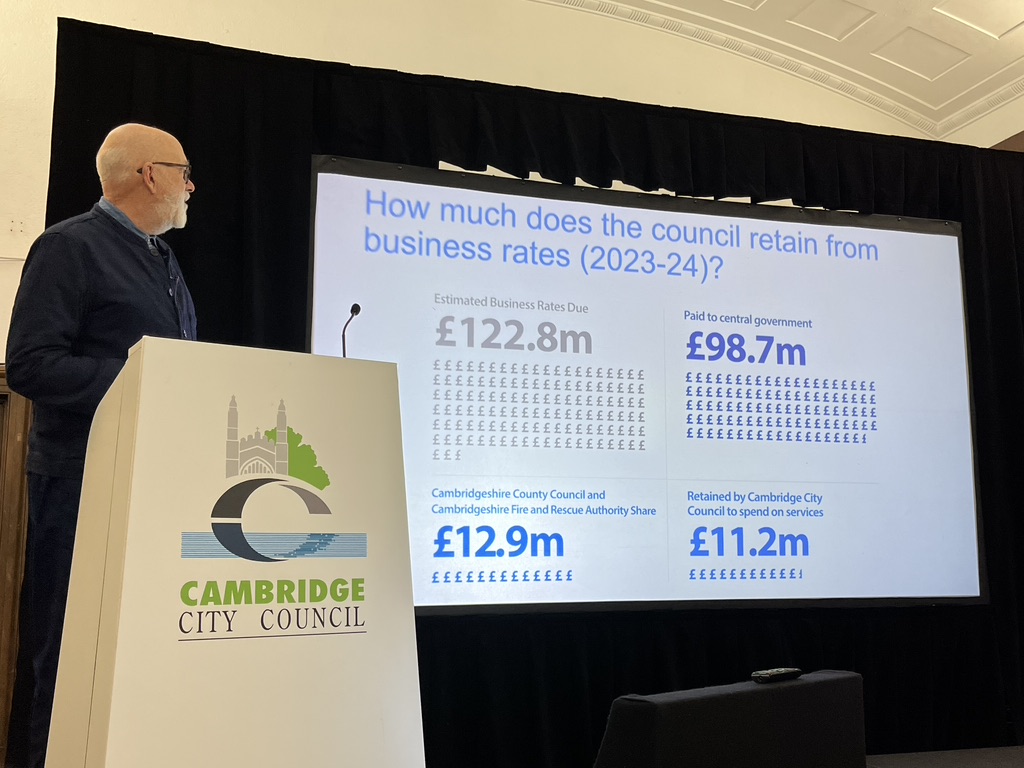
Above – from Cambridge: The state of the city 2023, vs East Anglia – Levelling Up 2023
The problem with this system is:
- it reduces the incentives for councils to bring in policies that might boost revenues – such as local infrastructure improvements,
- it prevents some local council areas from becoming more financially independent from central government
- it prevents central government from identifying those areas that could do with central funds because they have been allocated to places like Cambridge where, with better national policies, could raise the revenues from within their own economic sub-regions enabling ministers to focus on those less affluent areas that really need the help.
Cambridge has changed.
You only have to go to some of the food hubs or local community centres that cater for older people to hear their stories of what Cambridge was like. Although in my case like Mr Holbrook, I’m a child of 1980s Cambridge so the changes that have happened in the late 20th century in our city form the background of my childhood. Which is why the event at the end of the month at the Museum of Cambridge is ever so important:
Above – I’ve added it as a FB event here (I can’t find it on the Museum’s page but have added them as co-hosts)
“What does a ‘locally-designed vision’ look like?”
A corporate glossy brochure?
Actually, having something physical to hold onto is not a bad thing. Something that can summarise a series of co-ordinated and specific actions that will make sense to people who don’t follow politics day-to-day. And finally, something that the corporate types from outside of the city and county who don’t live/work here might learn something from given the input of those people who do live and work here. Because one big criticism of Gove’s plan is that it reads like an oxbridge graduate has plagiarised a tourists’ guide book.
“Cambridge already boasts such outstanding cultural institutions as the Cambridge Arts Theatre, founded by John Maynard Keynes, the Corn Exchange, which has hosted some of the world’s best-known artists, and the Fitzwilliam Museum, home to some of the most beautiful art from around the world”
Case for Cambridge (2024) p27
Above – ‘Cambridge already boasts’ …Do we?
As for the institutions mentioned, there are more than a few things that sit awkwardly with present government policy, and also miss out essential components of local history. For a start, while Maynard Keynes was cracking on with the Arts Theatre, his mother, Florence Ada Keynes was getting a new guildhall built for us. Any sound ‘local vision’ for the future of Cambridge would involve embedding the name and record of Florence as a civic hero much of our city would become familiar with.
Maynard Keynes was a Liberal (he ran seminars for Liberal Party summer schools in the interwar era), was an economist who also made himself very wealthy as an investor & speculator on the stock exchange – and it was that wealth that enabled him to finance the Arts Theatre ***when King’s College, Cambridge refused to incorporate the plans as part of new student accommodation***. (Maynard was the bursar of the college at the time, but could not persuade his fellow fellows to cough up). Furthermore, when establishing a new board of trustees he proposed a joint town-gown board. The wealth made in the City of London vs the crisis in the arts sector compare badly with Maynard Keynes’ record. (IMO).
As for the Corn Exchange, when it was originally built, the Mayor John Death dedicated it to all of the people of Cambridge irrespective of class & income, that historically it has been plagued with poor sound quality (because it was designed as a corn exchange, not a concert hall!), and that for a host of reasons it can no longer compete on the live entertainment market for those ‘best-known artists’. Instead like many other venues in second and third tier cities and large towns on the tour trail, its offer contains a mix of previously-famous (in 1980s/1990s) older bands reforming for a second round of touring, or tribute acts for long-deceased famous musicians. The one thing it has become better at is booking headline stand-up comedy acts. (Browse through its listing here)
As for the Fitzwilliam, no mention of how it has utterly transformed its public offer on learning for local schools and lifelong learning groups.
“There is also excellent work happening at the local level to develop the city’s cultural offering, which the government is committed to supporting and enhancing.”
Case for Cambridge (2024) p27
Such as…? And do the people working in the field locally feel the same? Or is this happening *despite* the Government’s policies?
Any new Case for Cambridge that’s locally designed needs to be embedded both in our local history (and not one restricted to the 1935-era boundaries), and in the day-to-day lived experiences of the people who make up our city. That includes people who commute into Cambridge – something I looked at in this blogpost that concluded: “Cambridge cannot solve its housing issues until London’s are resolved. And that requires radical action from ministers“
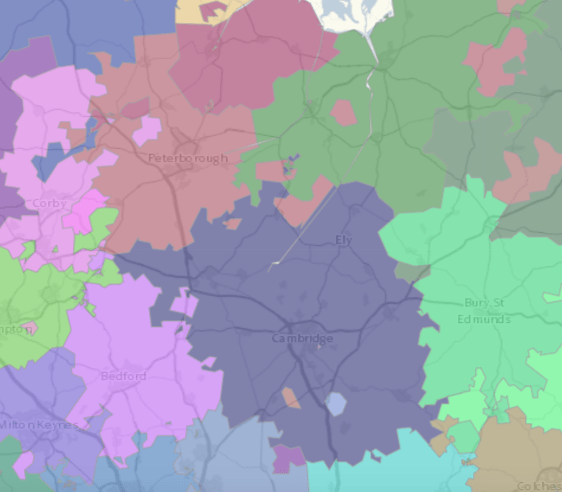
Above – Cambridge & Peterborough’s bus travel to work area commuting patterns 2011 – from the ONS here
If we are going to have a locally-inspired design, then massively improving both the active travel network of cycleways, and building a new rail-based mass transit system are (in my opinion) essential – if only to manage the existing infrastructure gaps and to pre-empt the already built in proposals for future growth in the Cambridge & South Cambs Local Plan 2018-30.
A locally-designed Case for Cambridge must involve sensible negotiations with neighbouring counties too
I had a look at what fast rail links to Bedford and Northampton could achieve for those old county towns in a blogpost that stated not everything needs to be in Cambridge.
“A new King Charles School of Medicine and Dentistry at the University of Northampton?”
CTO 29 May 2023
Furthermore, that blogpost looked at the options of constructing the sorts of new old-style building that Gove and his supporters are making the case for. In the case of Northampton, I looked at the industries along the banks of the River Nene.
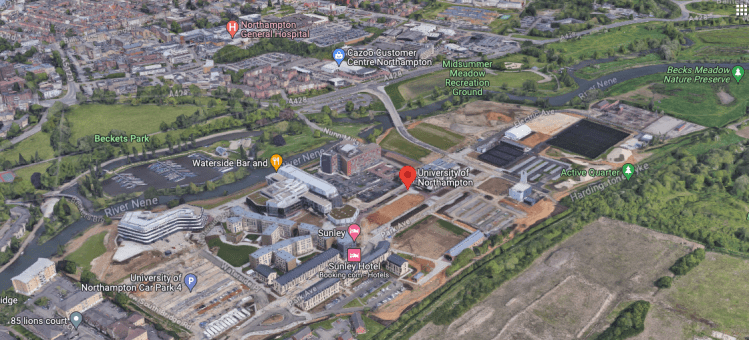
Above – University of Northampton from G-Maps
Irrespective of what happens with Cambridge, the challenge all towns and cities will face due to the climate emergency is overhauling their industries and urban environments so they are no longer dependent on fossil fuels. In the case of Northampton as you head westward along the River Nene, their big challenge is what to do with the large motor-car-based retail parks along the Nene’s north bank.

Above – Northampton looking north, from G-Maps here
From my perspective, what the people of Northampton choose to do should be a matter for them and the people who make up their county town. However, under our political system, ministers have the powers to impose a ‘Case for Northampton’ upon whatever lines they like. If Gove wanted to impose a development corporation on Northampton and saying ‘You are going to get Cambridge-style AI-designed beautiful buildings in these areas to replicate the feel of Cambridge’s colleges’, as far as I’m aware, he has the legal powers to set this up. (And if he doesn’t, general election timings aside, all that ministers need to do is to table the legislation in Parliament and whip their parliamentarians to vote for it).
Dealing with the existing county transport problems
Most of you will be familiar with the Cambridge Connect proposals. What I’ve been doing in support (other than keeping the FB page ticking over) is to look at the governance systems and structures that could make it work well. Hence looking at the recommendations from the past such as Redcliffe-Maud 1969, and noting Lichfield’s study that highlighted market town spheres of influence that feel like they are waiting to be connected by rail.


Above left, from Redcliffe-Maud 1969, and above right, from Lichfield 1965.
Below – the initial proposals from Connect Cambridge – 2023 iteration.

What I’ve done in this blogpost on a Cambridge transit-oriented region is extended the Cambridge-Haverhill line to loop around to connect up to:
- Saffron Walden historic market town,
- Wellcome Genome Campus,
- Imperial War Museum at Duxford, and
- Cambridge City Football Club at Sawston before…
- returning via the Biomedical Campus (thus linking up the above-five with one of the largest employment sites in East Anglia.
The proposals in the second image provide for an additional rail line to Ely via Newmarket, which improves the resilience of the connections as and when one line goes down.


Above – CTO 25 May 2023
The main improvement the second image needs is the restoration of an old chord by Newmarket.
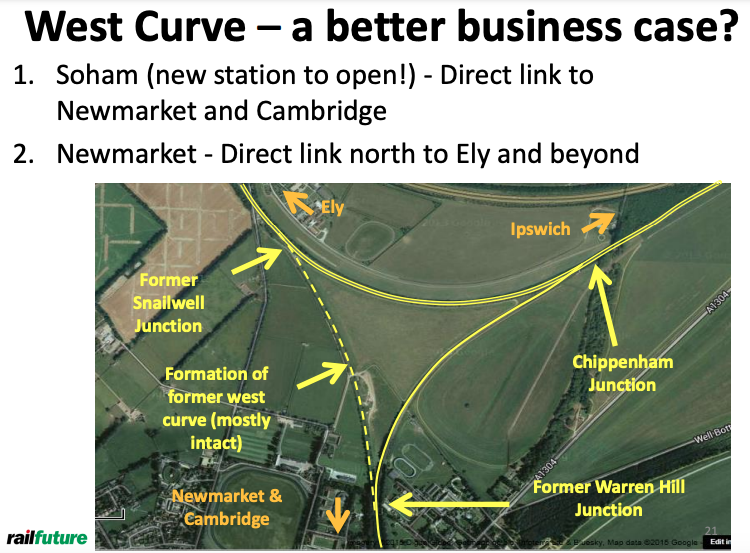
Above – CTO 02 Dec 2022 with Rail Future East’s challenges to Cambridge over our regional connections
“What say to the residents of surrounding market towns and villages get?”
If a Minister of the Crown wanted to drive it through and quickly, very little. But it does not have to be like that. One option that I agree with is to make much better use of the land around existing transport hubs outside of Cambridge. I had a look at this in the second half of this blogpost which I’ve re-stated below.
Commissioning new town squares for each public transport interchange
This could go to one of two extremes, but is more likely to end up somewhere in the middle. You either end up with an identikit design that’s cloned as per Network Rail’s design guide for small and medium stations as ‘Category D’ below;

Above – from Network Rail (2022) here (p18)
“Or…you take the above illustration ***as a concept*** and then bring in local artists, local historians, local urban designers, and any local architects [to come up with something better]”
We already have two rural stations east of Cambridge that would make for ideal new developments.
Dullingham near Newmarket, and Kennett near Bury St Edmunds – which I wrote about here.
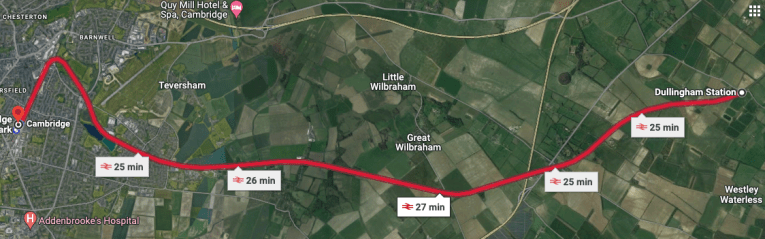
Above – Dullingham Station’s route to Cambridge
Note that it passes the Six Mile Bottom old railway station and has the A14-A11 junction to the north-west. Furthermore, Newmarket is to the North East.
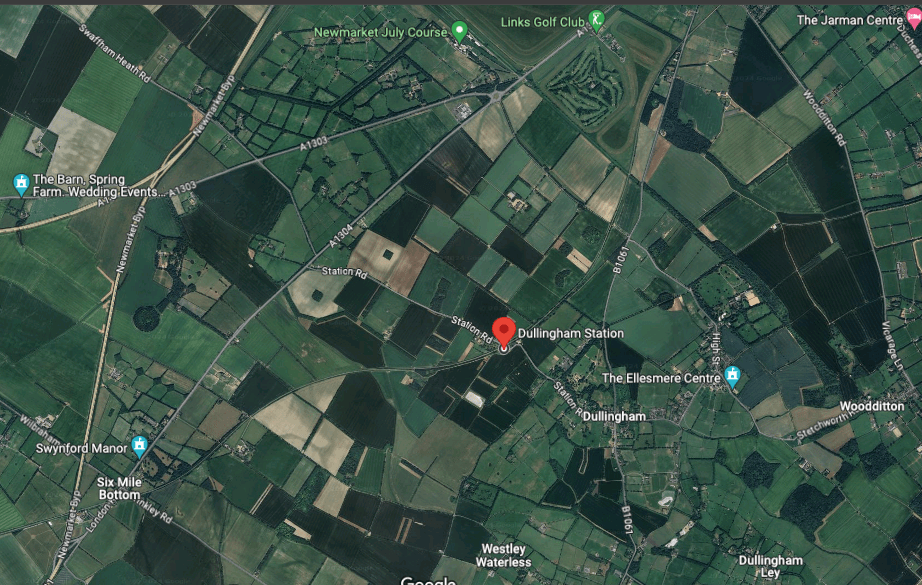
Mindful that you don’t want to be building all over prime agricultural land, and that inevitably the very wealthy and connected horse racing industry would kick up a storm over developments that got too close to their stables, a proposed development around the existing station could lean westwards towards the existing dual carriageway – if only to reduce road miles from the homes. (Assuming the dual carriageway could have sound barriers put up)
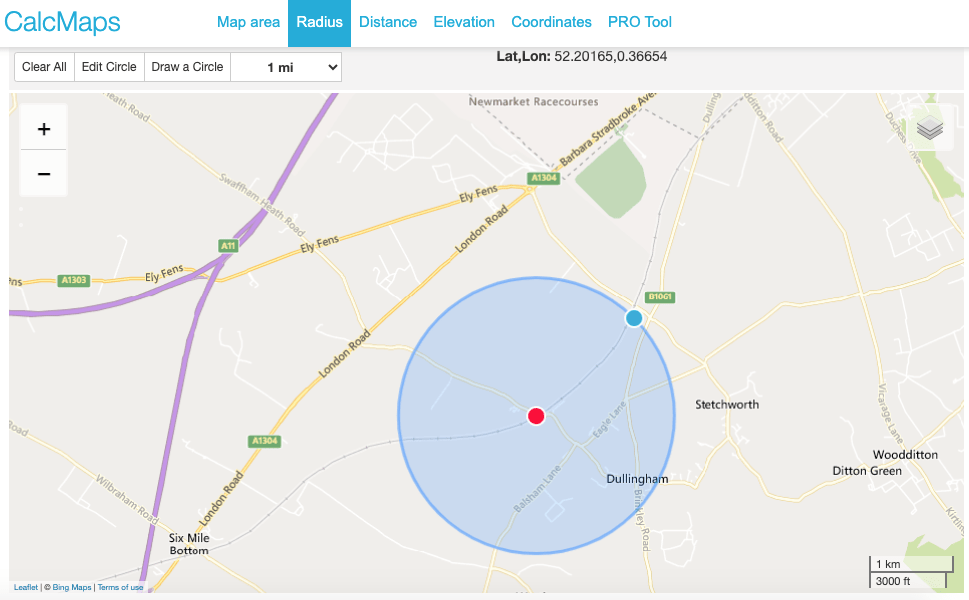
Above – a 1 mile radius from the existing Dullingham station from CalcMaps
“How do you stop such settlements from becoming dormitory towns/villages?”
Learn some of the lessons from postwar Basingstoke – see the second half of this blogpost. Furthermore decision-makers could ensure that each settlement is provided with some sort of sports/leisure/arts amenity that Cambridge and/or surrounding towns do not have. This is something I mentioned back in 2020 and have repeated in subsequent blogposts. That would give a reason for nearby residents to visit the new settlements and also provide local jobs rather than requiring everyone looking for work to commute outwards.
The one thing stopping the above is lack of long term evaluation of developments and the sharing of that learning.
Have a look at RIBA here. This is something that – certainly for medium-sized and above developments, ministers should be making mandatory, and should also be ensuring that summary reports are published and shared with local councils (if not the general public themselves). Certainly I think (well paid) council planners (in properly-resourced departments) should have access on a commercial in confidence basis to the detailed studies, and properly resourced to incorporate that learning. Otherwise we risk making the same mistakes that were highlighted in Parliament recently on child-friendly communities.
Food for thought?
If you are interested in the longer term future of Cambridge, and on what happens at the local democracy meetings where decisions are made, feel free to:
- Follow me on Twitter
- Like my Facebook page
- Consider a small donation to help fund my continued research and reporting on local democracy in and around Cambridge.
Below – if you are interested in dealing with local built environment issues, see The Cambridge Room’s proposals here
 The Cambridge Town Owl