
I’ve been wanting to get into the specifics of community centres for some time now – and the constructor of Cambridge United Football Club’s new training centre facility provides some interesting case studies
You can read ModuleK’s case study of their Cambridge United commission here
Beautiful verses functional
My previous blogpost on this asked whether the desire for beautiful buildings was compatible with an extractive economic system. i.e. one that was hot-wired to extract as much financial value as possible from the assets owned. The one prominent example we have of this is in Cambridge with the Cambridge Railway Station redevelopment, and the Ashwells-to-Brookgate move where the city lost so many of the civic amenities in the renegotiations. Perfectly legal, but one that still sickens more than a few of us locals today.
At the same time, it’s hard to avoid the historical cultural wars that that has engulfed the whole debate – as I wrote about here.
“Wow! Look at that beautiful and magnificent building over there! It was built in the late 1800s at the peak of the UK’s colonial power! Wouldn’t it be great if we could build like that again? Hey! Let’s bring back colonialism too!”
No one would actually say this out loud on a public platform…would they?!?
It is a bit ‘Empire 2.0’ – something that the former International Trade Secretary – the disgraced ex-Defence Secretary had to slap down his advisers on after a few presumably ex-public schoolboys got carried away with the fantasies of the cultures of their own former institutions – past or present! (He says!)
Modulek’s case studies are worth browsing in order to get a feel for the lower cost types of building that are being marketed to councils
In the current climate, given the choice between a minimal cost purely functional and value-engineered box vs having nothing, clearly the preference is for the former. It’s not the job of an individual firm to overhaul the structurally-broken construction industry that the Grenfell Inquiry exposed. The bit that I’m interested in for this blogpost are are on ‘how’ and why’ different designs were chosen by the clients.
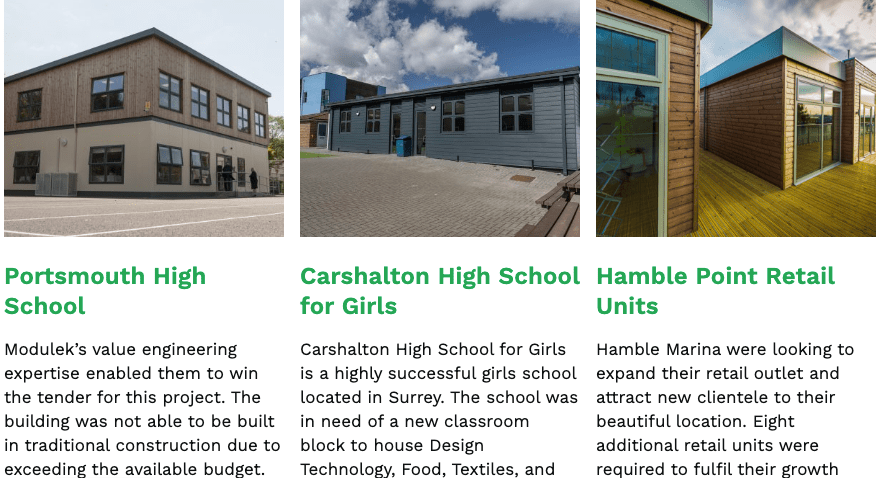
Above – Case Studies by Modulek, p3
The Portsmouth High School client’s brief (above-left) is particularly important here. The very tight budget provided ultimately by the state meant that almost everything had to be stripped back to the essential functional [the school’s needs], and legal [Planning law, guidance, and Building Regulations] requirements. Hence the term ‘Value Engineering’.
Cambridge’s recently-built community centres in and around our city.
Cambridge City Council’s centres are listed here
Of those plus some of the others, I can think of the recently-built ones as:
- Abbey [East of] – Marleigh Community Centre
- Arbury – Akeman Community Centre
- Arbury – Meadows Community Centre
- Castle – Storey’s Field Centre
- Cherry Hinton – Cherry Hinton Hub (due to open summer 2024)
- King’s Hedges [north of] – Orchard Park Community Centre
- Petersfield – Mill Road Community Centre
- Queen Edith’s – Nightingale Pavilion
- Trumpington – Clay Farm Community Centre
…and just outside of the city, the high profile Northstowe temporary community centre here under construction which shows how a modular community centre is constructed. (I’ll add to the list of the ones I’ve inevitably omitted).
No community centre in Coleridge?!?
Coleridge ward is conspicuous by its absence of new community facilities – something that I expect will be debated as/when the flats on Davy Road come up for redevelopment by the City Council. I guess it’s strange to see an estate agent describing Coleridge Rec as ‘stunning’.
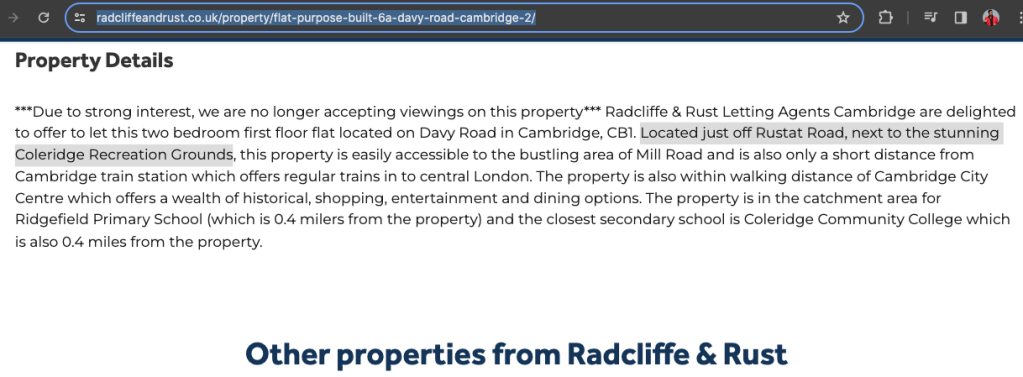
Above – ‘stunning‘
Or as I posted just now:
“Show me that you have low expectations for public parks without telling me you have low expectations for public parks.”
Or to paraphrase Mr B the Gentleman Rhymer:
“Where value-engineering is the standard brew, we’ve upped our standards, so ***up yours too!***
Above – All hail the chap, by Mr B the Gentleman Rhymer. Fans include one Michael Gove
The problems that some wards such as Coleridge and Queen Edith’s face is that existing designated community centres are:
- Church-run (which causes issues for some people – myself included)
- Are on school sites which means they are unavailable during the day
- Are designed for neighbourhood/sub-neighbourhood level only, which means they are too small for all but the most limited range of activities and events
Assuming Cambridge City Council chooses to include a new community centre in the Davy Road redevelopment – one economic and regulatory pressures will drive, I hope they will have done some surveys of the users, and evaluations of the existing community centres listed above. And then have the results of those feeding into the design processes.
To get council officers thinking about evaluation feeing into improved designs, I tabled a public question on how the council and developers carry out ‘post-construction evaluation’ of their developments *after* the occupants have moved into them. See the video clip from Planning and Transport Scrutiny here.
“It’s still going to be a Clay-Farm-Style box with some flats on top, isn’t it?”
Probably.
Back in 2021 I wrote about the long term future of another set of council flats in my neighbourhood – the Lichfield Road estate that was originally a set of post-war prefab houses. In the run up to the 2014 Cambridge City Council elections, the Liberal-Democrat-Run council proposed a programme of overhauling that estate – against the wishes of local residents at the time. (See here, and PQ 7b here). Given that the previous pre-2014 policies were over a decade ago, along with ongoing changes to regulations, to our city, and the inevitable passage of time, I wouldn’t be surprised to see future proposals emerging over the next decade or so – at which point a generation would have passed through. But as the recent developments on Ekin Road and Fanshawe Road (Abbey and Coleridge) show, there is no easy way to make the necessary improvements.
The way local councils are disempowered, underfunded, and are required to sell off council houses under right-to-buy (all too often the much-needed 3-4 bedroom homes) puts them in an impossible situation. But that doesn’t help the residents who may not want to move or face the disruption. Or the risk of gentrification and/or destabilised communities where some private housing is built, some of which inevitably ends up in the hands of the poorly-regulated short-term-lets sector.
Beyond neighbourhood level community centres
“I want that one!”
Above – the Tabernacle in Notting Hill
The former Tabernacle was repurposed into a community centre in 1975 (see more of the history here).
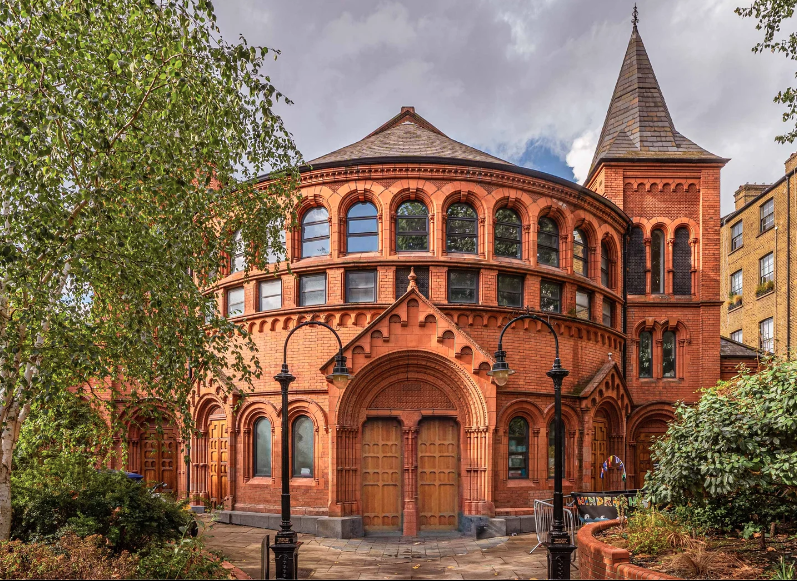
Above – photo by Russell Simpson here. I really like the semi-circular entrance and the effect fo the two tiers of windows above it. Ideal for a community venue.
Even on a larger scale it could work for a first floor seating area in a cafe – perhaps even in reverse as a concave entrance because that way you have seated cafe customers automatically overlooking the entrance and exits to the building – which is a built in deterrent for criminal activities. (Cambridge Junction redevelopment architects – are you watching?!?!)
I’m not going to try and compare the neighbourhoods – medium-rise affluent West London with interwar and post-war suburban Cambridge. Yet the former gives some idea of the sort of buildings Michael Gove’s supporters for building beautiful new homes (such as Create Streets) have been promoting not least in a series of AI-generated images. Given the monstrosity that is Eddington (no one is going to convince me that those buildings are beautiful – but then the designs are ‘marmite’ – with that ability to polarise opinion!) is beautiful, I think Gove should be encouraging some developers to pilot the proposals that are only at concept stage. Can the construction industry demonstrate that it can build the sorts of homes and community buildings that the Secretary of State has in mind? The problem the latter has is that the next general election is due to take place in less than ten months time. Given how slow wheels turn, he’ll be lucky if any developer can come up with new proposals in time – let alone get the required planning permission. In which case, will any shadow ministers in Labour’s team be willing to pick up that policy agenda?
Time will tell.
If you are interested in the longer term future of Cambridge, and on what happens at the local democracy meetings where decisions are made, feel free to:
- Follow me on Twitter
- Like my Facebook page
- Consider a small donation to help fund my continued research and reporting on local democracy in and around Cambridge.
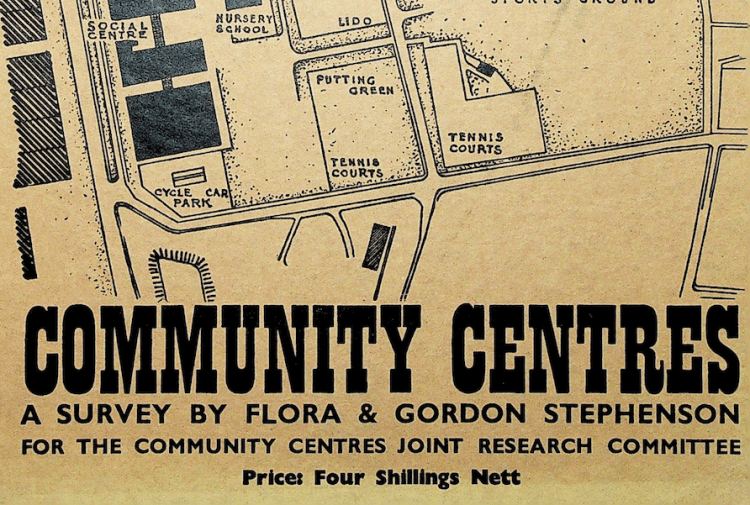
Below – Community Centres by Flora and Gordon Stephenson from 1946 digitised here. How does it read today?
 The Cambridge Town Owl