
Some of you may have heard about the UKREiiF event. Turns out they have a session about the future of Cambridge with keynote speakers not from Cambridge and no representation from the people who actually live in our city.
Which is nice of them.
If you want to go, you’ll have to stump up over £1,000 for a basic ticket – and that’s before you’ve included travel and accommodation.
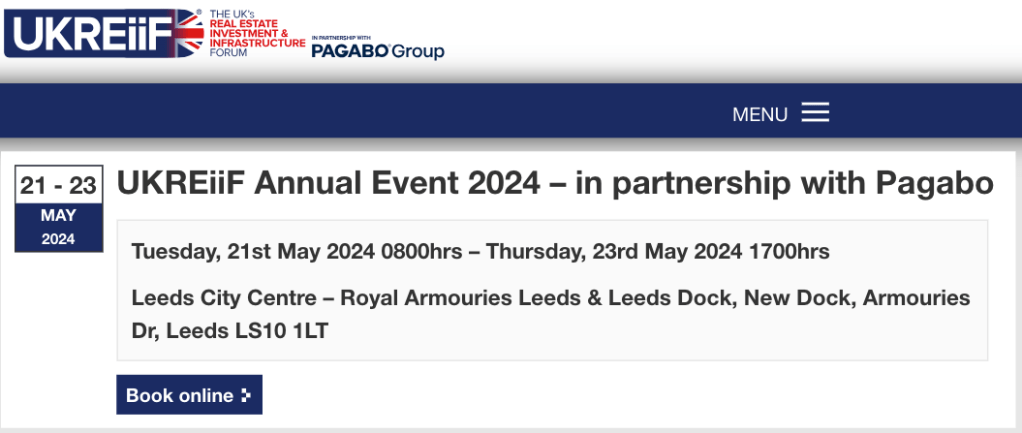
“Supported by a high number of regional combined authorities, local councils and Government departments – as well as the largest developers and investors from across the UK and internationally – this event will gather all the key players, influencers and decision makers within the investment and real estate markets to highlight investment and development opportunities, whilst connecting and facilitating new relationships to drive economic growth through development and regeneration.”
Above – the marketing blurb
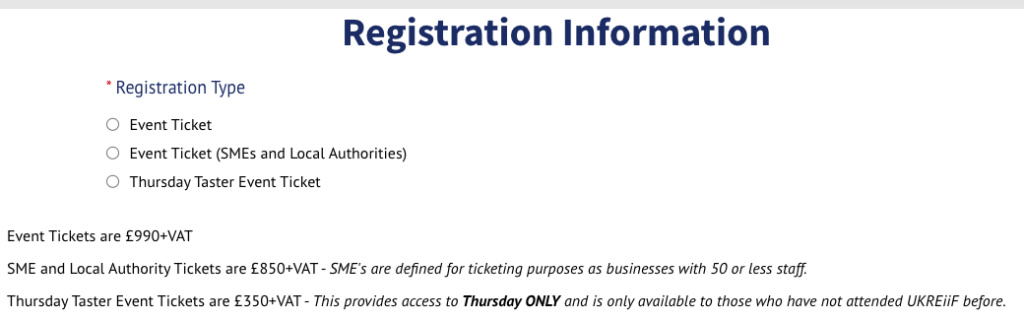
Above – huge barriers to access.
Also, their terms and conditions ban politics from what is effectively a very political event.
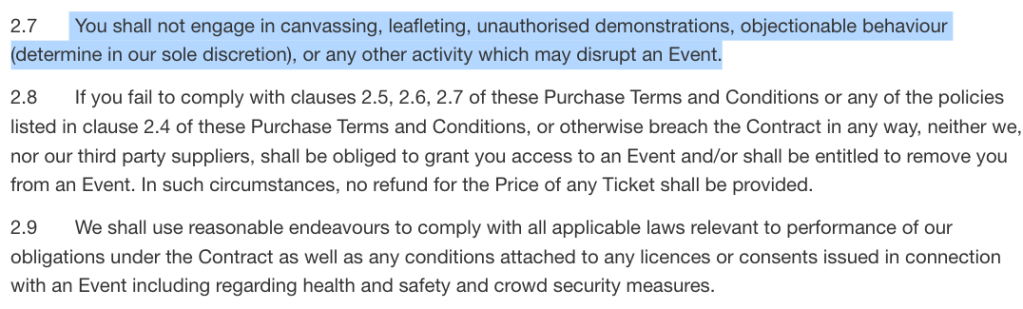
Above – terms and conditions. Par for the course at such events these days, but I can understand why more and more protesters from larger campaign groups buy tickets to such events in order to disrupt them, get the video footage, and let it go viral.
Picking out a few of the sessions, starting with Tuesday…
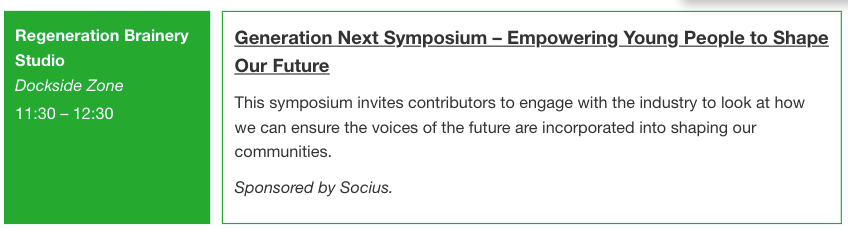
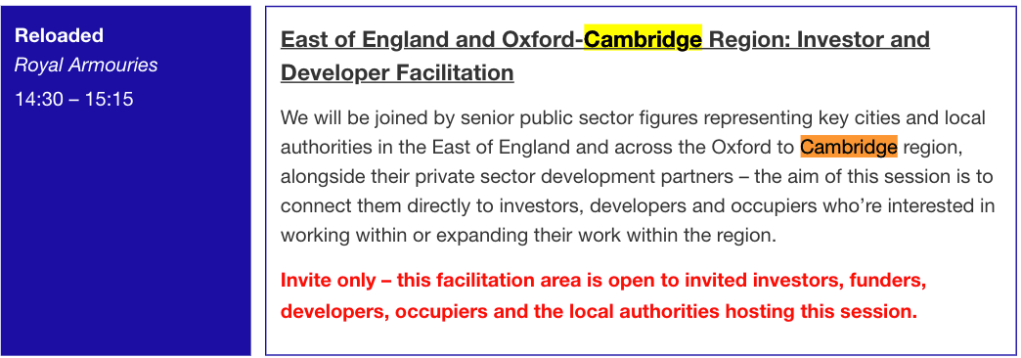
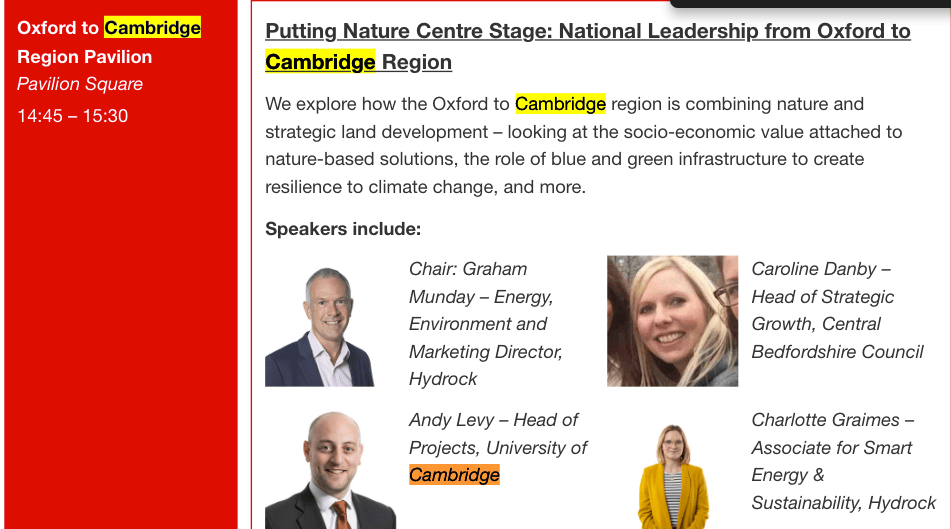
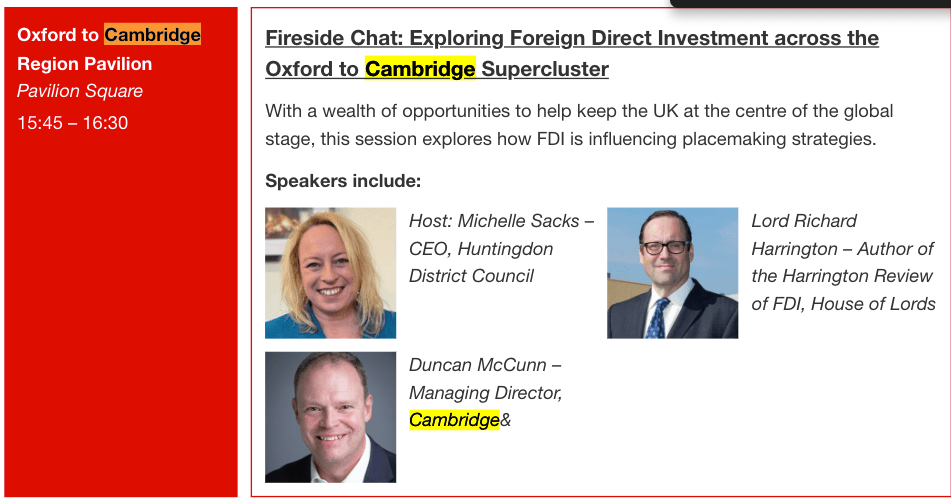
…and on Wednesday…
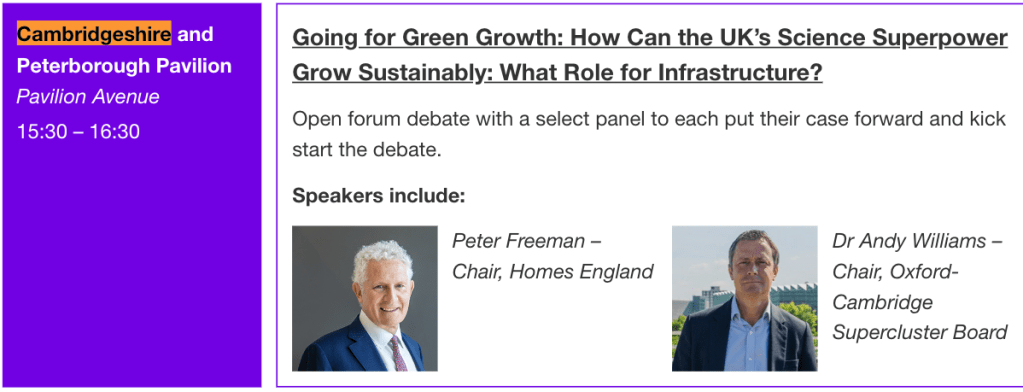
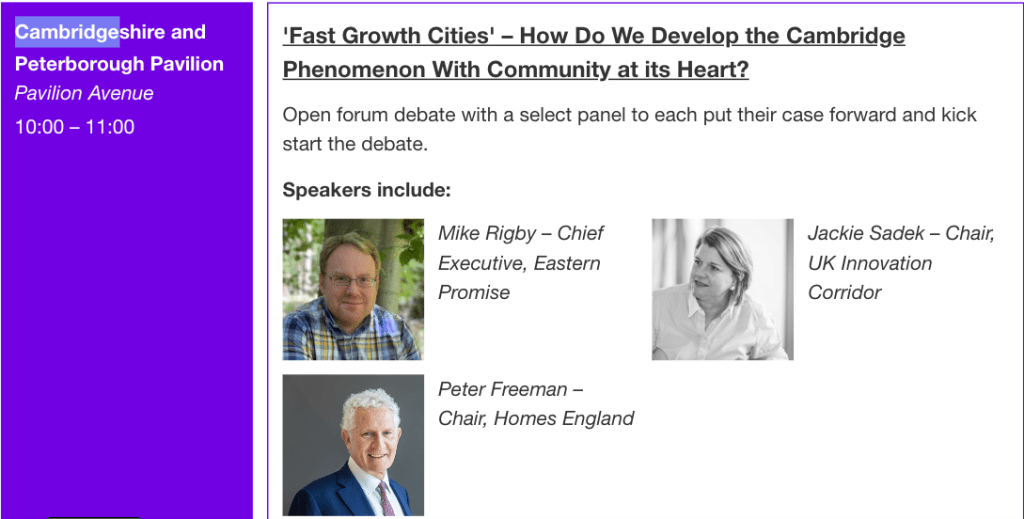
There are also more sessions on Thursday in the Cambs & P’boro Pavilion.
Prediction: The session on empowering young people will be conspicuous by its lack of young people participating and influencing proceedings.
Just as the session titled: ‘How do we develop the Cambridge Phenomenon with Community at its heart?’ will be lacking in people who actually live in Cambridge.
Now, I could do a hatchet job on the named participants at each of these sessions, but I won’t. As well as knowing some of them, doing that would be far too easy and generate more noise than light.
This is more about highlighting the sorts of events that happen all the time in industry. I should know – during my civil service days I was a guest speaker at more than a few of them, even though this was nearly two decades ago. Some of them were more productive than others depending on your viewpoint. Some were little more than opportunities for individuals to have a good time on the corporate expense account. Looking back now, alcohol was and still is a prominent feature at such events.
The problems as I see them are structural rather than issues with any specific individual
If the individuals highlighted as guest speakers were not participating, then the event organisers would have invited them to suggest alternatives. What public sector organisations really should be doing ***is charging the organisers for use of their staff*** – especially where 1) the event would not go ahead without them being a headline speaker, and 2) where the event is paying private sector firms to provide guest speakers for a corporate fee. I recall being struck by how the UK Civil Service never charged corporate event organisers for what were profit-making events – ones that they paid private sector speakers to participate.
Transparency
There are huge transparency issues with such events – especially when you have sessions debating the future of places without the involvement of the people directly affected.
“Bernard, what happens if there is some vacant land near say Cambridge, and there are multiple proposals for its use?”
Above – from Yes Prime Minister. Now, replace the departments with corporations and private institutions.
“British Democracy recognises that you need a system to protect our important profits – and to keep them out of the hands of the barbarians!” – What a 21st Century Sir Humphrey seconded in from the private sector might say today!
The elephant in the room – the looming general election
It wouldn’t surprise me to see a host of opposition politicians and their policy advisers not only attending, but also playing a prominent role in this and other such events as big businesses try to influence Labour’s yet-to-be-published manifesto. Senior Labour politicians have made it clear that the party is ‘open for business’ – with the inevitable concerns about the influence a smaller number of larger donations might be having on policy development within the party. Again, this is not new. Contemporary historians of the Labour Party can tell you of similar issues 20-30 years ago under Tony Blair’s leadership. Furthermore, this creates a dilemma for the trade unions – traditionally the larger donors for Labour whose contributions are made up from the membership fees of hundreds of thousands of members. (Hence why the movement has a large ‘voting block’ at the annual conference – the ultimate policy-making body of the party)
How much power will a future government transfer from Westminster to regional and local tiers of government?
This is a challenge that is sort of taken on by the Total Place 2.0 debate, but again because of our broken governance structures, it’s impossible for such decisions to be taken locally so long as major service providers – whether healthcare or public utilities such as water, have reporting silos that head back either to Westminster, or to the board of a multinational corporation. Do such institutions have the authority to commit their organisations both policy-wise and on major expenditure? Or do they have to continually seek approval from HQ? That’s the acid test on devolution in England. Which is why despite the presence of a number of metro mayors (including Nik Johnson), all of them would tell you if asked, that they do not have sufficient powers or finances to deliver on their ambitions.
I guess the one big question that many people might have upon finding out about the existence of this and other such events, is this: What decisions are going to be made about us and our future at this event?
Mindful that news of preparations about the eastern section of East West Rail (East of Cambridge) have now begun.
Disability rights campaigners have a slogan that applies to such events: “Nothing about us without us”. It’s something that future ministers should consider when it comes to overhauling how England is governed.
Food for thought?
If you are interested in the longer term future of Cambridge, and on what happens at the local democracy meetings where decisions are made, feel free to:
- Follow me on Twitter
- Like my Facebook page
- Consider a small donation to help fund my continued research and reporting on local democracy in and around Cambridge.
Below – Together Culture on Fitroy Street. One of the places where people can pop in and find out and take part in some of the workshops looking at the future of Cambridge.

 The Cambridge Town Owl