
The Civil Society Consulting Community Interest Company published their guide in 2022 – but following the steps is easier said than done
You can read their guide here.
I’m not picking on this guide over the many others other than I stumbled across it/it was there. Furthermore, the criticisms and comments are more for the public policy world rather than the authors of the guide. The 32 suggestions are groups into eight themes which are listed below:
- Think well
- Change your habits
- Help out
- Join something
- Be a great neighbour
- Open up your workplace
- Support your local state school
- Get political
I’m leaving out the first three themes because they are personal by their nature. Changing the habits of individuals, changing negative thought processes, and choosing to ‘help out’ are dependent on a whole host of things and can take a very long time to achieve – especially the first two. Furthermore, there is no guarantee that ‘helping out’ generically will give the personal satisfaction/boost that many of us seek (consciously or subconsciously) when we do so. Part of that theme has to involve taking the ‘shame’ away from failure or things not going as we planned. At the same time, what are the circumstances that help is being offered? Is it enthusiastically? Reluctantly? Under duress?
The ‘Join Something’ theme
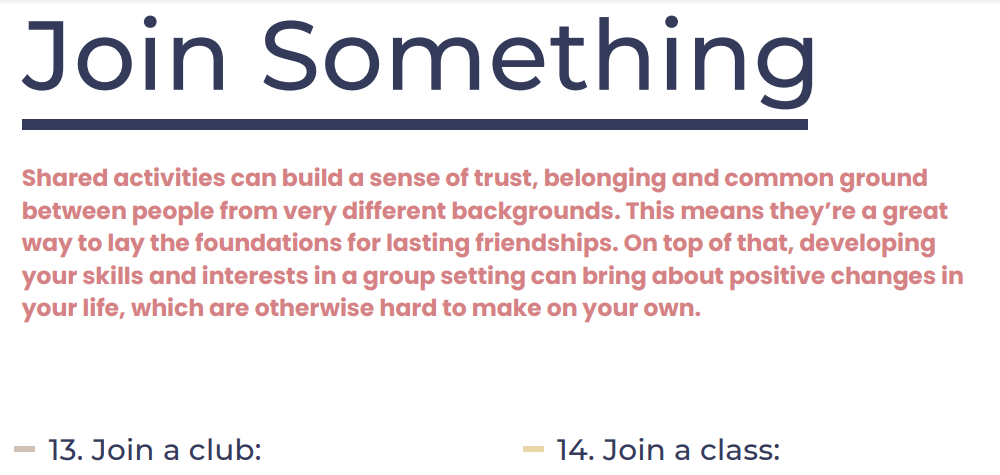
As I said, you’ll find similar recommendations in multiple guides dating back decades and longer. Furthermore, without exploring why trying to ‘join something’ doesn’t always succeed for people, we risk making the same mistakes. The result being when another cohort or generation comes along recommending the same thing, they have to overcome the negative experiences that people have had in the past. This is one of the big challenges with basic skills training – especially for English and Maths. If your target audience had horrible experiences at school, why would they want to go back into an environment that reminded them of it? Hence solutions need to include things that account for this – one of which might be the design and architecture of the places where such training, education, and learning programmes are provided. (i.e. ‘Don’t make it look like a crumbling 1960-90s school!’) The guide by Workers’ Educational Association/WEA – An Ideal Adult Education College by Derby WEA – 1968 shows one way of exploring this. Even though it is from *ages ago* and thus technologically dated, the principles are still worth reviewing.
The structural problems can be teased out by this simple exchange:
- **Join a club or class!!**
- “There’s hardly anything on, and nothing on that interests me”
- **Form your own club!**
- “No one else is interested / can’t afford to hire the premises”
One of the things I mentioned at Together Culture last week was the huge variety of relationships that the people of Cambridge have with this institution called ‘The State’. Taking local government as an example, in some parts of Cambridge the only routine and regular relationship they have with the state is refuse collection. Everything else can be automated (direct debit for utility bills) or can/has been outsourced or privatised. This is a very different relationship compared with those dependent on what’s left of our welfare state – such as those who live in council houses and/or who are dependent on social security payments because (as in my case) long term disability. (I went to two gatherings yesterday. The post-exertional malaise associated with my CFS/ME meant that it wasn’t until 7pm that I got out of the house – and even then I only managed a 10 minute walk before the symptoms got too much).
Furthermore, when you are on a low income, the provision of free events really matters.
“I went to Felixstowe recently. They’ve started charging people to sit there. Your first 30 minutes are free, and then they charge you! It seems like you’ve to pay for everything these days!”
Above – what one older resident told me on Saturday at the re-opened Queen Edith’s Food Hub. (Turns out it was for the car parking)
A very different world to one where more affluent and/or connected people can jump on a cheap flight to a continental resort. Note Cambridge has similar issues on that one given the prices charged for city centre car parking, and also calls for stricter regulation on coach parking. Which reflects how complex moving to a post-fossil-fuel economy and society is proving to be.
The extraction economy puts the hiring of venues out of reach for the many.
The decline of community venues since the end of WWII is one of the prominent features of post-war local history in Cambridge – between the 1970s-1990s they were falling like skittles. The same goes for the churches. Look at the list of non-conformist chapels in/around Cambridge in this 1951 annual report from the Union of Hope / anti-alcohol movement, and compare with how many are still around.


Above – from the Annual Report from the Cambridgeshire & Huntingdonshire Welfare of Youth and Band of Hope Union Annual Report 1951
Given Cambridge’s land values, the speculation and changing of ownership inevitably means the cost of hiring large premises becomes prohibitive – even though the good of the city might be served by it. For example premises close to major transport interchanges. or along well-served bus routes. How well-provided for are the newly-built housing estates? My take is that the guidance provided for by the planning system does not account for, and does not compel developers to take into account of the existing shortages of facilities. For example at some stage Cambridge will need to allocate space for large amenities to serve a city, county, and economic sub-region that we currently do not have. Very large concert halls and Olympic-sized swimming pools have been mentioned in successive planning documents since the late 1990s but have never come to fruiting. Why?
The decline of local news publications has meant there is no single point of information that the whole city knows about and uses.
The listings used to be weekly in the old Cambridge Evening News’ entertainment section every Wednesday.

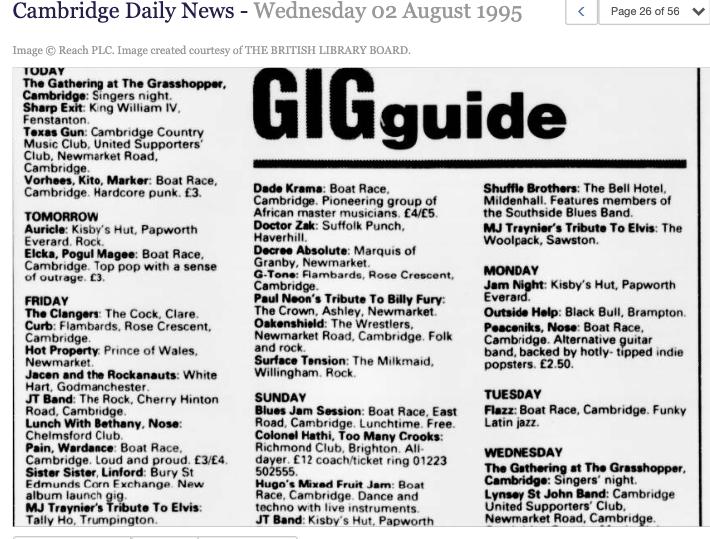
Above – Cambridge Evening News 02 August 1995, p26 (during a mini heatwave my diary tells me)
I’m old enough to remember MJ Traynier’s Tribute to Elvis – he was a regular on the local pub circuit in the 1990s!
As I’ve mentioned repeatedly, the Isle of Wight has Events On the Wight which shows what success looks like. But until we have a system and structure of local government that can facilitate the creation of something similar, we are left with under-resourced local attempts alongside the gamed algorithms of the big social media firms that have hoovered up the advertising revenues that used to go into the local print press.
‘I remain of the view that a city-and-district-wide societies fair provides one of several solutions’
This helps deal with a host of structural issues – one of them being enabling people to find out what is already out there, and also for existing clubs and societies to sign up new participants. It is something I’ve suggested time and again but to no avail. It basically involves doing what the students do every year for their freshers’/societies fairs. Inevitably local government doesn’t have the resources, neither does the voluntary sector, and the private sector only seem interested in it if it make money for someone and/or promotes their brand. For many, an event promoting local arts or hobby groups doesn’t meet the requirements of their CSR strategies. Especially in a city which feels like it is being rebranded as sci-tech only. (Something which Cam Creatives quite rightly is taking issue with).
Supporting young people
The recommendation to support state schools is an interesting one.

Above – 32 Steps (2022) p16
This assumes that local state schools have the administrative and organisational capacity to receive that support. How many times have people tried to engage with state schools only to be frustrated at the lack of responses? How come it always seems to be the private schools that get the nice things? Again, the fragmentation of the state by central government, combined with austerity are huge factors.
Furthermore, very few people and institutions have an understanding of the educational planning cycle. It’s all very well inviting schools to bring in a guest speaker or three, but if it does not align with the annual schemes of work that the teachers are starting the planning on around…now, then the impact will be limited. It was only after I did my basic teacher training for adults, and spent time as a school governor a decade ago that this started making sense – not least the random presentations made by guest speakers in the 1990s that seemed to have no relevance to what we were learning. That’s one of the huge shortcomings about citizenship education outreach activities.
Someone like me can try and make the case to politicians and councils to do something, but unless it’s part of a co-ordinated plan that involves preparing the children and teenagers *before* the arrival of outside speakers, quite understandably the response won’t be as receptive as it could be. Remember that Cambridge today is a much more internationalised city than the one I grew up in. That means a greater percentage of children are more likely to have parents who won’t have the right to vote. Therefore lectures on the importance of voting and democracy will be inconsistent with their lived experiences. Not least because how many of the guest speakers will be nimble enough to respond in a manner that explains what the current government’s policy is, what the methods are for changing it, and not making it party-political? (Which could get the school into trouble).
To conclude?
Collectively institutions need to go beyond the publications of the type demonstrated by 32 Steps. They need to identify what the barriers are with each of the steps, and start debates on how to overcome those barriers. And that means doing the last of their recommended themes: Getting Political.

Lucky we’ve got a general election looming, isn’t it?
If you are interested in the longer term future of Cambridge, and on what happens at the local democracy meetings where decisions are made, feel free to:
- Follow me on Twitter
- Like my Facebook page
- Consider a small donation to help fund my continued research and reporting on local democracy in and around Cambridge.
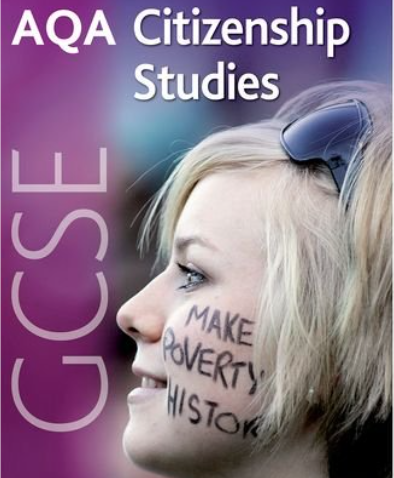
Want to know the essentials about politics in time for the general election? Get hold of a copy of any GCSE Citizenship Studies textbook (second hand copies are available online for under £5 – and when you’re done, pass it on to someone else or donate it to a charity bookshop)
 The Cambridge Town Owl