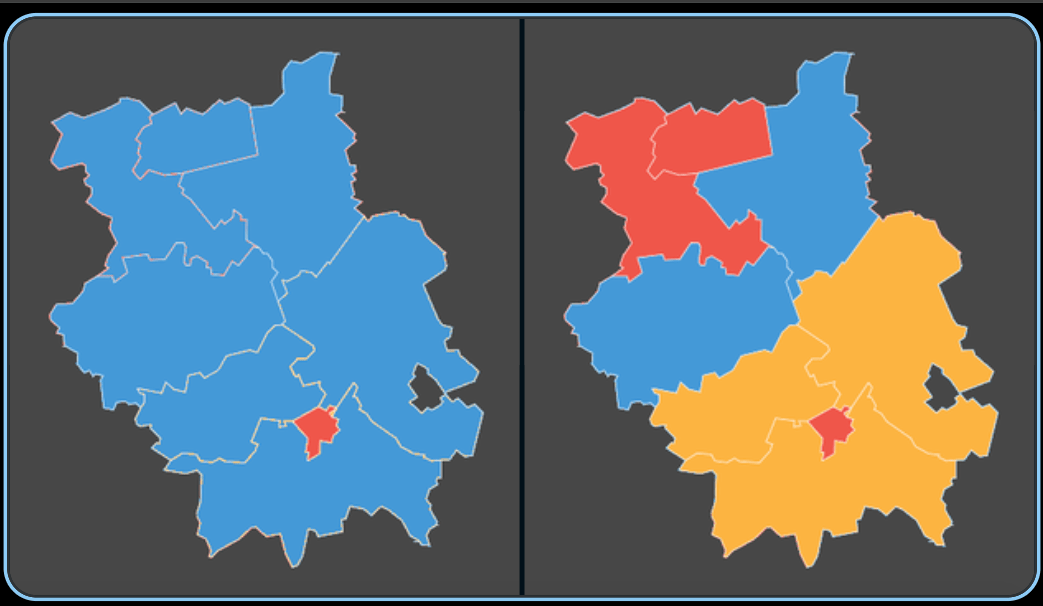
Time will tell whether this is a short term blip or the permanent shifting of the political tectonic plates in Cambridgeshire – historically a safe-as-castles blue-voting county
Image – Before & After map from Labour’s 2019 SE Cambs candidate James Bull
The inexplicable decision of Labour’s HQ to deprive a number of candidates for non-target seats of resources and support facilities halfway through the campaign as a means of disciplining people not fulfilling campaigning quotas in target seats probably cost them the Huntingdon seat amongst others, as the Labour campaign across the county seemed to dry up a couple of weeks before voting day. Not least here in Cambridge where despite it being a nominally safe Labour seat, the intensity of campaigns locally evaporated.
“It was a Labour Landslide. That’s all that matters.”
In a nutshell, true – as the House of Commons Library’s briefing on the General Election 2024 illustrates.
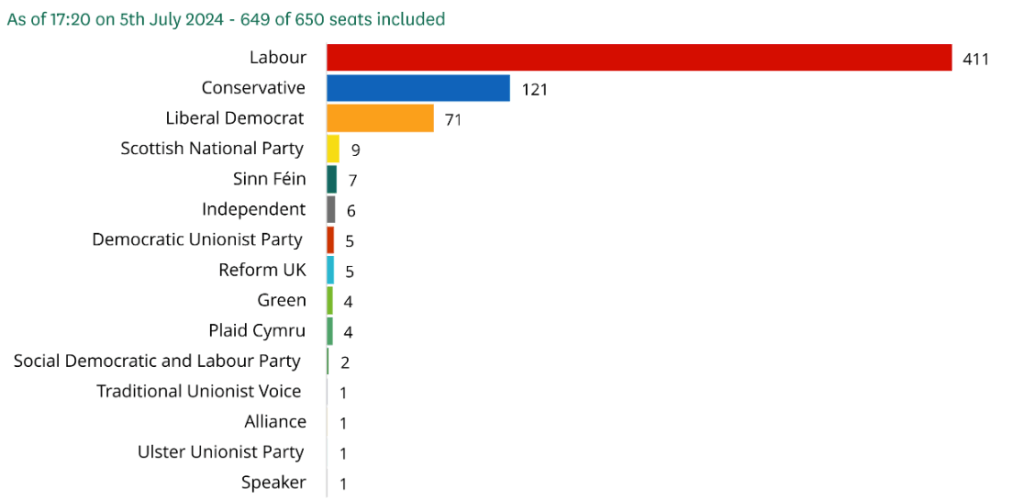
Above – the differences between the parties.
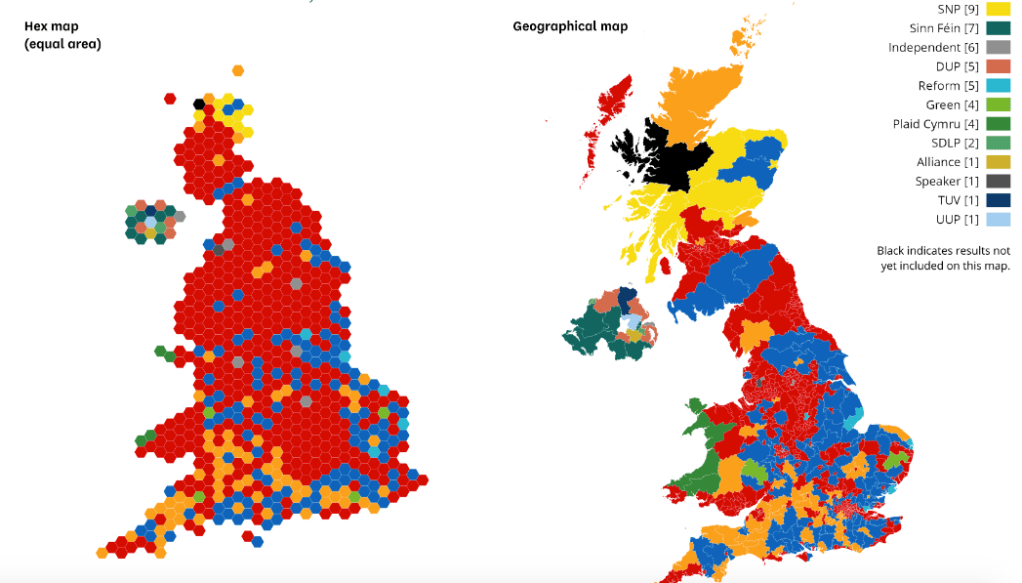
Above – the distribution of seats from the Commons Library
“So, who won what locally?”
As Phil Rodgers illustrates:
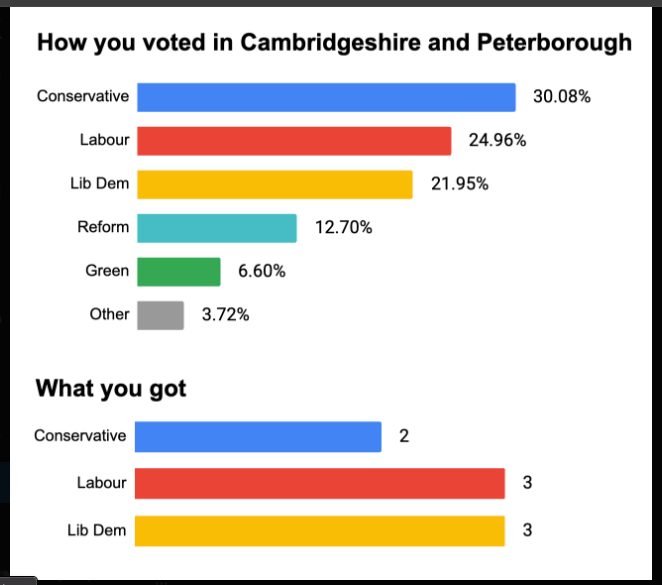
The MPs representing constituencies in the Cambridgeshire & Peterborough Combined Authority area are:
- Cambridge – Daniel Zeichner (Labour)
- South Cambridgeshire – Pippa Heylings (Liberal Democrats)
- St Neots and Mid Cambridgeshire – Ian Sollom (Liberal Democrats)
- Huntingdon – Ben Obese-Jecty (Conservatives)
- Ely and East Cambridgeshire – Charlotte Cane (Liberal Democrats)
- North West Cambridgeshire – Sam Carling (Labour)
- North East Cambridgeshire – Steven Barclay (Conservatives)
- Peterborough – Andrew Pakes (Labour)
Only Messrs Zeichner and Barclay held their seats. With the exception of Mr Obese-Jecty who was a new candidate for the Conservatives who held the seat for the party, all of the others are new MPs.
It would have been nice for Cllr Dr Alexandra Bulat to have won Huntingdon but it wasn’t to be. The same for Issy Waite in North West Essex/Saffron Walden, and my former civil service colleague during my Cambridge days, Rebecca Denness in West Suffolk where half-decent organised tactical voting campaigns could have seen them both oust high profile Tories in normally safe seats for them. But hey, you can’t have everything. As I mentioned earlier, I hope one of the newly-elected Labour MPs in/around Cambridge employs Dr Bulat as a policy adviser or senior caseworker (assuming she’s interested). It’s a well-trodden political path for candidates where potential candidates – especially younger adults – are employed as constituency researchers, advisers, and/or caseworkers. It’s not unusual for such staff also to stand for election to local government, and find themselves as elected councillors as well as caseworkers for MPs.
The Liberal Democrat doughnut around Cambridge
Pippa Heylings had spent the past two years or so campaigning in South Cambridgeshire – the seat having been identified as a top-ten target seat for the Liberal Democrats following the near miss from Ian Sollom back in 2019. With the Boundary Commissioners redrawing the boundaries to create an additional constituency for Cambridgeshire, both Ms Heylings (who contested the South East Cambridgeshire constituency in 2019) and Mr Sollom were reselected for as candidates, joined by Charlotte Cane for the new Ely and East Cambridgeshire seat. Facing two former ministers (Anthony Browne at the Department for Transport – who did not rebel once as a back-bencher, and Lucy Frazer the Culture Secretary), Mr Sollom won what was effectively his rematch of 2019 on slightly different terrain and very different political circumstances. Ms Cane on the other hand overcame what was a safe-as-military fortresses Conservative seat to win in Ely and East Cambridgeshire.
Young Cambridge City Councillor becomes youngest MP in the Commons
Cllr Sam Carling was elected to Cambridge City Council a couple of years ago – you can read his profile here. At the general election he was selected as the candidate for North West Cambridgeshire having served on the Combined Authority’s Skills and Employment Committee that covers the constituency as Cambridge’s representative. Despite the noise of the general election campaigns in the media, he kept a comparatively low profile compared to other constituencies and unseated the incumbent Conservative former minister Shailesh Vara by just 39 votes. His Labour colleague Andrew Pakes also won by a very narrow margin – just 119 votes in it in what was a volatile campaign in Peterborough as TeamNigel (Reform) and the Workers Party (Galloway) tore chunks out of the traditional votes for both Conservatives and Labour respectively – over 10,000 votes in total.
Green gains in Cambridgeshire
With five councillors on Cambridge City Council, and a declining Liberal Democrat presence that inevitably took councillors and activists out to the surrounding constituencies, The Green Party broke their previous record of just over 4,000 votes in 2015 under Rupert Read, with 6,842 votes for Sarah Nicmanis on a slightly lower turnout. (And no Cherry Hinton ward). The party saved most if not all of their deposits in the county on a night that saw the party gained over 22,000 votes across the county, and just under 2million nationally. It will be interesting to see whether and/or where that vote can be converted into county council seats in ten months time at the county council elections. My guess is that The Greens will gain both Newnham and Abbey Divisions from the Liberal Democrats and Labour (with Dr Alex Bulat now in Huntingdon) respectively.
“So…what happens now?”
We watch the rest of Euro 2024 and wait for both the State Opening of Parliament in a couple of weeks time – which will incorporate the new Government’s proposed legislative programme, and the early statements of Government policy as civil servants start turning the text of Labour’s manifesto into meaningful policy statements.
“What will this mean for Cambridge?”
That depends on the decisions made by ministers – in particular the new Deputy Prime Minister and Housing Secretary Angela Rayner, who has replaced Michael Gove and will have to decide what to do about the growth of Cambridge. Does she continue with her predecessor’s policy, or does she revert back to what existing planning law and planning processes require in the local development planning process?
Note every property lobbyist and their puppy will be going after her and her ministerial team like the…come up with your own choice of metaphor! Labour will need to come up with their own policies on both institutions and structures, as well as desired aims for how much development is ‘enough’ for Cambridge? (Noting that big property interests don’t like publicity or scrutiny).
It’ll take a few weeks for the new MPs to settle in and get their new offices up and running – constituency and Westminster. Once they are, then you can start putting your questions and issues to them.
MPs are legislators and scrutineers – they do not hold ‘executive’ public office *unless* they are appointed to ministerial office.
And that will only apply to the party/ies in government – in this case the Labour Party. It is highly likely that Mr Zeichner will be appointed to ministerial office – we’re awaiting confirmation from Downing Street. There is no generic ‘Sort my potholes out and my child’s school out and hospital appointments out’ job title where an MP can instruct people to do things like that. Which is why for me bringing back citizenship and civics education for adults is ever so important. Something I will be pestering the new MPs about – and the mayoral candidates about in the run up to the Combined Authority elections in May 2025.
In the meantime, remember: It was a Labour Landslide. They have a clear majority and a mandate to implement their manifesto. It is highly unlikely that we will see the sort of knife-edge votes in Parliament that we’ve seen in recent years. The people have spoken. Detailed analyses of the voting system and turnouts can wait for another blogpost. In the meantime, congratulations and good luck to all of our new MPs in Cambridgeshire as they take on their new responsibilities of elected public office.
If you are interested in the longer term future of Cambridge, and on what happens at the local democracy meetings where decisions are made, feel free to:
- Follow me on Twitter
- Like my Facebook page
- Consider a small donation to help fund my continued research and reporting on local democracy in and around Cambridge.
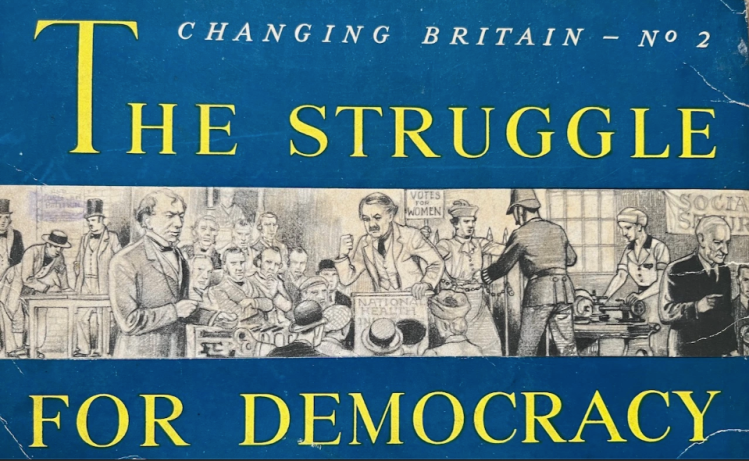
Below – for those of you who want to do some background reading on overhauling how the country is governed, or learning about how our democracy evolved in people-friendly texts of old, have a look at my collection of old digitised pamphlets here.
 The Cambridge Town Owl