
It’s 1.30am but I’ve only just stumbled across this report while listening into an excruciating press conference by the US President.
Only it felt like this was potentially a significant moment in international political history. It remains to be seen what that significance will be. In the meantime…
The Combined Authority is back with a stack load of papers from its Overview & Scrutiny Committee of 11 July 2024. It relates to a the CPCA’s Shared Ambition work which you can have a look at here. My complaint when I first spotted the datamaps in April 2024 was that they were not being displayed in places where people could view them. (See my blogpost here)
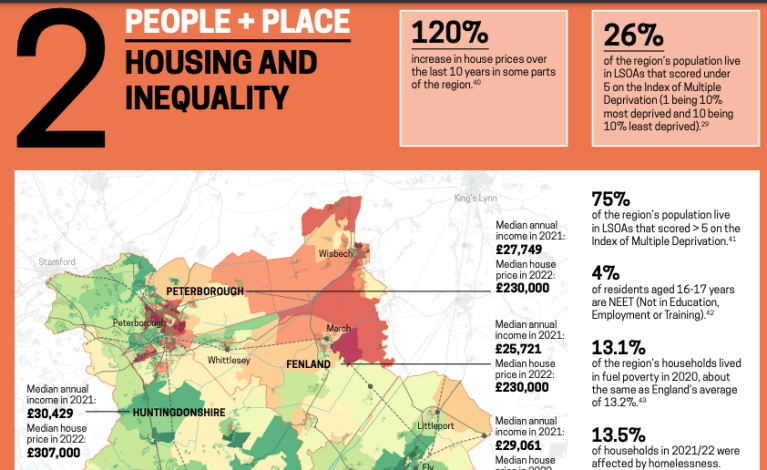
Above – could these be displayed in places where people wait for things?
I printed out the set onto A3 paper and deposited them at Together Culture on Fitzroy Street if you want to have a look at them. The thing is, very few people have ‘had their say’.

Above – from CPCA Shared Ambition
With so many consultations happening on so many different things, no one seems to be in a position to get a grip on it all and co-ordinate things. So important stuff slips through unnoticed.
“Since when was Cambridgeshire & Peterborough a region?”
Exactly. In the olden days it was the East of England/East Anglia that was the region, and Cambridgeshire that was the county. But that just reflects the inconsistency from ministers from the previous government who made stuff up as they went along. I get the sense from the Deputy Prime Minister that they have a much more solid understanding on how they want to proceed.
“The State of the Region Review aims to provide a comprehensive overview of the Cambridgeshire and Peterborough area. It’s a collaborative effort led by the Cambridge and Peterborough Combined Authority, aiming to collate essential data to help understand the region to support the development of regional policies.”
You can read:
There are some very striking charts – not least Cambridge chomping through electricity like candy.
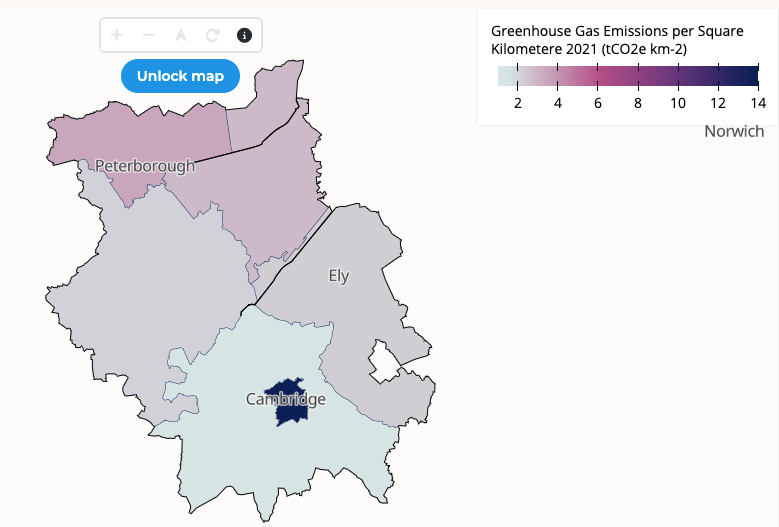
Above – Cambridge’s GHG emissions are considerably higher than other districts in the county.
Also, from the meeting papers copy, this table of comparator combined authorities is also striking

Above – CPCA O&S 11 July 2024 Item 11. App A. p184
This for me shows why the CPCA should never have been created (I did warn them back in 2016 here) because the Political concept of having combined authorities was about bringing mainly urban areas together for the purposes of conurbation-wide (eg Greater London, Greater Manchester etc) transport infrastructure improvements that don’t need to be micro-managed from Whitehall. When you compare areas of land covered, Greater Manchester has over three times the population of the CPCA area, but less than a third of the land area. The differences in the rural/urban divides should come as no surprise.
From chapter 15 onwards you get the list of indicators that are being measured. One of the features of town centres everywhere since the Banking Crisis 15 or so years ago is the decline of the High Street. Even in Cambridge the empty units in Grand Arcade are now so numerous that they’ve converted several small units into a small cinema facility next to the Central Library entrance.
Because Cambridge has become a place where ‘extraction of value’ is now rampant on anything to do with property, it’s not surprising that housing affordability is as it is.

Above – CPCA O&S 11 July 2024 Item 11. App A. p192
And yet the vacancies board is full of job adverts. The problem is that they pay so little that hardly anyone can afford to live in the city and live financially independently on the wages offered. Which means that almost every teenager or young adult working in retail in that shopping centre is having to be subsidised by someone else – eg their parents. Which then means that someone’s profits – the financiers getting their return on the investment for the Grand Arcade in the first place. What would the vacancy board and occupation levels look like if the law required wages to be proportional to the cost of living/rents in a city? Eg as a proportion of the median rent? What would ultimately have to give? Because under the present set up, substantial increases in wages would put most of the tenants out of business, leaving all but a few high end retailers serving a tourist market.
Do the transport plans from private firms co-ordinate with each other?

Above – Cambridge University’s transport strategy 2019-24
How does it read today? Who is responsible for it? How can the students hold their university accountable for it?
Which brings me back to privately-contracted commuter buses from my previous blogpost
Could the CPCA run an audit of existing private commuter buses alongside those proposed for new employment sites including but not limited to:
- The Beehive Centre
- The Grafton Centre
- Land south of Coldham’s Lane / Cherry Hinton Innovation
- Capital Park, Fulbourn
I.e. ones that incorporate such services as a potential planning condition. The list above does not cover what B-Gate are up to in Cambridge North, having got permission to build from ministers without resolving the water stress issues.
Finally there’s the ongoing project on the Anglian Water site alongside speculative pressure from Trinity College Cambridge / Science Park North, and the inevitable desire to expand the Cambridge Biomedical Campus while Addenbrooke’s A&E remains stuck at 2001 capacity. Hence part of the general election debate covering a light rail link from Cambridge to Haverhill.
Anyway, it’s past 2am. Have a browse through the reports and then let your councillors know what you think (https://www.writetothem.com/)
Food for thought?
If you are interested in the longer term future of Cambridge, and on what happens at the local democracy meetings where decisions are made, feel free to:
- Follow me on Twitter
- Like my Facebook page
- Consider a small donation to help fund my continued research and reporting on local democracy in and around Cambridge.
Below – a reminder on why it’s so hard to work out how our city and county function: Fragmented public services in Whtehall reporting silos – noting there’s more than a little that vocational courses aimed at further education students can teach the academic stream
 The Cambridge Town Owl