
And does the history of the institute hint at the re-establishment of the old CCAT – The Cambridge College for Art and Technology?
When I look at the course list within the bright fuchsia coloured pages of the 1950s course catalogue for CCAT’s predecessor institution, the Cambridge Technical College and School of Art, I sort of wish for something similar to be re-constituted for Cambridge. It’s a question I keep returning to (see this from 2020) in the face of rediscovered reports – ones launched sometimes with great fanfare and publicity – only to be forgotten shortly afterwards as the structures and systems of government prove too inflexible. A chronic issue covered by Parliamentary Affairs Journal on 07 August 2024 here.
One other document from the past is this pamphlet from Clement Attlee’s Government from 1947 which brings together learning for work, and learning for leisure.
At the moment there is significant debate on overhauling the policy-making system in the face of huge institutional and structural failures in Westminster and Whitehall. It’s one of the reasons why (for me at least) there is so much criticism of the limited devolution settlements and the mess that is local and regional government in England.
Coming up with a vision so that conversations move beyond concepts
The Derby WEA published a report on what an ideal adult education centre might be like back in 1968. I blogged about it here.

Above – An ideal adult education centre – Derby WEA 1968 digitised here.
“What can the Bishopsgate Institute teach Cambridge decision-makers?”
The first perhaps is being independent of central government – because the Conservatives dissolved the old CCAT as part of their reforms to further and higher education in 1989 under The Education (Cambridgeshire College of Arts and Technology Higher Education Corporation) (Dissolution) Order 1989. Irrespective of the merits or otherwise of this move – one that led to the creation of what we now know as Anglia Ruskin University (Anglia Polytechnic in between), and Cambridge Regional College – the fact was that the earliest component institutions in Cambridge were not founded by Central Government. Yet it was an Education Secretary to that tabled the Order in Council that dissolved it using powers granted by Parliament under the Education Reform Act 1988. And Parliament is Sovereign – it can legislate for whatever it likes within the UK.
“Proudly independent since 1895, Bishopsgate Institute is a cultural venue in the City of London. Our beautiful Victorian building is a place for people to connect over a shared love of learning. We believe everyone’s history should be valued, and our special collections and archives document the experiences of everyday life, as well as the people who have campaigned for social, political and cultural change.”
Above – from https://www.bishopsgate.org.uk/
When it comes to independence, note that:
- ‘Independence does not and should not mean ‘unaccountable’
- ‘Independence has its shortcomings too
Like many other civic institutions, the political, economic, and public health crises have taken their toll as Bishopsgate wrote in late 2023 here.
Long term financial sustainability goes with the territory of institutions that provide services in return for fee revenue and grant funding – whether from state or charitable sources.
Location, location, location
One of the reasons I am calling for a ‘Great Cambridge Masterplan’ is because without one, developers will simply put their commercial interests over the needs of the city and wider county. We saw that with Cambridge Station and where the developer chose to locate the bus stops and taxi ranks. Ideally the taxi ranks would have been put underground, and the bus stops would have been much closer to the station entrances and exits – intuitive for the many millions of tourists and passengers that pass through the station every year.
The lesson from the Bishopsgate Institute is that public transport matters. The Institute is next door to Liverpool Street Station in London – the capital’s gateway to East Anglia – along with the Central and Metropolitan+ underground lines and also the Overground and Elizabeth/Crossrail lines. Along with the numerous bus links and the accessibility requirements for taxis, there should be no need to use private cars. (I still wouldn’t cycle in London though!)
In Cambridge’s case, Brookgate monopolised what little available land might have been suitable at Cambridge North Station – or at Cambridge Station for that matter, with commercial gain being their priority. The Cambridge Biomedical Campus’s record on excellent civic and urban design isn’t that much better for Cambridge South Station given the land already accounted for before they even thought about transport. All three of them are significant missed opportunities for outstanding civic masterplanning that could have had grand station squares with iconic architecture for a civic college mirroring the railway stations opposite – in similar principle to Royal Naval College at Greenwich, just at a smaller scale. In the grand scheme of things I follow several the principles of symmetry and beauty that John Belcher articulated in 1907 – as also reflected in his unexecuted design for Cambridge Guildhall in the 1890s.
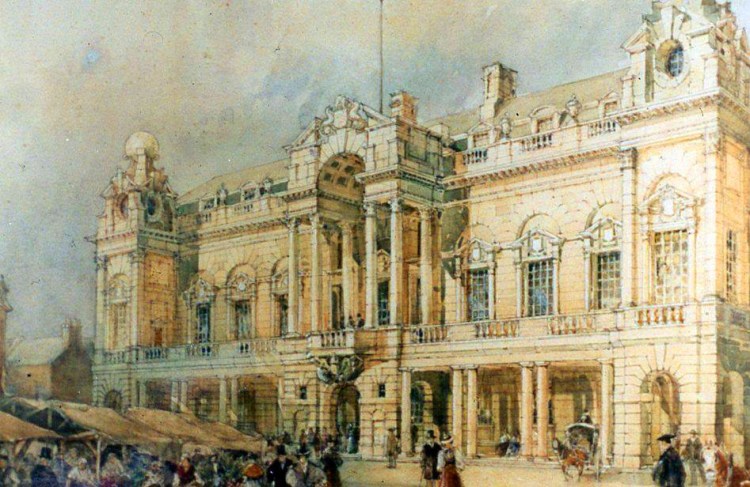
Above – John Belcher’s design for Cambridge Guildhall – rejected by Cambridge Borough Council in both 1898 and in 1913.
No, I haven’t forgiven them!
Hills Road Sixth Form College and Cambridge Airport as possible sites
Given the huge over-concentration of Cambridgeshire’s A-level places in a small part of Cambridge, one of my ‘blue skies’ options is to move Hills Road Sixth Form College out to a new site – whether out to Cambourne, or to North Cambridge (recalling the latter’s option to open a new North Cambridge campus that was rejected by politicians in 2023). The over-crowding and lack of facilities proportional to the number of students in that part of our city are well-known. The colleges expanded numbers without providing sufficient facilities for students – bike racks, independent study facilities, and lunch/refreshment facilities. The sixth form college vacating the premises of what was the Cambridge High School for Boys would create a space for a lifelong learning centre potentially within walking distance for adults able to travel in by bus and train.
The second option is the redevelopment of the airport site which is a corporate property developer’s proverbial dream. The site is large enough to incorporate sporting facilities and green open space. But as things stand the existing planning system cannot compel anyone to take into account the wider needs of the city both as it currently is, and is likely to become in the face of huge planned growth.

Above – a possible location for a new suburban railway station and light rail hub on the Cambridge Newmarket Line which could serve a new lifelong learning centre on the airport site when it is redeveloped post-2031.
What else could be built on the site that Cambridge does not currently have that could serve both city and surrounding villages?
Why Rob Cowan’s principles of Urban Design are ever so important
One thing developers all too often try to do is negotiate downwards the facilities they are required to provide. The commercial incentive and fiduciary duty to maximise profits/act in the interests of shareholders are two of the drivers. That means there is no standard/routine means to allocate land for facilities that an expanding city requires beyond maximising the financial return of all too often a dispassionate institution that could be based anywhere.

Above – Essential Urban Design by Cowan, R. (2021) RIBA
Using Mr Cowan’s book, community groups could do an audit of what sorts of facilities are in their neighbourhoods, districts, cities, and wider areas and compare them with the diagram above. What other things would you add to that list above?
Governance and accountability
While the Bishopsgate Institute has what looks like a standard model of a board of trustees that hold the Chief Executive and senior executives accountable (see their annual reports here), for a new lifelong learning centre for Cambridge I would prefer a structure that incorporates a streamlined and overhauled local government structure for ‘Great Cambridge’ – one where an elected full-time councillor can, as part of their duties, sits on a smaller board of governors who are then accountable to a much wider membership of people who want to be involved in the ‘hands off oversight’ of the institution – and one that the talents can be drawn from as and when needed.
It’s a lifelong learning centre at heart, not a minimalist corporate training facility
It’s in the opening values statement of the Bishopsgate Institute. I can’t think of any significant institution in/around Cambridge that has similar values.
“Our beautiful Victorian building is a place for people to connect over a shared love of learning“
This reminds me of what the Director of the Cambridge Science Park said in 2023:
‘We want everyone to feel welcome on our campus’
Which was all well and good, but the current urban design does not reflect it. Which is why at the open day from which I heard the speech, I picked up on the then shortcomings of the institution, and what it, its tenants, owners, and wider sector needed to do to help our city overcome the chronic problems of inequalities. The lack of community learning institutions that can re-skill and train up career switchers on both the Biomedical Campus and the Science Park are issues I have raised with both institutions. The lack of a Great Cambridge Masterplan means that there’s no formal mechanism to decide how to overcome that problem.
Ministers should not micromanage the processes – despite the temptations to do so.
The House of Lords concluded this general principle back in December 2021.

Above – Towns and cities: Local Power is the Path to Recovery.
The challenge for ministers is to ensure that local power is strong enough.
Food for thought?
If you are interested in the longer term future of Cambridge, and on what happens at the local democracy meetings where decisions are made, feel free to:
- Follow me on Twitter
- Like my Facebook page
- Consider a small donation to help fund my continued research and reporting on local democracy in and around Cambridge.
Below – one of the policies that was due to follow Strong and Prosperous Communities was Total Place – which I wrote about here – only it could be making a comeback.

 The Cambridge Town Owl