
With the furore of the Oasis dynamic ticket pricing headlines, a couple of charities announced raffle prizes of concert tickets. Which made me wonder about better alternatives for those who’d never be able to get to, let alone afford the tickets for the real thing. Then something sparked in my memory about the events Cambridge City Council organised in summer 1997
It was this.
Now, it would require a substantial change in financial circumstances for the city council to put on The Big Weekend as the lack of a headline sponsor combined with continued austerity from the Conservative Government meant that the big set piece Friday night events had to go. Furthermore, austerity forced the issue on the provision of free arts and entertainments events put on by Cambridge City Council that were also attended by residents living in surrounding rural districts that did not have equivalent events. This, by the way is a long term inequalities issue for city, county, and economic sub-region.
“What happened in 1997?”
The first thing to remember is the music scene then was very different to what it is today. Most people still only had terrestrial TV – four or five channels (Depending on your reception of Channel 5), although Sky, Satellite, and Cable TV were growing. Top of the Pops was one of the scheduled TV shows on BBC One on Thursday at 7pm that brought the nation together to see who was Number 1 in the music singles charts. (See Oasis with their first 1997 hit D’You know what I mean? from that year). Furthermore, it was peak rip-off Britain when it came to sales of music and video games – the firms involved making fortunes. So much so that it provided a massive incentive for a technological alternative that ultimately put the comparatively short-lived industry of record shops out of business. HMV, Our Price, Virgin Records – all big name brands that disappeared.
Council officers make the smart move of booking a Beatles Tribute Band as support for an Oasis Tribute Band at a time when tickets for the latter’s autumn 1997 tour were like gold dust.
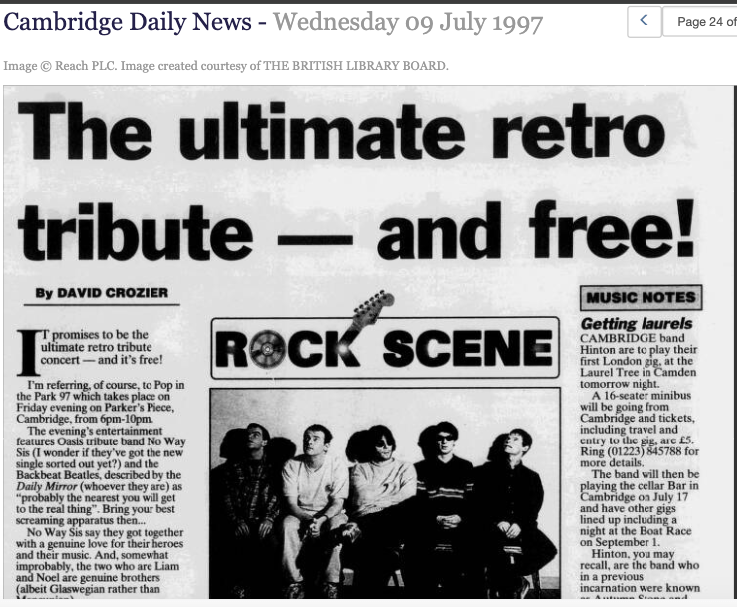
Above – Cambridge Evening News Wed 09 Juky 1997, in the British Newspaper Archive
The Oasis Tribute Band they booked – ‘No Way Sis’ – was one that bizarrely got into the UK top 40 with a cover of I’d like to teach the world to sing – and ended up on Top of the Pops themselves in late 1996. So here was a band that had been on TOTP.
It worked out splendidly for Cambridge City Council – double the attendance on the Friday evening on Parker’s Piece compared to the previous year, and barely any trouble
Which from a local government and policing point of view is what you want. Remember this was peak alco-pop public-scare about under-age drinking and booze-fuelled violence that over the coming years would result in strange late-night ‘documentaries’ trying to warn young people about the dangers of drinking but in hindsight were really just an excuse to film young people getting drunk and doing silly things on telly and getting cheap laughs out of it.
“Here’s Derek from Derby. He’s getting ready to go out for a night on the tiles as he normally does at the weekend. Here are his friends Andy and Dave! They’ve brought round the booze! There are a total of X units in each bottle! And if they drink them all, they will have consumed Y% of their recommended weekly limit! This can lead to them doing things that they might later regret”
Alcohol-based street violence was a persistent problem in many-a-market town, and as the TV channels proliferated (along with the reduced cost of TV production), so did the documentaries following and recording the violence. And it was something we had to be very aware of. What was worse is that our generation was never taught how to deal with it, let alone prevent or de-escalate it. (Generally us ’90s teenagers were not taught about ‘adulting’ – doing the things that were meant to make you more independent and self-reliant once you left home. Which is why I state repeatedly that my experience of going to school/college/uni was one of ‘being educated to be ignorant – and no I haven’t forgiven the Tories in government at the time and yes I have a very big chip on my shoulder a quarter of a century later!!!)
Something I also find interesting is that at the time I could not imagine future generations being any different to ours. In part because we’d heard all about the hippies, mods and rockers of previous generations, so why would future ones be any different? Turns out alcohol consumption amongst the teenagers of the 2020s is much lower than those of the 1990s. But then what is there for teenagers and young adults to do in somewhere like Cambridge? Especially if you’ve got little money?
The importance of free events in our grossly unequal city
As I wrote at the time, the cancellation of The Big Weekend reflected a collective failure of our city’s wealthy business sectors to support our city. They are the ones that lobby for lower taxes and government grants/spending on their interests. Yet precious little of that wealth finds its way back into providing not just the facilities for the things we’d like, but more importantly the essential infrastructure that cities need to function.
This also matters indirectly for the Cambs Unitaries debate on restructuring how our county is governed because one complaint urban councils across the country have is that their council tax payers put on free events that residents in surrounding rural councils get to go to for free, but whose councils do not contribute financially. (It’s even more of an issue where the latter has lower council tax bills!) Hence another reason for both re-drawing the boundaries and coming up with better, more equitable ways of funding local public services. Including leisure and events.
The minimal local government presence in the lives of many of us as we grow up
I was browsing through Prof Johanna Thoma’s thought-provoking (and award-winning) paper titled Social Science, Policy, and Democracy which unpicks the tension between democracy and ‘the will of the people’ vs technocracy and ‘evidence-based policy-making’. Ultimately the tension is based on both sides having imperfect and limited information. Remember the ‘Britain is wrong on everything‘ headlines about the public’s perception on a range of social/political issues vs the evidence? It’s a bit like that. How do those perceptions shape politics and voting patterns? Then think about it in terms of how we measure our wealth – the limitations of GDP have been around for decades. Yet from a Cambridge context, we are told how much wealth the city generates, yet at the same time we’re told the councils cannot repair the potholes or fund free public events like in the past. So who is right?
“Thoma argues in this article for abandoning the goal of creating a single index altogether in favor of pluralistic indices that make transparent the different concerns of different groups and persons. Only so, she argues, diverse groups and persons can engage in debates about the aims of policy on the same statistical grounds that social scientists and policymakers use to justify their views.”
Above – from Thoma wins Rockwell Prize, 03 Sept 2024
Take Cambridge again.
“£587 million – from the impact of tourism associated with the University” [EIR] vs “Please note, the Visitor Information Centre is permanently closed” [Visit Cambridge]
“How would Cambridge score on a much wider set of indicators?”
We used to know – it was one of the old policy areas (Local Area Agreements that all council areas in England had to negotiate with central government) I worked on during my civil service days. I touched on it in the Total Place article.
“…Local Area Agreements – such as this one for Cambridgeshire in 2006. The idea was that multiple funding streams would be grouped together, and councils were measured against a series of ‘national indicators’ – which you can browse through here.”

Above – out of the list of nearly 200 national indicators here that central government funded the data collection of, what would be in your top 200? What would not be in them?
Remember you’re thinking ‘outcomes’ rather than outputs or even inputs. And some are very subjective / a matter of opinion that is hard to pin down. Then consider the central vs local government issues (i.e. what Ministers think are priorities vs what local areas think are local priorities). Then think departmental turf wars and who should have the most. Then think what is already in legislation. (Harder to repeal).
“What’s all that got to do with booking tribute bands for free summer events?”
It links the provision of local leisure services and free entertainment for the public (in particular those on the lowest incomes) with how people interact with state institutions that take decisions on their behalf. Which is why civics/citizenship education for UK resident adults who were born in and grew up in the UK is ever so important as part of wider democratic renewal. The problem is there are no such formal programmes or policies that do this – as Qasir Shah of UCL wrote in his 2020 paper. What would Cambridge (and towns & cities across the country) be like if more people across the income spectrum had a greater understanding of how our city functions and malfunctions? Would wealthier citizens take a greater interest in supporting civic and public events? Would more residents feed into decision-making processes on what sort of events should be put on, when, and where?
Because if you’re an up-and-coming band getting sponsored to perform in front of a crowd of up to 10,000 people, that’s a fair amount of publicity you’re going to get offline as well as online.
Food for thought?
If you are interested in the longer term future of Cambridge, and on what happens at the local democracy meetings where decisions are made, feel free to:
- Follow me on BSky <- A critical mass of public policy people seem to have moved here (and we could do with more local Cambridge/Cambs people on there!)
- Like my Facebook page
- Consider a small donation to help fund my continued research and reporting on local democracy in and around Cambridge.

 The Cambridge Town Owl