
As the two-tier structure of local government for Cambridge comes to an end, ministers and their policy advisers must be told that continuing with enfeebled powers of revenue raising risks increasing, rather than decreasing the chronic inequalities in and around our city – both geographically and in magnitude.
Image – from Menagerie Theatre’s council-funded project on democracy – join in the conversations on the future of our city!
Oh – and the sectors creating all of that wealth we’re continually told about? They did not step forward to save one of the biggest council-organised free events in our annual calendar – an event that serves not just our city but the wider county and economic sub-region. One reason for this is unlike the likes of Kelsey Kerridge (who we named one of our major sports centres after), the family and personal connections between the wealth-making institutions and the people working in them are too disconnected from civic life.
Multinational corporations and the sci-tech sector are more likely to want to associate themselves with something specific to their industry, or something that will look good in an annual report. It’s much harder to make the case for arts events unless there are strong human and personal connections. In an era where we have a high population turnover in Cambridge (combined with a growing AirBnB market that deprives the city of long-term residential accommodation, and the longer term social investment residents make in our city over short-term lets), we’re seeing social bonds strained and too much of the wealth generated being extracted from the city rather than re-invested in it. The state of our city on the last Saturday night before Christmas last week was utterly soul-destroying.
Large, free civic events with live music, performing arts, community outreach, and public engagement matter to our city
If you are on a very low income and have young children, those free events can be a lifeline compared with the commercially-provided events that even for a city as affluent as Cambridge, are out of reach for a critical mass of people. If the only large events are the private festivals that require private transport and/or expensive ticketing, the chronic inequalities get still worse.
The importance of large free events in supporting the rise of civic pride in our city and county
I wrote about it in the summer of 2022 here – because in that year we lost one of our community festivals in Cherry Hinton, East Cambridge, due to a lack of volunteers. In reality it wasn’t just a lack of volunteers – it was the lack of a paid council officer capacity to do the things that people really should be paid to do rather than rely on ‘Big Society’ to sort things out.
I’m not interested in the organising and financing of events as being acts of charity where you hand over the cash and take a step back and watch from a ‘safe distance’ in a paternalist, patronising manner about the nice thing you did for the poor people.
“I was a long time realising that the social reform on the part of the Conservatives is like charity in the hands of a Lady Bountiful – everything to be made nice and pleasant, but the ‘upper class’ is to be respected and obeyed.“
Above – not me, but the then Cambridge Liberal activist Eglantyne Jebb on 08 July 1910 in the Cambridge Independent Press – a decade or so later she founded Save The Children.
This is why for me it has to be about participation as much as anything else – where people from a range of different backgrounds get to:
- watch arts and musical performances they might not otherwise pay to go and hear
- find out about the community and activity groups in their city and county they were not aware of previously (and possibly join them – increasing the sustainability of community groups)
- feed back their opinions in consultation and discussion tents – ones with big maps, pictures and diagrams, and also things for children to do as well (I wrote about this in 2022 here)
- try new cuisine from the multiple retailers and food trucks that are on offer
- meet up with, or bump into friends and acquaintances in an informal manner that might not normally happen for paid for set piece events
- dance in a huge crowd of thousands of people and potentially see a half-decent set as well – see Maizie Williams of Boney M with what was a competent session band and vocalists supporting her back in 2016 – note the crowd of several thousand swaying their arms in unison.
Between the General Election of 2024 and the first anniversary of the current Labour Government, Cambridge will have lost/had cancelled three of its five major free civic events that attract thousands of people from across city, county, and beyond our county boundary.
- Big Weekend on Parker’s Piece (summer) – cancelled in 2023 due to lack of commercial sponsors or benefactors coming forward
- Mill Road Winter Fair 2024 – cancelled due to Met Office warning of high wings and heavy rain
- Strawberry Fair 2025 – cancelled due to rising financial costs
All the more awkward re the cancellation of The Big Weekend given the presence of a huge photo of a packed Parker’s Piece used in Cambridge City Council’s Cultural Strategy 2024-29
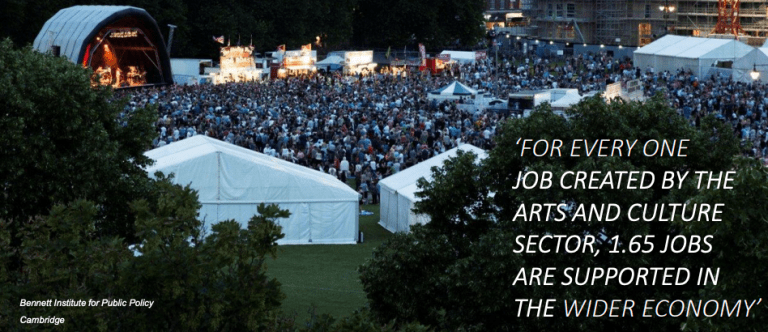
Above – p26 of item 8 Appendix A.
Cambridge Pride becoming established as a growing LGBTQ+ regional event
Credit to the Cambridge Pride organisers who have for the past couple of years put on two sizeable events on Jesus Green (see their FB page as they seek support for 2025 here). This is a particularly poignant event for me given that as a teenager in 1990s Cambridge, Section 28 of the Local Government Act 1988 was in force and it didn’t just apply to schools, but to local government as well. Anything that required a licence from the local council would have been vetoed not just because of breaking the law, but also because there were people and politicians in the city at the time with the motivation and means to pay for the legal costs of a prosecution. This is also where city residents including myself need to acknowledge that our city is a regional centre for a whole host of different communities and groups – a place where our city is the only place where people who otherwise live in smaller towns and villages find themselves quite isolated.
Civic Pride more widely has been on Labour’s agenda for nearly 20 years
I should know – I was working in the old Government Office for the East of England – then in John Prescott’s ‘ODPM’ empire of housing and local government policy when a new up-and-coming minister called David Miliband made a big announcement just before I had completed a year in the civil service.
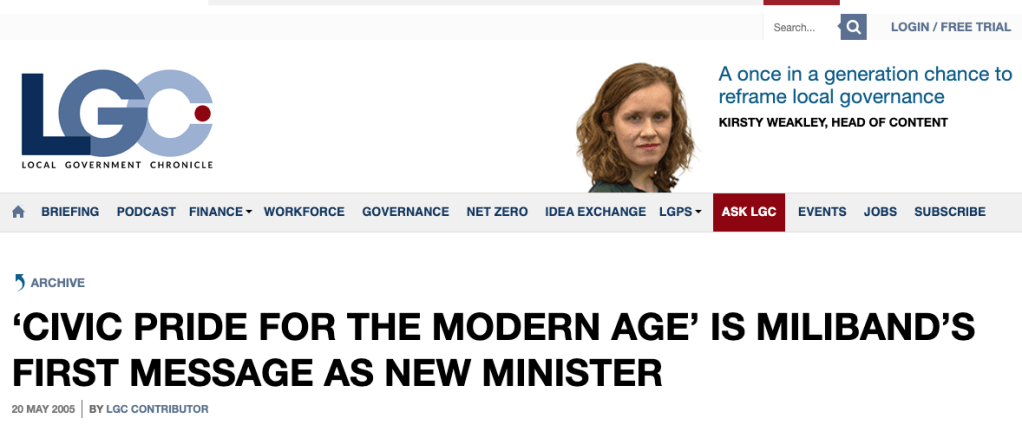
Above – the Local Government Chronicle (former editor, Sir Ivor Jennings QC – later Vice Chancellor of Cambridge University who committed the institution to going 50-50 on the costs of a new large concert hall – which I’m still trying to hold it to) from 20 May 2005
This was also followed up with a very positive write-up in the Labour-supporting Guardian in the same week. The weeks after the local elections in May 2025 might be an ideal point to look back at what ministers said at the time, what has happened since (and why), and what things the new government needs to be aware of as it takes on familiar-sounding problems.
Fast forward four years from that 2005 speech and another one to watch – David Lammy, the recently-appointed Higher Education Minister under Gordon Brown spoke about his support for a programme of National Civic Service in December 2009, and suggested universities incorporate 100 hours of community service – proposed in a Demos report from 2009.

“We therefore propose we should move to a system in which all undergraduates are expected to undertake 100 hours of community service over a three-year undergraduate degree”
Above – from Service Nation (2009) Demos, by Sodha and Leighton, p26.
Note this was under the lower-than-the-present fees regime (£3,000 p/a if I recall correctly) but because Tony Blair’s Government had passed the enabling legislation with the help from Labour’s Scottish MPs (the majority of MPs representing English constituencies voted against the clauses but were outnumbered) the Coalition only needed two votes in Parliament to raise the fees up to £9,000. And the rest is history.
This was also at a time when social media was still very new, and algorithms had not been gamed and hot-wired in the way they are today. Such has been the pace of political and social change (I can’t really call the past 14 years as ‘progress’) that the mindset Whitehall had (or the bit that I was in 15-20 years ago) would not be fit for purpose for the challenges of today and the next decade or so.
Pride in place
The Bennett Institute for Public Policy at the University of Cambridge published their report on townscapes in August 2022
In the executive summary starting on p8 the authors write:
“While the idea that place should be more integral to public policy has, as suggested above, become a recurrent theme in the public discourse during the last few decades, the idea of restoring or boosting feelings of pride in relation to local communities is a less familiar one”
They go onto state:
“There is an extensive body of evidence suggesting that communities which enjoy a strong sense of connection with their place and are broadly optimistic about its prospects are more likely to generate higher levels of local participation in civil society and have higher rates of volunteering in them. And, more generally, there are also indications in some studies of important relationships between place-identity and levels of trust, wellbeing and social capital. People living in these communities are also likely to witness lower levels of isolation, ill-health and dependency on welfare”
Townscapes (2022) pp8-9
If you’re a public policy maker or a Treasury official, the positive financial impact of improved health and well-being on the Exchequer is something worth looking into.
“How many more reports do we need before ministers, and then local councils just get on and do stuff?”
That’s one of the things that struck me about some of the points made in Prof David Bailey’s paper published on 28 Dec 2024 titled Place, devolution and industrial strategy: three key tests for labour. In particular this quotation (and I’ll end this piece on this point).
“First, the UK (particularly England) is too fiscally and governmentally centralised. Second, the UK is spatially and sectorally imbalanced. “
Bailey (2024)
The three tests that Prof Bailey poses to policy makers are:
- Can they break out of the narrow intellectual mindset that the market economics of Thatcher have imposed on public policy over the past half-century or so? (See Paying the price of privatisation, LRD 1987)
- Can they break out of Devolution In Name Only – where The Treasury holds the major financial levers and refuses to consent to granting the tiers of local and regional government any independence/freedom in setting new tax rates or substantially widening the range of tax types available in order to deal with bubbles – be they underused second homes in an area with chronic housing shortages, to tourist taxes on specific activities
- Can the Combined Authorities compose meaningful industrial strategies that don’t result in a small number of areas (Oxford, Cambridge, London) being magnets for investment at the expense of the rest of the UK? If they want ideas on *how* to spread out the over-concentration of international private sector investment in Cambridge I wrote some in this blogpost.
The Comprehensive Spending Review due in late spring 2025 (following the OBR’s Forecast which has to be published on 26 March 2025) should provide some answers to the first point. Time will tell for the rest.
If you are interested in the longer term future of Cambridge, and on what happens at the local democracy meetings where decisions are made, feel free to:
- Follow me on BSky <- A critical mass of public policy people seem to have moved here (and we could do with more local Cambridge/Cambs people on there!)
- Like my Facebook page
- Consider a small donation to help fund my continued research and reporting on local democracy in and around Cambridge.
Below – as mentioned in this blogpost, I’ve since had a catchup with Stir Cambridge’s new Cherry Hinton Road branch and have scheduled the first of what I hope will become a series of wider neighbourhood conversations on the future of our city. See details here for Sunday 12 Jan 2025.
 The Cambridge Town Owl