
And not just Cambridge – but the rest of England because they are restricting their proposals to the county and district boundaries established in haste by Sir Edward Heath’s Government of the early 1970s
And as we know, that government was dominated by things like problems with utilities, Europe, and an energy crisis. Sound familiar?
You can read the ministerial invitation here
The current boundaries and statuses of the councils around Cambridge looks as below:
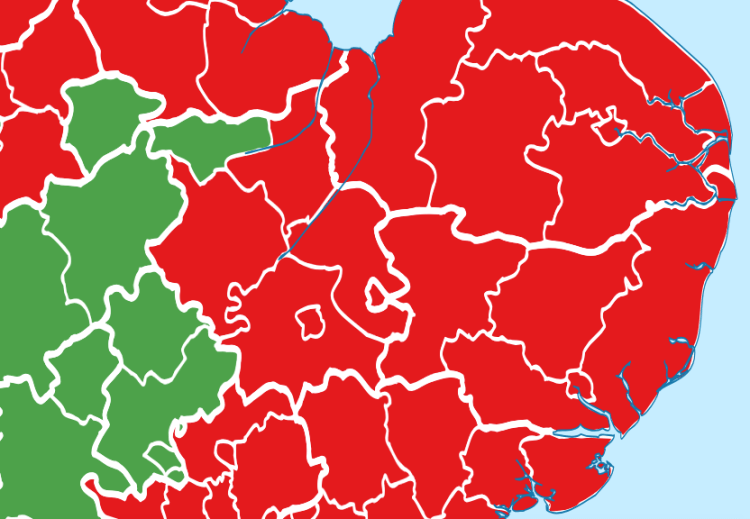
Above – Detail from the Districts of England Wiki-Page here, with red denoting two tier areas, and green denoting unitary councils. (Peterborough having been awarded unitary status in the late 1990s following a period of massive housing and population expansion as explained in this publication by the old Peterborough Development Corporation – of which there are some hard copies available to buy online).
The problem: Ministers are using powers under an existing and overly-restrictive Act of Parliament.
Within their guidance the ‘population minimum’ of 500,000 per unitary authority has come in for criticism because it’s just a number picked out of a hat – there’s no statistical or social-scientific reasoning behind it (such as the number of people best served by the institutions delivering a particular kind of public service). Redcliffe-Maud concluded in 1969 that the minimum should be half that – 250,000. As things stand, that would mean Cambridgeshire County having to become a unitary, and scrapping all of the districts. The problem with that is Cambridge’s current and projected population/housing growth – both extensions of the city as called for by the Minister for Housing, and any nearby Newtowns (which I predict we’ll get another one on the Cambridge-Newmarket line east of the city – possibly at Six Mile Bottom where speculators have repeatedly tried for decades), the population of Cambridge & South Cambs District together would meet that 500,000 point in the next decade or two. (Other speculative plans are available!)
Annex A of the letter from the Minister for Local Government states:
“Local Government and Public Involvement in Health Act 2007 Invitation for proposals for a single-tier of local government“ (Click here, scroll down past the minister’s sign-off)
The options are:
- Type A – turn the whole of the existing Cambridgeshire County Council into a Unitary Council. (Unlikely to happen as it involves giving Cambridge over to party political control of strong Conservative/TeamNigel-voting Fenland districts)
- Type B – Split Cambridgeshire County into two or more unitary council areas
- Type C – several options including:
- Re-join Peterborough to Cambridgeshire, and have that as a single unitary council
- Re-join Peterborough to Cambridgeshire, and split them into two or three unitary councils
- Rejoin Peterborough to Cambridgeshire, split them into two or three unitary councils, and then invite appropriate neighbouring districts over the county boundary to join the adjacent unitary council. Eg southern Lincolnshire districts to Peterborough, or West Suffolk/North Herts to Cambridge.
The problem is that the existing districts are far too large for that to happen. While Royston, currently in North Hertfordshire, has a strong case for being incorporated into a Greater Cambridge Unitary, the village of Offley halfway between Luton and Hitchin 20 or so miles south-west may feel no such affinity. (Even though the point-to-point distance as the crow flies between Luton Airport Parkway and Stevenage Railway Station is under 15 miles) I.e. connecting those two stations and upgrading the line between Hitchin and Cambridge could make rail commuting from Luton, a large town with over 225,000 people (i.e. larger than Peterborough) an attractive option for some, as well as attracting some of the airport traffic that otherwise goes by road from Cambridge. (I explored more in this post)
Had they not been so restrictive on the districts point, but had incorporated parishes and town council areas, there could have been more potential.
If you look at the maps of the structures that Lord Redcliffe-Maud was charged with overhauling by Harold Wilson in 1966, you can see that there were two county-level authorities – Cambridgeshire & the Isle of Ely being one, and Huntingdon & Peterborough for the other – both lasting less than a decade.

Above – from Vol 1 Maps Map 1 Redcliffe Maud Report (1969) HMSO
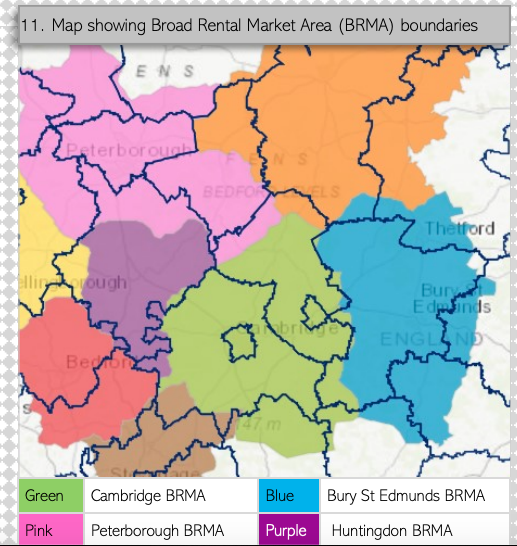
This helps explain why that Royal Commission recommended that Newmarket, Haverhill, Saffron Walden, and Royston should all be transferred over to what would have been a Greater Cambridge Unitary Council.

…which as you can see almost matches the current Broad Rental Market Area boundaries
So instead, we are back where we were in 1995 trying to figure out how to divide up Cambridgeshire and Peterborough – the result of that effort being Peterborough becoming its own unitary council

One of the options explored was…
…for Four new unitary councils

Above – you can find this in the Cambridgeshire Collection / Cambs libraries catalogue
“How will ministers engage with local residents in areas facing restructures?”
Good question because:
- Local and regional media has collapsed – look at those advertising revenues
- The big social media channels have skewed things so far away from the ‘social’ that their effectiveness at engaging communities (contested as that view always was), is not nearly as effective as it once was or could have been.
Therefore any public outreach activities has to be combined with something else that engages residents but in a more positive and imaginative way than with traditional consultation methods. The challenge as always is how to do this in an era of very low trust in political institutions, and even lower trust in the media that transmits those messages.
Food for thought?
If you are interested in the longer term future of Cambridge, and on what happens at the local democracy meetings where decisions are made, feel free to:
- Follow me on BSky <- A critical mass of public policy people seem to have moved here
- Like my Facebook page
- Consider a small donation to help fund my continued research and reporting on local democracy in and around Cambridge.
Below – should you wish to get involved in local discussions on possible unitaries, see the Cambs Unitaries Campaign at https://www.cambsunitaries.org.uk/
 The Cambridge Town Owl