The highly-choreographed events around the Lancaster House meeting earlier today showed that the visual signals sent out to the wider world were just as important as the content of discussions by the mainly European heads of government
[Updated to add: And as if to make that point, Downing Street released this video a few hours ago]
This follows on from my previous blogpost
It’s worth browsing through the content from news outlets from different countries to get a feel for how things were reported as well as what was reported.
Putting together the summit in such a short space of time would not have been easy for the UK Civil Service and Diplomatic Service
There were 16 countries represented according to the Downing Street press release, 15 of which had their heads of government or heads of state attending, with Turkey sending their foreign minister. Additionally the President of the EU Commission (almost certainly representing the interests of the smaller EU countries) and the Secretary General of NATO were also there. The group photograph at Lancaster House (one of the main conferencing venues owned by the Foreign Office (now FCDO)) was certainly designed to send a message of unity to all watching – friend, foe, neutral alike.
Even the small details such as the very corporate but somewhat awkward branding of ‘Securing our future‘ made for some less-than-ideal photographs given the angles of the placards.
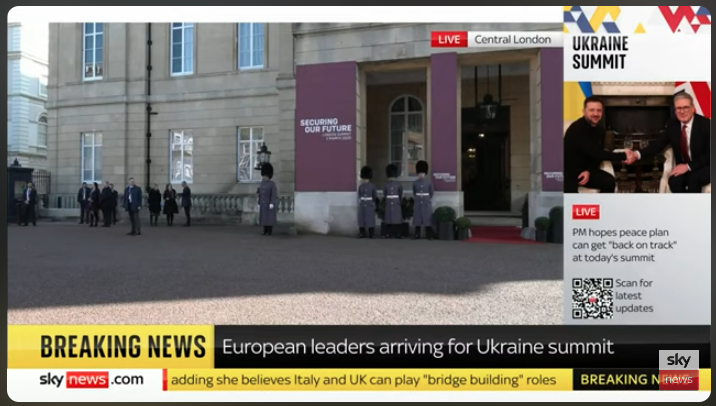
Above – Screengrab from Sky News – note how the corporate colour does not fit with the tone of the stonework at Lancaster House – or the uniforms of the soldiers on guard.
Canadian Prime Minister Trudeau to have an audience with The King
This was confirmed at a press conference at Canada House – the Canadian Government’s official representation to the Government of the UK. (See Reuters here). Given the repeated inflammatory statements by the returning US President regarding the territorial integrity of Canada – and Greenland and Panama, this will be another piece of soft diplomacy to remind the new administration in Washington that King Charles III is Canada’s head of state – just as with Australia and New Zealand. (Hence my points early in my previous blogpost about the royal dimension to international relations)
(Governors-General carry out the ceremonial state functions that would otherwise be carried out by the monarch in the UK. Hence also why Canada House is a High Commission with a High Commissioner, not an Embassy with an Ambassador. (The King cannot send an ambassador to himself – hence Commonwealth governments have high commissioners for government-to-government relations)).
We may see more of a Canadian presence in the UK’s international political reporting in the near future – especially if former Bank of England governor Mark Carney becomes Canada’s new Prime Minister
If only for the simple reasons that Canada wants to shore up its alliances with other countries given what’s happening in the USA, and also because most of the senior journalists in Westminster are familiar with Mr Carney in his former role. i.e. working relationships are long-established for things like short interview clips.
In the longer term, Canada has an even stronger interest in a peaceful resolution to the war.
“Canada and Ukraine have long been steadfast partners and close friends. In 1991, Canada became the first Western country to recognize Ukraine’s independence. Today, 1.3 million people of Ukrainian descent call Canada home – the largest Ukrainian diaspora in the Western world.”
Press release from the Prime Minister of Canada’s Office, 02 March 2025
That’s out of of population of around 40million people. (The UK is around 70million).
Don’t ask me what the final outcome is going to be – the incumbent’s in the Whitehouse are highly volatile and very unpredictable. What’s clear from today is that while there are a host of policy differences on who is prepared to commit to what – ones that may involve seeking consent from national parliaments (which is normal for large new spending commitments), there’s a much more clear and visible unity of purpose. In particular bringing an end to the fighting, and then securing a stable and lasting peace.
There’s arguably a role for the media to play in educating the public of the wider political context and the very deep historical roots that encompass both the Baltic states and Turkey
Until the end of the First World War, the predecessor states of the Soviet Union and the Republic of Turkey – the Tsarist Russian Empire, and the Ottoman Empire, were great power rivals, and both empires had fought bitter wars stretching from the Fall of Constantinople in 1452 all the way through to the end of the First World War in 1918. The emergence of the Cold War and the offer from the United States of America, fearing the expansion of communism, persuaded Turkey to join.

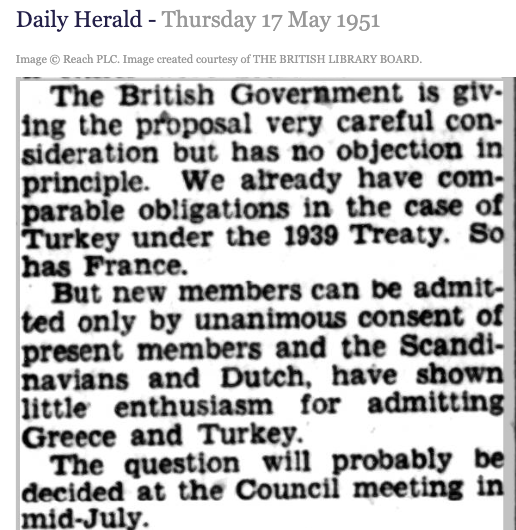
Above – The Daily Herald 17 May 1951 in the British Newspaper Archive – noting it highlights the pre-existing treaties of 1939 for Britain and France to come to Turkey’s aid if the latter was attacked.
The Baltic States and NATO
There was some social media comment about the Baltic States not being represented at Lancaster House, but Downing Street put out a press release on Sunday morning announcing that the Prime Minister had briefed his counterparts in Estonia, Latvia, and Lithuania – again also mindful that the President of the EU Commission attending the talks will have represented the interests of the smaller EU states.
“As the development of an independent air policing capability would be very costly for Estonia, the security of the airspace here has been ensured by the NATO Baltic Air Policing mission since the Baltic states joined NATO. …Therefore, NATO air policing is important for Estonia for both practical and political reasons…. …The constant deployment of air policing aircraft on the territory of Estonia, Latvia, and Lithuania is extremely important for the Baltic states, which is why the costs associated with the mission will be reimbursed to the state performing the air policing to the extent of the agreed amount.”
Estonia – Ministry of Foreign Affairs / NATO pages – stating that such is the importance they place on the presence of NATO forces in their country that they contribute financially to the costs of air patrols of the country contributing the aircraft and personnel.
The UK currently has 900 military personnel deployed in Estonia as part of the wider NATO deployment as announced by Defence Secretary John Healey in December 2024, with further deployments to follow according to local media in Estonia.
The historical context is this

Above – The Office of the Historian in the US State Department – diplomatic files on the occupation and incorporation of the Baltic States into the Soviet Union, just over 20 years after they had secured independence from the Tsarist Russian Empire following German occupation in the final months of the First World War.
Anyone who studied GCSE or A-level history in the 1990s might recall the failure of the the principle of collective security with the League of Nations. What the curriculum didn’t pay much attention to were the party-political splits in the UK, with mainly Labour politicians wanting to make the League of Nations a success (one of the few short-term successes of Labour’s 1924 government under Ramsay MacDonald was getting Germany to join the League of Nations). One of the noticeable differences between that era and this era for all of the assurances that the British Governments tried to give to European countries on guaranteeing security, it didn’t involve the deployment of substantial military forces. This contrasts with NATO’s Enhanced Forward Presence which has 20 or so countries being moulded into integrated combined units.
The further complication with this is also historical. In both the First and Second World Wars, it was Germany that declared war on Russia. Hence critics of NATO have identified that deployment as being inherently destabilising in the eyes of Russia, while for those countries occupied and incorporated into the Warsaw Pact (NATO’s Cold War adversary) who fear history repeating itself, the presence of NATO forces in their countries and integrated into their armed forces is a reassuring one.
Peter Mandelson on the presence of US companies in a minerals deal with Ukraine
The new UK Ambassador to the US, former EU Trade Commissioner and Labour Business Secretary Lord Mandelson gave an interview to ABC News in the USA which surprised a number of political watchers, not least because he said the Ukrainian President should have signed up to the minerals agreement in order to get US firms, investment, and civilian staff into the country as a means of creating a commercial incentive for the US to commit to any peace plan. Former UK Prime Minister Boris Johnson alluded to similar.
It remains to be seen what the outcome of any negotiations are, but given that the Prime Minister has to make a statement to Parliament on Monday afternoon, expect MPs to question the comments made by the new ambassador.
More generally, the challenge for diplomats and heads of government is to try and come up with a sustainable solution that in the very long term is agreeable to all, and is one that can span beyond the reigns, rules, and terms of office of individual heads of state and heads of government.
By the time that is achieved – if it is ever achieved, I’ll be long gone and will have become plant food in a forest woodland cemetery somewhere!
 The Cambridge Town Owl