
…ask Prof Julia Steinberger, and Grace Blakeley
Image – The Struggle for Democracy published during WWII, which you can browse through here along with some other old publications from times when democracy was in even more trouble than today
You can browse through:
- Professor Steinberger’s article from June 2024 is here
- Ms Blakeley’s newsletter about how to fight individualism and build collective power is here
This stems from an extended thread by Prof Steinberger that ends here, and also links to Ms Blakeley’s article. That in itself links to a lovely article about Blaenau Ffestiniog in North Wales (a place I visited as a child) written by Ms Blakeley in 2022 in Tribune Magazine here.
I was also reminded of George Monbiot’s call for ideas on individual actions here.
“So, what can we do? Especially as the weather warms up?”
TL:DR? Picking a couple of examples, see Mark Thomas’s 100 acts of minor dissent, and/or the templates in these books, and start very locally.
Before answering that question, a quotation from Ms Blakeley’s Tribune article:
“Blaenau isn’t so much an alternative to the Preston model as it is a bottom-up application of the same principles. In Preston, the impetus came from the council, so the focus has been on procurement, regeneration, and building new institutions. In Blaenau, it came from local people, so the focus has been on social enterprise, co-operatives, and community energy. “
Now put that in the context of the opening post of her new newsletter:
“I started to see the these feelings of isolation everywhere I looked. At first, I thought it was just projection. But when I started to discuss these ideas with friends, at public events, and with other organisers, I realized what I was saying had struck a nerve. The idea that we’re all alone, and that we have to fight to survive, seems to have become commonplace.”
Blakeley (Jan 2025) What can we do?
Both of her articles tell of how she found out about the work being done by the people of Blaenau – and also featured in one of a series of reports by Foundational Economy Research here.
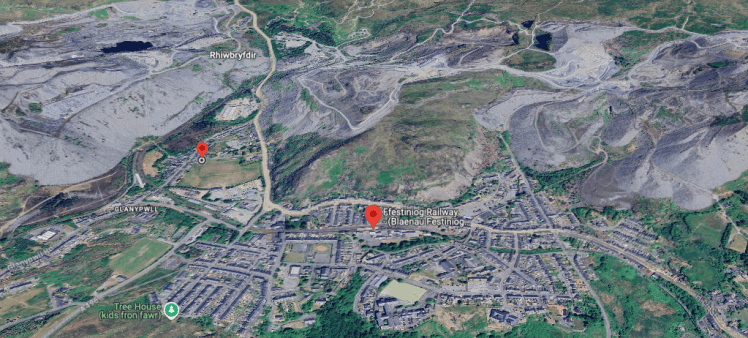
Above – Blaenau Ffestiniog’s post-industrial landscape via G-Maps, where for every single tonne of useful slate mined and exported, ten tonnes of waste/spoil was generated.
Empowering *Restanza* in a slate valley
That’s the subtitle of the report titled ‘A Way Ahead?’ The word Restanza resonates with my experience of growing up in Cambridge, trying to leave (Twice), having to return, and now being in a situation where chronic ill-health means I can’t leave under my own steam.
“Restanza means choosing to stay in a place in a conscious active and proactive way by actively guarding it, being aware of the past while enhancing what remains with an impulse towards the future where a new community is possible. In this sense, staying is a dynamic concept, it is a form of journey, a manner to affirm a different existence and existence made of presence and action to hinder absence and abandonment.
“Presence brings life back, places become liveable and are perceived as sources of opportunities not only for the ones who stay, but also for those who arrive. Moreover, the meaning of staying, is strictly linked with inhabiting as an intense relationship that is characterised by enjoyment and realisation of resources and, at the same time, by care of collective assets”
Above – A Way Ahead? (2022) Foundational Economy Research p3
In my case, Cambridge has chosen to keep me here. That’s how I see it. In that sense, I’ve chosen to be ‘aware of the past while enhancing what remains with an impulse towards the future where a new community is possible.’
Which sort of explains how I ended up at the top of Castle Hill just after the catastrophic EU Referendum result to film a video that would kick off a playlist about Cambridge’s local town history, and later my Lost Cambridge blog.
But what you don’t see or hear in those videos is the gut-wretching loneliness I ploughed through in order to deliver those 1-2-1 pieces to camera – something I wanted to become comfortable in doing which is why earlier that year I created the Vloguary 2016 set of video blogposts, aiming for one per day or every other day.
Existence made of presence and action to hinder absence and abandonment
One of the most regular phrases heard at local council meetings in Cambridgeshire in recent times has to be:
“And we have a public question here from Mr Carpen…” i.e. Me.
But because the Tories moved the county council out to Alconbury, and because they established a new Combined Authority with its headquarters in Huntingdon, both of which are ***ages away*** and very difficult to get to by public transport – even harder if you’ve got CFS/ME and have got two heart attacks behind you, I’m never there to ask the questions in person. Anecdotally, the public participation in council meetings from city residents feels like it has fallen, and it doesn’t seem to have been replaced by rural-based residents or the people of Huntingdon and Alconbury. Not that I blame the residents: local government is so starved of powers and funding that little in reality can be achieved through one-off public questions. In order to make even the smallest of dents in the system, you’ve got to be something of an obsessive. Like me. And that’s not fun! Or rather, most people have got better things to do.
And if you think those things are off-putting for people who might otherwise be interested in getting involved or even becoming candidates, Isabel Hardman’s book Why we get the wrong politicians comprehensively covers many of the other barriers.
“So…what can we do?”
In Ms Blakeley’s case, she recommends spending time with people who are doing things and are doing them successfully despite what’s going on in national politics. To refer back to her Tribune piece, that sense of doing stuff without the presence of national politicians really comes through – as does the importance of the devolved Welsh Assembly. Another example of this was Frome’s Flatpack Democracy movement that swept away political parties from their town council.
My one bloke-and-his-dragon/owl series of actions
With thanks to Amnesty’s Cambridge Bookshop (I squared this with one of their volunteers who is a fellow member of the Cambridge branch of the Acorn Community Union) I asked them if they would create a shop window display of democracy and citizenship books if & rocked up with a few bags worth. Which they combined with their existing stock to create the shop window on Mill Road below.
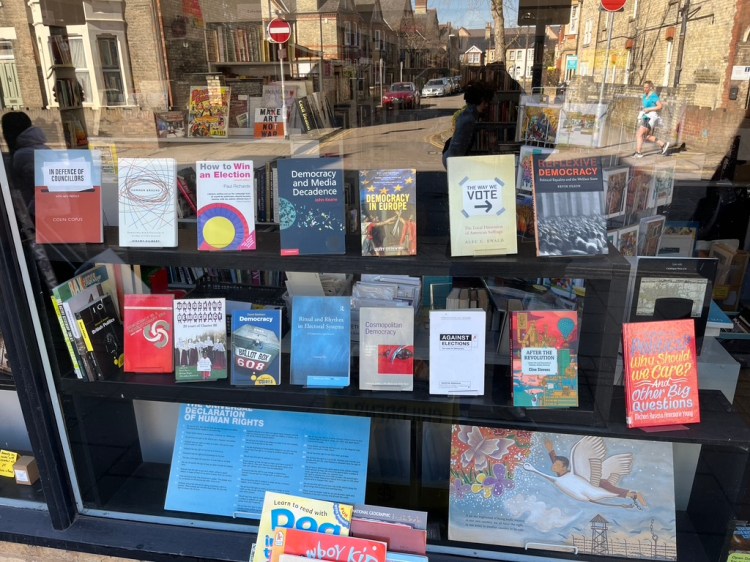
Above – Amnesty International’s bookshop, Mill Road, Cambridge with a range of books introducing readers to democracy, politics, and community action
“Where do you find those books? Especially the ones that look new?”
Most of them are from sites like World of Books where many titles are gathering dust in big warehouses – including stock that doesn’t appear to have been sold in the first place. There are others which do similar and sell on ABEBooks – see the Politics for Beginners by Usborne and the range of retailers selling that book for under a fiver.

Above – Four books for the price of three, at £3.50 each. This is one of the books I include as takeaway reading from the democracy crash course workshops that I ran in 2023 and 2024. (I hope to have some new ones coming up after the elections when hopefully I’ll be in slightly better health!)
The reason for doing this is that following my pop-up democracy bookstall in Autumn 2023 in my neighbourhood, the books that were the most popular (and sold) were the ones aimed at younger readers. The public policy-type books and even the popular politics titles didn’t shift at all. Which made me recalibrate everything I was doing (because no plan survives first contact with with general public!)
Books introducing local residents to politics and democracy via the medium of charity shops and local library sales is part of the background music
Given the raised concerns about the state of politics and democracy across the world right now, the lack of opportunities for the public to learn about, discuss and engage, let alone do anything about it, is striking. As are the lack of accessible books not just for children but also for adults. Too many ‘introductions’ are written and presented in a way that assumes the reader is at, or has graduated from university. Books written and presented for younger audiences cut through much of that noise – even though further feedback from locals has told me that even GCSE Citizenship textbooks are too heavy reading.
Templates for actions
This sort of comes back to Ms Blakeley’s point about seeking out those who are taking action – and are having some success with it. Not only that, but also seem like they are having fun at the same time. Hence I like the approach from Independence Educational Publishers based in Great Shelford just outside Cambridge with their extensive series of debating guides, and Mark Thomas’s 100 acts of minor dissent.

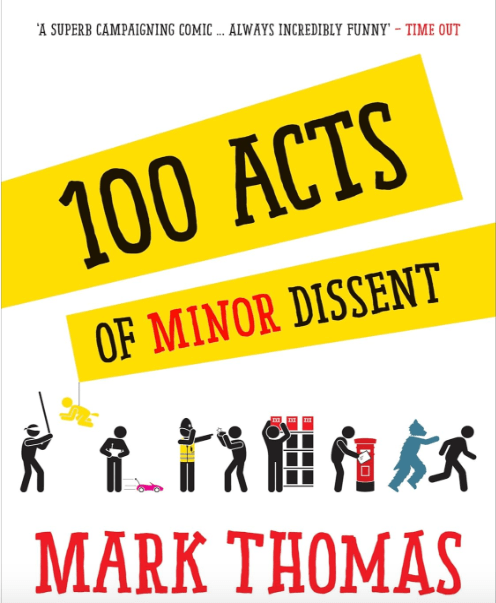
Above – Independence Educational, and Mark Thomas’s books
Remember that adbust in London against the advert for that well-known brand of electric cars? I’m sure that was one of the case studies in Mr Thomas’s book! (See some of his other books here, and his website here)
The difference between templates for actions and ‘cut-and-paste clicktivism’
I was reminded of Oldham’s Neighbourhood Agreements from the late 2000s which I learnt about from my civil service days. One involves copying and pasting text from a campaign group into an email or service such as the otherwise brilliant https://www.writetothem.com/ and demanding an elected representative do something on your behalf. The example of Neighbourhood Agreements (sometimes called Community Contracts) from the old New Deal for Communities Programme that I worked on, involved negotiated commitments from both public services and local residents. The result of the Oldham pilot led by Maxine Moar were five separate agreements which you can still download via here.
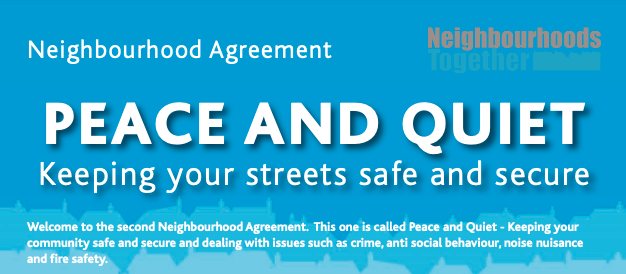
Above – one of the five agreements (this was the first), on reducing crime and anti-social behaviour
One of the senior police officers told me that the result of having residents helping design foot patrol routes and timings meant that officers were more likely to be in regular problem areas before incidents arose. As a result, residents said they were glad to see more officers around – even though the total number of officers had not changed. Note this wasn’t the only intervention – there were a host of positive investments in neighbourhood amenities such as large community centres, and a new range of community activities for young people outside of school – all of which were co-designed with residents.
Which also explains why local government austerity was so devastating
The situation for Cambridge is one where every year the city council seems to have to make spending cuts on services while at the same time the property industry boasts about how wealthy and prosperous the city is, ignorant of and oblivious to ‘The Other Cambridge’. History repeating itself? Kenneth Robinson from 1964 explains here via Lost Cambridge.
There are a host of templates that already exist that people can use
Although the series is 20 years old and long forgotten, the principles of the Developing Citizenship series and the designed-for-photocopying worksheet templates are still applicable to today. Many of the second-hand copies on sale online are available for under a fiver.
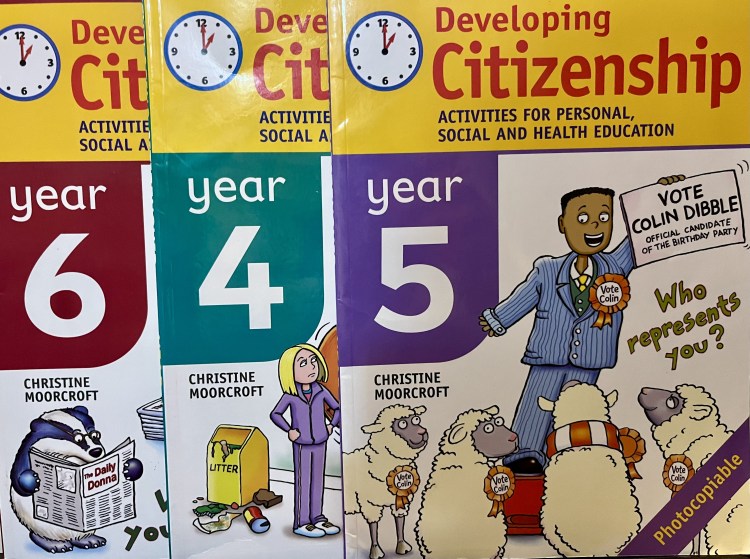
Above – the Developing Citizenship series aimed at primary school-age groups – suitable for others too!
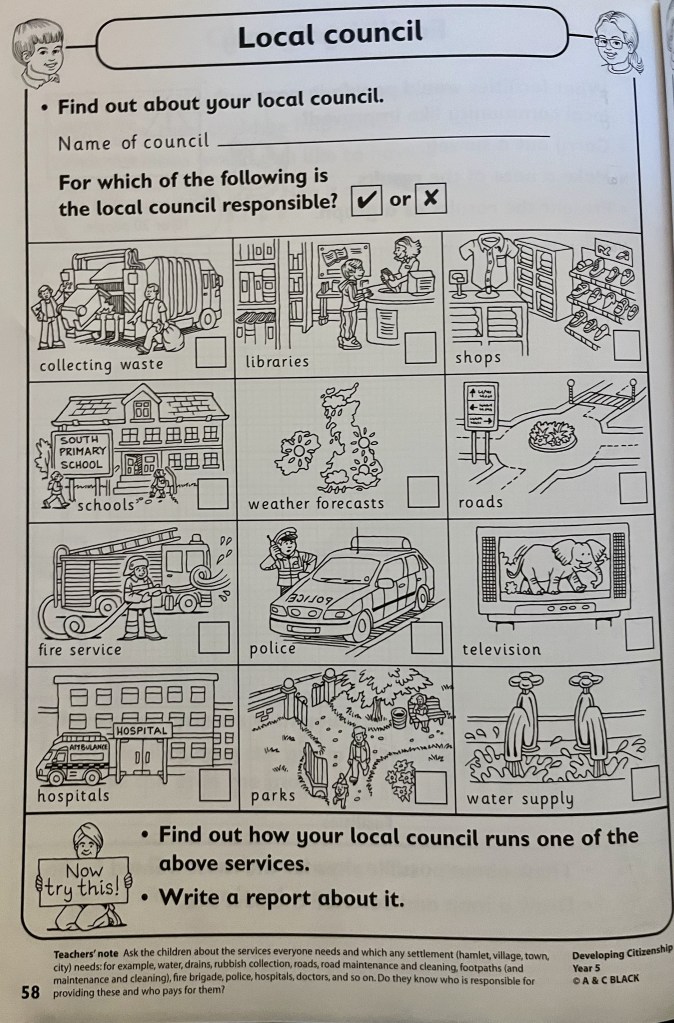
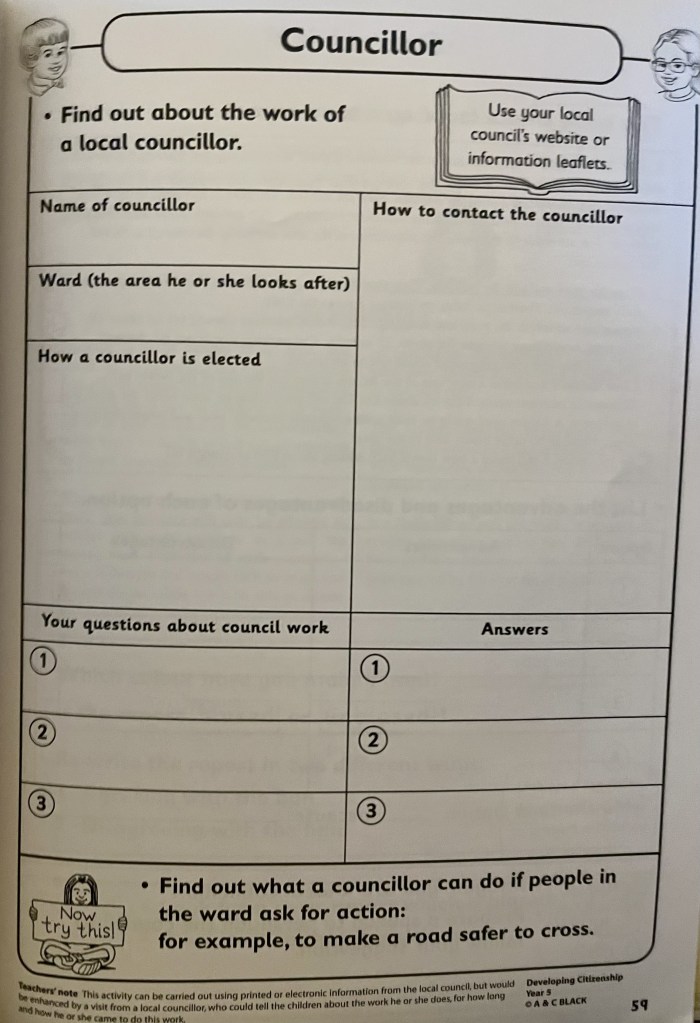
Above – if residents don’t know what their local councils are responsible for, it’s even less likely that they will get in touch with their councillors to raise issues.
Which is why outgoing Abbey Division councillor for Labour, Cllr Dr Alex Bulat and fellow Labour candidate Luke Viner (both are standing in different divisions in/around Huntingdon this time around) have created a series of short videos showing the public how to report issues.
“That’s hardly going to start the revolution that Prof Steinberger is calling for!”
(See item 9 in Prof Steinberger’s list here)
But then we have to start where the people are, not where we think they are or where we’d like them to be
As one couple with young children told me at my pop-up book stall back in 2023, “I should know about these things but I just don’t have the time with the children…”
Yet if we look at the templates below from the Developing Citizenship series, and combine them with the ones above, it’s potentially the start of conversations between residents and councillors.
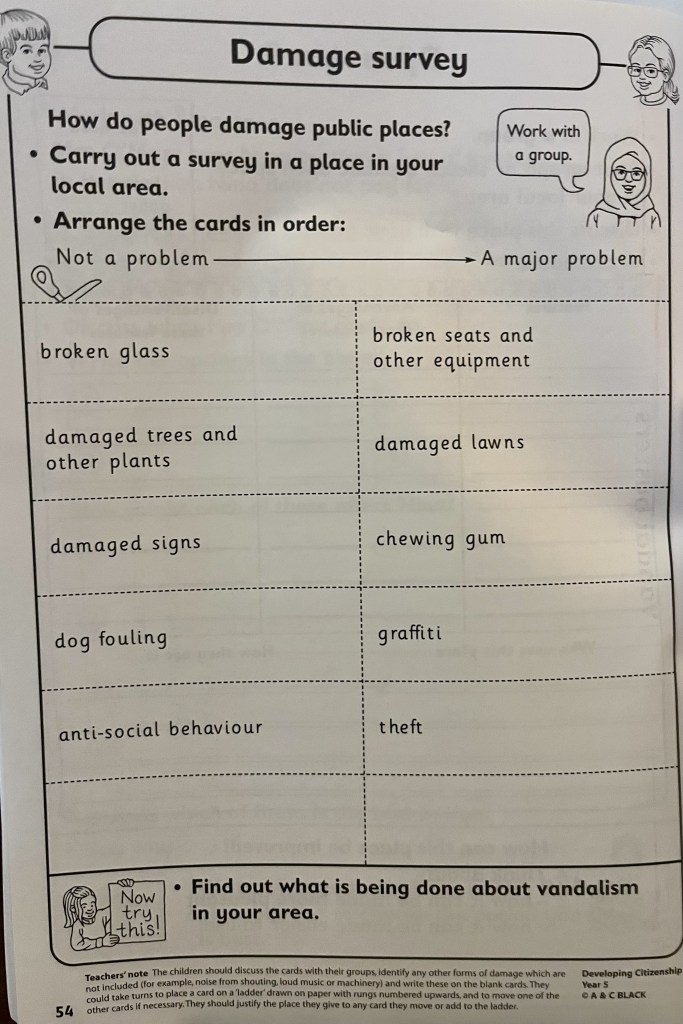
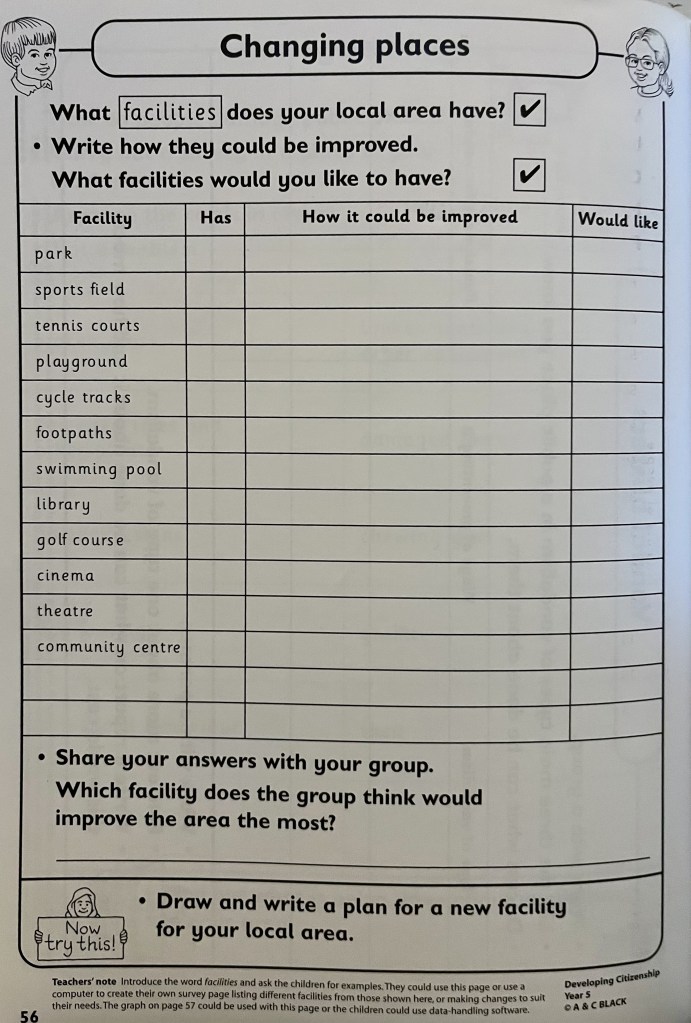
Above – Developing Citizens Year 5 (2005) pp56-56
Furthermore, and this comes back to Ms Blakeley’s point about isolation and the culture of individualism, activities like the ones suggested in the templates above encourage residents to think as a community rather than as individuals. Inevitably there are huge challenges in sustaining the actions, and ensuring that something tangible comes out of them. Easier said than done in an age of austerity.
But for somewhere like Cambridge where ministers and big property developers have got big plans – and also have to go out to public consultation, I think it’s worth the effort trying to help our communities prepare as best as possible so that their concerns are not completely ignored. Although as someone who has been following local government in and around Cambridge for the past 15 years, being ignored by senior council officers and senior politicians is something I’ve gotten used to! (Although I was pleasantly surprised that the years of Tweeting as @Puffles2010 (and standing the dragon for election in 2014) resulted in the installation of a dragon slide at Coleridge Rec – the dragon slide is ten years old this year.


Above – scrutinising local government, and with the dragon slide at Coleridge Rec
“It’s still not the revolution”
I still wonder how far away we are from this situation depicted in Dr Zhivago – which I referred to in the context of Cambridge’s inaccessible green spaces.
Above – Dr Zhivago finds his town house has been nationalised and turned into a workers’ co-operative in order to house the many homeless.
If you are interested in the longer term future of Cambridge, and on what happens at the local democracy meetings where decisions are made, feel free to:
- Follow me on BSky <- A critical mass of public policy people seem to have moved here (and we could do with more local Cambridge/Cambs people on there!)
- Like my Facebook page
- Consider a small donation to help fund my continued research and reporting on local democracy in and around Cambridge.
Below – new events are coming up from the Trials of Democracy project in 2025

 The Cambridge Town Owl