
What are the alternatives to London as destinations for Cambridge spin-outs that grow too big for the university city? (And what opportunities does East West Rail provide?)
The Centre for Cities wrote:
“University towns like Cambridge shouldn’t always expect their university spin-outs to stay and grow. Having a local innovative ecosystem as a ‘nursery city’ is a good thing. But it is the UK’s big cities that should be the ‘gardens’ that these cutting-edge firms bed down in. And – London aside – this is not the case, highlighting the problem of big cities’ underperformance.”
Rob Johnson for Centre for Cities, 03 Sept 2025
Finding somewhere for firms that grow too large for Cambridge has been something I have looked at across a number of past blogposts. Back in May 2023 I wrote how not everything needs to be in Cambridge, and that the historic county towns of Bedford and Northampton could make for sound ‘landing spots’ for Cambridge spin-outs that become too big for the university city, directing investment towards the midlands rather than back down to London. I also wrote that such moves needed to be underpinned by a significant upgrade in regional rail west of Cambridge.
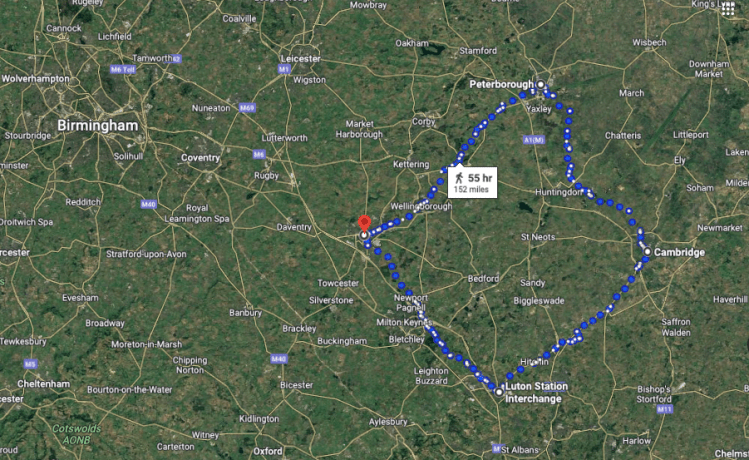
Above – from G-Maps where Northampton, Peterborough, Cambridge, and Luton make for a nice ‘quad’ – with potential extensions westward towards Rugby, Coventry, and Birmingham.
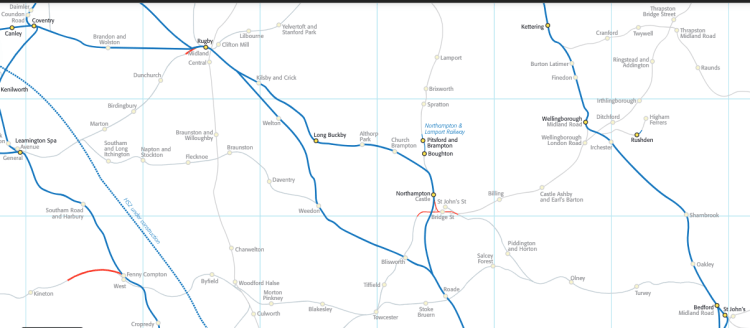
The old railway map of England here from the New Adlestrop Railway Atlas above shows that in principle there is an old rail corridor between Bedford and Northampton that could be revived (obviously depending on how much has been built over since Beeching’s cuts). At the time of writing in mid-2023, the government of the day were talking up a life sciences strategy and as mentioned earlier, I wrote how this was broken at source without a regional electrified rail network to underpin it. East West Rail is already scheduled to link Cambridge up to Bedford and Milton Keynes. This was also around the time Create Streets and others caught Michael Gove’s imagination with the concept of expanding Cambridge significantly based on a more historic architectural style.
The scale of Mr Gove’s proposals alarmed a number of Conservatives – and not surprisingly their candidates at the 2024 general election felt compelled to campaign against one of their party’s key policies. Not that it did them any good – both incumbents for South Cambridgeshire and South East Cambridgeshire lost their contests, and the additional seat created by the Boundary Commission went to the Liberal Democrats along with the other two.
Landing spots at Bedford and Northampton for firms that outgrow Cambridge
With Bedford, the first thing to note is the upgraded Bedford St John’s station as part of East West Rail
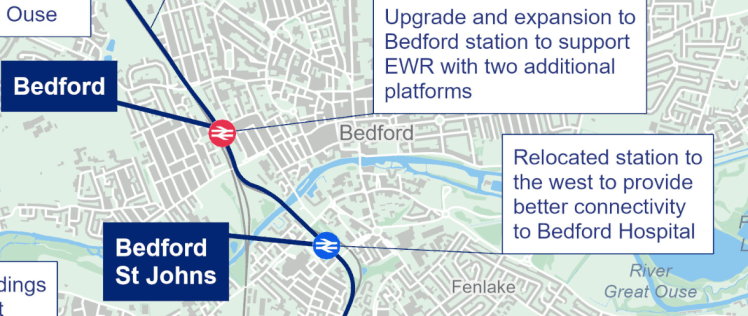
Above – from EWR Bedford here – noting that this is intended to provide better connectivity to Bedford Hospital
The question for local residents and politicians is whether the area between the Bedford Hospital buildings up through to Bedford College by the River Ouse would be suitable as a ‘landing spot’ for Cambridge firms looking to relocate while being close to a riverside location.
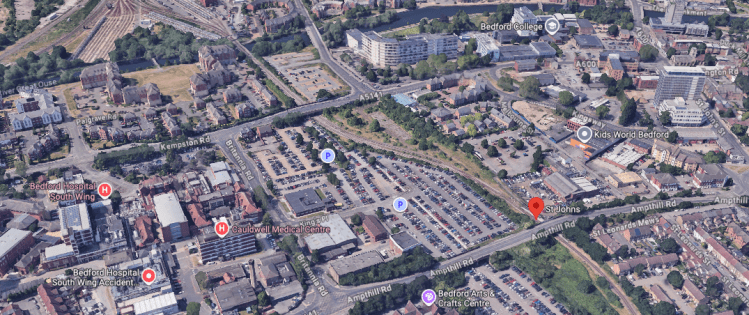
Above from G-Maps: The red H buildings (Bedford Hospital), the red balloon bottom-right (Bedford St John’s railway station which will be moved slightly further up), and top right in the grey and white hat symbol, Bedford College)
Given that Bedford’s Local Plan 2040 is now at Examination in Public Stage, I would be reluctant to go against anything that is currently in the plan.
“The residential quarter to be created around Bedford St Johns station could have an Italian influence to celebrate the town’s rich historical links with Italy. The land at Britannia Road provides potential for Bedford Hospital to expand to accommodate planned growth, including a new multi-storey car park and attractive links to Bedford St Johns station. A development brief for the area is currently being prepared.”
Bedford Local Plan 2040 – Plan for Submission, 2022, p38
The challenge here for designing any ‘landing sites’ is to make them compatible with the local plan in rather than the other way around. Don’t do what Cambridge did – which was to design resentment from local residents in from the start!
For Northampton, I had a look at an earlier blogpost
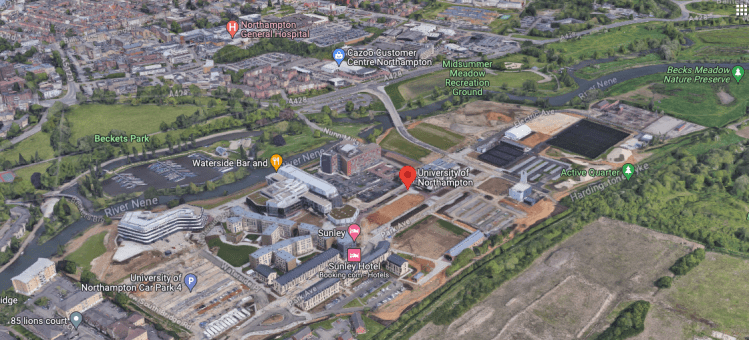
Above – University of Northampton from G-Maps.
In the case of Northampton, it has a much greater industrial heritage than either Bedford or Cambridge. Not surprisingly, it is around the same size as Peterborough. This also means that there may be more suitable brownfield sites that could be regenerated for the larger spinouts.
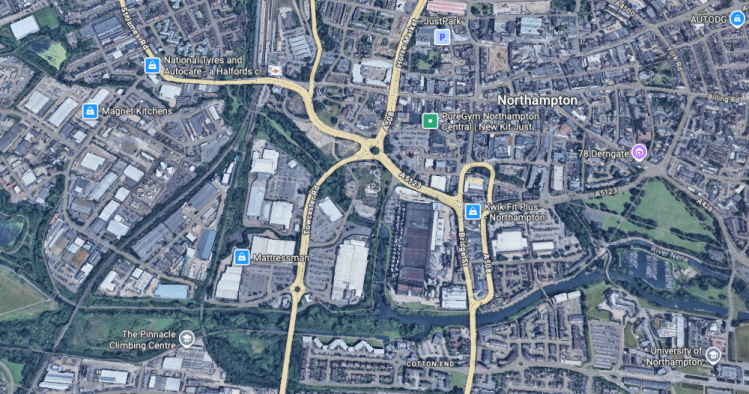
Above – Northampton on G-Maps with the University of Northampton at the bottom right of the image, and the railway station top-centre/left.
The large beer brewery […probably the best…] just below the roundabout in the middle isn’t something that’s going to move anytime soon. It’s an expensive-looking piece of industry. The warehouses to the left – over the road however, are traditional big box consumer retail. The sort that has suffered against internet sales. At the same time on the other side of the river, there are a number of fossil-fuelled motoring enterprises. What happens when the sale of fossil fuelled motor vehicles is prohibited in 2035? (Ten years away!) What is the transition plan? Hence why the sites straddling the River Nene potentially make for suitable co-ordinated landing sites with government support. Again, ultimately the residents need to be able to influence what happens so that this doesn’t happen!
Above – Sir Humphrey Appleby: “What happens if there is some vacant land in say [Northampton] and there are multiple proposals for its use?”
Central Government setting the direction, providing the resources for heavy infrastructure and land remediation…
…but not micromanaging the process. This is why the reforms to local government are ever so important – especially the ability of the new generation of unitary councils to raise revenues from a much wider range of sources without ministerial interference. At the same time, ministers should consider bringing back the Revenue Support Grant for those areas where the local and regional economy is not strong enough to provide a tax base to fund local public services.

