The Independent Parliamentary Standards Authority – AKA IPSA established a Citizens’ Forum of randomly-selected members of the public to examine the work and pay of MPs
You can:
- Read the report / browse through the summary at https://www.theipsa.org.uk/citizens-forum-report
- See more about the team that did the research at https://www.newcitizenproject.com/ – some of you will recognise a few of the names including Jon Alexander, author of Citizens: Why the Key to Fixing Everything is All of Us.
- Reflect on the document This is the Citizenshift published in 2015 and consider how it now reads in the context of the last decade including
- Our experience of the lockdowns (on which Mr Alexander wrote this in 2020)
- The last 3 presidential elections over the pond
- The churn of prime ministers (Chaos with Ed Miliband anyone?)
- The EU referendum
- The rise of TeamNigel, and to a lesser extent The Greens as new party political institutions
23 people randomly selected, undertaking 18 hours worth of activity
Imagine this as nine evening classes at two hours each – so a term’s worth. Hence the statement from the 23 participants:
“We have learnt so much and we feel that other people deserve the opportunity to be better informed and share their opinions”
Above – IPSA (2025) p2 Exec Summary
That thing about civics and democracy education for resident adults? In effect a similar conclusion – one made by the participants themselves rather than an academic or someone with a background in public policy.
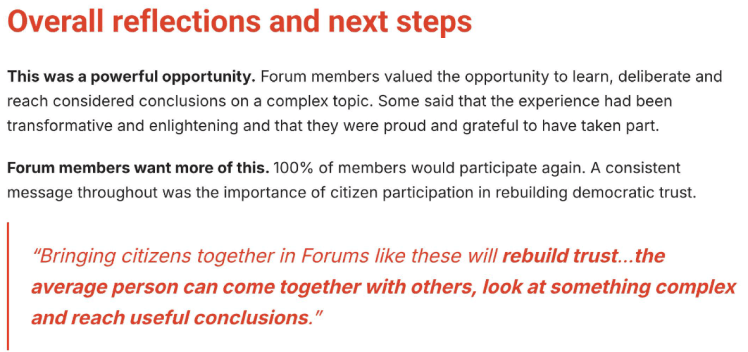
Above – “100% of members would participate again”
If that isn’t success, I don’t know what is. That’s not to say it’s easy to put on. On p17 of the full report there are sections on the experts that the forum members were able question and work with. These included former MPs, expert academics, and political journalists specialising in the work of Parliament and its committees.
That point about civic-wide democracy education also applies to what Cambridge City Council has lined up.
Cambridge City Council to discuss community engagement and democratic involvement
It’s the first supplementary paper in the agenda along with the papers in item 5, and is due to be discussed by the new Services, Climate and Communities Overview and Scrutiny on 07 October 2025 at The Guildhall.
Above – the consultant’s report from the New Local Think Tank. The recommendations are in Appendix 2 of Item 5 from p35 onwards
“That report looks familiar”
It should do – it was published over a year ago. See the blogpost here. The difference now is that councillors now have to decide what they want to do in the face of the recommendations.
Restoring the old area committees is an option – but not one recommended in the report.
The four types of engagement that council officers have highlighted are:
- Develop Cambridge Conversations (similar to where the leader of the council meets with local businesses and the voluntary and community sector groups – the inevitable risk being that only those willing, able, and available turn up, with the usual shortcomings associated with ‘the usual suspects’ of which I’m one of them.
- Adopt the Shaping Neighbourhoods approach; “an in-depth engagement approach where there is proposed significant change” – which is what we’re seeing in the Shaping North Cambridge work, and also in Abbey Ward in East Cambridge.
- Facilitate conversations with communities whose voices are seldom heard – something I would like to see turned into a structured and planned events as children progress through schools as part of citizenship education. By that I mean preparing the entire education sector for the next 25 years of central-government-mandated growth so that they can influence what their future is going to look like
- Provide appropriate tools, data and insights for members and officers. This reminds me of one of the policies in Puffles the Dragon Fairy’s manifesto for Cambridge 2014 – theme 3 to be precise. It included a clause stating:
- “All new paid management posts (in particular full-time posts, irrespective of whether internal or external) in both public institutions and charitable organisations to have basic social and digital media skills in a corporate environment, and basic data analysis skills as essential competencies“
These are looked at in Item 5 Appendix 1
Not that the contents look like it’ll change the world or anything. It’s more about managing expectations of the public by an enfeebled institution hollowed out by a decade-and-a-half of austerity. One of the things councillors may want to keep in mind is how these can be strengthened for the new unitary council. In particular the co-ordination and links with other local public service providers that sit outside the local government silo in Whitehall. Remember Total Place? That gives an idea of what breaking the silos might be like
If you are interested in the longer term future of Cambridge, and on what happens at the local democracy meetings where decisions are made, feel free to:
- Follow me on BSky
- Spot me on LinkedIn
- Like my Facebook page
- Consider a small donation to help fund my continued research and reporting on local democracy in and around Cambridge

 The Cambridge Town Owl