
Me moaning about ugly building designs again. But it’s not all bad news! There are at least 12 Cambourne-specific documents in the pile of Greater Cambridge Local Plan documents. Residents need access to them in order to scrutinise them well
TL:DR? Click on the documents list here from the GCSP Service, do [Ctrl+F] and type in Cambourne and look at the documents that are highlighted. Then browse away and discuss any points with those around you and/or your elected representatives via https://www.writetothem.com/ – because if you don’t tell them how will they know?
There is also a wider challenge of democratic legitimacy with our society so ill-informed about politics and the functioning/malfunctioning of our institutions of state
I come back to my point about citizenship education for resident adults who like me never got to study politics, democracy, and the rule of law at school because John Major’s Government would not let us. And like the neurodiverse freak that I am, I won’t let that one go!
“What’s the story with Cambourne?”
Cambourne – the new town west of Cambridge is a story that is still being written by its residents. One of their district councillors, Cllr Helen Leeming (LibDems – Cambourne) took me on a tour several years ago to show me what had been built since I last visited for a GCP meeting in the mid/late-2010s. Given the proposals that have just been published, I’m reminded again that the town is still ‘incomplete’ so should not be judged too harshly based on only being part-way through.
Part of the background was the party political controversy on Northstowe which got torn to bits in the print press for being a new town with no facilities. Shortly after the General Election, the Chancellor name-checked Northstowe as an area with issues – with the new Minister for Housing intervening not long after in appointing Homes England as the master planner for the town.
One of the things I noted about Cambourne back in 2023 was how the speculative land development options had been bought out in expectation of the massive expansion of the town.
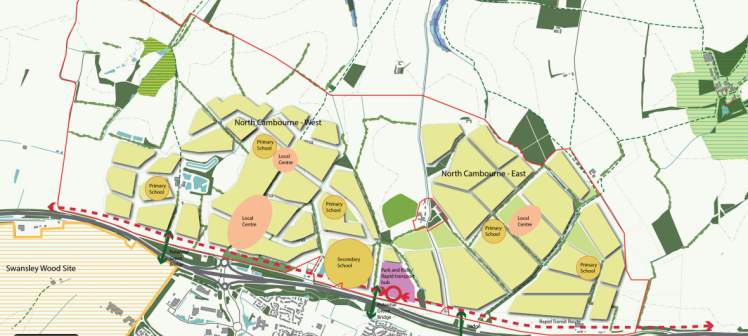
Above – someone snapped up the development rights ***ages ago*** as I mentioned here
The map published in Cambourne’s documents this week speak volumes about land ownership and who stands to make a fortune if ministers do nothing on land value uplift taxation.

Above – from Cambourne’s Spatial Framework Strategy p2
The corporate vision for Cambourne
It says:
“In 2060, Cambourne is a well-connected, sustainable, thriving and prosperous town that is rooted in nature. Cambourne is famous across the region for the forest which wraps around the town – allowing nature to flourish and improving the wellbeing of local residents, employees and visitors.
“As one of the best connected places in Cambridgeshire, Cambourne is a fantastic place to live, work or base a business. Everyone who calls Cambourne home has easy access to a wealth of employment opportunities, services and facilities. Cambourne’s excellent transport connections have also helped to make it a destination in its own right, with the Cambourne Forest, Events Hub, Leisure Hub and Cultural Hub all acting as major draws for visitors.”
Above – from Cambourne’s Spatial Framework Strategy p14.
“Who wrote that?”
Don’t ask. It reads like corporate dross that, with the exception of the forest proposal, could have been written about any town. They would have been far better advised to have run a competition for Cambourne Village College students to invite them to write two paragraphs on the future of their town. Because by 2060 I plan on being plant food. (The state of my health means I can’t see myself living to the age of 80). Therefore the younger generations are best placed to come up with a vision of a future that they are going to live.
“It’s hardly the planners’ and council’s fault that the big attractions have not been built yet!”
It’s more of a reflection of the failures of multiple individuals and institutions that Cambourne and Northstowe have not reached anywhere near their potentials – one huge failure being public transport.
It’s worth comparing the emerging local plan documents with those of their predecessors in the mid-20th Century
- Davidge’s report: The Cambridgeshire Regional Plan 1934 (which covers the old Cambridge County – and includes the area Cambourne is set in)
- Holford-Wright Report: The Cambridge Planning Proposals 1950 (i.e. the Cambridge Development Plan whose influence on planning decisions lasted all the way into the 1990s)
- Derek Senior’s Guide to the Cambridge Plan 1956 – which guides readers through the proposals adopted in non-technical language.
“Can someone write a Derek Senior-style guide for our current one?”
If you ask them nicely/pay them lots of money.
On a new civic square for Cambourne
It really should not look like this:

Above – bland, ugly identikit vernacular that reflects an industry without ideas or imagination. From Cambourne’s Spatial Framework Strategy p23
Boring Facades can seriously damage your health – Dr Cleo Valentine (Cantab)
Furthermore, Dr Valentine’s research has shown how Virtual Reality and AI can be used to measure the levels of mental stress generated in/by our brains by different building styles and urban designs. This is why I think she should be commissioned by those involved in the future design processes for Cambridge.
It’s so rage-inducing for my neuro-diverse mind that things like this put me off from engaging. Or worse. Because the impact on my blood pressure from the anger it generates is bad for my health – physical and mental. It’s like they looked at one of the worst modern buildings in Cambridge and decided to be inspired by it.
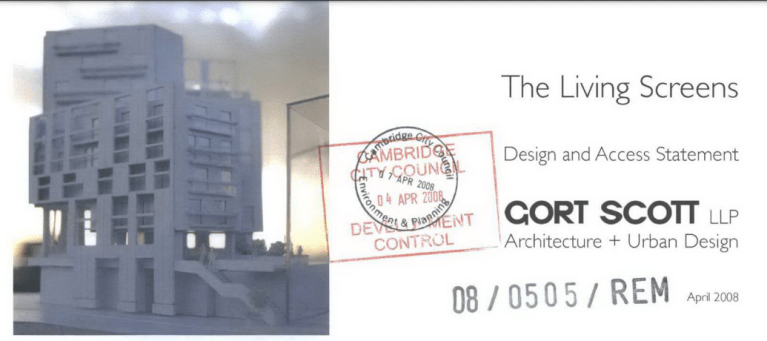
Above – The Marque. It came second in the Carbuncle Cup shortly after completion.
David Jones in Hideous Cambridge ((2013) Thirteen Eighty-one) is scathing:
“This dreadful collection of gormlessly gaping voids is banal in the extreme. Equally preposterous was the original version of this gimmick, which was key to getting planning permission, proved to be unbuildable!”
David Jones in Hideous Cambridge, p244
As I wrote in the blogpost featuring the above:
“The collapse of trust in the construction industry following Grenfell, and the rise of the ‘building beautiful’ movements are are reflection of our broken systems of governance and democracy.”
South Cambridgeshire District Council should commission some new partners to do some community engagement work to find out what building styles they do and don’t like. Eg:
…and use the results of that work to inform the future designs.
“What if the residents quite like the ugly brutalist stuff that we see lots of?”
In the grand scheme of things, I’d have absolutely no problem with it because those designs would then be as a result of the informed and active consent of the people most affected by them. Chances are that such public engagement that fires the imagination of local residents (especially when they see their designs being worked up and created) will come up with far more public benefits than even I or contemporary designers could imagine.
And that’s one key difference between the post-war culture of new town design where much was ‘left to the experts’ versus a system where rhetorically at least, ministers want the public to play a more active role in the creation of new towns as well as in the regeneration of existing towns. Part of that lesson comes from the Skeffington Report of 1970 which you can read here. The social study of Basingstoke in the 1960s also makes for interesting reading re lessons learnt.

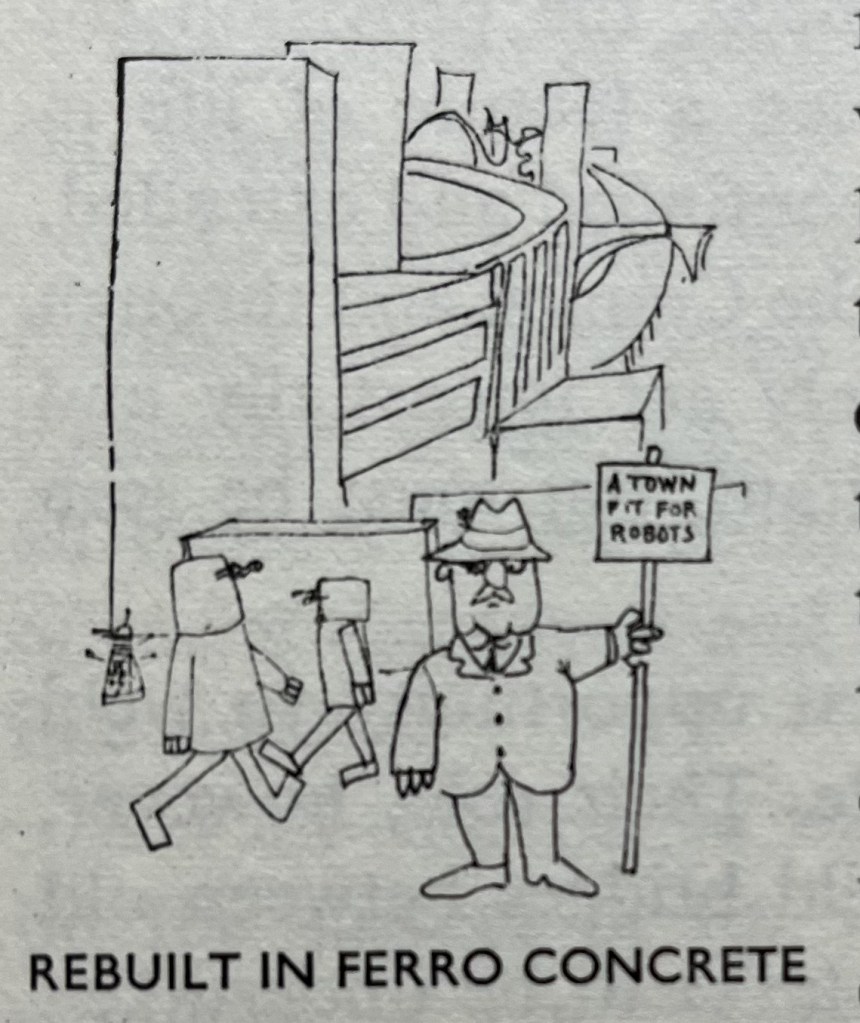
Above – Left: The map says *Neo-brutalist Supermarket* with the caption: “Elegance unrecognised in modern architecture. The chap on the right says: “It’ll be all right when they’ve got the thatch on!”
Above – right: The Caption says: “Rebuilt in ferro concrete“. The man in the hat holds a sign saying “A town fit for robots” as robots and a dalek move behind him.
East West Rail estimate for Cambourne’s population in 2050 is over 50,000
I wrote about their estimates in summer 2023 here. Which is why Cambourne’s extension will need to plan for facilities that not only serve its local residents, but also serve those in surrounding villages and even in Cambridge itself.
I made this point about new leisure facilities at a regional scale in 2020 here. My main conclusion at the end was that different larger new settlements needed to have something that could draw outside visitors in – something that could not be done in Cambridge due to the stupendously high land prices. An indoor roller-rink next to a light rail or mainline rail stop is one example. Furthermore, it should be clustered with other similar attractions and facilities – including things that do not require people to spend money at them all the time.
“It’s not all bad news – the content of the report, is it?”
These things seldom are – which is a major improvement because it shows more people are complaining and more people are listening within industry. For a start they seem to have acknowledged more than a few things they got badly wrong with the existing urban design and spatial planning.
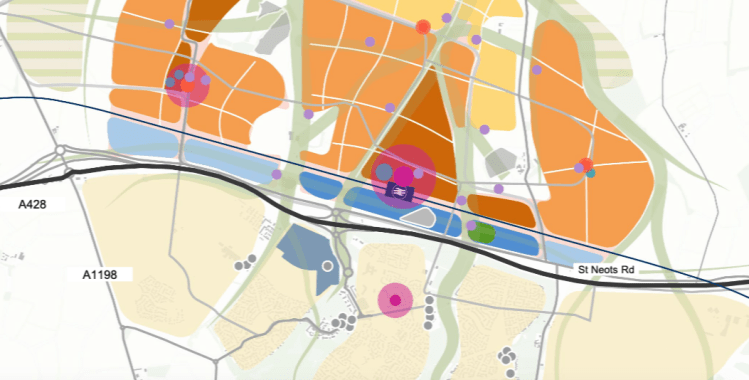
Above – the darker the shade of orange, the higher the density and building height. From Cambourne’s Spatial Framework Strategy p43
Compare it to the existing Cambourne town neighbourhoods in cream above (south of the proposed East West Rail line, and on GMaps here, which again is still under construction. Furthermore, remember that the Bourn Airfield development is also happening – again following Government intervention in the face of private sector reluctance to get going.
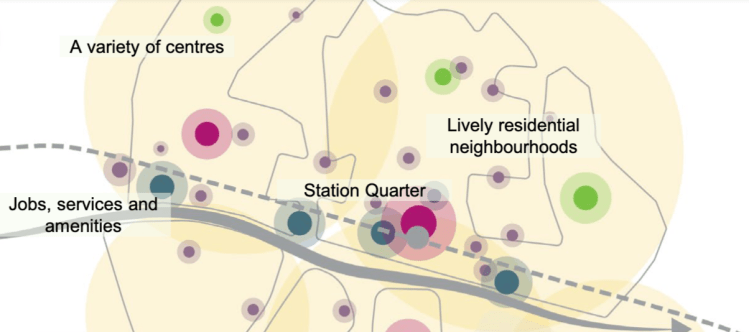
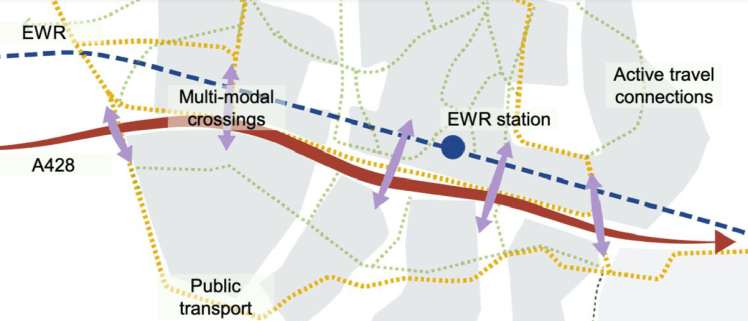

Above – more screengrabs. Yet without any firm ideas or proposals for what will be in the above-mentioned hubs, and with only bland and ugly contemporary architectural drawings to go by – the sort that Dr Valentine’s research shows measurably increases mental stress in our brains, it’s a challenge to feel excited/inspired by what the planners and developers are proposing.
If there’s one thing that firms of architects’ studios could do as side ‘for fun’ projects, it’s designing a new civic square for Cambourne. (Do get in touch with Cambourne Town Council *before* you do this though – it is their town!) What different concepts could they explore with residents? (Not only to explore ideas but also to enable residents to come up with their own ideas and see them worked up). It would make a change from having a ‘take it or leave it’ design thrust upon them.
Given that they have a blank canvass to work on…
Perhaps that’s what helped make King’s Cross Station and the area to the north of it what it is – something that CGC Chairman Peter Freeman led on.
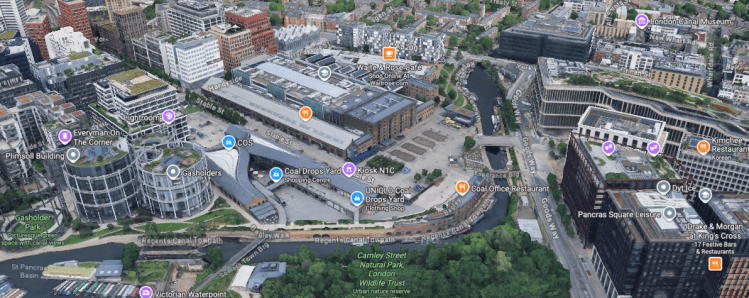
Above – just north of King’s Cross by Granary Square
Have a look what King’s Cross has here – is there anything that we can learn from it? Sadly for Cambridge the old heritage buildings that could have been reused or inspired something better than what we have were demolished in the last century. Maybe it’s the constraints and parameters that encourage designers to be more imaginative instead of something that says ‘maximise profits’.
I hope that significantly greater sums realised from the land value uplift are reinvested back in Cambourne. Because if it simply becomes an opportunity for investors and speculators to extract the financial value from the land value uplift and squirrel away the proceeds in an offshore tax haven… …which reminds me, it has been 15 years since the first UK Uncut protests. With The Budget briefings all about tax changes and the challenges faced by The Chancellor, time to have a conversation about who should pay what? Especially in the context of urban regeneration and reviving public services.
If you are interested in the longer term future of Cambridge, and on what happens at the local democracy meetings where decisions are made, feel free to:
- Consider a small donation to help fund my continued research and reporting on local democracy in and around Cambridge
- Follow me on BSky
- Spot me on LinkedIn
- Like my Facebook page

 The Cambridge Town Owl