On the weapon on enlightenment, and what we can learn today on democracy education in an era of disinformation.
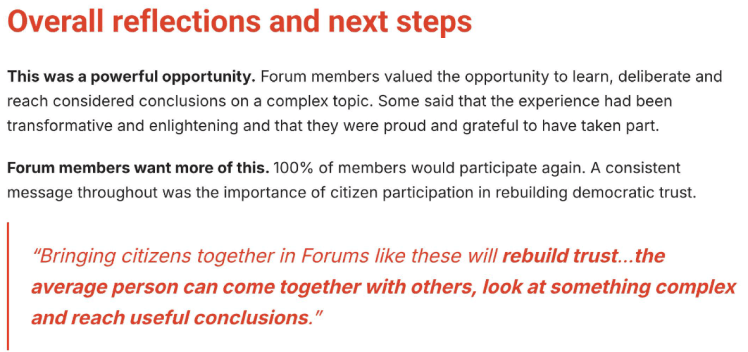
Pictured: The Independent Parliamentary Standards Authority – AKA IPSA established a Citizens’ Forum of randomly-selected members of the public to examine the work and pay of MPs
TL:DR? Watch the video here on how the British Army set up debates and discussion groups based on mass-produced pamphlets.
You can have a browse of hundreds of old copies of those pamphlets on sale here
Over the years I’ve collected a number of civics-related pamphlets from the early-mid 20th Century and have digitised them here. This also incentivised other publishers to come up with their own discussion series.
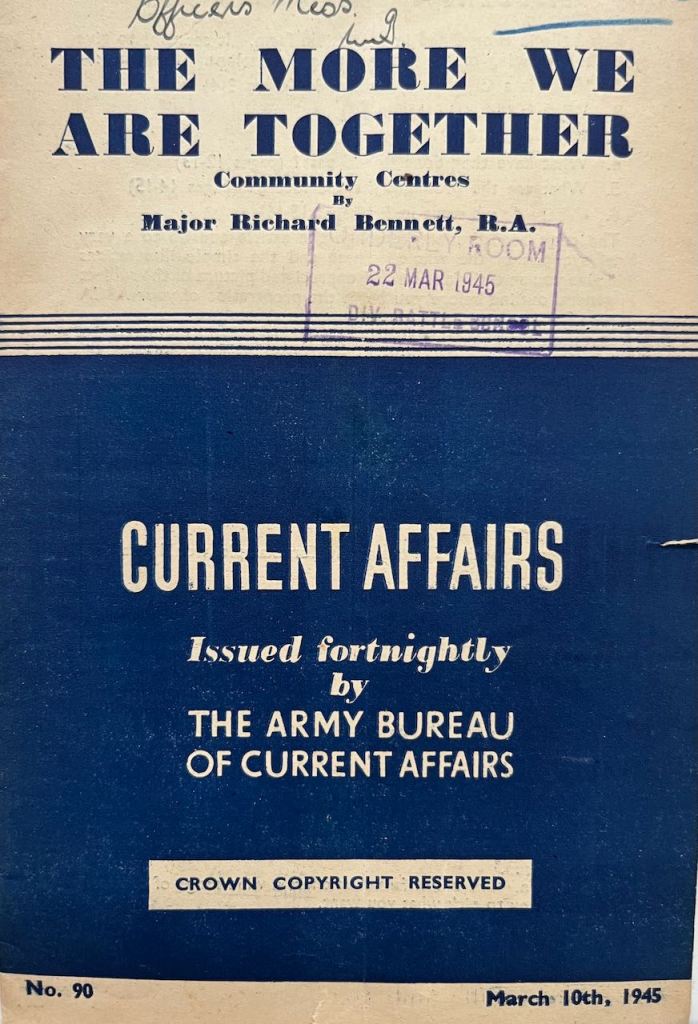
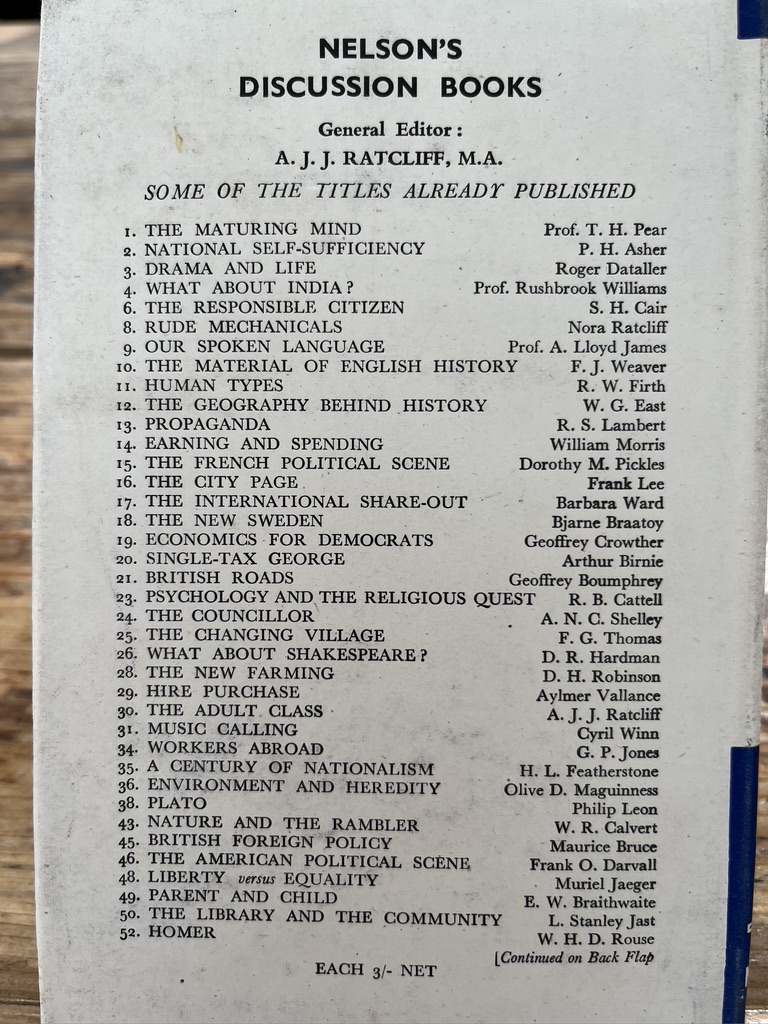
Above-left: The more we are together (1945) from ABCA, and Above-right: the back cover of Democracy in the Dock (1945) by Nelson, listing the many other subjects in their discussion series, many of which I think would make for interesting topics for today.
Compared with 1945, there are hardly any popular titles widely distributed in shops and workplaces that encourage discussion and debate on current affairs, local, national, and international. Hence my moan about the lack of books and pamphlets aimed at the mass market in this blogpost in 2023.
If you think the calibre of people in national party politics today is not great, and if you think that democracy is looking extremely fragile in light of rising authoritarian movements, you’ve got some sense of what it was like during the 1930s
Furthermore, there was no potential saviour-superpower in splendid isolation waiting to come to the rescue – ‘if only they knew’.
“The men who had come back from France, who were then standing by waiting for invasion, had been through a mental blitz for which they had been unprepared.”
Above – ABCA 1941
“Talk, rumour. Everywhere men were seeking for the truth. But doubt and rumour cannot be dispelled without a knowledge for the facts. These men were unprepared for a mental attack. Against a mental attack a new sort of defence was required. The mind must be trained as well as the body. So in 1941 the War Office embarked in an experiment”
Ground Rules
The video features an ageing general and what looks like a senior civil servant setting out what should and should not be done.
- Training the soldiers to be familiar with current affairs was to be part of the army’s timetable like weaponry (so effectively they got paid for it. It was work time)
- Responsibility of regimental officers to ensure it was carried out
- No [party political] propaganda, no long-winded lectures – the main thing was to be discussion
It’s easy to forget that the war did not involve fighting 24-7 for the six years of the war. Even in the First World War the soldiers did not spend months at a time stuck in the same trench shooting at/being shot at by the enemy.
“You’d stay in the frontline for say 4-6 days and then if possible you’d move back to the support line for a similar period of time and then the reserve line and then you’d get a period actually behind the line.”
Above – Imperial War Museum, life in the trenches
There are more than enough reports from a range of institutions telling ministers what they need to do to improve democratic/civic and media literacy
I wrote about one of the most recent – by IPSA, here
The lack of action from Whitehall reflects the paralysis associated with over-centralised systems. Ministers of all parties in recent times have talked about innovation being a good thing, yet they have maintained structures and systems that inhibit it at source.
It’s not just about politics and processes – where are the events about the futures of our villages, towns and cities?
Most of the events that I have been to have been about very specific consultations with a limited number of choices. For example Cambridge City Council’s event on whether we agreed with ‘Option B’ (combining Cambridge City and South Cambridgeshire Districts to form a new unitary council). It didn’t enable people to discuss much beyond that.
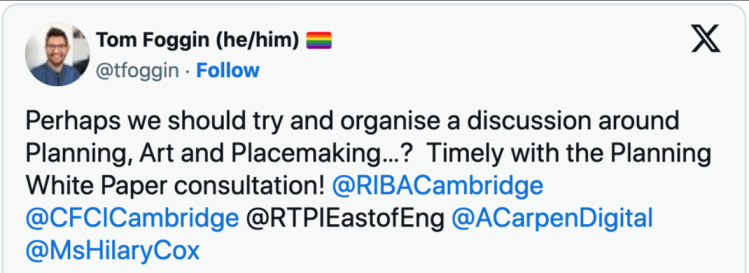
Planning, Art and Placemaking in a rapidly-growing Cambridge
Back in 2020 Cambridge architect Tom Foggin suggested we talk about this.
“The founders of the planning movement, inspired directly by John Ruskin and William Morris, saw the arts as central to liberating people and enabling happier lives.”
Above: Civic Art: the renewed philosophy of town planning (2020) Town and Country Planning Association
This was part of a wider series by the TCPA called Tomorrow 125 – which the TCPA could re-publicise given the confirmation a month ago of the locations of the first wave of New Towns of the Labour Government.
The civic art issue has also made me think about how Dr Cleo Valentine’s research on neuroarchitecture can be applied.
Boring Facades can damage your health – Dr Cleo Valentine
“Furthermore, Dr Valentine’s research has shown how Virtual Reality and AI can be used to measure the levels of mental stress generated in/by our brains by different building styles and urban designs. This is why I think she should be commissioned by those involved in the future design processes for Cambridge.”
Above – CTO on the new plans for Cambourne, 28 Oct 2025
I wonder if Dr Valentine’s research using virtual reality and AI could also be used to see how our brains respond to different pieces of very large public art as well as different building designs and urban landscapes.
So much of this comes back to empowering residents – educating us with the words and language to engage with debates that only seem to happen in places inaccessible to the public – with the latter only finding out after decisions have been made.
Food for thought?
If you are interested in the longer term future of Cambridge, and on what happens at the local democracy meetings where decisions are made, feel free to:
- Consider a small donation to help fund my continued research and reporting on local democracy in and around Cambridge
- Follow me on BSky
- Spot me on LinkedIn
- Like my Facebook page

 The Cambridge Town Owl